Allianz world’s No. 1 insurance brand for 7th consecutive year

Allianz has once again been recognised as the World’s No. 1 insurance brand in the Interbrand Best Global Brands 2025 ranking, marking its seventh consecutive year at the top.

This year, Allianz achieved its highest-ever brand value and strongest growth in history, increasing by 20% from $ 23.5 billion to $ 28.2 billion, and rising two places to No. 27 globally.

This achievement reflects Allianz’s strong financial performance and the consistent execution of its global brand strategy, reinforcing its reputation for trust, innovation, and reliability worldwide. It is also a testament to the dedication and collective effort of every Allianz employee across the globe.

Allianz Insurance Lanka Ltd., is a fully owned subsidiary of Allianz SE, a global financial services provider specialising in insurance and asset management, headquartered in Munich, Germany. Allianz world’s No. 1 insurance brand for 7th consecutive year | Daily FT
Read More........

The High-End Fashion Industry’s Reaction to Economic Turmoil


Illustration by Ruhi Bishnoi

While inflation has pinched the wallets of many, it’s ironically fueling the growth of luxury fashion. As most consumers scale back on spending due to rising costs, iconic brands like Chanel, Rolex, and Hermès are boldly raising their prices, sometimes surpassing inflation itself. For some, it's a response to economic pressures; for others, it’s a strategic move to preserve their elite status.

Luxury brands excuse their price inflation by claiming inflation pressures and rising material costs, but their figures do not hold up. Consider, for instance, Chanel in 2019, the average price for a Classic Flap bag stood at $5,800. At present, it has reached about $10,200, a phenomenal increase of about 76% in price. Chanel justified this by claiming a commitment to quality and exclusivity. This argument was pushed by the CEO, Leena Nair for the price hike, she said "We use exquisite raw materials and our production is very rigorous, laborious, handmade-so we raise our prices according to the inflation that we see." But is there more to it? Many consumers and analysts suspect otherwise, wondering whether such price bounds are truly to do with keeping up with cost or simply to maintain their ultra-high-end status.

The watch market is no different. Patek Philippe and Rolex rank among the world's most desirable brands, but to purchase them at retail is effectively impossible for someone who lacks any insider affiliation. On the secondary market, though, such timepieces tend to fetch two to three times their retail price. Are these brands genuinely facing supply chain restrictions, or do they limit production on purpose to keep demand strong? Most industry professionals believe the latter.

Beyond the realm of economics, luxury brands have learned a thing or two about price psychology. Economists call it the Veblen Effect; as the price for some luxury items rises, so does their demand. In contrast to mass-market items, a client does not buy Chanel handbags or Rolex watches just for their fine craftsmanship; he or she buys them for their prestige. Price hikes aren’t just about inflation; they create an aura of exclusivity around such goods. In short, the higher the price, the more desirable they become.

Hermès exemplifies this strategy. The brand, synonymous with scarcity and strict pricing, increased the price of an average Birkin bag by nearly 10% in 2023, exceeding inflation rates. A close examination of the discourse further reveals the possible truth that these bags do not just serve as accessories but genuine investments, worth holding and appreciating. Louis Vuitton had equally to trade from a playbook wherein multiple price raises go within a year despite the depressing foreign retail markets. These luxury goods stack up nowadays according to Business of Fashion on an average basis for around fifty-four percent more than they did during 2019. Yet, sales remain booming-some even argue more than ever. Why? Because these have successfully groomed the idea that affordability in hand and wrist should become a tag as status hallmark for completion in being successful. However, it too ends up being an ethical debate. Should luxury companies literally be allowed to raise prices this steeply while others are still cash-strapped? Some would just say that this is merely a business concept as the saying goes"If you find someone willing to pay, why not charge him more?" while some see it as a deliberate ploy to keep out regular buyers, thus making it all the more desired by ultra-high-net-worth individuals.

So, what’s next in the future? Will brands continue to push prices higher, or are we approaching a breaking point? History suggests that as long as affluent consumers remain eager to buy into exclusivity, luxury brands will continue raising prices, regardless of economic conditions. But there’s always the risk of alienating aspirational buyers, the ones who save up for a dream luxury purchase, if prices keep climbing.

Indeed, changes in behavior control the portion of this high drama. The industry remains high-class and entry-level as long as there is pursuit by people to be status seekers, this profit will always be there for these brands, be it a recession or not.Ruhi Bishnoi is a Data Science, Economics, and Business student at Plaksha University, set to graduate in 2027. She is passionate about leveraging data-driven insights to drive strategic business decisions and create meaningful impact. The High-End Fashion Industry’s Reaction to Economic Turmoil | MorungExpress | morungexpress.com
Read More........

Temasek Invests in Haldiram’s as India Becomes a Key Market


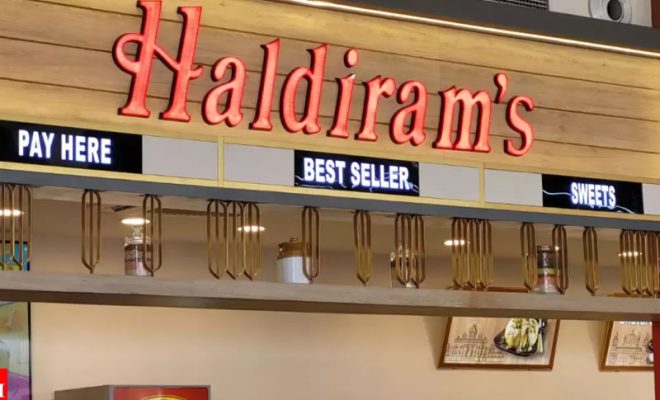
Singapore’s state-owned investment fund, Temasek, has made yet another major investment in India; this time it acquired a 10% stake in Haldiram‘s Snacks Food, one of the leading snack brands in India.

This deal was worth $1 billion, giving Haldiram’s a valuation of $10 billion. This is the largest private equity deal in the consumer sector in India.
Reasons for Investing in Temasek Haldiram’s

Temasek has put up investments across several sectors in India, including but not limited to medicals, finance, and technology. Long-term growth potential for India is seen by the fund, which plans to invest $10 billion in the next three years.

The spokesperson from Haldiram’s said they’re thrilled to welcome Temasek as an investor and partner. It is going to complement the company’s expansion further, both within India and abroad.

Haldiram’s: A Legacy of Success

Haldiram’s started as small snack shop in Bikaner, Rajasthan, in 1937. Today, it is a household name across India famous for savoury snacks, sweets, and fast-food outlets.

Beverage brand holds nearly 13% of India’s $6.2 billion snack market according to Euromonitor International. It has also set up a manufacturing facility in the UK from where products are exported to different countries.

Haldiram’s Attracting More Investors

Haldiram’s has already positioned itself as a company sought out by major global investors. Companies such as the Tata Group and Bain Capital have toyed with earlier decisions about purchasing a stake in the company.

It is joined in this latest funding round by Temasek, along with two other investors- Alpha Wave Global (New York-based) and the UAE’s International Holding Co.
Temasek Expanding Its Footprint in India

Since 2004, Temasek has been building its presence in India based on its Mumbai office. Investments in the country are nearing $40 billion by 2024.

Apart from Haldiram’s, Temasek has now invested in leading Indian companies like: 
Looking Beyond India

But while Temasek stays optimistic about India, it has been restructuring its portfolios across all geographies depending on economic and geopolitical factors.In 2020, China constituted 29% of Temasek’s investments. That is set to fall to 19% by 2024, whereas India now makes up 7% of the total portfolio.Temasek Invests in Haldiram’s as India Becomes a Key Market
Read More........

The High-End Fashion Industry’s Reaction to Economic Turmoil


While inflation has pinched the wallets of many, it’s ironically fueling the growth of luxury fashion. As most consumers scale back on spending due to rising costs, iconic brands like Chanel, Rolex, and Hermès are boldly raising their prices, sometimes surpassing inflation itself. For some, it's a response to economic pressures; for others, it’s a strategic move to preserve their elite status.

Luxury brands excuse their price inflation by claiming inflation pressures and rising material costs, but their figures do not hold up. Consider, for instance, Chanel in 2019, the average price for a Classic Flap bag stood at $5,800. At present, it has reached about $10,200, a phenomenal increase of about 76% in price. Chanel justified this by claiming a commitment to quality and exclusivity. This argument was pushed by the CEO, Leena Nair for the price hike, she said "We use exquisite raw materials and our production is very rigorous, laborious, handmade-so we raise our prices according to the inflation that we see." But is there more to it? Many consumers and analysts suspect otherwise, wondering whether such price bounds are truly to do with keeping up with cost or simply to maintain their ultra-high-end status.

The watch market is no different. Patek Philippe and Rolex rank among the world's most desirable brands, but to purchase them at retail is effectively impossible for someone who lacks any insider affiliation. On the secondary market, though, such timepieces tend to fetch two to three times their retail price. Are these brands genuinely facing supply chain restrictions, or do they limit production on purpose to keep demand strong? Most industry professionals believe the latter.

Beyond the realm of economics, luxury brands have learned a thing or two about price psychology. Economists call it the Veblen Effect; as the price for some luxury items rises, so does their demand. In contrast to mass-market items, a client does not buy Chanel handbags or Rolex watches just for their fine craftsmanship; he or she buys them for their prestige. Price hikes aren’t just about inflation; they create an aura of exclusivity around such goods. In short, the higher the price, the more desirable they become.

Hermès exemplifies this strategy. The brand, synonymous with scarcity and strict pricing, increased the price of an average Birkin bag by nearly 10% in 2023, exceeding inflation rates. A close examination of the discourse further reveals the possible truth that these bags do not just serve as accessories but genuine investments, worth holding and appreciating. Louis Vuitton had equally to trade from a playbook wherein multiple price raises go within a year despite the depressing foreign retail markets. These luxury goods stack up nowadays according to Business of Fashion on an average basis for around fifty-four percent more than they did during 2019. Yet, sales remain booming-some even argue more than ever. Why? Because these have successfully groomed the idea that affordability in hand and wrist should become a tag as status hallmark for completion in being successful. However, it too ends up being an ethical debate. Should luxury companies literally be allowed to raise prices this steeply while others are still cash-strapped? Some would just say that this is merely a business concept as the saying goes"If you find someone willing to pay, why not charge him more?" while some see it as a deliberate ploy to keep out regular buyers, thus making it all the more desired by ultra-high-net-worth individuals.
So, what’s next in the future? Will brands continue to push prices higher, or are we approaching a breaking point? History suggests that as long as affluent consumers remain eager to buy into exclusivity, luxury brands will continue raising prices, regardless of economic conditions. But there’s always the risk of alienating aspirational buyers, the ones who save up for a dream luxury purchase, if prices keep climbing.

Indeed, changes in behavior control the portion of this high drama. The industry remains high-class and entry-level as long as there is pursuit by people to be status seekers, this profit will always be there for these brands, be it a recession or not.Ruhi Bishnoi is a Data Science, Economics, and Business student at Plaksha University, set to graduate in 2027. She is passionate about leveraging data-driven insights to drive strategic business decisions and create meaningful impact. The High-End Fashion Industry’s Reaction to Economic Turmoil | MorungExpress | morungexpress.com
Read More........

Bunnings has toppled Woolworths as Australia’s most ‘trusted’ brand – what makes us trust a brand in the first place?

Think of some of the world’s biggest brands: Nike, McDonald’s, Coca-Cola, Apple. With what do you associate them? Are they positive associations? Now consider, do you trust them?

Brand trust is a measure of how customers feel about a brand in terms of how well the brand delivers on its promises. Trust is an important measure for any organisation, large or small.

Whether or not customers trust a brand can be the difference between choosing that brand’s products or services over another.

In Australia, Woolworths held the title of our most trusted brand for three and a half years. But recent cost-of-living pressures have put supermarkets in the spotlight for all the wrong reasons.

Roy Morgan Research’s most recent trust rankings show Woolworths has slipped to number two, handing its crown to hardware behemoth Bunnings.

It’s clear that trust is fragile and can be quickly squandered when brands lose touch with those they serve.

So what makes us trust a brand in the first place? And why do we trust some more than others?

What makes us trust a brand?

According to customer experience management firm Qualtrics, brand trust is

the confidence that customers have in a brand’s ability to deliver on what it promises. As a brand consistently meets the expectations it has set in the minds of customers, trust in that brand grows.

There are many ways to go about measuring brand trust. A typical first step is to ask lots of people what they think, collating their general opinions on product quality and the brand’s customer service experience.

This can be strengthened with more quantifiable elements, including:

  • online ratings and reviews
  • social media “sentiment” (positive, negative or neutral)
  • corporate social responsibility activities
  • philanthropic efforts
  • customer data security and privacy.

Some surveys go even deeper, asking respondents to consider a brand’s vision and mission, its approaches to sustainability and worker standards, and how honest its advertising appears.

Is this a real and useful metric?

The qualitative methodology used by Roy Morgan to determine what Australian consumers think about 1,000 brands has been administered over two decades, so the data can be reliably compared across time.

On measures of both trust and distrust, it asks respondents which brands they trust and why. This approach is useful because it tells us which elements factor into brand trust judgements.

Customer responses about the survey’s most recent winner, Bunnings, show that customer service, product range, value-for-money pricing and generous returns policies are the key drivers of strong trust in its brand.

Here are some examples:

Great customer service. Love their welcoming staff. Whether it’s nuts and bolts or a new toilet seat, they have it all, value for money.

Great products and price and have a no quibble refund policy.

Great stock range, help is there if you need it and it is my go-to for my gardening and tool needs. Really convenient trading hours, and their return policy is good.

In addition to trust, there are three other metrics commonly used to assess brand performance:

  • brand equity – the commercial or social value of consumer perceptions of a brand

  • brand loyalty – consumer willingness to consistently choose one brand over others regardless of price or competitor’s efforts

  • brand affinity – the emotional connection and common values between a brand and its customers.

However, trust is becoming a disproportionately important metric as consumers demand that companies provide increased transparency and exhibit greater care for their customers, not just their shareholders.

Why do Australians trust retailers so much?

Of Australia’s top ten most trusted brands, seven are retailers – Bunnings, Woolworths, Aldi, Coles, Kmart, Myer and Big W.

This stands in contrast with the United States, where the most trusted brands are predominantly from the healthcare sector.

So why do retail brands dominate our trust rankings?

They certainly aren’t small local businesses. Our retail sector is highly concentrated, dominated by a few giant retail brands.

We have only two major department stores (David Jones and Myer), three major discount department stores (Big W, Target and Kmart) and a supermarket “duopoly” (Coles and Woolworths).

It’s most likely then that these brands have been enjoying leftover goodwill from the pandemic.

As Australia closed down to tackle COVID-19, the retail sector, and in particular the grocery sector, was credited with enabling customers to safely access food and household goods.

Compared with many other countries, we did not see a predominance of empty shelves across Australia. Retailers in this country stepped up – implementing or improving their online shopping capabilities and ensuring physical stores followed health guidelines and protocols.

Now, with the pandemic behind us and in an environment of high inflation, the big two supermarkets face growing distrust and a public inquiry.

Lessons from the losers

After two high profile disasters, Optus finds itself the most distrusted brand in Australia.

Its companions in the “most distrusted” group include social media brands Meta (Facebook), TikTok and X.

Qantas, Medibank Private, Newscorp, Nestle and Amazon also made the top 10.

The main reason consumers distrust brands is for a perceived failure to live up to their promises and responsibilities.

For example, worker conditions at multinational firm Amazon are seen by some consumers as a reflection of questionable business practices.

Other brands may have earned a reputation for failing to deliver the basics, like when chronic flight delays and cancellations plagued many Qantas customers.

Lessons from the winners

On the flip side, consumers have rewarded budget-friendly retailers with increased trust in the most recent rankings.

Aldi, Kmart and Bunnings have improved their standing as trusted brands, no doubt in part because they have helped many Australian consumers deal with tight household budgets.

As discretionary consumer spending continues to tighten, we may see a more permanent consumer shopping shift towards value for money brands and discounters.

Trust is a fragile thing to maintain once earned. As we move through 2024, Australian companies must pay close attention to their most important asset – strong relationships with those they serve.The Conversation

Louise Grimmer, Senior Lecturer in Retail Marketing, University of Tasmania

This article is republished from The Conversation under a Creative Commons license. Read the original article.

Read More........

M&M 11th most valuable automobile manufacturer in world: Anand Mahindra


Mumbai, (IANS) Mahindra & Mahindra (M&M) is the 11th most valuable automobile manufacturer in the world, leaping over many competitors and erstwhile technology collaborators, its Chairman Anand Mahindra said on Wednesday.

In a New Year address to the employees of Mahindra Group, he said that among companies that were part of the NIFTY50 in 2002, M&M has had the highest compounded annual share price growth rate till date, and in just the past year, has soared 77 per cent.

“For the fourth straight year, we were included in the Dow Jones Sustainability Index’s World Index as the highest-ranked automotive OEM,” Anand Mahindra wrote.

Most notable among other businesses, Mahindra Susten exceeded its plans for the year, with a cumulative win pipeline of 3.3GWp, over 60 per cent of its targeted capacity.

“Last Mile Mobility continued its leadership position in the electrification of India’s 3W market, Mahindra Finance’s loan book swelled to over Rs 1.1 lakh crore and tractor business expanded its dominant position in India amid tough competition,” the company’s Chairman informed.

On the EV business, he said that it takes audacity for a traditional SUV company to make a big bet on the future of electric vehicles in an uncertain world.

“And it takes a deep commitment to innovation to forge cutting-edge technology, design, and performance into vehicles that have unique offerings. I hope this will be a portent for the future of every company within the Group,” said Anand Mahindra.

He further stated that India is well positioned to more than fend for itself.

“It is no longer the 99-pound lightweight on the beach. It can demonstrate military might. It can boast of political stability, anchored by its raucous and robust democracy that was on full display in the central elections, when a nation of over a billion people voted seamlessly, peaceably, and effectively,” he noted.

India can enhance its economic potential, by seizing the opportunity offered by shifting affinities and alliances to become a keystone in the global supply chain system.“We will be less affected by capricious global winds than many other countries. In that context, our Group should have no dearth of opportunities for growth, both domestic and international,” Anand Mahindra told employees. M&M 11th most valuable automobile manufacturer in world: Anand Mahindra | MorungExpress | morungexpress.com
Read More........

Mercedes-Benz India cruises to double-digit growth as demand for luxury cars rises

New Delhi, (IANS): Mercedes-Benz India is on course to close the current year with a double-digit jump in sales, fuelled by the rising demand for luxury cars in a fast-growing economy, the company’s managing director Santosh Iyer has said.

Mercedes-Benz India has now launched its new 'AMG C 63 S E PERFORMANCE' model equipped with F1 hybrid technology priced at Rs 1.95 crore. This is the company's 14th product launch this year, aimed at driving up sales volumes of its high-end vehicles which are priced upwards of Rs 1.5 crore.

Speaking to reporters at the launch, Iyer said that the festive season brought the company’s best sales figures, reflecting the strength of the auto major’s performance in a fiercely competitive and fluctuating market.

In the July-to-September quarter, sales of Mercedes-Benz India accelerated by 21% over the same period of the previous year amid an overall slowing auto market. He highlighted that the company has been experiencing substantial growth despite the challenges facing the automotive industry.

Iyer said the company plans to complete conversion of all of its existing 100 outlets under the direct-to-consumer model over the next year or so. He claimed that the new marketing strategy has helped to cut the country’s inventory costs.

The increase in luxury car sales also underscores the rising incomes of the upper middle class with the Indian economy emerging as the fastest growing economy in the world. This also reflected in the higher number of income tax payers in the above Rs 1 crore earnings segment.Figures compiled by the Income Tax department show that more than 9.54 lakh people with income of Rs 1 crore and above filed their returns until October 31 this year. The number has jumped more than 3-fold from 2.89 lakh tax payers in the country in the Rs 1 crore and above bracket five years ago. Mercedes-Benz India cruises to double-digit growth as demand for luxury cars rises | MorungExpress | morungexpress.com
Read More........

As Disney turns 100, the brand’s real legacy is its business acumen

“100 Years of Wonder” is the theme for Disney’s year-long promotion of the company’s centenary. From special Disney on Ice events to a retrospective at the British Film Institute and limited edition Disney100 merchandise, Disney’s celebration is big business.

The wonder and magic of Disney is consistently promoted. And yet I would argue that Disney’s greatest legacy is not its animated stories or characters, but the more mundane history of its mergers, acquisitions and intellectual property rights.

The business acumen of those behind the scenes at Disney have been central to the peaks and troughs of the company’s enduring presence in the film industry and popular culture at large.

Early Disney

The Walt Disney Company was founded in Hollywood by brothers Walt and Roy Disney in 1923.

Before this, along with friend and animator Ub Iwerks, the brothers had founded Laugh-O-Gram Studio in Kansas City. They then moved west with their successful silent Alice Comedies series, which featured both animation and live action.

Animation is what the Disney studio became known for. First with their shorts which included Mickey Mouse’s third outing in the studio’s first sound film, Steamboat Willie, and the Silly Symphony series. And then in their feature length films, beginning with Snow White and the Seven Dwarfs in 1937.

The first two decades of the studio established Disney’s desire for innovation and profit. This was illustrated through their early adoption of merchandising (Mickey Mouse merchandise was profitable in the mid 1930s) and various technologies, such as Technicolor and sound.

Sinking most of their profits back into their expensive animated ventures led Disney to find ways to cut costs. This included making live action nature series, television shows and opening Disneyland, their first amusement park, in Los Angeles in 1955.

While their animated products were no longer as groundbreaking as they once were, their adoption of television in the 1950s was lucrative and popular, especially The Mickey Mouse Club (1955) and Davy Crockett (1954).

Furthermore, television afforded the company the opportunity to promote their products and authenticate Disney’s position at the forefront of animation. However, live action films – quicker to make and less expensive than animation – dominated their releases in the 1960s, with stars Haley Mills, Fred MacMurray and Dean Jones appearing in multiple Disney films.

In 1966, Walt died. Roy then passed in 1971 and Walt Disney World opened in Florida the same year. In many ways, the Disney Company was never the same after the loss of the founding brothers.

Disney without Walt

The template was established for how the company would function for the next 50 years. Disney animation innovated again in the late 1980s and early 1990s through computer animation. A renaissance took place with the releases of The Little Mermaid (1989), Beauty and the Beast (1991) and The Lion King (1994).

They also expanded into cable television with The Disney Channel and founded a distribution label, Touchstone Pictures, that focused on films for adults.

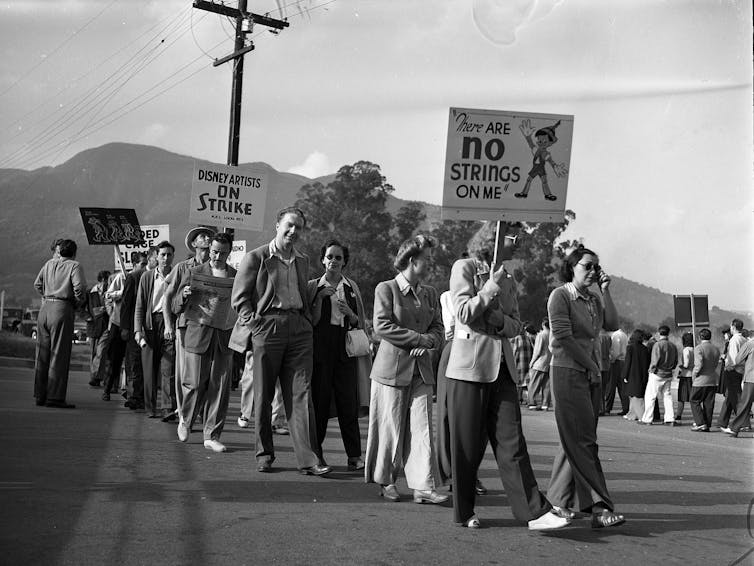
Screen Cartoonist’s Guild on strike at Walt Disney Productions in 1941. UCLA Library, CC BY

There was unhappiness among animators at the studio towards the company’s bureaucracy and the perception that profits always went back into the films and not to improving working conditions or salaries (one major strike against Disney took place in 1941).

The list of former Disney animators that went on to work elsewhere or open their own animated studios is long and diverse.

Walt had learned the importance of owning rights early in his career, after he lost the intellectual property to his first successful animated character, Oswald the Lucky Rabbit. The imperative to retain proprietorship and diversify the corporation can be witnessed in many of Disney’s deals and mergers.

In 1991, Disney agreed to make films with Pixar, which has gone on to be regarded as an innovative animated studio. They later acquired Pixar in 2006.

Disney Today

In 1995, Disney acquired the ABC television network, which also owned the cable sports network, ESPN. In April 2004, Disney purchased the Muppets franchise. In 2009, Marvel Entertainment was acquired and Lucasfilm was bought in 2012.

Through these purchases, Disney has become one of the most significant entertainment companies in the world and one of the few early Hollywood studios that still maintains name recognition (Disney bought out 20th Century Fox in 2019).

Whereas for earlier generations Disney stood for Mickey Mouse, animated fairy-tale features and family entertainment, for younger generations, Disney is a streaming service, amusement park brand and the creator of the Star Wars universe television programming.

Traces of Walt, Roy and the pioneering animation established in the early days of the studio can be seen in their animated releases, such as Encanto (2021), and company legacy through the “reimagining” of their animated films, such as the recently released live action The Little Mermaid.

The commercial landscape of the entertainment business is always in flux. While many companies are operating their own streaming services, the long term success of these services are questionable. This is most evident in the recent writers and actors strike in Hollywood that was mainly focused on outdated royalty models that do not account for streaming media content.

Disney’s last few releases were not as successful as they had anticipated at the box office and they have lost a significant amount of Disney+ subscribers this year. However, this is a trend taking place throughout Hollywood and, while Disney is struggling, they remain a significant brand in the global media market.

And there is no question that their theme parks continue to be popular with families who want to immerse themselves in all things Disney.

The magic of Disney’s animation and the memories created at their theme parks is part of their “100 years of wonder”. But so is their successful business model that has continually adapted to changes in the entertainment business and its persistent cultural relevance.


Looking for something good? Cut through the noise with a carefully curated selection of the latest releases, live events and exhibitions, straight to your inbox every fortnight, on Fridays. Sign up here.The Conversation


Julie Lobalzo Wright, Assistant Professor in Film and Television Studies, University of Warwick

This article is republished from The Conversation under a Creative Commons license. Read the original article.

Read More........