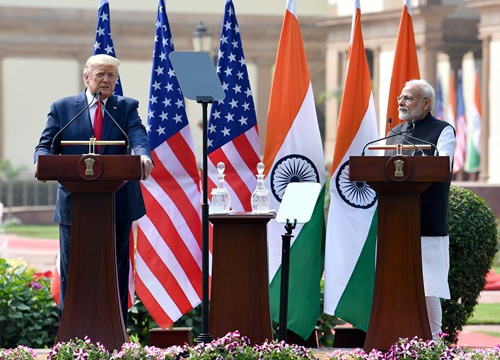
Biden's Secretary of State-designee Blinken sees India ties as 'high priority', important to Indo-Pacific 'order'


Antony Blinken, who has said that strengthening and deepening ties with India will be a “high-priority” in a new administration, has been designated for the post of secretary of state by President-elect Joe Biden. He said India will remain important "to the future of the Indo-Pacific and the kind of order that we all want.” 

Making the announcement of key foreign policy and national security designees on Monday, Biden said, “We have no time to lose when it comes to our national security and foreign policy. I need a team ready on Day One to help me reclaim America’s seat at the head of the table, rally the world to meet the biggest challenges we face, and advance our security, prosperity, and values.”

Kamala Harris, who will be the vice president, described Blinken as “crisis-tested” and among the “best of America.”

Blinken, who was the deputy secretary of state in the administration of former President Barack Obama, said during the presidential campaign that from “Biden’s perspective, strengthening and deepening the relationship with India is going to be a very high priority.”

Blinken is considered closer to the centre. He has met with Indian External Affairs Minister S. Jaishankar when he was the foreign secretary and Blinken was the deputy secretary of state.

India is “fair, stable, and hopefully increasingly democratic and it’s vital to being able to tackle some of these big global challenges,” Blinken said in July while speaking at the Hudson Institute, a conservative think tank in Washington DC.

"It’s usually important to the future of the Indo-Pacific and the kind of order that we all want,” he said affirming President Donald Trump's emphasis on the region as a counterbalance to China.

He spoke of the differences Biden has with India over Kashmir and the Citizenship Amendment Act, which gives priority for citizenship to Christians, Buddhists and Sikhs fleeing persecution in neighbouring Muslim countries.

Rather than the punitive actions advocated by some in the Democratic Party, Blinken said at the Hudson Institute, “You’re always better engaging with a partner and a vitally important one like India, when you can speak frankly and directly about areas where you have differences even as you’re working to build greater cooperation and strengthen the relationship going forward.”

“That would be the approach and again, I think we’ve seen evidence that it works,” he said.

But that would still be an irritant in the relations between the two democracies.

Biden is taking a broader view of international relations integrating the strategic aspects of issues like climate change, for which he has given high priority.

Blinken was a key figure in the Paris climate negotiations that produced the landmark agreement on fighting global warming.

He said that US team with Biden “worked hard to persuade India that it would be more prosperous and more secure if it’s signed on to the Paris Climate Agreement. We succeeded. It wasn’t easy.”

Trump pulled out of the Paris pact, which Biden has vowed to rejoin.

An important designation was that of former Secretary of State John Kerry as the special presidential envoy for climate and as a member of the National Security Council, highlighting the high-level of importance Biden places on the environment.

A close adviser to Biden, Jake Sullivan has been designated for the national security advisor post. He had been national secretary advisor to Biden when he was the vice president.

Avril Haines, who was designated for the director of national intelligence, will become the first woman to head the intelligence community.

She is a former deputy director of the Central Intelligence Agency and deputy national security advisor and had worked with Biden when he chaired the Senate Foreign Relations Committee.

Alejandro Mayorkas is the designee for Secretary of Homeland Security, the first Latino to hold the post if confirmed by the Senate.

For permanent representative to the United Nations, Biden has designated Linda Thomas-Greenfield, who will get a cabinet rank. She is a former assistant secretary of state in charge of Africa.

Harris said, “These crisis-tested national security and foreign policy leaders have the knowledge and expertise to keep our country safe and restore and advance America’s leadership around the world. They represent the best of America.” Source: https://southasiamonitor.org
Read More........

Modi’s phone call to Biden to affirm bilateral ties


Indian Prime Minister Narendra Modi phone called newly elected US President Joe Biden and congratulated him on Tuesday night. During this, he reiterated New Delhi’s commitment to affirm good bilateral relations with Washington.

At the same time, he told Biden to greet Kamala Harris, the elected Vice President of the United States of Indian descent. 

According to Indian media, the phone call was important in the coming days for India-US bilateral relations. 

“I greet US President-elect Joe Biden over the phone,” Modi tweeted, saying: “We pledge to continue our commitment to the strategic relationship between India and the United States. Issues like climate change, cooperation in the Indo-Pacific region, tackling COVID were also discussed.”

Modi’s last meeting with Biden was in 2014. Biden was then vice president of the United States under Barack Obama.

It is to be noted that Modi’s “friendship” with President Donald Trump in the past was eye-catching that took the relationship into a different dimension with “Howdy Modi” in Houston in September 2019 or “Namaste Trump” in Gujarat in February 2020. The world has seen those programs as evidence of the chemistry of the two leaders’ personal relationships.According to some diplomatic experts, Modi and Trump are residents of the same pole in terms of political position. However, despite his good relations with Modi, Trump’s stance on US immigration policy was quite strict. On the other hand, everyone knows about the Modi government’s “tough” stance on “infiltrators” in India. Source: https://www.daily-bangladesh.com/
Read More........

High time for Nepal to look beyond India and China

a
The US aid under MCC is a golden opportunity for Nepal to look beyond India and China and seek greater engagement with other powers and to derive economic benefit and relinquish meaningless geopolitical adventures, writes Vikash Kumar for South Asia Monitor

Among diverse political turbulences being seen in Nepal, one which is being less talked about is Nepal’s indecisiveness over the US aid amounting to $500 million under the Millennium Challenge Corporation (MCC). While the government is inclined to accept it, Finance Minister Yubaraj Khatiwada incorporated this in the new budget before its parliamentary endorsement – and now the grant is facing opposition, inter alia, from within the ruling Nepali Communist Party (NCP).

The opponents are forwarding the arguments that accepting the aid may damage its blossoming ties with China. Prima facie, there may be some element of truth in this argument, but it is shorn of any understanding of Nepal’s national interest.

Nepal is sandwiched between two Asian giants which share great ambitions for its future and whose geopolitical interests are colliding as they try to sell off their versions of worldview. Nepal is, of late, becoming hotbed for this bilateral competition. History is witness to the fact that when two big powers compete for their interests in other nations it has resulted in unbearable consequences. The two examples are of the Gulf nations and Afghanistan.

Fear of the dragon

The fear of China’s reaction over a sovereign decision, essentially economic in nature, speaks volume about the intrusion of that country in Nepalese political landscape. Discussions in Nepalese media platforms and among policymakers are revolving more upon the US Indo-Pacific agenda versus China’s Belt and Road Initiative (BRI). It should, in no way, be Nepal’s immediate priority. Surprisingly, what is absent in the discussions are the cost-benefit ratio of these projects. A perusal of the MCC aid and geopolitical events of recent past shows that the cost-benefit scale skews in favour of economic advantage to the country.

Firstly, the MCC aid is a grant, not a loan. Thus, it comes with a benefit sans any obligation. There are no legal or political conditions attached to it and thus a claim that Nepal’s sovereignty will be compromised by accepting the aid is wholly fallacious. Secondly, these projects relate to electricity transmission and road maintenance. As per MCC, the electricity projects include, inter alia, laying of 300 km of high voltage power lines, equivalent to one-third the length of Nepal; the addition of a second cross-border transmission line to facilitate greater electricity trade with India; and activities to improve sector governance to increase private investment. The road project is chiefly concerned with maintaining key roads, measuring 300 km, which are vital for the movement of goods and people. 

An aid amounting to nearly 1.5 percent of the GDP must not be rejected for imaginary fear of the dragon. Thirdly, China must not be expected to react negatively just because of the fact that the aid is coming from a rival nation. If it is so, India should have acted in a similar imaginary way in 2017 when Nepal became a party in BRI, an initiative India rejects as it passes through 'Pakistan Occupied Kashmir'. Also, the sensitivity of India’s concern, which relates to the geopolitical issue, is graver than that of China’s as it concerns an economic project.

Concerns relating to the issue of provisions of MCC may be alleviated by having negotiations with the US over it. For example, Nepal can negotiate that in place of the US law, it will have provisions of international law, and that there would be an independent international tribunal to settle any disputes, whatsoever that would arise pertaining to the project. In the past, we have seen Nepal’s compulsion as it has accepted its fate of playing a role between India and China, and thus making itself more vulnerable to the whims and caprices of these two countries. 

Multi-alignment approach

US aid under MCC is a golden opportunity for Nepal to look beyond India and China and seek greater engagement with other powers and to derive economic benefit and relinquish meaningless geopolitical adventures. The best example in South Asia is of India that followed a non-aligned policy, although a shaky one, throughout the Cold War which enabled it to get benefits from both the superpower blocs and wrath of none. 

Now, of course, there has been a shift in strategic alignment of India – it is now undertaking appropriate diplomatic manoeuvring – as China’s claim of peaceful rise seems rather flimsy in view of a perennial projection of its hard power against its neighbours, while the US under Donald Trump looks more unstable now. But the time has not come, till now, for Nepal to take any sides.

Economic cooperation should not be halted due to a geopolitical competition wherein Nepal does not have any significant stakes. Nepal must free itself from China-India paranoia and should start asserting its strategic autonomy. Nepal should seek greater engagement with other powers too and not just with the US. Rather than outrightly rejecting the MCC aid, it must undertake further negotiations to ward off its concerns relating to its sovereignty. The message should go out to both Asian giants that Nepal could not be taken for granted as it will follow a multi-aligned approach in contradiction to its hitherto China-India balancing approach. This will ensure more diplomatic leverage and clout for Nepal vis-à-vis India and China.

(The writer is pursuing LLM in International Law from Faculty of Legal Studies, South Asian University, New Delhi. The views expressed are personal. He can be contacted at vksharmaahiyapur@gmail.com) Source: https://southasiamonitor.org
Read More........

India need not compete with China in Bangladesh: Focus should be on mutually beneficial issues

Bangladesh is a very important neighbour for India. The fulcrum of India’s Act East policy and vital for development of India’s North East, it has a major role in the success of BIMSTEC, writes Maj Gen Alok Deb (retd) for South Asia Monitor

Two news items in the past few weeks provide interesting perspectives on the evolving nature of Bangladesh’s foreign relations and their implications for India. The first is a report (June 19 ) which notes that ‘In a significant show of economic diplomacy in South Asia, China has announced tariff exemption for 97% of exports from Bangladesh......Bangladesh imports around $15 billion in Chinese goods but its China-bound exports had been very low in comparison. The supply chain disruption caused by US-China trade war is likely to be filled by a boost in export of tariff-exempted goods from Bangladesh. Multiple sectors of Bangladesh are likely to be major beneficiaries of this move’.

The second item, by the Turkish news wire Anadolu Agency (July 8), refers to the visit of the High Commissioner of Pakistan (an appointment filled only in November 2019 after a gap of nearly 20 months) to the Bangladesh foreign ministry, after which the High Commissioner stated "...we want stronger relations with brotherly Bangladesh in all walks of life. We share common bonds of history, religion and culture..’" Interestingly, the report mentions that the Bangladesh foreign ministry did not issue a statement about this meeting.

Irritants in ties

Bangladesh is a very important neighbour for India. The fulcrum of India’s Act East policy and vital for development of India’s North East, it has a major role in the success of BIMSTEC ( Bay of Bengal Initiative for Multi-Sectoral Technical and Economic Cooperation). It has become India’s biggest trade partner in South Asia. India exported $9.21 billion worth of goods to Bangladesh in FY 2018-19, against imports of $1.04 billion during the same period. Despite restrictions imposed by Covid 19, improvements in connectivity continue, the latest manifestation being the Addendum to the Protocol on Inland Water Transit and Trade signed in May this year.

According to this the number of Indo Bangladesh Protocol routes have been increased from eight to ten with new locations added to existing routes. Five new ports of call in both countries have been operationalised, with each country now having eleven ports of call and two ‘extended’ ports of call. India continues to assist Bangladesh in other ways as well. In addition to providing grants for specific projects, it has extended three Lines of Credits (LOC) to Bangladesh in the last eight years amounting to $8 billion for the development of infrastructure in various sectors including roads, railways, shipping and ports – the highest to any country.

For bolstering our Neighbourhood First policy with Bangladesh, leveraging the gains of the last decade while scanning for the remotest cloud on the horizon is an ongoing imperative. While both countries have walked the talk to a great extent irritants continue to bedevil the relationship. Sharing of river waters, and reaction of Bangladesh’s civil society to the Citizenship Amendment Act, and proposed National Register of Citizens are two examples. Though the official line taken by that government on the second issue has been restrained, Bangladesh Prime Minister Sheikh Hasina’s statement to Gulf News in January this year that the Act was "not necessary" reflects its dismay.

This mood gets confirmed when examining the number of official visits from that country which have since been cancelled – prominently those of Foreign Minister A K Abdul Momen, just a day after passing of the CAA, Deputy Foreign Minister Shahriar Alam, who did not attend the Raisina Dialogue, and finally the parliamentary delegation which cancelled its March visit. Bangladesh is also pressing India to take a more active line in resolving the Rohingya issue. Perusal of vernacular media and writings of researchers indicate that views of diehard anti-India Islamists continue to find a constituency amongst the general public and sizeable segments of the opposition. This is where the Pakistani attempt to establish a foothold, mentioned in the July 8 news report merits attention.

China's growing footprints

China continues to woo Bangladesh as a member of the Belt and Road Initiative. Yet the Hambantota debt trap in Sri Lanka has imposed caution on Bangladesh: development of Sonadia port through Chinese assistance has been shelved. The largesse offered, however, is difficult to ignore – whether the $20 billion loan announced during President Xi Jinping’s 2016 visit or the 70% debt for financing the $2 billion Payra power project whose first unit has gone on steam this year. Further, China State Shipbuilding Corporation (CSSC) has announced that one of its affiliates has secured the bid for construction of a yard with ancillaries at the Payra port, the third-largest in Bangladesh.

The Bangladesh military continues to depend on China, importing tanks, fighter jets and frigates. As per the China Power report of CSIS, between 2008 and 2018, China provided $1.93 billion of weapons, supplying a range of systems from Ming class submarines to small arms.

That India has its eye firmly on the ball can be gauged from the communication of External Affairs Minister S Jaishankar to his Bangladeshi counterpart (July 9) where India’s view that ”an early, safe (and) sustainable repatriation of displaced persons from Rakhine (Myanmar) is in the collective interest of all..” has been clearly conveyed. This enunciation of India’s stand on the vexed Rohingya issue would go some distance in dispelling Bangladeshi misgivings.

With some nimble footwork India could also exploit opportunities that the slow pace of execution of China funded projects provide. After close to four years of signing deals for executing 27 projects valued at $20 billion, only six have commenced as of December 2019, as reported by Bangladesh’s Financial Express. India could focus on other important projects which are doable in an efficient and timely manner.

India need not compete with China in Bangladesh. It must remain focussed on mutually beneficial issues decided in an atmosphere of transparency to make this relationship stronger.

(The writer is a former Deputy Director-General of the Institute for Defence Studies and Analyses (IDSA). New Delhi. The views expressed are personal Source: https://southasiamonitor.org
Read More........

Rajnath Singh witnesses para dropping skills of Armed Forces at Stakna, Leh

JUL 17, 2020 LEH: Defence Minister Rajnath Singh, Chief of Defence Staff General Bipin Rawat and Army Chief General MM Naravane on Friday arrived at Stakna, Leh to witness para dropping skills of the Armed Forces here. Troops of Armed Forces carried out para dropping exercise here in presence of the Defence Minister and Army officials. The Defence Minister also witnessed scoping weapons. Defence Minister is on a two-day visit to Ladakh and Jammu and Kashmir. He will take stock of the situation at both the Line of Actual Control (LAC) and the Line of Control (LOC). Earlier today, taking to Twitter, Singh wrote, "Leaving for Leh on a two-day visit to Ladakh and Jammu-Kashmir. I shall be visiting the forward areas to review the situation at the borders and also interact with the Armed Forces personnel deployed in the region. Looking forward to it." While Pakistan constantly violates ceasefire from across the LoC, China has continued to intrude into Indian territory in Ladakh region in recent past, escalating tensions between India and its eastern neighbour. On June 15, twenty Indian soldiers were killed during combat with Chinese forces in Galwan valley, leading to tensions between both nations. Chinese soldiers subsequently started moving back following dialogues between two countries through the military level and diplomatic level. Copyright © Jammu Links News, Source: Jammu Links News
Read More........

President Trump still ready to mediate on Kashmir issue

US President Donald Trump today said he stood ready to mediate between India and Pakistan over the Kashmir issue even as he said that India and the United States will work together against terrorism and together both the countries are making all possible efforts towards it.
  • On the second day of his maiden visit to India, the US President stressed on the need for an India-US trade deal even as he praised Prime Minister Narendra Modi saying, ''You have a very special Prime Minister, he really knows what he is doing", President Trump also interacted with business leaders in Delhi after which he addressed media at a press conference held in the US Embassy.
  • Addressing the media, the President touched upon the India-Pakistan row and said Kashmir obviously is a big problem between India and Pakistan, they are going to work out their problem. They have been doing it for a long time. 
  • Trump said. “I have good equation with Pakistan PM Imran Khan, they are working to control cross-border terrorism: 
  • The US President also said, ''I don't think anyone has done more than I did on containing radical Islamic terrorism'' while addressing media in Delhi. 
  • Ready to mediate on Kashmir issue if India and Pakistan agree on it: US President Donald Trump while addressing media in Delhi
  • If you look back India has worked hard for religious freedom. PM Modi wants people to have religious freedom in India: US President Donald Trump while addressing a press conference in Delhi. 
  • On CAA, he said, ''I want to leave that to India and hopefully they will make the right decision for their people.''
  • ''Did not discuss CAA with PM Modi'', said President Trump while addressing media in Delhi. 
  • India, he said, is buying a lot of military equipments from the US. But he said, ''India is probably nation with highest tariffs, Harley Davidson has to pay huge amount of tariff.''
  • The US President was earlier given a ceremonial welcome at Rashtrapati Bhawan after which he went to Rajghat along with First Lady Melania to pay homage to Mahatma Gandhi. In the evening, President Trump will take part in the grand dinner programme being organised in the Rashtrapati Bhawan. 
  • The President's Banquet for Donald Trump is scheduled to start at 7.30 pm at Rashtrapati Bhawan. Around 90 to 100 guests are expected to attend the Banquet. Both US President and Indian President will make a short speech. A multi-course menu has been prepared for Trump and his delegation.
  • Prime Minister Narendra Modi and President said there was useful and comprehensive discussion on trade and that there was an appreciation that it increased steadily year on year over the last few years - US exports to India had a fairly dramatic increase.
  • What we have done for the healthcare sector is phenomenal, Trump said while addressing a press conference, adding that both countries are working out a trade deal and negotiations have already begun.
  • Our teams have made tremendous progress for a comprehensive trade agreement and I'm optimistic we can reach a deal of great importance to both countries. Since I took office, US exports to India are up nearly 60 per cent and exports of high quality American energy have grown by 500 per cent, he said.
  • Earlier today we expanded our defence cooperation with agreements for India to purchase more than $3 billion of advanced American military equipment, including Apache and MH-60 Romeo Helicopters - finest in the world. These will enhance our joint defence capabilities,Trump said.
  • Prime Minister Modi said the most important foundation of the special relationship between India and the USA is people to people contact. Professionals, students, the Indian diaspora in USA have a major contribution in this. We've also agreed to start negotiations on a massive trade deal. We hope that we will get positive results, benefitting both. At the global level, our relationship is depended on the similar democratic values we share, he said. Source: https://www.domain-b.com/
Read More........

2 MoUs, 1 Letter of Co-op signed during US President Donald Trump's India visit

New Delhi: The Prime Minister’s Office (PMO) has announced that three international documents, including two MoUs and one letter of cooperation, have been signed during US President Donald Trump’s official visit. One Memorandum of Understanding is on Mental Health, and the other MoU is on the Safety of Medical Products.

The Memorandum of Understanding on Mental Health was signed between the Department of Health and Family Welfare of the Government of India, and the Department of Health and Human Services of the Government of the United States of America.

The MoU on the Safety of Medical Products was signed between the Central Drugs Standard Control Organization within the Directorate General of Health Services of the Ministry of Health and Family Welfare of India, and the Food and Drug Administration (FDA) of the Department of Health and Human Services of the United States of America.

The Letter of cooperation was signed between the Indian Oil Corporation Limited and ExxonMobil India LNG Limited, and USA’s Chart Industries Inc.

Further information is awaited on the documents and will be published when made available Source: https://indusdictum.com
Read More........

Merkel, Macron meet as Germany takes on high-stakes EU presidency

Chancellor Angela Merkel and French President Emmanuel Macron

AFP/Berlin: Chancellor Angela Merkel hosts French President Emmanuel Macron for talks on Monday, days before Germany takes on the rotating presidency of the European Union with the economy in the throes of the most severe storm since World War II.

Berlin's chairing of the 26-member bloc will be its last with Merkel in charge, and could be the one that defines the legacy of the leader dubbed the ‘eternal chancellor’.

With the future of the bloc's relationship with Britain to be determined, a crucial shift to a lower carbon world in the balance and crises from Libya to Syria all jostling for attention, there is no shortage of burning issues to tackle.

But the COVID0-19 pandemic and the economic devastation it has wrought have become a bull in the painstakingly arranged EU china shop.

‘This crisis that we're currently experiencing is different compared to any other we have experienced since the founding of Europe,’ Merkel, in power since 2005, told parliament in an address laying out priorities for the EU presidency.

‘Alone in Europe, it has claimed more than 100,000 lives. A few weeks of economic standstill was enough to endanger what we have built up over years.’

With all to play for, member states are anxiously looking to Europe's biggest economy to take charge.

In an interview published Saturday, European Commission chief Ursula von der Leyen said it was ‘very fortunate that Germany is taking over the presidency at this time of a major crisis.’

Merkel's long experience and credibility ‘helps enormously,’ she told the Handelsblatt newspaper.

So high are the expectations that Germany's EU ambassador Michael Clauss said in jest they are making him ‘sleep badly, because I think the expectations are already a bit overstretched.’

‘We have to act as honest brokers, otherwise we won't have the support of the council.’

- German 'bulldozer' -

Besides its geopolitical weight and economic heft, Germany is taking on custodianship of the bloc with a strong hand as it has so far withstood the health emergency better than most other member states.

Its economy also entered the crisis well-endowed to fight the impact.

Crucially, compared to the debt crisis that threatened to sink the single currency zone in 2009-2010, Germany looks very different today -- it's out with Scrooge and in with Lady Bountiful.

Once an obstinate champion of budgetary rigour, Merkel's government has ditched its no-new-debt dogma to throw resources at the crisis.

At home, its programme to shore up the economy totals more than a trillion euros in spending, loans and guarantees.

Together with Macron, Merkel had sketched out the backbone of the 750 million-euro ($840-million) fund proposed by von der Leyen to bolster the bloc's economy.

The fund would offer grants -- with no repayment obligation -- to countries hardest hit by the pandemic, a major policy U-turn for Berlin.

With an eye on the devastating blow taken by the worst-hit countries like Spain or Italy, Merkel explained that it was ‘imperative that Germany not only thinks of itself but is prepared for an extraordinary act of solidarity’.

‘In such a crisis, everyone is expected to do what is necessary. And what is necessary in this case is rather extraordinary,’ she told the Sueddeutsche Zeitung newspaper.

The recovery fund is likely to be among the key points raised when Merkel and Macron hold talks at German government retreat Meseberg on Monday, with frugal nations such as Austria and the Netherlands sharp critics.

But observers believe that the EU's biggest paymaster Berlin will ram through a yes.

‘When the Germans are certain they are right, it's very bulldozer, there is no margin for discussion,’ a high-ranking EU official said.

- 'Swan song' -

An EU diplomat agreed, saying: ‘On the recovery fund, I expect Germany to dictate the whole process. Merkel is holding all the cards and (EU Council chief) Charles Michel will follow that.

‘She also wants to get Brexit out of the way and she will always go for the deal as she wants to keep the West together. Third leg will be restoring ties with US after the election there.’

Merkel, who has ruled out running for a fifth term next year, won't have much time.

Brexit talks will have to be done by the end of the year, while in November, focus will be on whether US President Donald Trump, whose relationship with Merkel has been frosty at best, manages to hold on to his job.

What is clear is that Merkel's fingerprints will be all over the EU's roadmap through the next six months.

‘This will be a very Merkel presidency, her swan song,’ said the EU diplomat, adding that she would be using it ‘to craft her legacy’.Merkel,  Source:https://www.gulf-times.com/
Read More........