Birth rates are declining in most of the world, including Australia. Here’s why that really matters

Liz Allen, Australian National University

Birth rates have been declining worldwide since the peak of the post-second world war baby boom. Birth rates have now reached below replacement in most of the world, including Australia. Put simply, populations on average aren’t replacing themselves.

Everyone from Elon Musk to Italian Prime Minister Giorgia Meloni, to the pope have opinions on declining total fertility (or birth) rates – the average number of births per woman.

Overpopulation has dominated popular discourse since the 1960s. While fears of overpopulation remain, especially tied to immigration, concerns have shifted to depopulation and the related economic and national security issues.

Overpopulation fears to depopulation woes

In his 1968 book The Population Bomb, Paul Ehrlich warned the 1970s would bring “people, people, people, people” and an overpopulation “cancer” resulting in famine and war. Human extinction was imminent, we were warned.

Overpopulation-associated human extinction has not come to be.

The global total fertility rate has more than halved since 1950. Average birth rates for OECD countries now sit at 1.46 births per woman, well below the 2.1 required for generational replacement.

World population decline is projected by the mid-2080s. China is now in its fourth year of population decline. South Korea has been declining since 2019 with its near-global record low birth rates. Germany has seen deaths outnumber births since 1972. Japan, Greece, Italy, Cuba and Thailand are also among those in the depopulation club.

Without immigration, the United Kingdom would also see population decline, with deaths outnumbering births. Australia is about a generation away from the same fate. Immigration controls have seen depopulation in Canada.

Birth rates a solution to the ageing ‘problem’

Enormous advancements since the 1950s, mostly in health and medical technologies like immunisation, mean humans are living longer. We’re also having fewer children, and as a result populations are ageing.

An ageing population is a mark of success and human ingenuity, but economic systems tend to view ageing societies as problematic.

Workers and working-aged people are essential to maintain a healthy economy. Individual income taxpayers are the top source of federal government revenue in Australia. Too few people of working age replacing those retiring can seriously undermine economic wellbeing, forcing governments to do more service provision with less financial resources.

Below-replacement fertility and its implications for government bottom lines have resulted in Australian politicians calling on Australians to have more babies. “Have one for mum, one for dad, and one for the country”, treasurer Peter Costello famously said in 2004.

In 2020, former prime minister Tony Abbott suggested the wrong kind of women were having children, calling on “middle class” women to have more. Talking the budget, treasurer Jim Chalmers in 2024 said it would be “better if birth rates were higher”.

Human catastrophe of low birth rates

People are increasingly saying the choice to have children is constrained by external factors. Worldwide, around one-in-five surveyed by the United Nations said fears about the future would or has resulted in them having fewer children than they wanted.

Housing affordability, economic stability, gender inequality and climate change present insurmountable barriers for having a much-wanted family.

The lack of choice to have children in below-replacement regions, I’d argue is indeed a human catastrophe. How is it that we’ve allowed society to become so hostile that children are out of the question for so many who want them?

The intergenerational bargain is well and truly corrupted.

We are confronted with the tough question of who will care for us with the children gone.

Can a human catastrophe be avoided?

The burden of having a family falls on working-aged people, especially women.

A baby bonus or one-off payment is unlikely to change people’s minds and increase the total fertility rate; such payments merely change timing. Instead, increasing total fertility rates requires a comprehensive suite of measures from a policy perspective.

Tackling the big four big domains of housing, the economy, gender and climate encompass issues such as

  • secure, affordable and appropriate housing
  • employment and income security
  • accessible childcare
  • social and workplace gender equality
  • climate change action.

People of childbearing age aren’t being hedonistic when making family and fertility decisions. They’re not thinking about themselves, they’re actually thinking about the future world and weighing what that might look like for prospective children.

Loss of hope among people of childbearing age, including fears of being left behind, contribute to overall concerns about an insecure future.

Not only is the human catastrophe of low births rates reflecting more widespread concerns, such as insecurity, it could also be undermining social cohesion.

Rather than an exploding bomb of overpopulation, the world faces an economic and social implosion due to lacking substantive supports necessary to help raise much-wanted children.

Surely it’s beyond time we ask people what they actually need – and give it to them.The Conversation

Liz Allen, Demographer, POLIS Centre for Social Policy Research, Australian National University

This article is republished from The Conversation under a Creative Commons license. Read the original article.

Read More........

AST SpaceMobile satellite placed into wrong orbit


Posted by Harry Baldock : The failed deployment could hinder commercial pilots of direct-to-device (D2D) services for AST’s mobile operator partners

Satellite company AST SpaceMobile has hit a setback this week, with its latest BlueBird 7 satellite being deployed in the wrong orbit.

The launch, which took pace on Sunday, saw BlueBird 7 carried into low Earth Orbit (LEO) by Blue Origin’s New Glenn reusable rocket. However, issues in deployment led to the satellite being placed into too low an orbit.

“During the New Glenn 3 mission, BlueBird 7 was placed into a lower than planned orbit by the upper stage of the launch vehicle. While the satellite separated from the launch vehicle and powered on, the altitude is too low to sustain operations with its on-board thruster technology and will [be] de-orbited,” explained AST SpaceMobile in a statement, noting that the cost of the lost satellite was covered by an insurance policy.

AST is currently in the process of deploying a constellation of roughly 90 LEO satellites, which will be used to provide global coverage of D2D satellite services. This will allow AST’s mobile operator partners, such as Vodafone and AT&T, to provide customers with coverage beyond the limits of their terrestrial networks.

AST currently has six active satellites in orbit, which provide intermittent coverage and have primarily been used for preliminary tests of the company’s D2D technology. BlueBird 7 was set to be the first of the company’s upgraded satellites, with 45–60 additional devices targeted for launch before the end of the year.

“The company is currently in production through BlueBird 32, with BlueBird 8 to 10 expected to be ready to ship in approximately 30 days,” said the company statement. “The company continues to expect an orbital launch every one to two months on average during 2026, supported by agreements with multiple launch providers, and it continues to target approximately 45 satellites in orbit by the end of 2026.”The extent to which the failure to deliver BlueBird7 will impact AST’s customers is unclear. VodafoneThree, for example, is scheduled to begin trials of the technology with customers this summer. AST SpaceMobile satellite placed into wrong orbit - Total Telecom
Read More........

Your smart home can be easily hacked. New safety standards will help, but stay vigilant

Yang Xiang, Swinburne University of Technology

On a quiet suburban street, a modern Australian home wakes before its owners do.

The lights turn on automatically, the thermostat adjusts to a comfortable temperature, and the coffee machine begins brewing. A doorbell camera watches the front yard, a baby monitor streams live footage to a parent’s phone, and a smart speaker waits for its next command.

This is the promise of the smart home: convenience, efficiency and peace of mind.

But behind this smooth experience is a hidden risk: every connected device can also be a way for cyber attackers to get in.

The Australian government has responded by introducing minimum security standards for smart devices to better protect households in this increasingly connected world.

These standards recently took effect. So what’s in them? And are they sufficient to keep people safe?

Starting with manufacturers

From my experience working in cybersecurity, I’ve seen that security risks start from manufacturers themselves.

Many smart devices are not designed with security as a priority. Manufacturers often focus on keeping costs low, releasing products quickly, and making them easy to use. Security is treated as an afterthought.

For example, many devices arrive with weak default passwords such as “admin” or “1234”, which users rarely change. This creates an easy opportunity for attackers to gain access.

The Mirai botnet attack in 2016 clearly demonstrated the risks. In this case, hundreds of thousands of insecure devices such as doorbell cameras were hijacked to launch massive “distributed denial-of-service” (DDoS) attacks. This is a type of cyber attack where many computers or devices are used together to overwhelm a website, server, or network with traffic, so it becomes slow or completely unavailable to legitimate users.

More recent research has shown smart home devices can be exploited not only to disrupt systems but also to spy on households. In some cases, strangers have accessed baby monitors, and poorly secured cameras have exposed private footage online.

Another major issue is the lack of regular software updates.

Many low-cost or older devices don’t receive ongoing security patches, which means known software vulnerabilities remain open indefinitely. Attackers actively scan the internet for such devices, exploiting weaknesses at a large scale. Cloud-connected and AI-enabled systems amplify risks.

The consequences of these weaknesses go beyond individual households. Compromised devices can be used as part of larger cyber attacks, forming botnets that target critical infrastructure or businesses.

In effect, an insecure smart lightbulb or camera can become a building block in global cyber crime operations.

What are the new standards?

In response to these growing threats, the Australian government has begun introducing mandatory minimum security standards for connected devices.

These standards took effect earlier this month. They aim to establish a baseline level of protection across all products entering the market.

While the details of these standards may evolve, the key ideas are clear.

First, devices must not use universal default passwords. Each device should either require users to create a unique password during setup or be shipped with a unique credential.

Second, manufacturers must provide a clear vulnerability disclosure policy, allowing security researchers to report issues responsibly.

Third, there must be transparency around how long a device will receive security updates, so consumers can make informed decisions.

These changes shift some responsibility from users to manufacturers. Instead of expecting consumers to fix security problems themselves, devices must be designed to be safer from the start.

In practice, this means fewer vulnerabilities and greater accountability across the industry.

Regulation alone isn’t enough

However, regulation alone is not enough. Household behaviour still plays a critical role in maintaining security. Fortunately, some of the most effective steps are simple.

Changing default passwords to strong, unique ones is one of the most important steps. A strong password should be long, complex and not reused across multiple devices or accounts.

Enabling multi-factor authentication wherever possible adds a second layer of defence, making it significantly harder for attackers to gain access.

Regularly updating device firmware, also known as “software for hardware”, is equally important. Firmware updates often include patches for newly discovered vulnerabilities, and delaying them leaves devices exposed.

Users should also consider their home network design. Placing smart devices on a separate network, such as a guest wifi, can help isolate them from more sensitive information on personal or work devices.

Finally, choosing reputable manufacturers matters. Companies with a strong track record of providing ongoing security updates and transparent policies are generally safer choices than unknown or low-cost alternatives.

Smart homes are becoming an integral part of everyday life, and their benefits continue to grow. But as intelligence and automation expand, convenience must not come at the expense of security and trust.

With stronger standards, better-designed devices and more informed users, it is possible to enjoy the benefits of smart homes without exposing ourselves to unnecessary cyber risks.The Conversation

Yang Xiang, Professor, Computer Science, Swinburne University of Technology

This article is republished from The Conversation under a Creative Commons license. Read the original article.

Read More........

France Bans Forever Chemicals in Cosmetics, Fashion, and Ski Wax

Christin Hume – Unsplash

Being that many of the so-called “forever chemicals” are involved in making products water-resistant, a French ban on their use in the textile, fashion, and cosmetics industries should serve to greatly reduce the nation’s population to their exposure.

There are hundreds of forever chemicals often called per or poly fluoroalkyl substances (PFAS) like perfluorooctanoic acid (PFOA) and perfluorooctane sulfonic acid (PFOS). They are used in the manufacturing of non-stick pans, waterproof clothing, waterproof treatments, ski wax, fire-fighting equipment, and much more.

Their exposure has been linked to numerous health conditions, from cancer to birth defects, and their presence has been recorded in most human organs, and in every Earthbound environment assayed for them, including the summit of Everest.

The French lower-house, the National Assembly, adopted the bill put forward by the Green Party with 231 votes to 51 in February of last year, following a green light from the Senate. 14 of the deputies tested their hair and presented the results on the floor as a demonstration—all of the samples contained forever chemicals.

Signed by President Emmanuel Macron, it entered into effect at the start of the year, and comes with a provision that will see the government routinely testing for PFAS in civic water supplies.

The legislation bans the chemicals’ use in clothing, cosmetics, ski wax, but fell short of including non-stick pan coatings. “Essential” emergency equipment was also exempt from the ban.

A ban in Denmark along similar lines will come into effect in July.Many of the known PFAS were banned in a UN treaty signed during the Stockholm Convention of 2001. 150 Member States ratified the treaty, but certain notable producers declined to do so. The European Union has been studying a possible ban on the use of PFAS in consumer products. France Bans Forever Chemicals in Cosmetics, Fashion, and Ski Wax
Read More........

The world’s carbon emissions continue to rise. But 35 countries show progress in cutting carbon

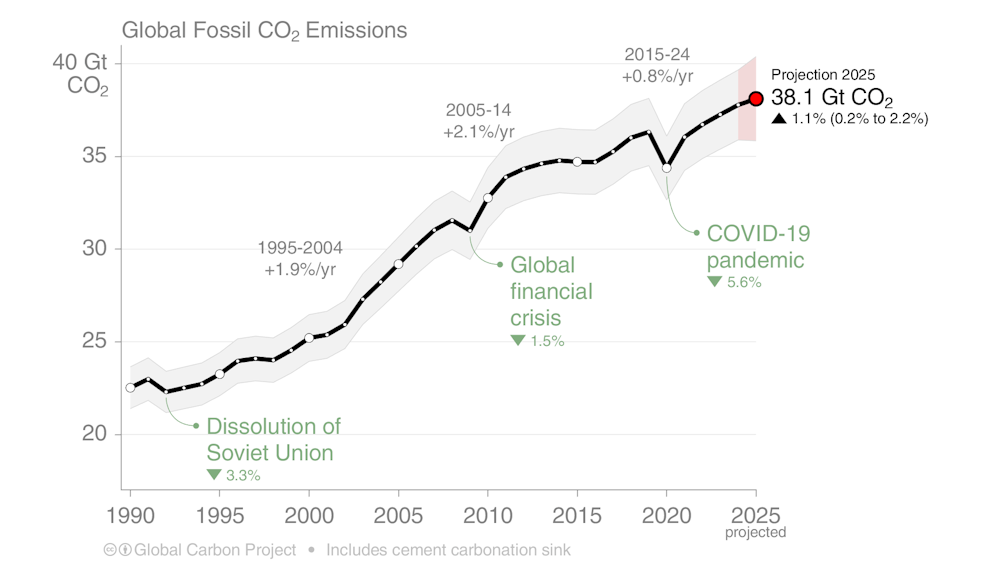
Global fossil fuel emissions are projected to rise in 2025 to a new all-time high, with all sources – coal, gas, and oil – contributing to the increase.

At the same time, our new global snapshot of carbon dioxide emissions and carbon sinks shows at least 35 countries have a plan to decarbonise. Australia, Germany, New Zealand and many others have shown statistically significant declines in fossil carbon emissions during the past decade, while their economies have continued to grow. China’s emissions have also been been growing at a much slower pace than recent trends and might even be flat by year’s end.

As world leaders and delegates meet in Brazil for the United Nations’ global climate summit, COP30, many countries that have submitted new emissions commitments to 2035 have shown increased ambition.

But unless these efforts are scaled up substantially, current global temperature trends are projected to significantly exceed the Paris Agreement target that aims to keep warming well below 2°C.

These 35 countries are now emitting less carbon dioxide even as their economies grow. Global Carbon Project 2025, CC BY-NC-ND

Fossil fuel emissions up again in 2025

Together with colleagues from 102 research institutions worldwide, the Global Carbon Project today releases the Global Carbon Budget 2025. This is an annual stocktake of the sources and sinks of carbon dioxide worldwide.

We also publish the major scientific advances enabling us to pinpoint the global human and natural sources and sinks of carbon dioxide with higher confidence. Carbon sinks are natural or artificial systems such as forests which absorb more carbon dioxide from the atmosphere than they release.

Global CO₂ emissions from the use of fossil fuels continue to increase. They are set to rise by 1.1% in 2025, on top of a similar rise in 2024. All fossil fuels are contributing to the rise. Emissions from natural gas grew 1.3%, followed by oil (up 1.0%) and coal (up 0.8%). Altogether, fossil fuels produced 38.1 billion tonnes of CO₂ in 2025.

Not all the news is bad. Our research finds emissions from the top emitter, China (32% of global CO₂ emissions) will increase significantly more slowly below its growth over the past decade, with a modest 0.4% increase. Emissions from India (8% of global) are projected to increase by 1.4%, also below recent trends.

However, emissions from the United States (13% of global) and the European Union (6% of global) are expected to grow above recent trends. For the US, a projected growth of 1.9% is driven by a colder start to the year, increased liquefied natural gas (LNG) exports, increased coal use, and higher demand for electricity.

EU emissions are expected to grow 0.4%, linked to lower hydropower and wind output due to weather. This led to increased electricity generation from LNG. Uncertainties in currently available data also include the possibility of no growth or a small decline.

Fossil fuel emissions hit a new high in 2025, but the growth rate is slowing and there are encouraging signs from countries cutting emissions. Global Carbon Project 2025, CC BY-NC-ND

Drop in land use emissions

In positive news, net carbon emissions from changes to land use such as deforestation, degradation and reforestation have declined over the past decade. They are expected to produce 4.1 billion tonnes of carbon dioxide in 2025 down from the annual average of 5 billion tonnes over the past decade. Permanent deforestation remains the largest source of emissions. This figure also takes into account the 2.2 billion tonnes of carbon soaked up by human-driven reforestation annually.

Three countries – Brazil, Indonesia and the Democratic Republic of the Congo – contribute 57% of global net land-use change CO₂ emissions.

When we combine the net emissions from land-use change and fossil fuels, we find total global human-caused emissions will reach 42.2 billion tonnes of carbon dioxide in 2025. This total has grown 0.3% annually over the past decade, compared with 1.9% in the previous one (2005–14).

Carbon sinks largely stagnant

Natural carbon sinks in the ocean and terrestrial ecosystems remove about half of all human-caused carbon emissions. But our new data suggests these sinks are not growing as we would expect.

The ocean carbon sink has been relatively stagnant since 2016, largely because of climate variability and impacts from ocean heatwaves.

The land CO₂ sink has been relatively stagnant since 2000, with a significant decline in 2024 due to warmer El Niño conditions on top of record global warming. Preliminary estimates for 2025 show a recovery of this sink to pre-El Niño levels.

Since 1960, the negative effects of climate change on the natural carbon sinks, particularly on the land sink, have suppressed a fraction of the full sink potential. This has left more CO₂ in the atmosphere, with an increase in the CO₂ concentration by an additional 8 parts per million. This year, atmospheric CO₂ levels are expected to reach just above 425 ppm.

Tracking global progress

Despite the continued global rise of carbon emissions, there are clear signs of progress towards lower-carbon energy and land use in our data.

There are now 35 countries that have reduced their fossil carbon emissions over the past decade, while still growing their economy. Many more, including China, are shifting to cleaner energy production. This has led to a significant slowdown of emissions growth.

Existing policies supporting national emissions cuts under the Paris Agreement are projected to lead to global warming of 2.8°C above preindustrial levels by the end of this century.

This is an improvement over the previous assessment of 3.1°C, although methodological changes also contributed to the lower warming projection. New emissions cut commitments to 2035, for those countries that have submitted them, show increased mitigation ambition.

This level of expected mitigation falls still far short of what is needed to meet the Paris Agreement goal of keeping warming well below 2°C.

At current levels of emissions, we calculate that the remaining global carbon budget – the carbon dioxide still able to be emitted before reaching specific global temperatures (averaged over multiple years) – will be used up in four years for 1.5°C (170 gigatonnes remaining), 12 years for 1.7°C (525 Gt) and 25 years for 2°C (1,055 Gt).

Falling short

Our improved and updated global carbon budget shows the relentless global increase of fossil fuel CO₂ emissions. But it also shows detectable and measurable progress towards decarbonisation in many countries.

The recovery of the natural CO₂ sinks is a positive finding. But large year-to-year variability shows the high sensitivity of these sinks to heat and drought.

Overall, this year’s carbon report card shows we have fallen short, again, of reaching a global peak in fossil fuel use. We are yet to begin the rapid decline in carbon emissions needed to stabilise the climate.The Conversation

Pep Canadell, Chief Research Scientist, CSIRO Environment; Executive Director, Global Carbon Project, CSIRO; Clemens Schwingshackl, Senior Researcher in Climate Science, Ludwig Maximilian University of Munich; Corinne Le Quéré, Royal Society Research Professor of Climate Change Science, University of East Anglia; Glen Peters, Senior Researcher, Center for International Climate and Environment Research - Oslo; Judith Hauck, Helmholtz Young Investigator group leader and deputy head, Marine Biogeosciences section at the Alfred Wegener Institute, Universität Bremen; Julia Pongratz, Professor of Physical Geography and Land Use Systems, Department of Geography, Ludwig Maximilian University of Munich; Mike O'Sullivan, Lecturer in Mathematics and Statistics, University of Exeter; Pierre Friedlingstein, Chair, Mathematical Modelling of Climate, University of Exeter, and Robbie Andrew, Senior Researcher, Center for International Climate and Environment Research - Oslo

This article is republished from The Conversation under a Creative Commons license. Read the original article.

Read More........

Over 2,000 flights cancelled across US as federal govt shutdown enters day 40


Representational photo. (IANS Photo)

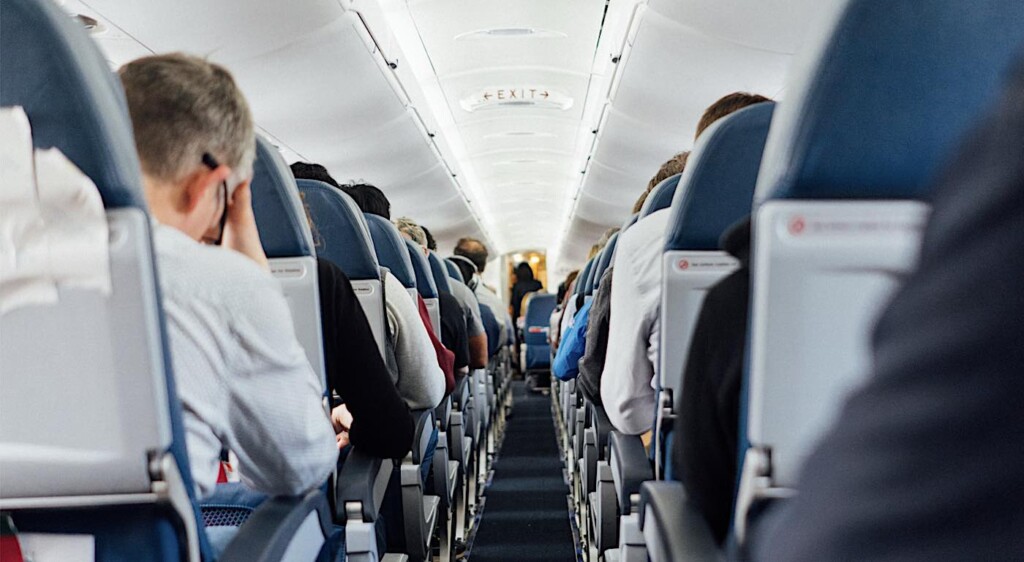
Washington, (IANS): As the US federal government shutdown entered its 40th day, more than 2,000 flights were cancelled and over 8,000 delayed nationwide, according to flight tracking website FlightAware.

Since the Federal Aviation Administration's (FAA) mandated flight reduction policy took effect on Friday, the number of canceled flights surged from 202 on Thursday to 1,025 on Friday, and further to 1,566 on Saturday, Xinha news agency reported.

The number of air traffic controllers taking leave has risen since the shutdown began on October 1, forcing many others to work overtime.

The US Department of Transportation and the FAA recently announced a 10 per cent capacity reduction at 40 major airports across the country starting Friday, aiming to ease staffing pressures and reduce airspace safety risks.

"It's only going to get worse," Transportation Secretary Sean Duffy told CNN on Sunday. "I look to the two weeks before Thanksgiving. You're going to see air travel be reduced to a trickle."

On the same day, National Economic Council Director Kevin Hassett told CBS that if people are not traveling during Thanksgiving, "we really could be looking at a negative quarter for the fourth quarter."

The regular budget, which should have been ready on October 1, marks the start of the US fiscal year. Instead, it is snaggled in party polarisation. A temporary measure known as a “continuing resolution” is needed to finance the government for now.

That resolution has been held up in the Senate due to a procedural element known as the filibuster, which blocks a legislative measure from coming up for a vote.

Sixty votes are required to break it, instead of a simple majority, as a way of putting the brakes on a party with a majority running roughshod.The Republicans, with only 53 votes, are powerless to break the filibuster and pass their version of the temporary funding resolution.Over 2,000 flights cancelled across US as federal govt shutdown enters day 40 | MorungExpress | morungexpress.com
Read More........

New Rule Requires US Airlines to Give Automatic Refunds for Canceled or Delayed Flights and Late Baggage

By Hanson Lu

The White House recently announced it has issued a final rule that requires airlines to promptly provide passengers with automatic cash refunds when owed. The new rule makes it easy for passengers to obtain refunds when airlines cancel or significantly change their flights, and following significantly delayed checked bags, or failures to provide extra services when purchased.

“Passengers deserve to get their money back when an airline owes them—without headaches or haggling,” said U.S. Transportation Secretary Pete Buttigieg. “Our new rule sets a new standard to require airlines to promptly provide cash refunds to their passengers.”

The final rule creates certainty for consumers by defining the circumstances in which airlines must provide prompt refunds. Prior to this rule, airlines were permitted to set their own standards for what kind of flight changes warranted a refund, which differed from airline to airline, making it difficult for passengers to know or assert their refund rights.

Under the new rules, which will start going into effect within six months, passengers are entitled to a refund for:

Canceled or significantly changed flights:

Passengers will be entitled to a refund if their flight is canceled or significantly changed, and they do not accept alternative transportation or travel credits offered. For the first time, the rule defines “significant change.” Significant changes to a flight include departure or arrival times that are more than 3 hours domestically and 6 hours internationally; departures or arrivals from a different airport; increases in the number of connections; instances where passengers are downgraded to a lower class of service; or changes that result in less accessible or accommodating situations to a person with a disability.

Significantly delayed baggage return:

Passengers who file a mishandled baggage report will be entitled to a refund of their checked bag fee if it is not delivered within 12 hours of their domestic flight arriving at the gate, or 15-30 hours of their international flight arriving at the gate, depending on the length of the flight.

Extra services not provided:

Passengers will be entitled to a refund for the fee they paid for an extra service — such as Wi-Fi, seat selection, or inflight entertainment — if an airline fails to provide this service.

The DOT’s (U.S. Department of Transportation) final rule also makes it simple and straightforward for passengers to receive the money they are owed. Without this rule, consumers have to navigate a patchwork of cumbersome processes to request and receive a refund — searching through airline websites to figure out how make the request, filling out extra “digital paperwork,” or at times waiting for hours on the phone. In addition, passengers would receive a travel credit or voucher by default from some airlines instead of getting their money back, so they could not use their refund to rebook on another airline when their flight was changed or cancelled without navigating a cumbersome request process.

Refunds are required to be:

Automatic: Airlines must automatically issue refunds without passengers having to explicitly request them or jump through hoops.

Prompt: Airlines and ticket agents must issue refunds within seven business days of refunds becoming due for credit card purchases and 20 calendar days for other payment methods.

In Cash or original form of payment: Airlines and ticket agents must provide refunds in cash or whatever original payment method the individual used to make the purchase, such as credit card or airline miles. Airlines may not substitute vouchers, travel credits, or other forms of compensation unless the passenger affirmatively chooses to accept alternative compensation.

In the full amount: Airlines and ticket agents must provide full refunds of the ticket purchase price, minus the value of any portion of transportation already used. The refunds must include all government-imposed taxes and fees and airline-imposed fees, regardless of whether the taxes or fees are refundable to airlines.

The final rule also requires airlines to provide prompt notifications to consumers affected by a cancelled or significantly changed flight of their right to a refund of the ticket and extra service fees, as well as any related policies.

Happily, during 2023, the flight cancellation rate in the U.S. was a record low at under 1.2% — the lowest rate of flight cancellations in over 10 years despite a record amount of air travel.

However, in the event that an airline causes a significant delay or cancellation, thanks to pressure from the Biden-era DOT, all 10 major U.S. airlines now guarantee free rebooking and meals—and nine guarantee hotel accommodations. These are new commitments the airlines added to their customer service plans that DOT can legally ensure they adhere to. Find the details displayed on a new web domain that links to DOT: flightrights.gov.

Getting rid of hidden fees

A second rule will require airlines and ticket agents to tell consumers upfront what fees they charge for checked bags, a carry-on bag, for changing a reservation, or cancelling a reservation. This ensures that consumers can avoid surprise fees when they purchase tickets from airlines or ticket agents, including both brick-and-mortar travel agencies or online travel agencies.

The rule will help consumers avoid unneeded or unexpected charges that can increase quickly and add significant cost to what may, at first, look like a cheap ticket.

Airlines must inform consumers that seats are guaranteed: To help consumers avoid unneeded ‘seat selection fees’, airlines and ticket agents must tell consumers that seats are guaranteed and that they are not required to pay extra. The new rule also prohibits airlines from advertising a promotional discount off a low base fare that does not include all mandatory carrier-imposed fees. LEARN all the details from DOT, here.There are different implementation periods in these final rules ranging from six months for airlines to provide automatic refunds when owed to 12 months for airlines to provide transferable travel vouchers or credits when consumers are unable to travel for reasons related to a serious communicable disease. New Rule Requires US Airlines to Give Automatic Refunds for Canceled or Delayed Flights and Late Baggage
Read More........

Want more protein for less money? Don’t be fooled by the slick black packaging

The Conversation, CC BY-SA Emma Beckett, UNSW Sydney

If you’ve been supermarket shopping lately, you might have noticed more foods with big, bold protein claims on black packaging – from powders and bars to yoghurt, bread and even coffee.

International surveys show people are shopping for more protein because they think it’ll help their fitness and health. But clever marketing can sway our judgement too.

Before your next shop, here’s what you should know about how protein is allowed to be sold to us. And as a food and nutrition scientist, I’ll offer some tips for choosing the best value meat or plant-based protein for every $1 you spend – and no, protein bars aren’t the winner.

‘Protein’ vs ‘increased protein’ claims

Let’s start with those “high protein” or “increased protein” claims we’re seeing more of on the shelves.

In Australia and New Zealand, there are actually rules and nuances about how and when companies can use those phrases.

Under those rules, labelling a product as a “protein” product implies it’s a “source” of protein. That means it has at least 5 grams of protein per serving.

“High protein” doesn’t have a specific meaning in the food regulations, but is taken to mean “good source”. Under the rules, a “good source” should have at least 10 grams of protein per serving.

Then there is the “increased protein” claim, which means it has at least 25% more protein than the standard version of the same food.

If you see a product labelled as a “protein” version, you might assume it has significantly more protein than the standard version. But this might not be the case.

Take, for example, a “protein”-branded, black-wrapped cheese: Mini Babybel Protein. It meets the Australian and New Zealand rules of being labelled as a “source” of protein, because it has 5 grams of protein per serving (in this case, in a 20 gram serve of cheese).

But what about the original red-wrapped Mini Babybel cheese? That has 4.6g of protein per 20 gram serving.

The difference between the original vs “protein” cheese is not even a 10% bump in protein content.

Black packaging by design

Food marketers use colours to give us signals about what’s in a package.

Green signals natural and environmentally friendly, reds and yellows are often linked to energy, and blue goes with coolness and hydration.

These days, black is often used as a visual shorthand for products containing protein.

But it’s more than that. Research also suggests black conveys high-quality or “premium” products. This makes it the perfect match for foods marketed as “functional” or “performance-boosting”.

The ‘health halo’ effect

When one attribute of a food is seen as positive, it can make us assume the whole product is health-promoting, even if that’s not the case. This is called a “health halo”.

For protein, the glow of the protein halo can make us blind to the other attributes of the food, such as added fats or sugars. We might be willing to pay more too.

It’s important to know protein deficiency is rare in countries like Australia. You can even have too much protein.

How to spend less to get more protein

If you do have good reason to think you need more protein, here’s how to get better value for your money.

Animal-based core foods are nutritionally dense and high-quality protein foods. Meats, fish, poultry, eggs, fish, and cheese will have between 11 to 32 grams of protein per 100 grams.

That could give you 60g in a chicken breast, 22g in a can of tuna, 17g in a 170g tub of Greek yoghurt, or 12g in 2 eggs.

In the animal foods, chicken is economical, delivering more than 30g of protein for each $1 spent.

But you don’t need to eat animal products to get enough protein.

In fact, once you factor in costs – and I made the following calculations based on recent supermarket prices – plant-based protein sources become even more attractive.

Legumes (such as beans, lentils and soybeans) have about 9g of protein per 100g, which is about half a cup. Legumes are in the range of 20g of protein per dollar spent, which is a similar cost ratio to a protein powder.

Nuts, seeds, legumes and oats are all good plant-based options. Towfiqu Barbhuiya/Unsplash, CC BY

Nuts and seeds like sunflower seeds can have 7g in one 30g handful. Even one cup of simple frozen peas will provide about 7g of protein.

Peanuts at $6 per kilogram supply 42g of protein for each $1 spent.

Dry oats, at $3/kg have 13g of protein per 100g (or 5g in a half cup serve), that’s 33g of protein per dollar spent.

In contrast, processed protein bars are typically poor value, coming in at between 6-8g of protein per $1 spent, depending on if you buy them in a single serve, or in a box of five bars.

Fresh often beats processed on price and protein

Packaged products offer convenience and certainty. But if you rely on convenience, colours and keywords alone, you might not get the best deals or the most nutritious choices.

Choosing a variety of fresh and whole foods for your protein will provide a diversity of vitamins and minerals, while reducing risks associated with consuming too much of any one thing. And it can be done without breaking the bank.The Conversation

Emma Beckett, Adjunct Senior Lecturer, Nutrition, Dietetics & Food Innovation - School of Health Sciences, UNSW Sydney

This article is republished from The Conversation under a Creative Commons license. Read the original article.

Read More........