Japan births, fertility rates dropped to record low in 2025: Report
AST SpaceMobile satellite placed into wrong orbit

Your smart home can be easily hacked. New safety standards will help, but stay vigilant
Yang Xiang, Swinburne University of Technology
On a quiet suburban street, a modern Australian home wakes before its owners do.
The lights turn on automatically, the thermostat adjusts to a comfortable temperature, and the coffee machine begins brewing. A doorbell camera watches the front yard, a baby monitor streams live footage to a parent’s phone, and a smart speaker waits for its next command.
This is the promise of the smart home: convenience, efficiency and peace of mind.
But behind this smooth experience is a hidden risk: every connected device can also be a way for cyber attackers to get in.
The Australian government has responded by introducing minimum security standards for smart devices to better protect households in this increasingly connected world.
These standards recently took effect. So what’s in them? And are they sufficient to keep people safe?
Starting with manufacturers
From my experience working in cybersecurity, I’ve seen that security risks start from manufacturers themselves.
Many smart devices are not designed with security as a priority. Manufacturers often focus on keeping costs low, releasing products quickly, and making them easy to use. Security is treated as an afterthought.
For example, many devices arrive with weak default passwords such as “admin” or “1234”, which users rarely change. This creates an easy opportunity for attackers to gain access.
The Mirai botnet attack in 2016 clearly demonstrated the risks. In this case, hundreds of thousands of insecure devices such as doorbell cameras were hijacked to launch massive “distributed denial-of-service” (DDoS) attacks. This is a type of cyber attack where many computers or devices are used together to overwhelm a website, server, or network with traffic, so it becomes slow or completely unavailable to legitimate users.
More recent research has shown smart home devices can be exploited not only to disrupt systems but also to spy on households. In some cases, strangers have accessed baby monitors, and poorly secured cameras have exposed private footage online.
Another major issue is the lack of regular software updates.
Many low-cost or older devices don’t receive ongoing security patches, which means known software vulnerabilities remain open indefinitely. Attackers actively scan the internet for such devices, exploiting weaknesses at a large scale. Cloud-connected and AI-enabled systems amplify risks.
The consequences of these weaknesses go beyond individual households. Compromised devices can be used as part of larger cyber attacks, forming botnets that target critical infrastructure or businesses.
In effect, an insecure smart lightbulb or camera can become a building block in global cyber crime operations.
What are the new standards?
In response to these growing threats, the Australian government has begun introducing mandatory minimum security standards for connected devices.
These standards took effect earlier this month. They aim to establish a baseline level of protection across all products entering the market.
While the details of these standards may evolve, the key ideas are clear.
First, devices must not use universal default passwords. Each device should either require users to create a unique password during setup or be shipped with a unique credential.
Second, manufacturers must provide a clear vulnerability disclosure policy, allowing security researchers to report issues responsibly.
Third, there must be transparency around how long a device will receive security updates, so consumers can make informed decisions.
These changes shift some responsibility from users to manufacturers. Instead of expecting consumers to fix security problems themselves, devices must be designed to be safer from the start.
In practice, this means fewer vulnerabilities and greater accountability across the industry.
Regulation alone isn’t enough
However, regulation alone is not enough. Household behaviour still plays a critical role in maintaining security. Fortunately, some of the most effective steps are simple.
Changing default passwords to strong, unique ones is one of the most important steps. A strong password should be long, complex and not reused across multiple devices or accounts.
Enabling multi-factor authentication wherever possible adds a second layer of defence, making it significantly harder for attackers to gain access.
Regularly updating device firmware, also known as “software for hardware”, is equally important. Firmware updates often include patches for newly discovered vulnerabilities, and delaying them leaves devices exposed.
Users should also consider their home network design. Placing smart devices on a separate network, such as a guest wifi, can help isolate them from more sensitive information on personal or work devices.
Finally, choosing reputable manufacturers matters. Companies with a strong track record of providing ongoing security updates and transparent policies are generally safer choices than unknown or low-cost alternatives.
Smart homes are becoming an integral part of everyday life, and their benefits continue to grow. But as intelligence and automation expand, convenience must not come at the expense of security and trust.
With stronger standards, better-designed devices and more informed users, it is possible to enjoy the benefits of smart homes without exposing ourselves to unnecessary cyber risks.![]()
Yang Xiang, Professor, Computer Science, Swinburne University of Technology
This article is republished from The Conversation under a Creative Commons license. Read the original article.
Franchise businesses have long been plagued by scandals. Domino’s is just the latest
Jenny Buchan, UNSW Sydney
The blue and red boxes with white dots are immediately recognisable as containing Domino’s pizzas. The pizza chain is Australia’s largest and is run as a franchise, with the ASX-listed public company Domino’s Pizza Enterprises holding the Australian master franchise rights.
Industry analysts IBISWorld calculate Domino’s has 4.2% of the fast food and takeaway market in Australia.
But recent reports suggest all is not well with many of the store owners, who are struggling with rising costs and declining profitability.
Troubling reports
The central issue appears to be what the federal government describes in its code of conduct as the “the imbalance of power between franchisors and franchisees”.
The Australian Financial Review has reported troubling claims in two key areas:
Domino’s appears to have doubled the margin on the key food ingredients it sells to franchisees and increased its advertising levy, according to a letter from store owners represented by the Australian Association of Franchisees. This could reduce their profitability
Domino’s Australian chief operating officer, Greg Steenson, reportedly encouraged franchisees in a presentation to take advantage of restructuring schemes that allow insolvent companies to continue to trade by negotiating repayment plans with the tax office and other creditors.
In a letter to Domino’s quoted in the report, the franchisees said their earnings have remained flat for 15 years, and have not kept up with inflation.
A long history of disputes
A former franchisee told a parliamentary inquiry into the franchising model the margin squeeze meant
franchisees can be ripped off by [Domino’s Pizza Enterprises] when forced to buy supplies at a higher price than they could get through their wholesalers.
He said the cost of food, labour, rent and other fixed costs had risen, but in 2019 pizzas were still sold at 1990s prices. “Nobody is left to pay for this but the franchisees,” the former owner said.
According to the Financial Review article, the cost of supplies remains a problem for franchisees. Time will tell whether Domino’s proposed 70 cent increase in pizza prices will help.
In response to questions from the Financial Review, Domino’s said the food margin had not “materially changed” in five years, despite volatility in ingredients prices.
Government reviews found the previous regulations had loopholes that did not sufficiently protect franchisees. There have been a string of high-profile disputes involving auto services company Ultra Tune, coffee chain 85 Degrees Coffee, Pizza Hut and others.
Following a 2024 inquiry, changes to the code of conduct were introduced this year.
Advertising costs on the rise
Advertising expenditure comes from what is now known as a “special purpose fund” in the code of conduct. Franchisors need to provide franchisees with disclosure about how the money is spent.
In 2017, the consumer regulator Australian Competition and Consumer Commission fined Domino’s A$18,000 for allegedly slipping on its obligations to advise franchisees about its marketing spend.
Ensuring franchisees have a genuine say in how their increased contribution is spent could help to address any imbalance of power between Domino’s and its franchisees.
Franchisees reportedly now pay 6% of their earnings to Domino’s for marketing and advertising, up from 5.35%. That is in addition to 7% of gross sales paid as royalties, and other costs for email and bookkeeping.
What insolvent means
The insolvency law for small businesses is explained by the Australian Taxation Office as a process that enables financially distressed but viable firms to restructure their existing debts and continue to trade.
The press reports say the franchisees of about 65 Domino’s stores were on repayment plans with the Australian Taxation Office. Many franchisees own two or more outlets.
Under the Corporations legislation, companies on these repayment plans may be trading insolvent, or believe they will become insolvent. Insolvent means they cannot pay their debts when they fall due. If this is the case, a key question that needs to be answered by Domino’s is whether their franchised outlets can become profitable.
In another media report, Domino’s was quoted as saying it disputed the number of stores on repayment plans, adding it was a “significantly smaller” number of franchisees.
The company was contacted for comment but did not respond before deadline.
What this means for the stores
So what does this mean for Domino’s store owners who may be trading insolvent?
Under the law, the restructuring process allows eligible small business companies:
- to retain control of the business, property and affairs while developing a plan to restructure with the assistance of a small business restructuring practitioner
- to enter into a restructuring plan with creditors.
If a company proposes a restructuring plan to its creditors, it is taken to be insolvent. This is a game changer for the franchisee and its creditors.
Franchisees receive protection from creditors who want to enforce rights under existing contracts. A franchisee’s creditors include suppliers, its landlord, employees, the tax office and the franchisor (in this case, Domino’s).
Currently these store owners are protected from any creditors pushing them to pay their debts. The restructuring process gives the store owners some breathing room while the debt negotiations take place.
The imbalance of power persists
Despite government inquiries and reviews, it seems the imbalance of power between the Domino’s franchisees and their franchisor persists.
But Domino’s can’t afford to stay the same. Franchisees need to make a profit. The move to enter restructuring could be a temporary band aid.
Domino’s largest shareholder and executive chairman, Jack Cowin, was appointed in July after the former chief executive left after just seven months. Cowin understands the franchised fast food sector and has pledged to lead a cost reduction program that will improve the profitability of stores.![]()
Jenny Buchan, Emeritus Professor, Business School, UNSW Sydney
This article is republished from The Conversation under a Creative Commons license. Read the original article.
HIV breakthrough stalled by red tape barriers in India
Rupee crashes to record low beyond 90 per dollar
The world’s carbon emissions continue to rise. But 35 countries show progress in cutting carbon
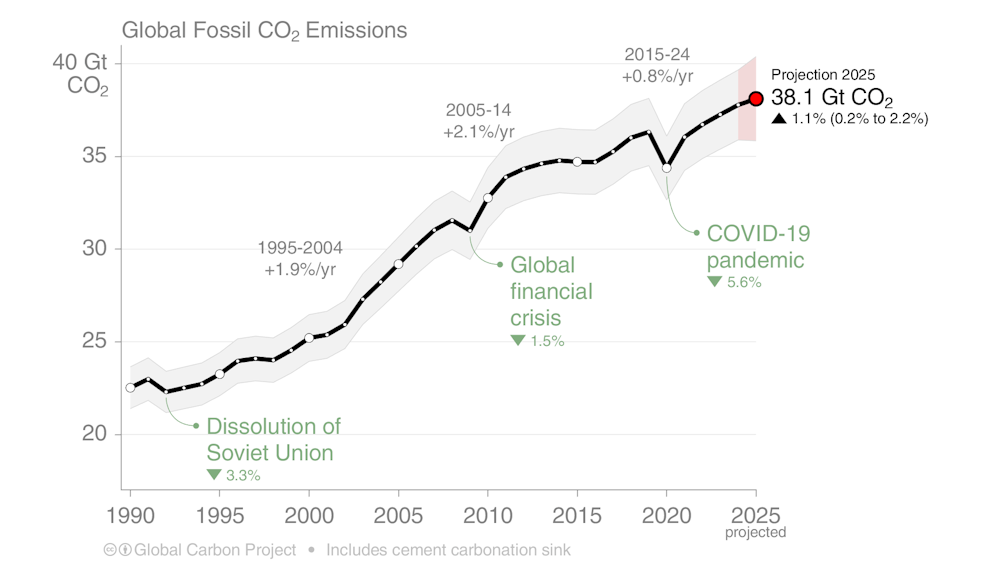
Global fossil fuel emissions are projected to rise in 2025 to a new all-time high, with all sources – coal, gas, and oil – contributing to the increase.
At the same time, our new global snapshot of carbon dioxide emissions and carbon sinks shows at least 35 countries have a plan to decarbonise. Australia, Germany, New Zealand and many others have shown statistically significant declines in fossil carbon emissions during the past decade, while their economies have continued to grow. China’s emissions have also been been growing at a much slower pace than recent trends and might even be flat by year’s end.
As world leaders and delegates meet in Brazil for the United Nations’ global climate summit, COP30, many countries that have submitted new emissions commitments to 2035 have shown increased ambition.
But unless these efforts are scaled up substantially, current global temperature trends are projected to significantly exceed the Paris Agreement target that aims to keep warming well below 2°C.
These 35 countries are now emitting less carbon dioxide even as their economies grow. Global Carbon Project 2025, CC BY-NC-NDFossil fuel emissions up again in 2025
Together with colleagues from 102 research institutions worldwide, the Global Carbon Project today releases the Global Carbon Budget 2025. This is an annual stocktake of the sources and sinks of carbon dioxide worldwide.
We also publish the major scientific advances enabling us to pinpoint the global human and natural sources and sinks of carbon dioxide with higher confidence. Carbon sinks are natural or artificial systems such as forests which absorb more carbon dioxide from the atmosphere than they release.
Global CO₂ emissions from the use of fossil fuels continue to increase. They are set to rise by 1.1% in 2025, on top of a similar rise in 2024. All fossil fuels are contributing to the rise. Emissions from natural gas grew 1.3%, followed by oil (up 1.0%) and coal (up 0.8%). Altogether, fossil fuels produced 38.1 billion tonnes of CO₂ in 2025.
Not all the news is bad. Our research finds emissions from the top emitter, China (32% of global CO₂ emissions) will increase significantly more slowly below its growth over the past decade, with a modest 0.4% increase. Emissions from India (8% of global) are projected to increase by 1.4%, also below recent trends.
However, emissions from the United States (13% of global) and the European Union (6% of global) are expected to grow above recent trends. For the US, a projected growth of 1.9% is driven by a colder start to the year, increased liquefied natural gas (LNG) exports, increased coal use, and higher demand for electricity.
EU emissions are expected to grow 0.4%, linked to lower hydropower and wind output due to weather. This led to increased electricity generation from LNG. Uncertainties in currently available data also include the possibility of no growth or a small decline.
Fossil fuel emissions hit a new high in 2025, but the growth rate is slowing and there are encouraging signs from countries cutting emissions. Global Carbon Project 2025, CC BY-NC-NDDrop in land use emissions
In positive news, net carbon emissions from changes to land use such as deforestation, degradation and reforestation have declined over the past decade. They are expected to produce 4.1 billion tonnes of carbon dioxide in 2025 down from the annual average of 5 billion tonnes over the past decade. Permanent deforestation remains the largest source of emissions. This figure also takes into account the 2.2 billion tonnes of carbon soaked up by human-driven reforestation annually.
Three countries – Brazil, Indonesia and the Democratic Republic of the Congo – contribute 57% of global net land-use change CO₂ emissions.
When we combine the net emissions from land-use change and fossil fuels, we find total global human-caused emissions will reach 42.2 billion tonnes of carbon dioxide in 2025. This total has grown 0.3% annually over the past decade, compared with 1.9% in the previous one (2005–14).
Carbon sinks largely stagnant
Natural carbon sinks in the ocean and terrestrial ecosystems remove about half of all human-caused carbon emissions. But our new data suggests these sinks are not growing as we would expect.
The ocean carbon sink has been relatively stagnant since 2016, largely because of climate variability and impacts from ocean heatwaves.
The land CO₂ sink has been relatively stagnant since 2000, with a significant decline in 2024 due to warmer El Niño conditions on top of record global warming. Preliminary estimates for 2025 show a recovery of this sink to pre-El Niño levels.
Since 1960, the negative effects of climate change on the natural carbon sinks, particularly on the land sink, have suppressed a fraction of the full sink potential. This has left more CO₂ in the atmosphere, with an increase in the CO₂ concentration by an additional 8 parts per million. This year, atmospheric CO₂ levels are expected to reach just above 425 ppm.
Tracking global progress
Despite the continued global rise of carbon emissions, there are clear signs of progress towards lower-carbon energy and land use in our data.
There are now 35 countries that have reduced their fossil carbon emissions over the past decade, while still growing their economy. Many more, including China, are shifting to cleaner energy production. This has led to a significant slowdown of emissions growth.
Existing policies supporting national emissions cuts under the Paris Agreement are projected to lead to global warming of 2.8°C above preindustrial levels by the end of this century.
This is an improvement over the previous assessment of 3.1°C, although methodological changes also contributed to the lower warming projection. New emissions cut commitments to 2035, for those countries that have submitted them, show increased mitigation ambition.
This level of expected mitigation falls still far short of what is needed to meet the Paris Agreement goal of keeping warming well below 2°C.
At current levels of emissions, we calculate that the remaining global carbon budget – the carbon dioxide still able to be emitted before reaching specific global temperatures (averaged over multiple years) – will be used up in four years for 1.5°C (170 gigatonnes remaining), 12 years for 1.7°C (525 Gt) and 25 years for 2°C (1,055 Gt).
Falling short
Our improved and updated global carbon budget shows the relentless global increase of fossil fuel CO₂ emissions. But it also shows detectable and measurable progress towards decarbonisation in many countries.
The recovery of the natural CO₂ sinks is a positive finding. But large year-to-year variability shows the high sensitivity of these sinks to heat and drought.
Overall, this year’s carbon report card shows we have fallen short, again, of reaching a global peak in fossil fuel use. We are yet to begin the rapid decline in carbon emissions needed to stabilise the climate.![]()
Pep Canadell, Chief Research Scientist, CSIRO Environment; Executive Director, Global Carbon Project, CSIRO; Clemens Schwingshackl, Senior Researcher in Climate Science, Ludwig Maximilian University of Munich; Corinne Le Quéré, Royal Society Research Professor of Climate Change Science, University of East Anglia; Glen Peters, Senior Researcher, Center for International Climate and Environment Research - Oslo; Judith Hauck, Helmholtz Young Investigator group leader and deputy head, Marine Biogeosciences section at the Alfred Wegener Institute, Universität Bremen; Julia Pongratz, Professor of Physical Geography and Land Use Systems, Department of Geography, Ludwig Maximilian University of Munich; Mike O'Sullivan, Lecturer in Mathematics and Statistics, University of Exeter; Pierre Friedlingstein, Chair, Mathematical Modelling of Climate, University of Exeter, and Robbie Andrew, Senior Researcher, Center for International Climate and Environment Research - Oslo
This article is republished from The Conversation under a Creative Commons license. Read the original article.
TPG suffers data breach impacting 280,000 customers