David Cameron returns: how can a prime minister make someone who isn’t an MP foreign secretary? And what happens now?

Thomas Caygill, Nottingham Trent University

In a surprise move, Rishi Sunak, the UK’s prime minister, has appointed former prime minister David Cameron as foreign secretary. Cameron, who resigned immediately after losing the 2016 Brexit referendum, has been almost entirely absent from the political scene ever since.

It’s rare these days for a prime minister to appoint someone who is not a sitting member of the House of Commons as a cabinet level minister in their government but Sunak certainly can do it. The prime minister has what we call the power of patronage.

What we mean by this is that there are a number of public roles for which the prime minister gets to decide who gets the job. Those powers of patronage include appointing members of the cabinet as well as other junior ministers to serve in government.

It is only a constitutional convention, rather than a rule, that government ministers be a member of either house of parliament. However, it is a convention that has been strongly abided by.

This convention revolves around the constitutional principle of responsible government where the executive is accountable to parliament. That’s why Cameron has been granted a life peerage to sit in the House of Lords, the upper house of parliament.

Making Lord Cameron the new foreign secretary is, from a historical and constitutional position, not unusual or forbidden. Under the government of Gordon Brown, both Lord Mandelson and Lord Adonis served in the cabinet, for example.

How quickly does this all happen?

While there are often set times when prime ministers appoint peers to the House of Lords, such as resignation honours, they can appoint anyone at any time. That means Cameron is now already a peer.

He will sit on the Conservative benches in the House of Lords for life – regardless of how long he spends in the role as foreign secretary.

This conferring of a peerage does mean he will need to be formally introduced into the House of Lords but this doesn’t take long to arrange. There is nothing to prevent Cameron from taking up the role of foreign secretary immediately, which explains why he has already been photographed at the Foreign, Commonwealth and Development Office.

Is it OK to appoint a minister in this way?

There isn’t a problem with Cameron’s appointment from the perspective of the constitution. It is all above board.

However some people will (legitimately) question whether the British government should be continuing to appoint peers to cabinet level jobs in the 21st century, given that debates around its democratic legitimacy, as an appointed rather than elected chamber, have been going on for decades already.

It’s worth noting that Cameron had a preference for appointing his cabinet ministers from the House of Commons when he was in charge.

And while the government is accountable to parliament as a whole, generally speaking we are talking about being accountable to the House of Commons, which is the elected house. MPs are likely to be annoyed that a senior member of the cabinet is not a member of their house.

Lindsay Hoyle, the speaker of the House of Commons, has already expressed concern about how the foreign secretary will be held to account by the House of Commons. While there are mechanisms available to hold the new foreign secretary to account, MPs are likely to need pacifying.

Cameron’s arrival shocks Sky News.

As a member of the House of Lords, Cameron will not be able to take part in the monthly Foreign Office questions in the House of Commons. He will not be able to answer urgent questions in the House of Commons or take part in their debates either.

Nor will he be able to deliver major foreign policy statements in the House of Commons. Junior ministers in the department will have to face MPs instead.

He can answer questions and take part in debates in the House of Lords and will be held to account by his fellow peers but it is a different political arena to the House of Commons.

There is precedence for cabinet level ministers in the House of Lords to appear there regularly. In 2009, House of Lords procedures were changed to allow cabinet ministers to answer questions on their departmental brief once a month for 20 minutes, and I am sure Lord Cameron will deliver statements on foreign affairs.

But, again, MPs cannot take part in this scrutiny. This is likely to annoy many, given the major foreign policy issues the country is facing at the moment.

When was the last time a great office of state was held by a peer?

While the appointment of cabinet ministers from the House of Lords is not unusual in post-war history, it has been some time since such a senior member of the government (a holder of one of the great offices of state) has come from the House of Lords.

The last member of the House of Lords to serve in one of the great offices of state was Lord Carrington, who was Margaret Thatcher’s foreign secretary between 1979 and 1982.

It also isn’t unheard of for former prime ministers to return to cabinet. Alex Douglas Home, who was until recently the shortest serving prime minister in post-war history, was appointed as foreign secretary by prime minister Ted Heath, serving from 1970 to 1974.The Conversation

Thomas Caygill, Senior Lecturer in Politics, Nottingham Trent University

This article is republished from The Conversation under a Creative Commons license. Read the original article.

Read More........

When it comes to Indigenous affairs, Australian voters’ opinions are complicated

Geoffrey Robinson, Deakin University The academic study of public opinion is a well-developed area. One foundational finding is that while the views of voters often seem contradictory and incoherent, these apparent inconsistencies have a pattern. The views that voters express in opinion polls reveal that many voters, especially those disengaged from politics, understand key concepts such as “equality” and “disadvantage” in a very different way from political elites of both left and right. The fact that public opinion does not align with traditional “left” and “right” viewpoints means that both progressives and conservatives have opportunities to gain majority support. The marriage equality plebiscite dashed conservatives’ dreams of a suburban “silent majority”. The Voice referendum seems likely to be disappointing for the left. The dynamics of both ballots are similar. One key finding from the study of popular ideology is that voters often express loyalty to general principles while also supporting policies that contradict those principles. Often these general principles are conservative. For example, Americans worry about government being too large, but when questioned about specific government programs, will support their extension. Australians have very high levels of patriotism, but most are not aggressive nationalists. There are some left-wing general principles that attract strong majority support, such as equal opportunity and that immigration contributes to cultural enrichment. However, voters’ interpretation of these principles is not a left-wing one: affirmative action for women is very unpopular, and although voters support multiculturalism as an aspiration, they are much more doubtful about immigrant communities receiving government assistance to maintain culture and traditions. Many aspects of the history of public opinion about Indigenous affairs, as chronicled in Murray Goot and Tim Rowse’s 2007 book Divided Nation, are consistent with this pattern. The political right is often more divided on policy than the left, but it has been successful in maintaining a coalition based on an appeal to abstract principles. The success of the “no” campaign is a case in point. In a liberal democracy, “equality” is a powerful idea, but its meaning is contested. From the 19th century, conservatives found to their surprise that formal political equality did not mean the disappearance of the social and economic inequalities they cherished. Conservatives have mostly championed formal political equality. The campaign against the Voice has centred themes of equality against the special treatment of Indigenous people. The theme is almost 50 years old, going back to mining industry campaigns against land rights in the 1970s. However, the idea of equality is also a tool against institutionalised racism. At the 1967 referendum, voters supported the idea of equality, even though the same voters rejected social closeness to Indigenous people and had a low opinion of their character and abilities. Supporters of “yes” have complained of the invocation of racist themes by some “no” campaigners. However, since the 1990s, public attitudes to Indigenous claims have shifted from hostility to mild support. But in an Australia less racist than it has ever been, the Voice now seems destined for defeat. The question is why were progressives unable to propose a convincing counter-narrative? The fact that initially the Voice attracted strong support suggests this was not inevitable. Although “equality” is a deeply popular idea, voters do not understand equality as simple sameness. In other words, they do not support a narrowly libertarian view that past history and current cultural differences have no bearing on the entitlements of contemporary Australians. Australian society is no longer, if it ever was, dominated by a culture of sameness. Voters recognise the claims of identity and difference, but only to a limited extent. As Goot and Rowse show, settlers have recognised the distinctiveness of Indigenous people, but they tend to understand it as applying only to some groups: those defined as “tribal”, remote, distinctive in appearance and so on. They show that public support for land rights was higher when beneficiaries were defined in this sense. Both left and right have cited the disadvantaged position of Indigenous people in arguments for and against the Voice. But voters’ support for Indigenous specific programs is based less of perceptions of disadvantage than Indigenous distinctiveness. Voters are sympathetic to identity claims when they are understood as something innate about individuals. However, they are less sympathetic when they are understood as the assertion of a collective political project. Scott Morrison’s personal religiosity initially contributed to an image of authenticity that voters found attractive. But his attempt to grant legal privileges to religious schools in the form of exemptions from anti-discrimination legislation were unpopular. The campaign for marriage equality appealed powerfully to ideas about the right to love. Conservatives deviate from a libertarian script when they argue that the high number of Indigenous MPs means that that First Nations peoples are already represented, but this expresses the view of Indigeneity as a personal attribute rather than a political force. The settler majority has come to accept Indigenous people as equal individual citizens of the nation-state. In some cases, they have supported special entitlements for some Indigenous people, rejecting a purely libertarian approach. Early support for the Voice reflected this, but the decline in support for the Voice demonstrates settlers are resistant to the idea of Indigenous peoples as a collective subject entitled to a unified Voice. Australian democracy is not colour-blind, but it defines difference within a limited framework. Geoffrey Robinson, Senior Lecturer, School of Humanities and Social Sciences, Deakin University This article is republished from The Conversation under a Creative Commons license. Read the original article.
Read More........

Georgia grand jury indicts former US President Trump, alleging 'conspiracy to unlawfully change outcome' of 2020 presidential election

Trump at last month's Turning Point Action Conference in West Palm Beach, Florida. Image: Gage Skidmore.
Last Monday, a Fulton County, Georgia grand jury seated in Atlanta indicted nineteen people, including former United States President Donald Trump, on 41 counts overall, Trump himself facing thirteen. Referencing the Republican's election loss to President Joe Biden in 2020 in Georgia and nationally, it alleged they "refused to accept that Trump lost, and they knowingly and willfully joined a conspiracy to unlawfully change the outcome of the election in favor of Trump." The grand jury's indictment continued: "That conspiracy contained a common plan and purpose to commit two or more acts of racketeering activity in Fulton County, Georgia, elsewhere in the State of Georgia, and in other states." Fulton County District Attorney Fani Willis told press later the accused had eleven days to surrender. Trump faced a charge of violating the Georgia Racketeer Influenced and Corrupt Organizations Act (RICO) along with his co-defendants; three counts of soliciting a public officer to violate their oath; conspiracy to commit impersonation of a public officer; two each of conspiracy to commit forgery in the first degree, conspiracy to commit false statements and writings, and false statements and writings; conspiracy to commit filing false documents; and filing false documents. Trump said the day of the indictment: "I didn't tamper with the election!" Ahead of the announcement of the charges, his 2024 presidential campaign claimed the prosecution the Democratic Willis was leading was "election interference". In a statement the campaign said: "The timing of this latest coordinated strike by a biased prosecutor in an overwhelmingly Democrat jurisdiction not only betrays the trust of the American people, but also exposes true motivation driving their fabricated accusations." He previously repeatedly asked for her disqualification based on her public remarks on the case. On Tuesday, he wrote on his social media website, Truth Social: "A Large, Complex, Detailed but Irrefutable REPORT on the Presidential Election Fraud which took place in Georgia is almost complete & will be presented by me at a major News Conference at 11:00 A.M. on Monday of next week in Bedminster, New Jersey". On Thursday, he announced he would not stage the press conference, posting to Truth Social: "Rather than releasing the Report on the Rigged & Stolen Georgia 2020 Presidential Election on Monday, my lawyers would prefer putting this, I believe, Irrefutable & Overwhelming evidence of Election Fraud & Irregularities in formal Legal Filings as we fight to dismiss this disgraceful Indictment". This fourth case followed indictments of the former president in New York City, on state-level charges of falsification of business records to conceal hush money payments, the first indictment of a US president Miami, Florida, on federal charges of purposeful retention of classified documents; and Washington, D.C., on federal charges of "[pursuit] of unlawful means of discounting legitimate votes and subverting" the 2020 election. Unlike impeachment and conviction by the US Congress, a criminal conviction unrelated to insurrection would not have legal effects on Trump's campaign, but, as the charges were state-level, a US president could not pardon those, if any, found guilty or remove state prosecutors. In its 98 pages, the indictment mentioned 30 more involved in the conspiracy, but did not charge or name them. It said Trump and associates, including lawyers Rudy Giuliani and John Eastman, both indicted alongside him Monday, unsuccessfully attempted to persuade state officials involved in the certification of the results. It described Trump asking Governor Brian Kemp and the Georgia secretary of state, Brad Raffensperger, both Republicans, to interfere with the results — calling Raffensperger on January 2, 2021 to ask him to "find" votes so Trump could overcome Biden's victory and US Department of Justice employees to pronounce the results "corrupt". It said Trump made false claims of election fraud in, without success, petitioning courts to undo the results in lawsuits
Georgia.The indictment. Image: State of Georgia.

against  According to the indictment, Trump organized individuals to present themselves as legitimate electors, including state Republican Party chairman David Shafer and Cathleen Latham; some said the Trump campaign told them they would cast their presidential votes only if Trump's legal efforts to overturn Biden's victory were successful. The grand jury indicted Shafer and Mike Roman, another alleged participant in the scheme, who worked on Trump's 2020 campaign. The indictment continued Trump attorneys three times attempted to convince members of the Republican-majority Georgia legislature to present their election fraud allegations. It said the US Department of Justice's civil division's top official, Jeffrey Clark, prepared a never-sent letter asking legislators to "convene a special session" on the results and the electors it would certify to vote for president, charging Clark. The grand jury described how "several of the Defendants [...] falsely accused Fulton County election worker Ruby Freeman of committing election crimes", then used these claims as basis for their argument the Georgia legislature and others in its government should alter the results. Mark Meadows was another facing charges. The grand jury accused the one-time Trump Executive Office Chief of Staff of trying to gain unauthorized entry to a Cobb County, Georgia civic center where state law enforcement was conducting audits of election-related signatures in December 2020. "Is there a way to speed up Fulton county signature verification in order to have results before Jan 6 if the trump campaign assist financially", he texted Raffensperger's Chief Investigator Frances Watson. The grand jury indicted him on violating RICO and soliciting a public officer to violate their oath, the latter stemming from scheduling the Trump–Raffensperger phone call. Latham, the grand jury charged, also participated in a pro-Trump scheme to compromise ballots and election machines in Coffee County, Georgia. In Georgia, prosecutors have had the option of convening special grand juries for investigations before a regular grand jury hears its findings and considers indictment, and Willis did so about a year into her investigation in 2022. Among those who testified to the special grand jury before it dissolved in January were Eastman, Giuliani, Meadows, and Ken Chesebro, all of whom the regular grand jury charged. Others who testified were Mike Flynn, a national security advisor to Trump, and legislators Senator Lindsey Graham of South Carolina and Representative Jody Hice of Georgia, both Republicans. Both Willis and Judge Robert McBurney, who oversaw the special grand jury's work, said Shafer was at the greatest risk of prosecution of the pro-Trump electors. Source: https://en.wikinews.org, available under the terms of the Creative Commons Attribution 2.5 License
Read More........

US climate envoy John Kerry on 5-day visit to India, will attend G20 Climate Meeting in Chennai

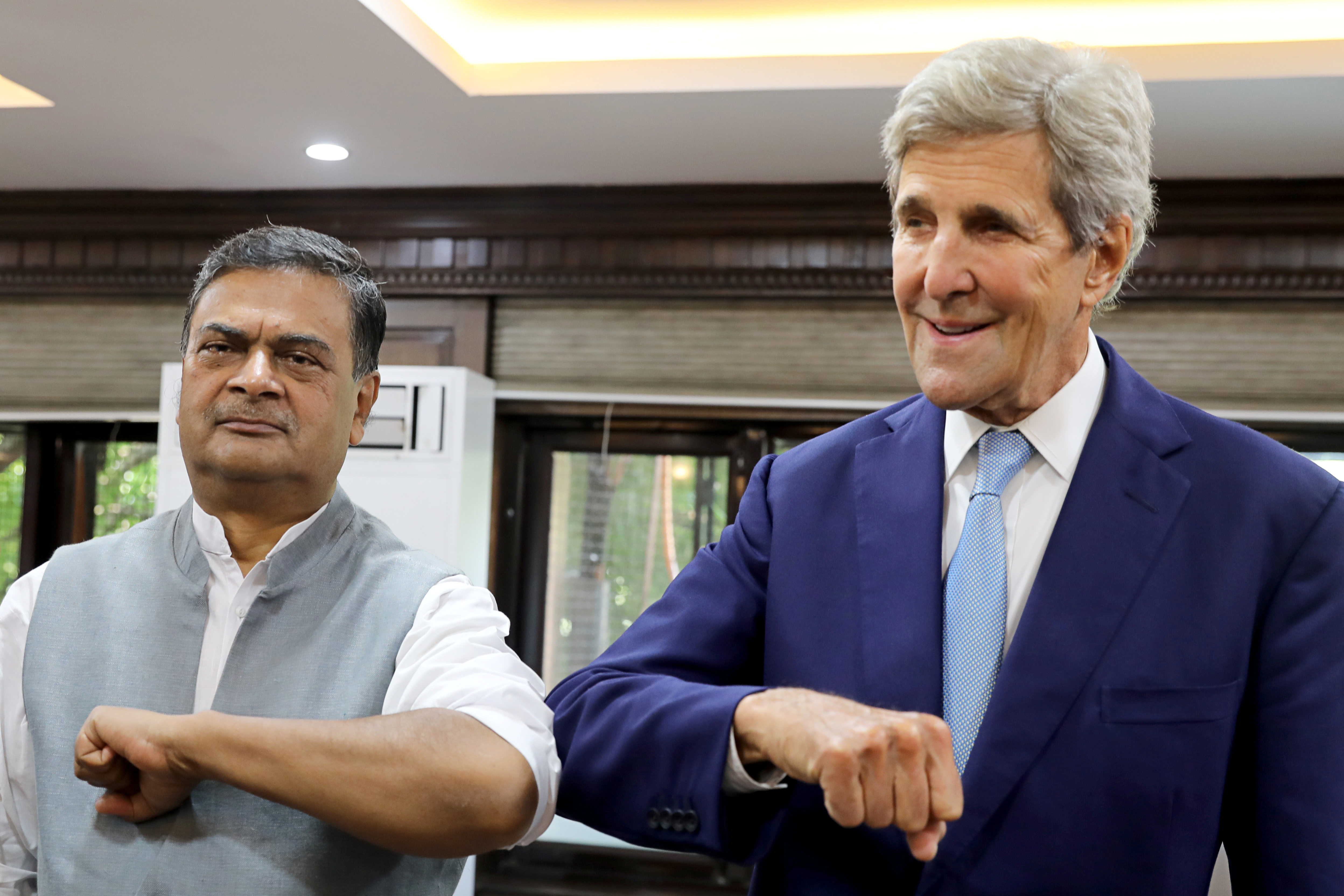
US special presidential envoy for climate John Kerry meets India’s Minister of Power and New & Renewable Energy Raj Kumar Singh in New Delhi, India, September 13, 2021. REUTERS/Anushree Fadnavis 

United States Special Presidential Envoy for Climate John Kerry is slated arrives on a five-day visit to India beginning Tuesday, July 25, 2023, days after returning from China. During his visit Kerry is visiting Chennai and Delhi, the US State Department said. In India, Kerry will attend the G20 Environment and Climate Sustainability Ministers (ECSM) Meeting in Chennai to be held on July 28, the US Department of State said in a statement. In Delhi, Kerry will meet with senior government officials to advance shared objectives on renewable and clean energy, and climate, the statement read. “Special Presidential Envoy for Climate John Kerry will travel to New Delhi and Chennai, India, July 25—29, to advance shared objectives on climate and clean energy, including mutual efforts to build a platform for investments in renewable energy and storage solutions, support the deployment of zero-emission buses, and diversify clean energy supply chains,” the US State Department said. The third Environment and Climate Sustainability Working Group (ECSWG) meeting was also under India’s G20 Presidency on May 21. The three-day meeting witnessed the participation of 141 delegates from G20 countries and 10 invitee countries. The representatives of 14 international and regional organizations also attended deliberations.. Earlier, Kerry ended his four-day visit to China on July 19 without any new agreements. in fact, the Chinese president, Xi Jinping, insisted in a speech that China would pursue its goals to phase out carbon dioxide pollution at its own pace and in its own way. Still, Kerry appeared buoyed that the world’s two biggest polluters had restarted discussions, which had been frozen for a year because of strained relations over Taiwan, trade and other issues. He insisted he was not disappointed in the outcome, noting that just talking marked progress, according to the Washington Post.“We had very frank conversations but we came here to break new ground,” Kerry said, adding, “It is clear that we are going to need a little more work.” Source: https://www.newsindiatimes.com/
Read More........

Biden's meeting with Bucharest Nine is signal of political attention – Lithuanian PM

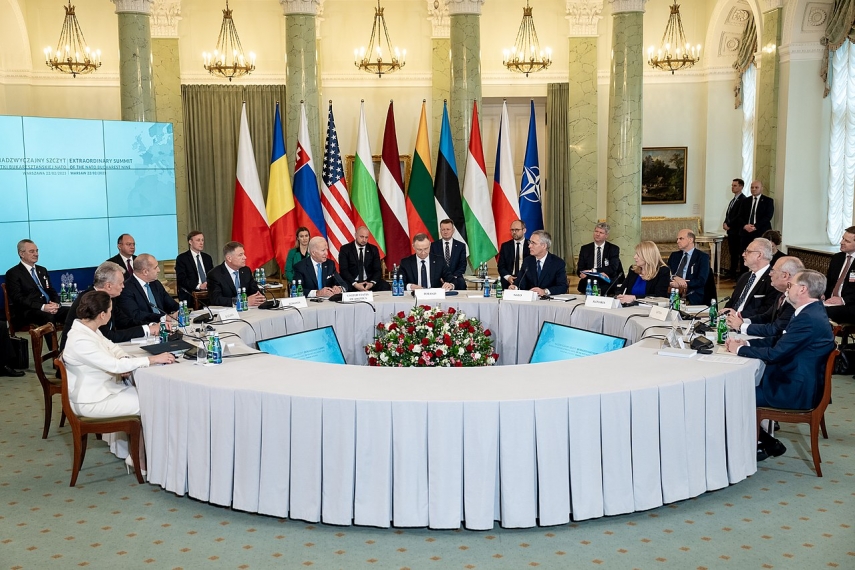
Photo: Office of the President of the United States

VILNIUS - US President Joe Biden's meeting with representatives of the Bucharest Nine, also attended by Lithuanian President Gitanas Nauseda, is an important signal of political and practical attention to NATO's eastern flank, Lithuanian Prime Minister Ingrida Simonyte says.

"The meeting with the leaders of NATO's eastern flank countries is a very important signal. It has been mentioned many times over the years that the Article 5 guarantees are ironclad, they are very solid, but they have to be reinforced with a political dimension, with such political attention, and with a practical dimension, with the physical reinforcement of the eastern flank," Simonyte told the Ziniu Radijas news radio on Thursday. "This invasion (…) has given NATO second wind."

As Russia's war in Ukraine continues, many of the Bucharest Nine countries are worried that if Russian President Vladimir Putin succeeds in Ukraine, his next target could be any of these countries.

The Bucharest Nine includes Bulgaria, the Czech Republic, Estonia, Hungary, Latvia, Lithuania, Poland, Romania and Slovakia.

The US president concluded his four-day visit to NATO's eastern flank allies Ukraine and Poland on Wednesday. On Monday, several days before the 1st anniversary of Russia's invasion of pro-Western Ukraine, Biden made a surprise visit to Kyiv where he met Ukrainian President Volodymyr Zelensky and vowed a new arms package and strong American support.

"I think it's extremely symbolic that President Biden visited Kyiv at this particular time because there was a very clear message here," the Lithuanian prime minister noted.

Putin delivered his annual speech on Tuesday and accused Western countries of causing and supporting the war in Ukraine. He also rejected Moscow's any responsibility."Clearly, the real event was President Biden in Kyiv, not Putin's speech," Simonyte said. Source: https://media.baltictimes.com/
Read More........

Modi congratulates Mamata


Indian prime minister Narendra Modi congratulated West Bengal Chief Minister Mamata Banerjee this evening and assured that the Centre will "continue to extend all possible support to the West Bengal Government to fulfil people's aspirations and also to overcome the COVID-19 pandemic". Counting the BJP's gains in a state where it only had a marginal presence, he thanked the people of Bengal for their "blessing" to the party.

"From a negligible presence earlier, BJP's presence has significantly increased," PM Modi tweeted as his party -- which aspired to 200 of Bengal's 294 seats -- looks set to win only 70-plus seats. Mamata Banerjee's Trinamool Congress is likely to win more than the 211 seats it won in 2016.

PM Modi's congratulations came hours after several of his party leaders, including Union Minister Rajnath Singh, extended their good wishes to the Chief Minister.

In another tweet, the Prime Minister -- who addressed more than 50 meetings as part of the BJP's Mission Bengal – said: "I would like to thank my sisters and brothers of West Bengal who have blessed our party. From a negligible presence earlier, BJP’s presence has significantly increased. BJP will keep serving the people. I applaud each and every Karyakarta for their spirited effort in the polls."

The BJP has been aiming to expand their footprint in the eastern India since coming to power at the Centre in 2014. In 2015, then BJP chief Amit Shah had laid down a 200-seat goal to the state unit of the party. But over the years, while the BJP has managed to bring the states of the northeast under its control, Bengal has proved elusive yet again.

For many in the party, the disappointment has been sharp, especially after the 2019 Lok Sabha polls where the BJP managed to win 18 of the state's 42 Lok Sabha seats – a long way up from two seats.
But Babul Supriyo was the only leader who refused to congratulate her.

In a short, angry Facebook post, Mr Supriyo – whose Asansol seat was a BJP stronghold long before 2019 -- said Bengal's voters had made a "historic mistake"."Neither will I congratulate Mamata Banerjee... nor do I wish to say I 'respect' the people's verdict... sincerely think people of Bengal made a historic mistake by not giving BJP a chance... by electing this corrupt, incapable, dishonest government and a cruel lady back to power," his message read. Source: https://www.daily-bangladesh.com
Read More........

Mamata Banerjee wins in Nandigram


Trinamool Congress leader Mamata Banerjee today won a white-knuckled fight in Bengal's Nandigram, beating the BJP's Suvendu Adhikari, her former right-hand man.

The West Bengal Chief Minister trailed Suvendu Adhikari in the early rounds of counting, which dimmed her party's euphoria at a spectacular election victory in Bengal. But finally, she scraped past him and managed a 1,200-vote lead to clinch a victory.

Nandigram is the town that catapulted Mamata Banerjee to power for the first time in 2011 and winning here serves as a big message to aides - mainly Mr. Adhikari -- who ditched her this time to cross over to the BJP.

In 2011, Suvendu Adhikari was by Mamata Banerjee's side as she campaigned for farmers' land rights. He became an MLA in the constituency and for years, the Adhikari family had a firm grip over Nandigram. But in this election, he was weaponized by the BJP against the Chief Minister, who was pitched as an "outsider" in Nandigram.DailyBangladesh/SA Source: https://www.daily-bangladesh.com
Read More........

US House delivers Trump impeachment article to Senate


The House impeachment case against Donald Trump has been delivered to the Senate for his upcoming trial, CNN reported on Tuesday.

Walking from one side of the US Capitol to the other, nine House managers appointed by Speaker Nancy Pelosi hand-delivered the impeachment document to the Senate on Monday evening.

Under the US Constitution, impeachment hearings must begin the day after the documents placed in the Senate. But senators could take another two weeks to begin the hearing, as new President Joe Biden's cabinet is not yet complete.

All the members of Congress who took the impeachment motion are from the Democratic Party. The other eight members are Diana Degette, David Sicilini, Joaquin Castro, Eric Salwell, Ted Liu, Stacey Plasket, Joe Negus, and Madeleine Dean. They will argue in the Senate why Trump should be indicted.

The House impeached Trump on January 13 on the same charge – making him the first president in US history to be impeached twice.

According to CNN, Trump is making legal preparations to address the impeachment hearing in the Senate.It is learned that the former president is staying in Florida after leaving the White House. He spends most of his time there playing golf. Source: https://www.daily-bangladesh.com
Read More........