Birth rates are declining in most of the world, including Australia. Here’s why that really matters

Liz Allen, Australian National University

Birth rates have been declining worldwide since the peak of the post-second world war baby boom. Birth rates have now reached below replacement in most of the world, including Australia. Put simply, populations on average aren’t replacing themselves.

Everyone from Elon Musk to Italian Prime Minister Giorgia Meloni, to the pope have opinions on declining total fertility (or birth) rates – the average number of births per woman.

Overpopulation has dominated popular discourse since the 1960s. While fears of overpopulation remain, especially tied to immigration, concerns have shifted to depopulation and the related economic and national security issues.

Overpopulation fears to depopulation woes

In his 1968 book The Population Bomb, Paul Ehrlich warned the 1970s would bring “people, people, people, people” and an overpopulation “cancer” resulting in famine and war. Human extinction was imminent, we were warned.

Overpopulation-associated human extinction has not come to be.

The global total fertility rate has more than halved since 1950. Average birth rates for OECD countries now sit at 1.46 births per woman, well below the 2.1 required for generational replacement.

World population decline is projected by the mid-2080s. China is now in its fourth year of population decline. South Korea has been declining since 2019 with its near-global record low birth rates. Germany has seen deaths outnumber births since 1972. Japan, Greece, Italy, Cuba and Thailand are also among those in the depopulation club.

Without immigration, the United Kingdom would also see population decline, with deaths outnumbering births. Australia is about a generation away from the same fate. Immigration controls have seen depopulation in Canada.

Birth rates a solution to the ageing ‘problem’

Enormous advancements since the 1950s, mostly in health and medical technologies like immunisation, mean humans are living longer. We’re also having fewer children, and as a result populations are ageing.

An ageing population is a mark of success and human ingenuity, but economic systems tend to view ageing societies as problematic.

Workers and working-aged people are essential to maintain a healthy economy. Individual income taxpayers are the top source of federal government revenue in Australia. Too few people of working age replacing those retiring can seriously undermine economic wellbeing, forcing governments to do more service provision with less financial resources.

Below-replacement fertility and its implications for government bottom lines have resulted in Australian politicians calling on Australians to have more babies. “Have one for mum, one for dad, and one for the country”, treasurer Peter Costello famously said in 2004.

In 2020, former prime minister Tony Abbott suggested the wrong kind of women were having children, calling on “middle class” women to have more. Talking the budget, treasurer Jim Chalmers in 2024 said it would be “better if birth rates were higher”.

Human catastrophe of low birth rates

People are increasingly saying the choice to have children is constrained by external factors. Worldwide, around one-in-five surveyed by the United Nations said fears about the future would or has resulted in them having fewer children than they wanted.

Housing affordability, economic stability, gender inequality and climate change present insurmountable barriers for having a much-wanted family.

The lack of choice to have children in below-replacement regions, I’d argue is indeed a human catastrophe. How is it that we’ve allowed society to become so hostile that children are out of the question for so many who want them?

The intergenerational bargain is well and truly corrupted.

We are confronted with the tough question of who will care for us with the children gone.

Can a human catastrophe be avoided?

The burden of having a family falls on working-aged people, especially women.

A baby bonus or one-off payment is unlikely to change people’s minds and increase the total fertility rate; such payments merely change timing. Instead, increasing total fertility rates requires a comprehensive suite of measures from a policy perspective.

Tackling the big four big domains of housing, the economy, gender and climate encompass issues such as

  • secure, affordable and appropriate housing
  • employment and income security
  • accessible childcare
  • social and workplace gender equality
  • climate change action.

People of childbearing age aren’t being hedonistic when making family and fertility decisions. They’re not thinking about themselves, they’re actually thinking about the future world and weighing what that might look like for prospective children.

Loss of hope among people of childbearing age, including fears of being left behind, contribute to overall concerns about an insecure future.

Not only is the human catastrophe of low births rates reflecting more widespread concerns, such as insecurity, it could also be undermining social cohesion.

Rather than an exploding bomb of overpopulation, the world faces an economic and social implosion due to lacking substantive supports necessary to help raise much-wanted children.

Surely it’s beyond time we ask people what they actually need – and give it to them.The Conversation

Liz Allen, Demographer, POLIS Centre for Social Policy Research, Australian National University

This article is republished from The Conversation under a Creative Commons license. Read the original article.

Read More........

A new ad campaign is pushing Australians to use less petrol. Has this happened before?

David Lee, UNSW Sydney

A new federal government advertising campaign is prompting Australians to reduce their fuel consumption during the current global oil crisis.

It asks Australians to consider using their car less and offers tips to boost fuel efficiency, such as “driving smoothly” and “unloading excess weight”.

It comes soon after Prime Minister Anthony Albanese’s whirlwind trip to Singapore, which makes up more than a quarter of Australia’s refined fuel imports, including more than half of our petrol, 22% of jet fuel and 15% of diesel.

However, the launch of the campaign shows the government is concerned to some degree about fuel supplies in Australia.

The federal government’s new campaign is titled ‘every little bit helps’.

So, why is this happening, are there historic precedents in Australia and what are other countries doing at the moment?

Why the concerns about fuel supply?

The campaign comes two weeks after national cabinet endorsed a four-stage National Fuel Security Plan – which mentions rationing as a final step – as global fuel supplies continue to fluctuate due to the ongoing conflict in the Middle East.

The Strait of Hormuz is a key factor – it was tentatively re-opened after the two-week ceasefire was agreed to last week. Since then, Iran has blocked ships from passing through the strait after Israel launched a wave of strikes in Lebanon. Then on Monday, US President Donald Trump threatened to block it via the US Navy.

Even before the ceasefire, the Australian government said it had secured supplies into May and that rationing would not be needed.

But it may be necessary if there’s no lasting peace in the Middle East.

How Asian countries are responding

Asian economies are particularly dependent on oil and gas supplies from the Middle East. According to the US Energy Information Administration, 84% of crude oil shipped through the Strait of Hormuz in 2024 was bound for Asia.

Understandably, several countries have already introduced rationing or other measures:

Countries in Europe and Africa have also implemented rationing but Asian countries have been particularly affected.

Australia’s experience with fuel conservation

Australia has rationed petrol in earlier emergencies.

When the second world war broke out in September 1939, Australia only had enough petrol to last three months of normal consumption.

At first, the wartime government led by Robert Menzies encouraged Australians voluntarily to reduce their petrol consumption and promoted conversion to vehicles powered by gas from coal.

But as the fighting intensified, oil tankers which were on their way to Australia turned around because of the war, and supplies dwindled.

In June 1940, cabinet aimed to reduce consumption by 50%, a goal later reduced to 30%.

Under national security regulations, civilians were issued ration coupons limiting how much fuel a person could purchase. Non-essential driving was restricted. Public transport and essential industries were prioritised and diesel was tightly controlled for military and agricultural operations.

Even in wartime, rationing was unpopular. The issue contributed to Menzies’s near-defeat at the September 1940 election. His government was replaced the following year by a Labor government.

The end of the war did not automatically lead to the end of petrol rationing.

This was because Australia had to use US dollars to purchase most of its petrol, which were in short supply throughout the British Commonwealth. Consequently, the Chifley government continued with rationing to conserve dollars.

In June 1949, the High Court decided rationing was a matter for states – not the Commonwealth.

Australia’s next serious oil crisis came in the 1970s.

In 1973, the Organisation of Arab Petroleum Exporting Countries (OAPEC) reduced oil production and suspended deliveries to some western countries.

Like many other countries, Australia experienced “stagflation” – higher unemployment and inflation – for about a decade.

But Australia was shielded from the full reverberations because it reached about 70% sufficiency in oil through the discovery of oil and natural gas in Bass Strait.

Only in 1979, after a second oil price spike and a strike at the Caltex Refinery in Kurnell, New South Wales, was petrol rationing introduced through an “odd-even” number plate method.

Further action on fuel supply

After the 1970s oil crisis, the Hawke government sponsored legislation to allow the Governor-General to declare a formal national liquid fuel emergency.

The Liquid Fuel Emergency Act may be invoked as a last resort when a fuel shortage has national implications.

Under the act, the minister for climate change and energy can direct refineries, importers and distributors to adjust production and manage stocks.

The legislation also allows the government to implement two levels of rationing: retail and bulk.

Retail rationing involves service stations limiting how much individual motorists can buy at a time while also exempting essential users.

Bulk rationing targets large-scale distributors and wholesale customers, such as mining companies and large transport fleets.

Historic footage shows how Australians coped with fuel conservation in the past.

A reprieve, for now

Albanese’s National Fuel Security Plan mentions rationing as a final step.

Triggers include shortages threatening the operation of critical infrastructure, stockpiles being dangerously depleted and if the economy is at risk of stalling.

The wobbly ceasefire in the Middle East means Australians have been granted a reprieve. But rationing remains a possibility if hostilities resume.The Conversation

David Lee, Associate Professor of History, UNSW Sydney

This article is republished from The Conversation under a Creative Commons license. Read the original article.

Read More........

Electric vehicles: what to know if you’re considering an EV

Most EV drivers charge at home a few times a week. Fast chargers are used on longer trips. Zaptech/Unsplash

Hussein Dia, Swinburne University of Technology Soaring petrol prices are once again making many Australians think seriously about switching to an electric vehicle.

As politicians warn Australians not to resort to panic buying, finding constructive ways to reduce your petrol costs and cut carbon emissions has become increasingly appealing.

The strikes on Iran have seen prices of Brent crude – the global oil benchmark – trade around US$104 (A$150) per barrel, up from roughly US$68 (A$96) a few weeks earlier. There is no clear end in sight for the current crisis.


The good news is buying and owning an electric car is becoming much easier as more models arrive in Australia and charging networks expand. But there are still a few things worth considering before making the switch.

What should you look for when choosing an EV?

Choosing an electric vehicle is not very different from choosing any other car. Size, price and safety features still matter.

But there are a few additional things worth checking.

The first is driving range, which is how far the vehicle can travel on a full battery. Most new EVs sold in Australia offer between 300 and 500 kilometres of range, which is more than enough for typical daily driving.

It is also worth looking at charging capability. Some vehicles can accept faster charging speeds than others, meaning they can recharge more quickly when using high-power public chargers. This can make a difference on long trips.

Finally, check the battery warranty. Most manufacturers offer warranties of eight years or around 160,000km, providing reassurance about long-term battery performance.

For most buyers, the key is simply choosing a vehicle that suits their everyday driving needs.

How To Buy The Right Electric Car.

Check how much you drive

An important question to ask when choosing an electric vehicle is: how far do you usually drive each day?

Most Australians drive far less than they think. Car passenger kilometres per person have reduced from a peak of 13,184 in 2004 to 10,238 in 2024–25.

That’s roughly 28km per day, meaning many drivers could go several days between charges with today’s EVs. Most new models now sold in Australia have a real-world driving range of 300–500km on a full battery.

In practice, many EV owners simply plug their car in at home overnight once or twice a week.

Most EV drivers charge at home a few times a week. Fast chargers are used on longer trips. Zaptech/Unsplash

Do you need to install a charger at home?

Many people assume installing a home charger is essential, but that is not always the case.

Electric vehicles can be charged from a standard household power point. This is the slowest method, but it can still add 10–15km of range per hour of charging. At that rate, a 12-hour overnight charge could give you up to 180km.

Many owners choose to install a dedicated wall charger instead. These typically cost A$1,000–2,000 plus installation. These charge much faster, allowing most vehicles to fully recharge overnight.

Fast chargers are useful, but usually not for everyday charging. Public fast chargers are designed mainly for longer trips.

These high-power chargers can add 150–300km of driving range per hour, depending on the vehicle and type of charger.

They are very convenient for highway travel but usually cost more than charging at home. Public fast charging can range from around 50 to 70 cents per kilowatt-hour, which is still cheaper than petrol, but the savings are smaller than charging at home.

Many EV owners only use public chargers occasionally, not every day.

EV drivers in Australia will come across three different charger speeds. Here’s how they work.

How much should you charge the battery?

Another common question is whether EV batteries should always be charged to 100%.

For everyday driving, many manufacturers recommend keeping the battery between 20% and 80% most of the time. This helps maximise long-term battery health.

A fully charged battery is generally under more stress. However, charging to 100% shortly before a long trip is fine. Modern EV battery management systems are designed to protect the battery automatically.

In practice, drivers quickly develop simple routines, often charging overnight a few times per week.

How much could you save on fuel?

One of the main reasons drivers consider switching to an EV is the potential saving on running costs.

Electric cars are typically cheaper to run because electricity costs less than petrol and electric motors are far more energy efficient than combustion engines.

Home charging is also the cheapest way to run an EV. Electricity for overnight charging typically costs 20–30c per kilowatt-hour, which can translate to around $3–5 per 100km of driving.

By comparison, fuel-efficient petrol cars typically consume 6–8 litres per 100km and cost $14–18 to drive that distance at current fuel prices.

That difference can add up quickly over a year. Online tools, such as our public EV payback calculator, allow drivers to compare different vehicles and test how savings change depending on electricity prices, fuel costs and driving distance.

What if you live in an apartment or unit?

Charging can be more complicated for people living in apartments or units, but options are expanding quickly.

Many new residential developments now include shared EV charging infrastructure in car parks. Some apartment owners are also installing chargers in their individual parking spaces where building rules allow it.

Workplace charging is another growing option. Many employers are beginning to install chargers for staff vehicles, allowing drivers to top up their battery during the day.

Public charging networks are expanding across Australian cities. While these chargers typically cost more than home electricity, they provide an important option for drivers without dedicated parking or charging access at home.

As EV adoption increases, improving charging access for apartment residents is becoming a major focus for building managers and policymakers.

Where next?

The decision to switch to an electric vehicle has never been more straightforward. Ranges are longer, models are more affordable, charging networks are expanding and running costs are lower than ever.

As petrol prices remind Australians of their exposure to global oil markets, the case for making the switch gets stronger.

For most drivers, the question is no longer whether an EV could work for them – it is simply a matter of when.The Conversation

Hussein Dia, Professor of Transport Technology and Sustainability, Swinburne University of Technology

This article is republished from The Conversation under a Creative Commons license. Read the original article.

Read More........

What the RBA wants Australians to do next to fight inflation – or risk more rate hikes

Meg Elkins, RMIT University

When the Reserve Bank of Australia (RBA) board voted unanimously to lift the cash rate to 3.85% on Tuesday, the decision was driven by one overriding concern. It wants to stop the rising cost of living from becoming entrenched.

For some, like self-funded retirees, the rate rise was good news. Higher interest means their savings and term deposits will earn more. But for many others, including first home buyers who might have stretched themselves just to get a foot into the housing market, it was a very bad day.

RBA Governor Michele Bullock acknowledged that, saying:

I know this is not the news that Australians with mortgages want to hear, but it is the right thing for the economy.

She warned the alternative – letting inflation keep rising – would be even harder for more Australians.

So what’s the psychology behind the RBA raising rates now and leaving the door open to further hikes if needed? And what does the central bank hope Australians will do in response?

The price squeeze you’re feeling

There’s a striking gap between how the RBA describes the economy and how most Australians experience it.

On paper, things look healthy: unemployment is low, wages are growing.

But as Bullock acknowledged on Tuesday, the daily reality has felt very different.

The price level has gone up 20% to 25% over the last few years, and people see that every time they walk into a supermarket, or they go to the doctor, or whatever – that’s I think what’s hurting people.

That relentless price squeeze is not something you forget, even when the rate of increase starts to slow.

What’s driving inflation up?

The headline consumer price index (CPI) hit 3.8% in the year to December, well above the RBA’s target band of 2–3%. The “trimmed mean” – the underlying measure the RBA watches most closely – rose to 3.3%. Both are too high and moving in the wrong direction.

Bullock singled out three factors contributing to inflation. Each behaves differently and requires a different response.

Housing was the single largest contributor to inflation in December, up 5.5% over the year. That includes rents, which rose 3.9% (or 4.2% stripping out government rent assistance), as well as insurance, utilities, and new construction costs, which rose 3% as builders passed through higher labour and material costs.

There is an irony here. Rising interest rates are intended to cool demand, but they slow housing construction. Limited supply of housing is what’s pushing rents up in the first place.

“Durable goods” are the things we buy to last, such as cars, refrigerators, washing machines, televisions and furniture. Demand for many of those has been higher in the past year.

“Market services” are items such as restaurant meals, taxis, haircuts, gym memberships, medical appointments and holiday travel.

The RBA watches these carefully, because these are services priced by supply and demand in the domestic market. Those prices tend to be “sticky”: once they start rising, they don’t come back down easily.

Wages are also a big part of market services inflation. If the people providing those services are earning more, the cost goes up.

How rate cuts made shoppers relax

This is where the behavioural psychology gets interesting.

The RBA cut interest rates three times in 2025. Each cut sent a signal, whether intentionally or not: it’s OK to spend a bit more.

And spend we did. CommBank data shows Australians spent A$23.8 billion over the two-week Black Friday period, up 4.6% on the year before.

It’s a cautionary tale about “rational expectations”. Each rate cut potentially fuelled the belief that more would follow.

If people feel like they can afford to spend, then they spend. Businesses, sensing demand, may raise their prices to match. That’s exactly the self-fulfilling dynamic central banks worry about.

The 3 ways the RBA hopes we’ll react

When prices go up, as they have been, workers ask for bigger wage rises to keep up. To pay higher wages, businesses lift prices to protect their profit margins. Together, that can create a “wage-price spiral” that becomes very hard to break.

The RBA will be hoping Australians respond to this rate rise in three ways:

  • spending less

  • saving more

  • not asking for big wage rises (although they’d never phrase it that way).

RBA Governor Michele Bullock described raising interest rates as “a very blunt instrument” to bring inflation down, and noted setting rates is “not a science. It’s a bit of an art, really […] We’ve just got to respond as best we can.”

The RBA can’t undo the price rises that have already happened. It can only try to slow down further increases.The Conversation

Meg Elkins, Associate Professor in Economics, RMIT University

This article is republished from The Conversation under a Creative Commons license. Read the original article.

Read More........

Time to move beyond billboards: Australia’s tourism strategy needs to embrace the personal

Australia continues to rely on billboard-style and cinematic advertising to promote itself as a destination. This approach, used for decades, presents a national image built around iconic sites and curated visuals.

While this style may appeal to tourism bodies because of the celebrity-fronted content and central control, it is increasingly out of step with how modern travellers plan their journeys.

In 2025, travellers are scrolling TikTok, watching Instagram reels, and browsing peer reviews. Tourism campaigns should meet people where they are.

Authenticity beats curated content

Social media is a central source of travel inspiration, particularly for Gen Z and millennials, according to a global survey of 20,000 respondents across all age groups.

Almost 90% of young travellers discover new destinations through TikTok, and 40% say they have booked a trip directly because of something they saw on the platform.

What matters most is not just reach, but trust.

Influencers shape behaviour from desire to booking and post-trip sharing. Their impact rests on perceived authenticity. Real people telling stories resonate more than stylised ads.

Storytelling sits at the heart of this shift, and tourism providers can engage in this form of storytelling, too. Airbnb’s Host Stories campaign invites hosts to share personal narratives through short videos and blog posts.

By highlighting real hosts and their daily lives, marketing moves beyond selling places and instead emphasises authentic, locally rooted connections that resonate with travellers.

It introduces travellers to places through personal experience, grounded in local knowledge and genuine connection.

User-generated content builds trust

A 2025 study found user-generated content enhances emotional connection and perceived authenticity with potential tourists.

Stumbling on a friend’s holiday photo or a short travel video in their feed can increase the appeal of a destination. Unlike traditional advertising, which requires deliberate placement, peer content can influence simply by appearing in everyday browsing.

Australia has used participatory storytelling before. One powerful example is Tourism Queensland’s 2009 Best Job in the World campaign, which invited applicants from around the world to compete for a six-month caretaker role on Hamilton Island in the Great Barrier Reef. All they had to do was submit a short video explaining why they were the right candidate.

The campaign went viral, attracting over 34,000 applicants from 200+ countries, millions of website hits and global media overage.

Its success was driven less by who eventually got the job and more by the anticipation and unusual premise. It stood out because of simplicity and inclusivity, inviting real people to be part of the narrative.

Yet, 16 years on, Australia’s national tourism campaigns still rely on cinema ads, billboards and polished TV commercials built around icons such as Uluru and the Sydney Harbour Bridge.

From storytelling to story-sharing

The long-running Inspired by Iceland campaign consistently encourages locals to share authentic travel memories, cultural insights and personal stories.

Iceland Hour, launched in June 2010, saw schools, parliament and businesses pause for a coordinated social media push. Citizens and international supporters posted more than 1.5 million positive, personal messages across social media in a single week.

The campaign helped rebuild confidence after the Eyjafjallajökull volcanic eruption, and contributed to a 20% year-on-year rise in tourist arrivals.

Finland’s Rent a Finn campaign, launched in 2019, embraced a similarly human-centred approach. Showcasing ordinary people rather than cinematic landscapes, the campaign reached 149 countries, contributed €220 million in additional tourism revenue and reinforced Finland’s reputation as the “world’s happiest country”.

The United Kingdom’s Great Chinese Names for Great Britain campaign in late 2014 invited Chinese audiences to propose Mandarin nicknames for 101 British landmarks.

Suggested names, such as “Strong Man Skirt Party” for a kilted parade or “Stone Guardians” for Hadrian’s Wall, were featured on Google Maps and Wikipedia.

The campaign attracted more than 13,000 submissions, sparked widespread engagement on Chinese social media and was followed by a 27% increase in visits from China. It was worth an estimated £22 million boost to the UK economy.

Storytelling as a sustainability strategy

Participatory storytelling is not only more engaging, it can also be more sustainable.

Japan’s Hidden Gems campaign redirects tourist traffic away from overcrowded areas like Kyoto and Tokyo by spotlighting lesser-known destinations through locally led narratives. These stories promote slower travel, distribute benefits more evenly and reduce pressure on fragile ecosystems.

Australia faces a similar challenge. Our global image is still anchored to a handful of spectacular but vulnerable icons.

Yet tourism is about more than selfies in front of sandstone or coral. By inviting regional communities and visitors to tell their stories, we could shift attention beyond brochure highlights and encourage deeper, more diverse engagement.

There is also a strong economic case for prioritising emotional connection. Research shows when travellers form personal bonds with a place – through memorable, localised experiences – they are more likely to return, recommend it to others and stay longer.

Tourism is a relationship, not a product

Visitors are not passive consumers of postcard moments but active contributors to a shared story.

Australia’s tourism strategy should reflect this. This could mean amplifying visitor photos and videos on official platforms, inviting local communities to co-design campaigns, and drawing on authentic user-generated content rather than polished advertising and cinematic masterpieces.

That means letting go of perfection, embracing authenticity and trusting that the people who come here, as well as the people who live here, have stories worth sharing.The Conversation

Katharina Wolf, Associate Professor in Strategic Communication, Curtin University

This article is republished from The Conversation under a Creative Commons license. Read the original article.

Read More........

A US startup plans to deliver ‘sunlight on demand’ after dark. Can it work – and would we want it to?

Can a new satellite constellation create sunlight on demand? SpaceX/Flickr, CC BY-ND Michael J. I. Brown, Monash University and Matthew Kenworthy, Leiden University

A proposed constellation of satellites has astronomers very worried. Unlike satellites that reflect sunlight and produce light pollution as an unfortunate byproduct, the ones by US startup Reflect Orbital would produce light pollution by design.

The company promises to produce “sunlight on demand” with mirrors that beam sunlight down to Earth so solar farms can operate after sunset.

It plans to start with an 18-metre test satellite named Earendil-1 which the company has applied to launch in 2026. It would eventually be followed by about 4,000 satellites in orbit by 2030, according to the latest reports.

So how bad would the light pollution be? And perhaps more importantly, can Reflect Orbital’s satellites even work as advertised?

Bouncing sunlight

Sunlight can be bounced off a wristwatch to produce a spot of light . M. Brown

In the same way you can bounce sunlight off a watch face to produce a spot of light, Reflect Orbital’s satellites would use mirrors to beam light onto a patch of Earth.

But the scale involved is vastly different. Reflect Orbital’s satellites would orbit about 625km above the ground, and would eventually have mirrors 54 metres across.

When you bounce light off your watch onto a nearby wall, the spot of light can be very bright. But if you bounce it onto a distant wall, the spot becomes larger – and dimmer.

This is because the Sun is not a point of light, but spans half a degree in angle in the sky. This means that at large distances, a beam of sunlight reflected off a flat mirror spreads out with an angle of half a degree.

What does that mean in practice? Let’s take a satellite reflecting sunlight over a distance of roughly 800km – because a 625km-high satellite won’t always be directly overhead, but beaming the sunlight at an angle. The illuminated patch of ground would be at least 7km across.

Even a curved mirror or a lens can’t focus the sunlight into a tighter spot due to the distance and the half-degree angle of the Sun in the sky.

Would this reflected sunlight be bright or dim? Well, for a single 54 metre satellite it will be 15,000 times fainter than the midday Sun, but this is still far brighter than the full Moon.

Mylar reflectors can be unfolded in orbit. Josh Spradling/The Planetary Society, CC BY

The balloon test

Last year, Reflect Orbital’s founder Ben Nowack posted a short video which summarised a test with the “last thing to build before moving into space”. It was a reflector carried on a hot air balloon.

In the test, a flat, square mirror roughly 2.5 metres across directs a beam of light down to solar panels and sensors. In one instance the team measures 516 watts of light per square metre while the balloon is at a distance of 242 metres.

For comparison, the midday Sun produces roughly 1,000 watts per square metre. So 516 watts per square metre is about half of that, which is enough to be useful.

However, let’s scale the balloon test to space. As we noted earlier, if the satellites were 800km from the area of interest, the reflector would need to be 6.5km by 6.5km – 42 square kilometres. It’s not practical to build such a giant reflector, so the balloon test has some limitations.

So what is Reflect Orbital planning to do?

Reflect Orbital’s plan is “simple satellites in the right constellation shining on existing solar farms”. And their goal is only 200 watts per square metre – 20% of the midday Sun.

Can smaller satellites deliver? If a single 54 metre satellite is 15,000 times fainter than the midday Sun, you would need 3,000 of them to achieve 20% of the midday Sun. That’s a lot of satellites to illuminate one region.

Another issue: satellites at a 625km altitude move at 7.5 kilometres per second. So a satellite will be within 1,000km of a given location for no more than 3.5 minutes.

This means 3,000 satellites would give you a few minutes of illumination. To provide even an hour, you’d need thousands more.

Reflect Orbital isn’t lacking ambition. In one interview, Nowack suggested 250,000 satellites in 600km high orbits. That’s more than all the currently catalogued satellites and large pieces of space junk put together.

And yet, that vast constellation would deliver only 20% of the midday Sun to no more than 80 locations at once, based on our calculations above. In practice, even fewer locations would be illuminated due to cloudy weather.

Additionally, given their altitude, the satellites could only deliver illumination to most locations near dusk and dawn, when the mirrors in low Earth orbit would be bathed in sunlight. Aware of this, Reflect Orbital plan for their constellation to encircle Earth above the day-night line in sun-synchronous orbits to keep them continuously in sunlight.

Cheaper rockets have enabled the deployment of satellite constellations. SpaceX/Flickr, CC BY-NC

Bright lights

So, are mirrored satellites a practical means to produce affordable solar power at night? Probably not. Could they produce devastating light pollution? Absolutely.

In the early evening it doesn’t take long to spot satellites and space junk – and they’re not deliberately designed to be bright. With Reflect Orbital’s plan, even if just the test satellite works as planned, it will sometimes appear far brighter than the full Moon.

A constellation of such mirrors would be devastating to astronomy and dangerous to astronomers. To anyone looking through a telescope the surface of each mirror could be almost as bright as the surface of the Sun, risking permanent eye damage.

The light pollution will hinder everyone’s ability to see the cosmos and light pollution is known to impact the daily rhythms of animals as well.

Although Reflect Orbital aims to illuminate specific locations, the satellites’ beams would also sweep across Earth when moving from one location to the next. The night sky could be lit up with flashes of light brighter than the Moon.

The company did not reply to The Conversation about these concerns within deadline. However, it told Bloomberg this week it plans to redirect sunlight in ways that are “brief, predictable and targeted”, avoiding observatories and sharing the locations of the satellites so scientists can plan their work.

The consequences would be dire

It remains to be seen whether Reflect Orbital’s project will get off the ground. The company may launch a test satellite, but it’s a long way from that to getting 250,000 enormous mirrors constantly circling Earth to keep some solar farms ticking over for a few extra hours a day.

Still, it’s a project to watch. The consequences of success for astronomers – and anyone else who likes the night sky dark – would be dire. The Conversation

The number of satellites visible in the evening has skyrocketed.

Michael J. I. Brown, Associate Professor in Astronomy, Monash University and Matthew Kenworthy, Associate Professor in Astronomy, Leiden University

This article is republished from The Conversation under a Creative Commons license. Read the original article.

Read More........

Want more protein for less money? Don’t be fooled by the slick black packaging

The Conversation, CC BY-SA Emma Beckett, UNSW Sydney

If you’ve been supermarket shopping lately, you might have noticed more foods with big, bold protein claims on black packaging – from powders and bars to yoghurt, bread and even coffee.

International surveys show people are shopping for more protein because they think it’ll help their fitness and health. But clever marketing can sway our judgement too.

Before your next shop, here’s what you should know about how protein is allowed to be sold to us. And as a food and nutrition scientist, I’ll offer some tips for choosing the best value meat or plant-based protein for every $1 you spend – and no, protein bars aren’t the winner.

‘Protein’ vs ‘increased protein’ claims

Let’s start with those “high protein” or “increased protein” claims we’re seeing more of on the shelves.

In Australia and New Zealand, there are actually rules and nuances about how and when companies can use those phrases.

Under those rules, labelling a product as a “protein” product implies it’s a “source” of protein. That means it has at least 5 grams of protein per serving.

“High protein” doesn’t have a specific meaning in the food regulations, but is taken to mean “good source”. Under the rules, a “good source” should have at least 10 grams of protein per serving.

Then there is the “increased protein” claim, which means it has at least 25% more protein than the standard version of the same food.

If you see a product labelled as a “protein” version, you might assume it has significantly more protein than the standard version. But this might not be the case.

Take, for example, a “protein”-branded, black-wrapped cheese: Mini Babybel Protein. It meets the Australian and New Zealand rules of being labelled as a “source” of protein, because it has 5 grams of protein per serving (in this case, in a 20 gram serve of cheese).

But what about the original red-wrapped Mini Babybel cheese? That has 4.6g of protein per 20 gram serving.

The difference between the original vs “protein” cheese is not even a 10% bump in protein content.

Black packaging by design

Food marketers use colours to give us signals about what’s in a package.

Green signals natural and environmentally friendly, reds and yellows are often linked to energy, and blue goes with coolness and hydration.

These days, black is often used as a visual shorthand for products containing protein.

But it’s more than that. Research also suggests black conveys high-quality or “premium” products. This makes it the perfect match for foods marketed as “functional” or “performance-boosting”.

The ‘health halo’ effect

When one attribute of a food is seen as positive, it can make us assume the whole product is health-promoting, even if that’s not the case. This is called a “health halo”.

For protein, the glow of the protein halo can make us blind to the other attributes of the food, such as added fats or sugars. We might be willing to pay more too.

It’s important to know protein deficiency is rare in countries like Australia. You can even have too much protein.

How to spend less to get more protein

If you do have good reason to think you need more protein, here’s how to get better value for your money.

Animal-based core foods are nutritionally dense and high-quality protein foods. Meats, fish, poultry, eggs, fish, and cheese will have between 11 to 32 grams of protein per 100 grams.

That could give you 60g in a chicken breast, 22g in a can of tuna, 17g in a 170g tub of Greek yoghurt, or 12g in 2 eggs.

In the animal foods, chicken is economical, delivering more than 30g of protein for each $1 spent.

But you don’t need to eat animal products to get enough protein.

In fact, once you factor in costs – and I made the following calculations based on recent supermarket prices – plant-based protein sources become even more attractive.

Legumes (such as beans, lentils and soybeans) have about 9g of protein per 100g, which is about half a cup. Legumes are in the range of 20g of protein per dollar spent, which is a similar cost ratio to a protein powder.

Nuts, seeds, legumes and oats are all good plant-based options. Towfiqu Barbhuiya/Unsplash, CC BY

Nuts and seeds like sunflower seeds can have 7g in one 30g handful. Even one cup of simple frozen peas will provide about 7g of protein.

Peanuts at $6 per kilogram supply 42g of protein for each $1 spent.

Dry oats, at $3/kg have 13g of protein per 100g (or 5g in a half cup serve), that’s 33g of protein per dollar spent.

In contrast, processed protein bars are typically poor value, coming in at between 6-8g of protein per $1 spent, depending on if you buy them in a single serve, or in a box of five bars.

Fresh often beats processed on price and protein

Packaged products offer convenience and certainty. But if you rely on convenience, colours and keywords alone, you might not get the best deals or the most nutritious choices.

Choosing a variety of fresh and whole foods for your protein will provide a diversity of vitamins and minerals, while reducing risks associated with consuming too much of any one thing. And it can be done without breaking the bank.The Conversation

Emma Beckett, Adjunct Senior Lecturer, Nutrition, Dietetics & Food Innovation - School of Health Sciences, UNSW Sydney

This article is republished from The Conversation under a Creative Commons license. Read the original article.

Read More........

Solar-Powered Cars Race Across Australian Outback – with Fins to Also Harness the Wind

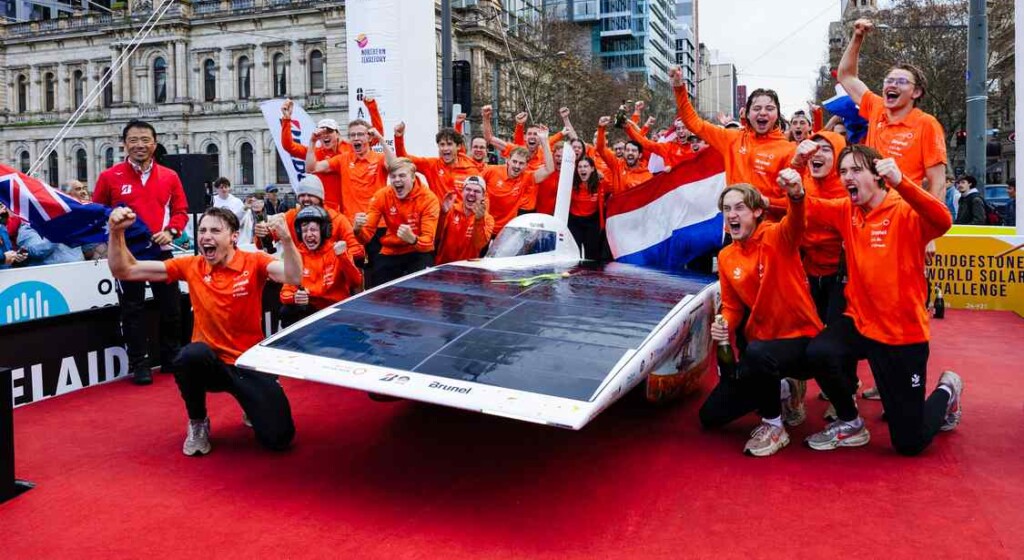
The Brunel Solar team from the Netherlands celebrates victory in Adelaide – credit, Charlie Bliss, Tim Hanley, Riley Williams, Julian Modra, Michael Hurren & Reece Calvert from Swift Hound.

At the Bridgestone World Solar Challenge, innovators and motorsport experts competed to race solar-powered cars 2,000 miles across the Australian Outback.

Reminiscent of the 24 Hours of Le Mans, when Interwar Period engineers tried to balance speed, maneuverability, and durability with wild designs, some of which eventually became road-standard, the World Solar Challenge hopes to push engineers to develop sustainable solutions to challenges facing electric automotion today.

This year, the spirit of innovation and problem solving was pushed even further, as along with racing from Darwin to Adelaide, the challenge took place in the wintertime, with 20% less sun than in other Australian seasons.

When looking at the cars, the first thing one notices is how much they look like aircraft carriers—a necessity for fitting enough solar panels to charge the batteries.

The other boat-like design is their narrow undercarriage and hull-shaped sides which help make them more aerodynamic. Much of the actual horsepower of an average car comes from pushing the air out of its way. The more aerodynamic a car, the less wind it must move, and the less energy it consumes.

This year however, even with these radical body shapes, the contests have had to push further the bounds of aerodynamism and efficiency.

“Fins are the flavor of the month, or certainly the flavor of this event,” said one organizer.

Indeed many of vehicles sported one or even two hi-tech fins. The Millennium car from the University of Michigan team uses its fin like a combination of the rudder and sail on a boat, generating forward thrust while also stabilizing it in crosswinds.

“This event is very relevant to look at the future,” said Bridgestone Vice President Hiroshi Imai, in a report from Reuters. “Even near-future technology may come from this kind of event.”

The Dutch team Brunel Solar eventually won the race, arriving in Adelaide 34 hours after leaving Darwin. Their car, the Nuna 13, had not one but two fins, which it used to achieve higher speeds without extra energy consumption. Solar-Powered Cars Race Across Australian Outback – with Fins to Also Harness the Wind
Read More........