India on track to acquire Russian S-400 missile defence system

India is on track to acquire the S-400 missile defence system, while it examines the US decision to impose sanctions on NATO ally Turkey’s defence industry over the purchase of the Russian system. Persons familiar with the dynamics of India’s global outreach told ET that since New Delhi maintains autonomy in its foreign policy, the US decision won’t affect the Indian deal. Last week, the external affairs ministry had emphasised that it pursued foreign policy based on national interest and hoped that this was appreciated by partners. “Our relations with Russia stand on their own merits, including in the sphere of military-technical cooperation,” MEA spokesperson had said.Diplomatic sources indicated that India’s case is different from that of Turkey as Ankara went ahead with the purchase of S-400 system despite being a NATO member. The MEA had earlier made it clear that India had no plans to scrap its S-400 deal with Russia despite the US nudge. The Ministry of Defence had also expressed similar views. The Indian government has not been comfortable with repeated US attempts to dissuade it from purchasing the S-400 system. Moreover, India has often taken a strong stand against the use of sanctions as a political tool by one country against the other. In fact, after the June 15 clash with the Chinese PLA on LAC in eastern Ladakh, which resulted in the killing of about 20 Indian military personnel, India had requested Russia to expedite S-400 supply, following which Moscow assured that some systems would reach much before the deadline of 2021-end. /// economictimes Source: Defenseblog-njs.blogspot.com
Read More........

India approves procurement of 72,000 assault rifles from US

a

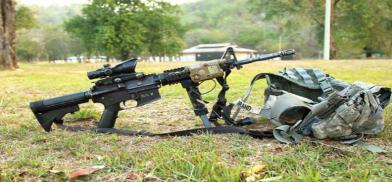
India's Defence Ministry has approved a proposal to purchase 72,000 Sig Sauer assault rifles from the United States at a cost of around Rs 780 crore.

The Defence Acquisition Council led by Defence Minister Rajnath Singh on Monday approved proposals for capital acquisition of various equipment required by the Indian armed forces at an approximate cost of Rs 2,290 crore.

These include procurement from the domestic industry as well as foreign vendors.

To equip the frontline troops of the Army, the council has accorded approval for the procurement of 72,000 Sig Sauer assault rifles at a cost of around Rs 780 crore.

Under the 'Buy Indian' category, the council has approved the procurement of Static HF Tans-receiver sets and smart anti-airfield weapons. The HF radio sets will enable seamless communication for the field units of the Army and the Air Force. They are being procured at a cost of Rs 540 crore.

The smart anti-airfield weapons being procured at cost of Rs 970 crore will add to the firepower of the Navy and the Air Force.

Earlier, the Indian Army had received the first lot of Sig Sauer assault rifles to boost its counter-terrorism operations. India had acquired the rifles under the fast-track procurement programme.

The new rifles will replace the existing Indian small arms system (Insas) 5.56x45 mm rifles used by the forces and manufactured locally by the Ordnance Factories Board. (IANS),  Source: https://southasiamonitor.org
Read More........

Rafale fleet will be a game-changer for India

a

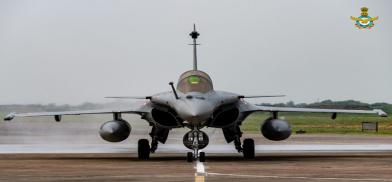
On 29 July 2020, India received the delivery of the much-awaited French fighter jets – Dassault Rafale. The first batch of five jets out of the 36 fighter jets arrived in Ambala marking a historic procurement by the Indian defence ministry. The fighter jets are part of an $8.78 billion deal signed with France in 2016. It is said to revolutionize the combat, offensive and defensive strategies of the Indian Air Force.

The three single-seater and two twin-seater jets with delta wing have been previously used by the French naval and air force, in addition to being also purchased and tested by Qatar and Egypt and has been deemed as omnirole aircraft that can take up several missions on a single flight. It is a 4.5 generation fighter that is somewhat stealthy, though less so than the fifth-generation US F-35. It can carry weapons such as SCALP/Storm shadow which can engage the targets precisely in any weather conditions during day and night and has a range much over 300 km. It can take out targets with extreme accuracy. METEOR, which is a next-generation, active radar-guided, beyond visual range air-to-air missile (BVRAAM) consists of a unique ramjet propulsion system. This ‘ramjet’ motor provides the missile with thrust all the way to target intercept, providing the largest no-escape zone of any air-to-air missile.

This would indicate that it can shoot off Chinese aircraft from a long-range and attack armed military bases within 600 km in Pakistan without crossing the Line of Control or being tracked. Rafale also has the Front Sector Optronics (FSO) system, which is immune to radar jamming while operating in the optronic wavelengths. Several more modifications are being made according to the Indian Air Force standards and needs; including the Israeli helmet-mounted display.

Need for Rafales

The specific features of these jets make them of strategic importance to India and the Indian Air Force and further indicate the growing need for such technology for India. In the past months, the South Asia region, in general, has witnessed growing tensions while India, in particular, has ongoing disputes with Pakistan and witnessed recent border clashes with China. Further, what can be regarded as a significant security threat to India, is the growing presence of China in neighboring countries like the Maldives and Sri Lanka. This procurement of Rafale fighter jets speaks volumes about the increasing security concerns and needs of India, in addition to the much-required reform in the technology adopted by the defense organization. 

Comparing it to China’s Chengdu J-20, which is a 5th generation combat jet, Chinese authorities argue that Rafale does not yield a significant qualitative change. Yet, the performance of J-20 is to be seen while that of Rafale has already been witnessed in Afghanistan, Libya, and Mali. Moreover, while the difference and the combat capacity of Pakistan’s F-16 and India’s Rafale are quite similar, the Rafale has been customized according to India’s warfare experience and is nuclear-capable fighter jets which lack in Pakistan’s F-16. This provides it an edge over the adversaries and strengthens the air-power of India which is extremely required under the present circumstances.

India's security dilemma

India has come to become one of the largest importers of arms in the world. There has been an increase in procurement and investment by the Indian authorities in advanced technologies and modern equipment for military and defense purposes. This can be seen as a response to the increasing military capacity of Chinese. Recent years have witnessed an increase in the budget of the Chinese military and has made China the second-largest country in terms of military expenditure. Further, with close ties between Pakistan and China, it has led to a significant development in Pakistan’s military and nuclear weapons program. This increasing the military capacity of its neighbors and the formation of a strong alliance is a classic case of security dilemma which has caused India to take similar actions and increase its security. 

Although the phenomenon is a common occurrence in the international order, considering the present situation between India-Pakistan-China, there is a possibility of an increase in border conflicts and expansion by the adversaries. According to Robert Jervis, the Adlai E. Stevenson Professor of International Affairs at Columbia University, "Making an adversary more insecure will often increase its interest in expansion since expansion can often increase security". In other words, the growing need for enhancing one’s security can trigger the adversary to do the same through different means, amongst which one of them is seizing more territories and resources. For India, this would mean higher chances of border disputes with both countries.

The delivery of Rafales was a gamechanger for India. It indicated growth and prosperity not only for the military organization but for the nation in general. Moreover, the delivery of the fighter jets could not be more of perfect timing, giving out a loud and clear message to its adversaries, making this event more symbolic than substantive, amid intensified security concerns in India. 

As the scars of the recent border clash between China and India are still afresh and the tug of war between Pakistan and India over Kashmir continues, security concerns for each nation will continue to rise. To seek security, nations have engaged in the process of procuring and developing new military technologies but, in that process, they have set in motion an arms race that is exacerbating.

(The writer is a graduate of Frederick S. Pardee School of Global Studies, Boston, US. The views expressed are personal. She can be contacted at Bharadwaj.megda@gmail.com)

Read More........

India adds five Rafale aircraft amid border tensions with China


Five new Rafale fighter jets have been added in Indian Air Force amid ongoing border tensions with China.

India received the aircraft as the first delivery of the 36 warplanes purchase deal with France in 2016. 

The country is hoping to modernize its dwindling Soviet-era air force fleet with the induction of Rafale multi-role jets. But according to experts, these aircraft cannot be used right away in case of a conflict.

Air Marshal (retd) Pranab Kumar Barbora, who oversaw the induction of the Jaguar aircraft fleet, told that the arrival of the Rafale was a welcome move because it will significantly enhance the air force’s capability.

“But it will take a while before these aircraft are fully operational. You have to set up a logistics chain, train technical and ground staff in India,” he said.

He added that it usually takes up to two years before a new squadron is fully functional. The Rafale squadron will be fully operational when it has at least 18 aircraft. The delivery of the remaining Rafale aircraft is expected to be completed by next year. Source: https://www.daily-bangladesh.com
Read More........

With Rafales’ induction, IAF will have an edge over neighbours. Here’s how

Five Rafale fighter jets of the 36 ordered by the Indian Air Force (IAF) from France will land at their home base in Haryana’s Ambala on Wednesday.

The new aircraft will significantly enhance the offensive capabilities of IAF, which has for long-planned to update its fighter jet force. Defence experts have said the induction of the controversial Rafale fighter jets will be a “game-changer” for India in regional politics of South Asia.

France has expedited the deliveries of Rafale fighters to India and five jets are coming to Ambala instead of four that were originally planned to be delivered in the first batch.

Here’s how the Rafale fighter aircraft will add to IAF power:

* Rafale, categorised as a 4.5 generation aircraft for its radar-evading stealth profile, is important for IAF since most of the aircraft in its fleet, including the Mirage 2000 and the Su-30 MkI, are classified as either third or fourth-generation fighters.

* The Rafale is a twin-jet fighter aircraft able to operate from both an aircraft carrier and a shore base. The manufacturers describe it as a fully versatile aircraft which can carry out all combat aviation missions to achieve air superiority and air defence, in-depth strikes, reconnaissance, anti-ship strikes and nuclear deterrence.

* The first Rafale combat aircraft manufactured for India bears the tail number RB-01, the initials of IAF chief Air Chief Marshal RKS Bhadauria. The IAF chief had played a crucial role in the signing of India’s biggest-ever defence deal worth about Rs 60,000 crore.

* India had ordered 36 Rafale fighter jets from France in a deal worth about Rs 60,000 crore in September 2016. Out of the 36 Rafale aircraft, 30 will be fighter jets and six will be trainers. The trainer jets will be twin-seater and they will have almost all the features of the fighter jets.

* The Rafale jets will be a crucial enhancement to India’s Medium Multi-role Combat Aircraft fleet.

* The Rafale fighter jets have been tailor-made for the Indian Air Force. India-specific enhancements include helmet-mounted sight, radar warning receivers, flight data recorders with enough storage for 10 hours of data, infrared search and track systems, jammers, cold engine start capability to operate from high-altitude bases and towed decoys to lure incoming missiles away.

* They will be the first imported fighter jet to be inducted into the IAF in 22 years after the Russian Sukhoi-30 fighters. The first Su-30 entered IAF service in June 1997.

* The Rafales will be a part of the IAF’s No 17 Squadron, which is also known as the “Golden Arrows”. The first squadron of the aircraft will be stationed at Ambala air force station, considered one of the most strategically located bases of the IAF. The second squadron of Rafale will be stationed at Hasimara base in West Bengal.

* The IAF spent around Rs 400 crore to develop infrastructure like shelters, hangars and maintenance facilities at the two bases.

* India will be the fourth country, after France, Egypt and Qatar, to fly the Rafale.

* The Rafale fighter jet, however, cannot be compared with the J-20, an indigenously developed fifth-generation aircraft of China. The J-20 is soon set to be inducted in large numbers into the People’s Liberation Army Air Force of China after it was successfully developed and displayed.

* The 2016 Rafale deal was an emergency purchase to arrest the worrying slide in the IAF’s combat capabilities. The count of the IAF’s fighter squadrons had been reduced to 31 compared to an optimum strength of 42-plus units required to fight a two-front war with China and Pakistan.

* The first 18 jets, including the four in the first batch, were to be delivered to the IAF by February 2021, with the rest expected by April-May 2022, according to the original delivery schedule.

Read More........

First batch of six Rafale jets likely to arrive in July 27 , will be placed in Ambala

India is likely to receive by July 27 the first batch of six Rafale fighter jets which are expected to significantly boost the combat capability of the Indian Air Force, people familiar with the development said.

The IAF has been on a high alert for the last two weeks in view of escalation in tension with China following clashes between troops of the two countries in Galwan Valley in eastern Ladakh in which 20 Indian Army personnel were killed. The two armies are locked in a bitter standoff in the region for seven weeks.

On June 2, Defence Minister Rajnath Singh held a telephonic conversation with his French counterpart Florence Parly during which she conveyed that the Rafale jets will be delivered to India as scheduled notwithstanding the coronavirus pandemic in France.

Military officials, on the condition of anonymity, said the arrival of the Rafale jets will significantly enhance the IAF's overall combat capability and will send a clear message to India's "adversaries".

When asked about the matter, the IAF did not comment.

The first squadron of the aircraft will be stationed at Ambala air force station, considered one of the most strategically located bases of the IAF.

India had signed an inter-governmental agreement with France in September 2016 for procurement of 36 Rafale fighter jets at a cost of around Rs 58,000 crore.

The aircraft is capable of carrying a range of potent weapons. European missile maker MBDA's Meteor beyond visual range air-to-air missile and Scalp cruise missile will be the mainstay of the weapons package of the Rafale jets

Meteor is the next generation of BVR air-to-air missile (BVRAAM) designed to revolutionise air-to-air combat. The weapon has been developed by MBDA to combat common threats facing the UK, Germany, Italy, France, Spain and Sweden

Besides the missile systems, the Rafale jets will come with various India-specific modifications, including Israeli helmet-mounted displays, radar warning receivers, low-band jammers, 10-hour flight data recording, infra-red search and tracking systems among others

The IAF has already completed preparations, including readying required infrastructure and training of pilots, to welcome the fighter aircraft.

The second squadron of Rafale will be stationed at Hasimara base in West Bengal. The IAF spent around Rs 400 crore to develop infrastructure like shelters, hangars and maintenance facilities at the two bases

Out of the 36 Rafale jets, 30 will be fighter jets and six will be trainers. The trainer jets will be twin-seater and they will have almost all the features of the fighter jets.

The Congress had raised questions on the deal, including on rates of the aircraft, and alleged corruption, but the government had rejected the charges.

Economic times, Source: Defenseblog-njs.blogspot.com
Read More........

PM Narendra Modi dedicates largest warship INS Vikramaditya to the nation, pitches for self-reliance

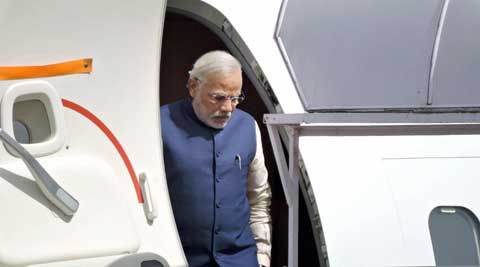
Prime Minister Narendra Modi inspects the Guard of Honour at INS Hansa airbase at Dabolim in Goa. (Source: PTI)
Prime Minister Narendra Modi on Saturday dedicated India’s largest warship INS Vikramaditya to the nation and pitched for making the country self-reliant in manufacturing defence equipment, shedding dependence on imports.
In his first outing after taking charge as Prime Minister, he addressed the naval personnel onboard the ship off the Goa coast, calling the addition of the warship to the force as a “historic” step. “It is an important day for our nation. It is a golden day in Indian Navy’s history. For me, it is a matter of pride and happiness that INS Vikramaditya is joining the Navy. It is a historic step,” he said. Stressing on the need for self-reliance in defence equipment manufacturing, he said, “We need to give immense importance 
to latest technology. This will help the nation. Why should we import defence equipment? We must be self sufficient. Why can’t we  The Prime Minister also promised to set up a War Memorial for those who sacrificed their lives for the country. send our defence equipment to other nations.”  He said this government has come with a determination and was committed to implement the “One Rank, One pension” scheme for defence personnel. “Our government has the potential to match anyone in the world and the reason for this is the capability of our soldiers who give us the strength to do so,” he said in his address, adding that the country intends to move forward in the same manner, without lowering its eyes. He also called
for setting up a Naval NCC network across the country that could prepare a dedicated force of soldiers which could help the Navy emerge as a big force in the coming times. Arriving on board the warship in a Sea King chopper, the Prime Minister was given the ceremonial guard of honour by the Navy and was briefed about the warship. He also sat in a MIG 29 aircraft and had a feel of the combat fighter on the ship. The Prime Minister spent a few hours on board the 44,500-tonne warship, his first visit to any defence facility. The prime minister was accompanied by Minister of State for Defence Rao Inderjit Singh, National Security Adviser Ajit Doval, Defence Secretary R K Mathur and Naval Chief Admiral Robin Dhowan. During his stay on the ship, acquired from Russia for over Rs 15,000 crore, Modi witnessed ‘air power demonstration’ by various naval aircraft, including MiG 29K, Sea Harriers, P 8I Long Range Maritime Patrol Anti-Submarine Warfare aircraft, TU 142M and IL-38SD maritime surveillance planes along with Kamov and
Sea King helicopters. He also witnessed high-speed manoeuvres by the Navy’s Western Fleet ships including aircraft carrier INS Viraat, Delhi-class destroyers and Talwar-class frigates. The air demonstrations were, however, hampered by heavy rain. Modi interacted with the senior officers and the crew. The deal for the aircraft carrier was signed during the previous NDA regime in 2004 and the ship will be dedicated to the nation after a gap of ten years. The vessel had joined the Indian Navy on November 16, 2013. The ship was earlier commissioned by the then defence minister A K Antony in Russia. Vikramaditya, a floating airfield, has an overall length of about 284 metres and a maximum beam of about 60 metres, stretching as much as three football fields put together. Standing about 20 storeys tall from the keel to the highest point, the ship has a total of 22 decks and carries 1,600 personnel. With her complete stock of provisions, she is capable of sustaining herself at sea for about 45 days. It is a modified Kiev-class aircraft carrier which was purchased by India from Russia for the Indian Navy in 2013. The ship has been renamed in honour of Vikramaditya, a legendary 1st century BC emperor. Originally built as Baku and commissioned in 1987, the carrier served with the Soviet (until the dissolution of the Soviet Union) and Russian Navies before being decommissioned in 1996 as it was too expensive to operate. Source: The Indian Express
Read More........

Four for Four: Successful Griffin Missile Test Fire in U.S. 5th Fleet


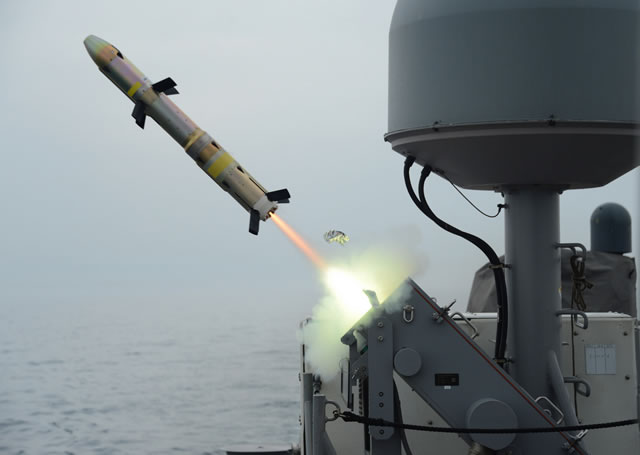
A flotilla of coastal patrol (PC) ships launched four missiles at target sleds last week to test the operational capability of the system. Each missile fired resulted in a successful test of the system and destruction of the target. The U.S. Navy recently completed the installation of the Griffin Missile System (GMS) aboard USS Firebolt (PC 10), USS Sirocco (PC 6), USS Typhoon (PC 5) and USS Whirlwind (PC 11), which represent four of the eight U.S. 5th Fleet PC force. Source: World Defence News
Read More........

New speed record for the Eurocopter X3 hybrid helicopter at 263 knots 487 km/hr.

The Eurocopter X3 is an experimental high-speed hybrid helicopter under development by the French aviation Company Eurocopter. 
The Eurocopter X3 hybrid helicopter has opened the frontiers of aviation by attaining a speed milestone of 255 knots (472 km/hr) in level flight on June 7. Several days before this accomplishment, the X3 reached a speed of 263 knots (487 km/hr) during a descent. With these two successes, the X3 surpasses the unofficial speed record for a helicopter. Source: Article
Read More........

Agni V to be operational by 2015


With two or three more successful test firings, the Agni V missile is expected to be operational by 2015, said Tessy Thomas, director, Agni Missile Project, Defence Research and Development Organisation, here on Friday. Interacting with the media after inaugurating a national conference on ‘Systems, Energy and Environment,’ organised by the Government College of Engineering at Mangattuparamba, Ms. Thomas said this ambitious project can carry multiple independently targetable re-entry vehicles which can deliver multiple warheads at different targets. Affirming that India is self-reliant in missile technology, Ms. Thomas said the country had made a quantum leap in the field. Agni V is one of the biggest achievements of the country and this is being further improved upon. As per earlier calculations, the intercontinental ballistic missile had a range of 5,000 km, but according to the observations made by neighbouring countries, it has a range of 7,000 km, a statement which underlines the strength and potential of the missile. She observed that missile technology is used as a weapon of peace. Acknowledging that more than 2,000 institutions and industry players are associated with the DRDO for the project, Ms. Thomas said the Agni series is of global standards, while Agni IV and V belong to a new class of technology. Speaking on female representation in the area of missile technology, Ms. Thomas said the zone, generally considered a male bastion, is opening to change. When she joined the DRDO in the eighties, the scenario was different as there were not many engineering colleges. With more colleges, more people are approaching the field, including women, she added. Source: DefenseblogSource: Image
Read More........

IAF to now have midair refueling capacity in all Air assets

In a major step to increase its range and operational capabilities, the Indian Air Force (IAF) has decided tbat all its aircraft and helicopters will have the capability for midair refueling. Disclosing this, the IAF vice chief, Air Marshal D.C. Kumaria, said at the Fifth National Seminar on Aerospace Technologies (N-SAT) recently that the decision applies to all its current and future acquisitions – whether combat jets, transport aircraft, helicopters or other assets. Only aircraft with this capability will be considered for acquisition in future, he observed adding thattechnology and strategic requirements have evolved over time and that the IAF decision is in line with the current thinking in military aviation worldwide. The N-SAT series on military aviation is held by India Strategic defence magazine (www.indiastrategic.in) annually. It lays emphasis on a building technological edge for the Indian armed forces, and significantly, most participants agreed that if an air force was not thinking of 20 years hence, they it is already behind the times. In the late 1970s for instance, Air Marshal Kumaria pointed out, the IAF actually sought removal of aerial refueling plumbing from the Anglo-French Jaguar aircraft even though they were meant for a deep penetration strike role. Today, whether it is the long-range aircraft or helicopters, aerial refueling capability is a key requirement. It may be noted that IAF’s current acquisition line includes Lockheed Martin C-130J Super Hercules, Boeing C-17 Globemaster, Embraer 145 for electronic radars, Agusta Westland’s VIP role AW 101 helicopters, new AWACS and midair refuelers (Airbus Military MRTT or Russian IL 78) , Rafale fighter jets, and Boeing’s Chinook and Apache helicopters. The last four items are under various stages of procurement. The existing Mirage 2000s, Sukhoi Su-30 MKIs and Jaguars already have this capability while on the Mig 29s, its plumbing will be activated during upgrades for midair refueling. According to defence analyst Air Marshal (retd) Ashok Goel, the inflight refueling capability is standard worldwide now and it would, in fact. cost more to remove it than to have it while acquiring and inducting new aircraft. All NATO and US aerial assets, for instance, are equipped with midair or in-flight refueling capability and in the Gulf and Afghanistan operations, aircraft were able to conduct multi-mission strikes during single flights. “This in-flight refueling capability,” Air Marshal Goel told India Strategic, “literally has far-reaching implications, enabling modern aircraft to cover long distances 360 degrees.” Thanks to the IAF’s Il-78 midair refuelers, its Su-30 combat aircraft have gone up to the US in 2008 to take part in the multi-national Red Flag exercise, and will again do so in 2013, he said. It may be noted that midair refueling capability will also be on board army and navy combat assets as the Chief of Staff Committee already has a tri-Service agreement on common parameters for same and similar systems needed by them. The committee is currently headed by the IAF chief, Air Chief Marshal N.A.K. Browne, and he is on record as having said that there are no differences between the three Services on acquiring common systems with same or similar requirements. Army sources also told India Strategic that it will follow IAF’s Air Staff Qualitative Requirements (ASQRs) while going in for the Apache combat helicopters. Source: Astrashastra
Read More........

India developing Agni-VI ballistic missile: DRDO

The country on Friday said it is developing a long-range nuclear-capable Agni-VI ballistic missile that would carry multiple warheads allowing one weapon system to take out several targets at a time. "Agni-V is major strategic defence weapon. Now we want to make Agni-VI which would be a force multiplier," DRDO chief VK Saraswat said in Bangalore. Refusing to divulge the range of the new under-development missile, he said the force multiplier capability of the missile would be because of its Multiple Independently Targetable Re-entry Vehicle (MIRV) capability. The Agni-5 ballistic missile, which was test-fired in April 2012, has a range of upto 5,500 kms and it is believed that the Agni-6 would have a range longer than its predecessor. "It will have force multiplier capability by the MIRV approach which would enable us to deliver many payloads at the same time using only one missile. "Work is on in this area and designs have been completed. We are now in the hardware realisation phase," he said. DRDO officials said once the Agni-6 is developed, it would propel India into the elite club of nations with such a capability including the US and Russia. The DRDO chief said his organisation was also working towards developing a cruise missile defence programme which would enable the armed forces to defend against low-flying cruise missiles and enemy aircraft. Source: Hindustan Times
Read More........

Next-generation PAC-3 missile has successful test at White Sands

Patriot PAC-3 |
A PAC-3 Missile Segment Enhancement successfully engaged, intercepted and destroyed a tactical ballistic missile target over White Sands Missile Range during a test earlier this week. The test was conducted by PAC-3 MSE's prime contractor Lockheed Martin and the U.S. Army Lower Tier Project Office. During the test, Patriot ground support equipment fired two PAC-3 MSE missiles from a launching station to intercept the TBM. Source: Naval Open Source INTelligence
Read More........

China's New MIRV Ballistic Missile Is A Big Deal

DF-31 Telar |
During the nuclear honed days of the Cold War, the Soviet Union developed a nuclear missile able to strike anywhere in the U.S. Loaded with multiple maneuverable warheads (MIRVs), while carrying decoys and chaff to keep from getting struck down, the missiles undermined the entire balance of power between the two superpowers and struck fear into hard hearts at the Kremlin and the Pentagon alike. When China successfully tested its DF-31A missile several days ago, it confirmed another country now has proven nuclear ability reach any city in the U.S. with precisely the type of missiles that troubled the U.S. decades ago. Source: Naval Open Source INTelligence
Read More........

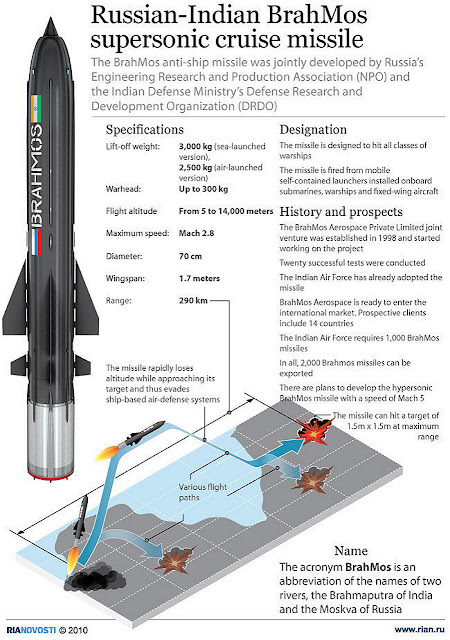
BrahMos set to become a “Super Rocket”

Brahmos Infographic |
The BrahMos supersonic cruise missile is all set to become a “super rocket” soon, which would beef up India’s tactical defence capability significantly. However, the test launches of the air variant of the BrahMos II hyper-sonic missile, which were supposed to be completed by 2012, are experiencing delays. The realistic date for completion of these tests is now believed to be 2015.Source: Naval Open Source INTelligence
Read More........

Next generation of military aircraft will be unmanned - commander

The role of unmanned aerial vehicles in future will increase, Russian Air Force Commander-in-chief Maj. Gen. Viktor Bondarev told Interfax. "The trends for weapons of armed struggle, including combat aviation, give reason to believe that sixth-generation military aerial vehicles will be mostly unmanned. This concerns fighters, bombers and strategic bombers," the commander said.
 "The technical progress and information technology development is occurring at such a pace that a man, pilot, operator already has to stretch himself to the limit of his physical and psychological abilities," Viktor Bondarev said. "And what will happen tomorrow, at the next stage of scientific and technological development? Man simply cannot keep up, he cannot realize all the potential of new next-generation aircraft. Involuntarily, he has already delegated some of his duties to the machine, be it an artificial intellect or an on-board supercomputer," the commander said. Both Russia and other countries "are working on the drone theme, work on strategic drones is going at full speed," he said. "They are keeping low profile. But we know that such work is being carried out. And it has already yielded some results. Every now and one can see from stories on military operations in any particular region the results of unmanned aviation. Many drones are involved in operations conducted by the U.S. and their allies in the Middle and Near East. It will suffice to recall how one U.S. drone recently became a trophy of the Iranian air defense force," the Air Force commander said. Source: Voice of Russia
Read More........

US offers 245 Stinger missiles to India

The US is offering 245 Stinger missiles to India as part of a weapons package for the Apache attack choppers being acquired by the Air Force. "245 air-to-air Stinger missiles and 56 launchers are included in the weapons package for the Apache helicopters," officials of Raytheon, which manufactures the missiles, said."The Stinger compliments the advanced performance of the Apache by providing the IAF with the critical air-to-air defence capability," they said. Source: Naval Open Source INTelligence
Read More........

Long range strategic missile Agni-IV test-fired

Agni IV missile is displayed at the Republic Day parade in New Delhi. AFP file Photo.
India on Wednesday test-fired its nuclear-capable strategic missile Agni-IV with a strike range of about 4000 km from a test range off Odisha coast. It was test launched with the help of a mobile launcher from launch complex-4 of ITR at Wheeler Island, about 100 km from Balasore,  at about 1145 hours, defence sources said. A high performance on-board computer with distributed avionics architecture and high speed reliable communication bus and a full Digital Control System were used to control and guide the missile to the target. "It is equipped with modern and compact avionics to provide high level of reliability," a DRDO official said. "The state-of-the-art Ring Laser Gyros based high accuracy INS (RINS) and Micro Navigation System (MINGS) complementing each other in redundant mode have been incorporated into the missile system in guidance mode," the sources said. The sophisticated missile is lighter in weight and has two stages of solid propulsion. The payload, with a re-entry heat shield?can withstand temperature of more than 3000 degree Celsius, a defence scientist said. The missile, is undergoing developmental trials by country's premier defence research and development organisation.The last trial of the missile, carried out on November 15, 2011 from the same base was successful. India follows Pakistan with missile test Pakistan, which has fought three wars with arch-rival India since their 1947 independence, test-fired a nuclear-capable cruise missile on Monday with "stealth features". DRDO spokesman Gupta insisted India's test was not "country-specific".  "None of our missiles are country-specific. We are a peaceful nation which has never attacked any country in thousands of years," the DRDO spokesman added. India unveiled its 5,000-kilometre range Agni-V in April, which was seen as a massive boost to its regional power aspirations and one that narrows -- albeit slightly -- the huge gap with China's missile systems. Agni-V a definite game changer The Agni-V left India knocking at the door of a select club of nations with inter-continental ballistic missiles (ICBMs), which have a minimum range of 5,500 kilometres. Currently only the five permanent members of the UN Security Council -- Britain, China, France, Russia and the United States -- possess a declared ICBM capability. China and India fought a brief but bloody war in 1962 over a border dispute that remains unresolved despite several rounds of talks between Asia's two most militarily-powerful nations. Agni, which means "fire" in Sanskrit, is the name given to a series of rockets the DRDO developed as part of its ambitious integrated guided missile development project launched in 1983. While the shorter-range Agnis I and II were mainly developed with traditional rival Pakistan in mind, later versions with longer range reflect the shift in India's focus towards China. Source: Hindustan Times
Read More........

China building new Type 052D guided missile destroyer

The Chinese Navy appears to be developing a brand new type of guided-missile destroyer (DDG) and could be producing several hulls simultaneously, a development that could further tip the balance of power in the Taiwan Strait. Images have emerged on Chinese military Web sites in recent weeks that seem to confirm the long-rumored development of the Type 052D destroyer, which some analysts are comparing to Aegis-equipped destroyers in the US Navy. More recently, two hulls were pictured at China State Shipbuilding Corp’s Jiangnan Changxing shipyard near Shanghai earlier this month. The first “dock launch” occurred yesterday. Source: Naval Open Source INTelligence
Read More........

DARPA autonomous robotic surface vessel to track and follow enemy subs for months

The growing number of adversaries able to build and operate quiet diesel electric submarines is a national security threat that affects U.S. and friendly naval operations around the world. To address this emerging threat, DARPA recently awarded a contract for Phases 2-4 of its Anti-Submarine Warfare (ASW) Continuous Trail Unmanned Vessel (ACTUV) program to Science Applications International. During Phases 2-4 the ACTUV program will attempt to design, construct and demonstrate an unmanned vessel that tracks quiet diesel electric submarines for months at a time spanning thousands of kilometers of ocean with minimal human input. Source: Naval Open Source INTelligence
Read More........