Singapore’s First 3D-Printed Bridge Planned for 2028 After Rigorous Testing

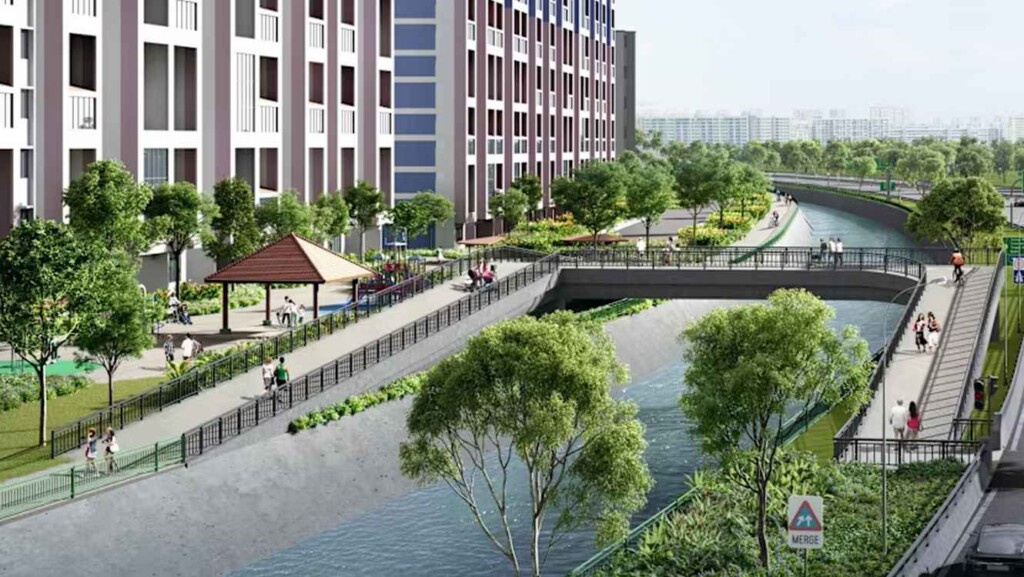
An artistic rendering of the 3D-printed bridge – credit, Singapore LTA

Singapore’s transportation officials are set to debut the use of 3D-printed concrete in the form of a new pedestrian bridge that will stretch 30 feet across a waterway.

Brought onboard a larger project to improve transit options in the Jurong River and Temah areas of the city state, it’s the country’s first use of 3D printing for this kind of infrastructure.

The project, managed by the Land Transit Authority (LTA) has just completed a testing phase where segments of printed concrete, made up of cement, sand, and water, were subjected to stress tests under the weight of large water tanks weighing 1 metric ton each.

The first printed segments formed a scale model of what will be the eventual bridge. 10 segments in total took about 40 hours to finish compared to two weeks that might have been expected with manual concrete laying.

It cost a mere $1.4 million to develop and supply the specialized 3D-printing mixture, and the whole project was carried out by Singapore Center for 3D Printing at Nanyang Technological University, with help from the engineering consultancy Witteveen+Bos and 3D concrete printing construction firm CES_Innovfab.

The real thing is slated for completion in 2028, when each of the 10 segments will be threaded together on robust steel cables until it measures 30 feet long and 15 feet wide.

3D-printed bridges have also been installed in China and the Netherlands. The longest in the world is in the Dutch city of Nijmegen, where it stretches 95 feet (29 meters) across a canal.

MORE 3D-PRINTING:

The bridge is striking to look at, with sculpted conical feet that gives it a shape a little like that of a caterpillar.

In Singapore, it’s very much early days for the technology, and the load-bearing tests carried out on the scale model will inform any future applications of the technology. It’s hoped they will be successful, as labor shortages are affecting LTA’s ability to conduct similar projects at scale.

SINGAPORE STORIES: 3D-printed homes present as a much easier engineering challenge since the structure is built from the ground up. Printing each bridge segment—set for a life of foundationless suspension, required a precise mixture of ingredients, printing flow rate, and printing speed to ensure each layer fell, filled, and dried in a perfectly even pattern to ensure no cracks would develop as the mixture hardened. Singapore’s First 3D-Printed Bridge Planned for 2028 After Rigorous Testing
Read More........

India Deep Tech Accelerator announced to help scale up IIT startups


(AI image/IANS)

New Delhi, (IANS) The India Deep Tech Alliance (IDTA) and the University of Chicago’s Polsky Center for Entrepreneurship and Innovation on Tuesday announced the launch of the India Deep Tech Accelerator, a 10‑week programme designed to help IIT‑affiliated deep‑tech startups scale internationally.

The initiative, led by Polsky Center, is developed in collaboration with leading Indian Institutes of Technology (IIT) innovation networks and incubators, including SINE at IIT Bombay, FITT at IIT Delhi, and IIT Madras Research Park, a statement said.

The programme, aimed at supporting India’s emerging deep tech startup ecosystem, will run from April through June 2026 and will be structured for a cohort of up to 15 startups through targeted workshops, coaching, and strategic customer and investor connections.

The accelerator will also include "an India showcase and a Bay Area showcase for top-performing companies in June," the statement said.

The initiative builds a structured, repeatable pathway connecting startups from India’s premier technical institutions with the potential for fundraising and the Polsky Center’s deep experience in venture creation, startup acceleration, and international market access.

The accelerator will run from April through June 2026 and take a cohort of up to 15 startups through targeted workshops, coaching and investor and customer connections. Top performers will be showcased at an India event and a Bay Area showcase in June.

The India Deep Tech Accelerator aims to support globally ambitious, IIT-affiliated startups for near-term commercializsation and financing milestones in the United States and other global markets.

IDTA will provide strategic guidance and founder support, while Aroa Venture Partners has committed up to $2,00,000 per startup for select companies emerging from the accelerator. Several other venture capital firms have committed to contribute to workshops, office hours, selective mentoring, and may provide potential investment support to cohort startups.“India’s IITs produce world‑class engineering and research, but too many deep‑tech breakthroughs still struggle to cross the last mile into scalable commercialisation,” said Sriram Viswanathan, Founding Managing Partner, Celesta Capital, and Founding Executive Committee Member, IDTA. India Deep Tech Accelerator announced to help scale up IIT startups | MorungExpress | morungexpress.com
Read More........