Singapore’s First 3D-Printed Bridge Planned for 2028 After Rigorous Testing

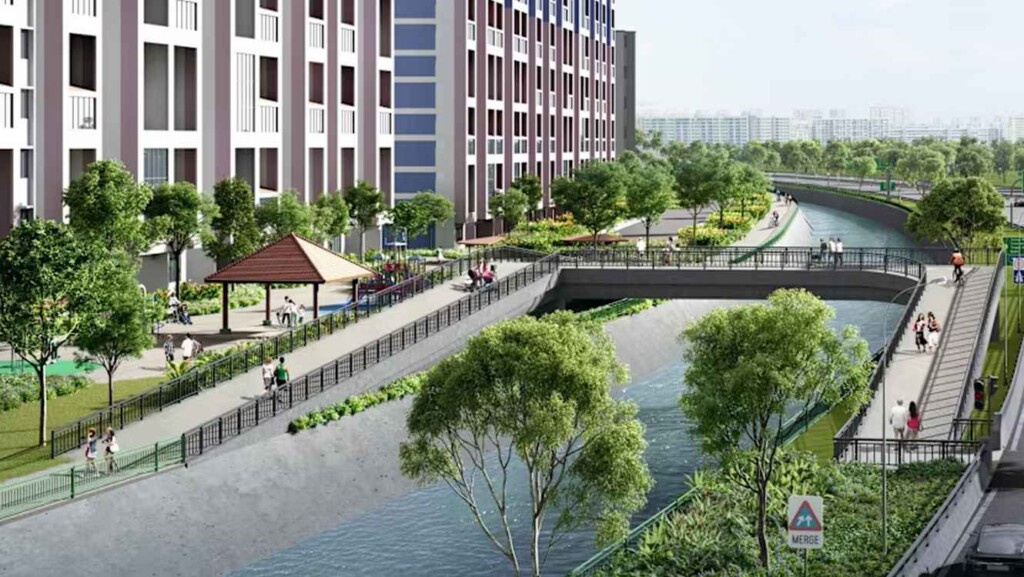
An artistic rendering of the 3D-printed bridge – credit, Singapore LTA

Singapore’s transportation officials are set to debut the use of 3D-printed concrete in the form of a new pedestrian bridge that will stretch 30 feet across a waterway.

Brought onboard a larger project to improve transit options in the Jurong River and Temah areas of the city state, it’s the country’s first use of 3D printing for this kind of infrastructure.

The project, managed by the Land Transit Authority (LTA) has just completed a testing phase where segments of printed concrete, made up of cement, sand, and water, were subjected to stress tests under the weight of large water tanks weighing 1 metric ton each.

The first printed segments formed a scale model of what will be the eventual bridge. 10 segments in total took about 40 hours to finish compared to two weeks that might have been expected with manual concrete laying.

It cost a mere $1.4 million to develop and supply the specialized 3D-printing mixture, and the whole project was carried out by Singapore Center for 3D Printing at Nanyang Technological University, with help from the engineering consultancy Witteveen+Bos and 3D concrete printing construction firm CES_Innovfab.

The real thing is slated for completion in 2028, when each of the 10 segments will be threaded together on robust steel cables until it measures 30 feet long and 15 feet wide.

3D-printed bridges have also been installed in China and the Netherlands. The longest in the world is in the Dutch city of Nijmegen, where it stretches 95 feet (29 meters) across a canal.

MORE 3D-PRINTING:

The bridge is striking to look at, with sculpted conical feet that gives it a shape a little like that of a caterpillar.

In Singapore, it’s very much early days for the technology, and the load-bearing tests carried out on the scale model will inform any future applications of the technology. It’s hoped they will be successful, as labor shortages are affecting LTA’s ability to conduct similar projects at scale.

SINGAPORE STORIES: 3D-printed homes present as a much easier engineering challenge since the structure is built from the ground up. Printing each bridge segment—set for a life of foundationless suspension, required a precise mixture of ingredients, printing flow rate, and printing speed to ensure each layer fell, filled, and dried in a perfectly even pattern to ensure no cracks would develop as the mixture hardened. Singapore’s First 3D-Printed Bridge Planned for 2028 After Rigorous Testing
Read More........

Nuclear energy included in JPMorganChase USD1.5 trillion initiative

(Image: Thomas Breher/Pixabay)

JPMorganChase has announced it will make direct investments of up to USD10 billion as part of a USD1.5 trillion initiative to address pressing needs in key sectors from critical minerals to frontier technologies, including nuclear energy.

The USA-based financial services firm's newly announced Security and Resiliency Initiative is a 10-year plan to facilitate, finance and invest in industries critical to national economic security and resiliency. The initiative, which expands the firm's existing plans to "facilitate and finance" some USD1 trillion over the next decade, will see it make direct equity and venture capital investments to help select companies, primarily in the USA, to enhance their growth, spur innovation, and accelerate strategic manufacturing.

JPMorganChase said it will focus on four key areas, with 27 sub-areas, to support companies across all sizes and development stages by offering advice, providing financing, and, in some cases, investing capital. The initial list of 27 sub-areas will be refined and augmented over time.

The four key areas are:

• Supply Chain and Advanced Manufacturing, including critical minerals, pharmaceutical precursors and robotics
• Defence and Aerospace, including defence technology, autonomous systems, drones, next-gen connectivity and secure communications
• Energy Independence and Resilience, including battery storage, grid resilience and distributed energy
• Frontier and Strategic Technologies, including AI, cybersecurity and quantum computing

Nuclear energy - specifically, "power generated through next generation nuclear tech" - is identified as a sub-area under the Energy Independence and Resilience key theme. "Diversified sources of energy production and the modernisation and resiliency of the grid will be imperative to the national interest and advancing artificial intelligence," the company notes. The other sub-areas under this theme are grid resilience, distributed energy, battery storage and solar.

"It has become painfully clear that the United States has allowed itself to become too reliant on unreliable sources of critical minerals, products and manufacturing - all of which are essential for our national security," said Jamie Dimon, Chairman and CEO of JPMorganChase. "Our security is predicated on the strength and resiliency of America's economy. America needs more speed and investment. It also needs to remove obstacles that stand in the way: excessive regulations, bureaucratic delay, partisan gridlock and an education system not aligned to the skills we need."

The new initiative "includes efforts like ensuring reliable access to life-saving medicines and critical minerals, defending our nation, building energy systems to meet AI-driven demand and advancing technologies like semiconductors and data centres", Dimon added.

The firm also said it will advocate for policies that can accelerate these efforts, including research and development, permitting, procurement and regulations conducive to growth. "As the bank intensifies its focus on these essential industries, it will also continue to work closely with its community and business partners to champion these sectors, foster talent and support skills training to ensure companies can fill critical jobs," it said.With operations worldwide, JPMorganChase & Co had USD4.6 trillion in assets and USD357 billion in stockholders' equity as of 30 June, and serves its customers under the JP Morgan and Chase brands Nuclear energy included in JPMorganChase USD1.5 trillion initiative
Read More........