Delta Airlines Treats Teens to Free ‘Dream Flights’ Inspiring Many to Become Pilots and Engineers

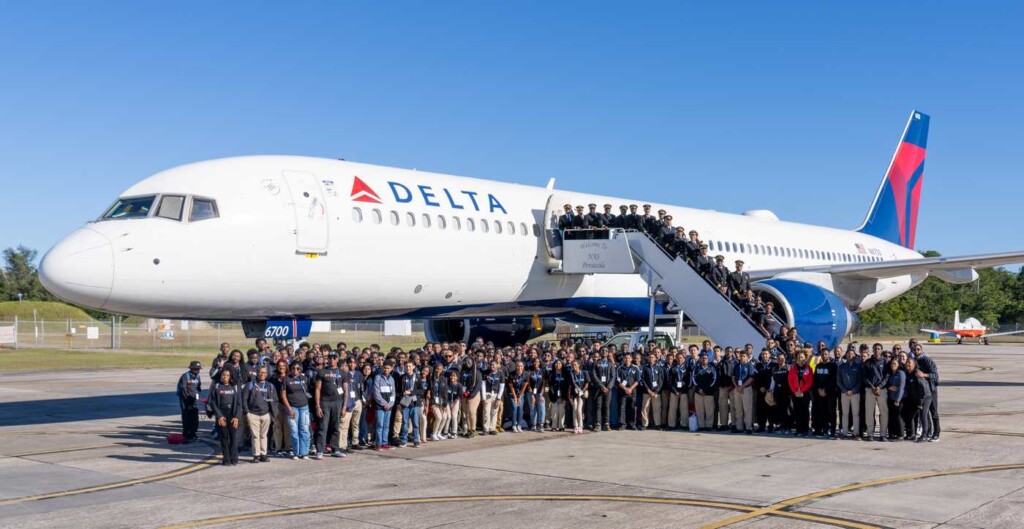
Delta’s 24th Dream Flight – credit, Delta Airlines

Every year, Delta Airlines hosts a special, one-of-a-kind trip to place the heads of ambitious Black students squarely in the clouds.

Climbing aboard a Boeing 757 as it took off from Hartsfield-Jackson International Airport in Atlanta, 100 local teens were the latest passengers on Delta’s “Dream Flights” program, a give-back initiative that introduces students to the concept of a career in aerospace and aviation.

Organized in partnership with the Organization of Black Aerospace Professionals (OBAP), the concept goes right back to that famous quote Whoopi Goldberg said when she saw Lieutenant Uhuru in Star Trek: “I just saw a black woman on TV and she ain’t no maid!”

“When I met my first Black pilot, that’s when I realized I could do it too,” said Delta captain Justin Mutawassim. “Now, I get to show these students—especially Hayden—that they can follow that same path.”

17-year-old Hayden Lynch has Mutawassim as a program mentor, and years before he stepped onboard Delta flight 2025, he became smitten with aviation after receiving a drone for Christmas.

At the helm was First Officer Dana Nelson, Delta’s first Black woman pilot, hired in 2001. The theme continued with an all-black cabin crew and co-pilot Lyob Makonnen.

This year, their final destination was NASA’s Kennedy Space Center on Florida’s “Space Coast.” Once there, the students wandered around with necks craned to see towards the ceiling to gaze at the collection of historic rockets, shuttles, and simulators used in NASA missions past. The trip finished with a panel discussion hosted by OBAP aviators and astronauts on how to navigate turbulence, whether in the cockpit, or in life.

This year was the 25th edition of Delta’s Dream Flight. They’ve transported and inspired more than 4,000 students throughout that time.

Many of these, CBS News reports, have followed their dreams born on the flight to careers as pilots, in aviation engineering, and in aerospace at large.“My dream is to become a Delta pilot one day—and inspire others just like they inspired me,” Hayden told CBS. Delta Airlines Treats Teens to Free ‘Dream Flights’ Inspiring Many to Become Pilots and Engineers
Read More........

Over 2,000 flights cancelled across US as federal govt shutdown enters day 40


Representational photo. (IANS Photo)

Washington, (IANS): As the US federal government shutdown entered its 40th day, more than 2,000 flights were cancelled and over 8,000 delayed nationwide, according to flight tracking website FlightAware.

Since the Federal Aviation Administration's (FAA) mandated flight reduction policy took effect on Friday, the number of canceled flights surged from 202 on Thursday to 1,025 on Friday, and further to 1,566 on Saturday, Xinha news agency reported.

The number of air traffic controllers taking leave has risen since the shutdown began on October 1, forcing many others to work overtime.

The US Department of Transportation and the FAA recently announced a 10 per cent capacity reduction at 40 major airports across the country starting Friday, aiming to ease staffing pressures and reduce airspace safety risks.

"It's only going to get worse," Transportation Secretary Sean Duffy told CNN on Sunday. "I look to the two weeks before Thanksgiving. You're going to see air travel be reduced to a trickle."

On the same day, National Economic Council Director Kevin Hassett told CBS that if people are not traveling during Thanksgiving, "we really could be looking at a negative quarter for the fourth quarter."

The regular budget, which should have been ready on October 1, marks the start of the US fiscal year. Instead, it is snaggled in party polarisation. A temporary measure known as a “continuing resolution” is needed to finance the government for now.

That resolution has been held up in the Senate due to a procedural element known as the filibuster, which blocks a legislative measure from coming up for a vote.

Sixty votes are required to break it, instead of a simple majority, as a way of putting the brakes on a party with a majority running roughshod.The Republicans, with only 53 votes, are powerless to break the filibuster and pass their version of the temporary funding resolution.Over 2,000 flights cancelled across US as federal govt shutdown enters day 40 | MorungExpress | morungexpress.com
Read More........

New Rule Requires US Airlines to Give Automatic Refunds for Canceled or Delayed Flights and Late Baggage

By Hanson Lu

The White House recently announced it has issued a final rule that requires airlines to promptly provide passengers with automatic cash refunds when owed. The new rule makes it easy for passengers to obtain refunds when airlines cancel or significantly change their flights, and following significantly delayed checked bags, or failures to provide extra services when purchased.

“Passengers deserve to get their money back when an airline owes them—without headaches or haggling,” said U.S. Transportation Secretary Pete Buttigieg. “Our new rule sets a new standard to require airlines to promptly provide cash refunds to their passengers.”

The final rule creates certainty for consumers by defining the circumstances in which airlines must provide prompt refunds. Prior to this rule, airlines were permitted to set their own standards for what kind of flight changes warranted a refund, which differed from airline to airline, making it difficult for passengers to know or assert their refund rights.

Under the new rules, which will start going into effect within six months, passengers are entitled to a refund for:

Canceled or significantly changed flights:

Passengers will be entitled to a refund if their flight is canceled or significantly changed, and they do not accept alternative transportation or travel credits offered. For the first time, the rule defines “significant change.” Significant changes to a flight include departure or arrival times that are more than 3 hours domestically and 6 hours internationally; departures or arrivals from a different airport; increases in the number of connections; instances where passengers are downgraded to a lower class of service; or changes that result in less accessible or accommodating situations to a person with a disability.

Significantly delayed baggage return:

Passengers who file a mishandled baggage report will be entitled to a refund of their checked bag fee if it is not delivered within 12 hours of their domestic flight arriving at the gate, or 15-30 hours of their international flight arriving at the gate, depending on the length of the flight.

Extra services not provided:

Passengers will be entitled to a refund for the fee they paid for an extra service — such as Wi-Fi, seat selection, or inflight entertainment — if an airline fails to provide this service.

The DOT’s (U.S. Department of Transportation) final rule also makes it simple and straightforward for passengers to receive the money they are owed. Without this rule, consumers have to navigate a patchwork of cumbersome processes to request and receive a refund — searching through airline websites to figure out how make the request, filling out extra “digital paperwork,” or at times waiting for hours on the phone. In addition, passengers would receive a travel credit or voucher by default from some airlines instead of getting their money back, so they could not use their refund to rebook on another airline when their flight was changed or cancelled without navigating a cumbersome request process.

Refunds are required to be:

Automatic: Airlines must automatically issue refunds without passengers having to explicitly request them or jump through hoops.

Prompt: Airlines and ticket agents must issue refunds within seven business days of refunds becoming due for credit card purchases and 20 calendar days for other payment methods.

In Cash or original form of payment: Airlines and ticket agents must provide refunds in cash or whatever original payment method the individual used to make the purchase, such as credit card or airline miles. Airlines may not substitute vouchers, travel credits, or other forms of compensation unless the passenger affirmatively chooses to accept alternative compensation.

In the full amount: Airlines and ticket agents must provide full refunds of the ticket purchase price, minus the value of any portion of transportation already used. The refunds must include all government-imposed taxes and fees and airline-imposed fees, regardless of whether the taxes or fees are refundable to airlines.

The final rule also requires airlines to provide prompt notifications to consumers affected by a cancelled or significantly changed flight of their right to a refund of the ticket and extra service fees, as well as any related policies.

Happily, during 2023, the flight cancellation rate in the U.S. was a record low at under 1.2% — the lowest rate of flight cancellations in over 10 years despite a record amount of air travel.

However, in the event that an airline causes a significant delay or cancellation, thanks to pressure from the Biden-era DOT, all 10 major U.S. airlines now guarantee free rebooking and meals—and nine guarantee hotel accommodations. These are new commitments the airlines added to their customer service plans that DOT can legally ensure they adhere to. Find the details displayed on a new web domain that links to DOT: flightrights.gov.

Getting rid of hidden fees

A second rule will require airlines and ticket agents to tell consumers upfront what fees they charge for checked bags, a carry-on bag, for changing a reservation, or cancelling a reservation. This ensures that consumers can avoid surprise fees when they purchase tickets from airlines or ticket agents, including both brick-and-mortar travel agencies or online travel agencies.

The rule will help consumers avoid unneeded or unexpected charges that can increase quickly and add significant cost to what may, at first, look like a cheap ticket.

Airlines must inform consumers that seats are guaranteed: To help consumers avoid unneeded ‘seat selection fees’, airlines and ticket agents must tell consumers that seats are guaranteed and that they are not required to pay extra. The new rule also prohibits airlines from advertising a promotional discount off a low base fare that does not include all mandatory carrier-imposed fees. LEARN all the details from DOT, here.There are different implementation periods in these final rules ranging from six months for airlines to provide automatic refunds when owed to 12 months for airlines to provide transferable travel vouchers or credits when consumers are unable to travel for reasons related to a serious communicable disease. New Rule Requires US Airlines to Give Automatic Refunds for Canceled or Delayed Flights and Late Baggage
Read More........

These 4 aeroplane failures are more common than you think – and not as scary as they sound

“It is the closest all of us passengers ever want to come to a plane crash,” a Qantas flight QF1889’s passenger said after the plane suddenly descended about 20,000 feet on Monday September 22, and diverted back to Darwin.

The Embraer 190’s crew received a pressurisation warning, followed the procedures, and landed normally – but in the cabin, that rapid drop felt anything but normal.

The truth is, in-flight technical problems such as this one are part of flying. Pilots train extensively for them. Checklists contain detailed instructions on how to deal with each issue. Aircraft are built with layers of redundancy, and warning systems alert pilots to problems. It is because of these safety systems that the vast majority of flights that experience technical issues end with a safe arrival rather than tragic headlines.

Here are four scary-sounding failures you might hear about (or even experience) and how they are actually dealt with in the air.

1. Air-conditioning and pressurisation hiccups

What it is

At cruising altitudes (normally around 36,000 feet), aeroplane cabins are kept at a comfortable “cabin altitude” of 8,000 feet using air from the engines that is cooled through the air conditioner.

This artificial air pressure allows us to survive while the atmosphere outside the plane is highly hostile to human life, with temperatures around -55°C and no breathable air. However, if the system misbehaves or the cabin altitude starts to rise for whatever reason, crews treat it as a potential pressurisation problem and initiate the preventive procedures immediately.

What you might feel/see

A quick, controlled descent (it can feel dramatic), ears popping, and sometimes oxygen masks – these typically drop automatically only if the cabin altitude exceeds roughly 14,000 feet. Similar to QF1889, a rapid descent without masks being deployed is the most common outcome.

What pilots do

As soon as they notice a problem with the cabin pressurisation, the pilots put on their own oxygen masks, declare an emergency, and follow the emergency descent checklist, bringing the aircraft as quickly as possible to about 10,000 feet. This is usually followed by a diversion or return to the departure airport.

2. Most feared: engine failures

What it is

Twin-engine airliners are certified to fly safely on one engine. Yet, one-engine failures are treated seriously and thoroughly rehearsed in flight simulators at least annually.

Dual failures, however, are exceptionally rare. The 2009 “Miracle on the Hudson”, for example, was a once-in-a-generation bird strike event that led to both engines stopping. The plane safely landed on the Hudson River in New York with no casualties.

US Airways Flight 1549 after crashing into the Hudson River, January 15 2009. Wikimedia Commons, CC BY

What you might feel/see

A loud bang, vibration, sparks coming out of the engine, smell of burning or a sudden quietening. This may result in a turn-back and an emergency services welcome. Recent headlines on engine failures – from a 737 in Sydney to a multiple bird-strike-related return in the United States ended with safe landings.

What pilots do

After being alerted by the warning system, pilots identify the affected engine and follow the checklist. The checklist typically requires them to shut down the problematic engine, descent to an appropriate altitude and divert if in cruise, or return to the departure airport if after takeoff.

Even when an engine failure damages other systems, crews are trained to manage cascades of warnings – as Qantas A380 flight QF32’s crew did in 2010, returning safely to Singapore.

3. Hydraulic trouble and flight controls

What it is

The many aeroplane flight controls move because of multiple hydraulic or electric systems. If one system misbehaves – for example the left wing aileron, which is used to turn the aircraft, won’t move – redundancy keeps the aeroplane flyable because the right wing aileron will still work.

Crews use specific checklists and adjust speeds, distances and landing configurations to ensure a safe return to the ground.

Ailerons are the hinged parts you can see at the end of the aeroplane wing. Stephan Hinni/Unsplash

What you might feel/see

A longer hold while the crew troubleshoots, a return to the departure airport or a faster-than-normal landing. In July, a regional Qantas flight to Melbourne made an emergency landing at Mildura after a hydraulics issue.

What pilots do

After the warning system’s detection, pilots run through a checklist, decide on the landing configuration, request the longest suitable runway and emergency services just in case.

All these resources are available because lessons learned from extreme events – such as United 232’s 1989 loss of all hydraulic systems – were brought into the design of modern aeroplanes and training programs.

4. Landing gear and brake system drama

What it is

Airliners have retractable landing gears that remain inside a compartment for most of the flight. Those are the wheels that come out of the aeroplane belly before landing. Assembled in the wheels are the brakes. They aim to reduce the aircraft speed after touchdown, like in a car.

With so many moving parts, sometimes the landing gear doesn’t extend or retract properly, or the braking system loses some effectiveness, such as the loss of a hydraulic system.

What you might feel/see

A precautionary return, cabin preparation for potential forced landing, or “brace for impact” instruction from the cabin crew right before landing can happen.

While scary, these are preventive measures if something doesn’t go as planned. Earlier this year, a Qantas flight returned to Brisbane after experiencing a problem with its landing gear; passengers were told to keep “heads down” while the aircraft landed safely.

What pilots do

They’ll use long checklists and eventually contact maintenance engineers to troubleshoot the problem. There are also redundancies available to lower the landing gear and to deploy the brakes.

In extreme cases, they may be required to land at the longest runway available (in case of brake problems) or land on the belly (if the landing gear can’t be lowered).

The big picture

Most in-flight failures trigger a chain of defences aimed at keeping the flight safe. Checklists, extensive training and decades of expertise are backed by multiple redundancies and robust design. And these flights typically end like QF1889 did: safely on the ground, with passengers a little shaken.

A dramatic descent or an urgent landing doesn’t mean disaster. It usually means the safety system (aircraft + crew + checklist + training + redundancy) is doing exactly what it’s supposed to do.The Conversation

Guido Carim Junior, Senior Lecturer in Aviation, Griffith University

This article is republished from The Conversation under a Creative Commons license. Read the original article.

Read More........

Domestic airline passenger traffic rises 0.3 pc in August, outlook stable: Report


New Delhi, (IANS): India’s aviation industry remains resilient despite operational challenges as domestic passenger traffic increased 0.3 per cent in August (year-on-year), a report said on Friday.

Credit rating agency ICRA gave a stable outlook for the sector, driven by expectations of a modest 4 to 6 per cent growth in domestic air passenger traffic in FY2026, the report said.

Analysts indicated that reduced ATF costs and strong yields will help airlines in managing short-term challenges, despite ongoing supply-chain and engine failure issues.

For August 2025, domestic air passenger traffic stood at 131.7 lakh against 131.3 lakh in August 2024, implying a 0.3 per cent YoY increase, the report said. On a sequential basis, domestic air passenger traffic in August 2025 was higher by 4.5 per cent.

For the five months of FY2026, domestic air passenger traffic was 677.5 lakh, reflecting a YoY growth of 2.2 per cent, the report noted.

In FY2025, domestic traffic reached approximately 1,653.8 lakh, marking a 7.6 per cent increase. Further, international passenger traffic for Indian carriers rose by 14.1 per cent to 338.6 lakh.

ICRA revised international passenger traffic growth expectations to 13–15 per cent for this fiscal, from an earlier 15–20 per cent, citing cross‑border tensions and travel hesitancy following the recent air accident tragedy. Aviation turbine fuel (ATF) prices in September 2025 were lower by around 1.4 per cent on a sequential basis.

Engine failures and supply-chain disruptions have grounded a significant portion of fleets, increasing costs through wet leases and maintenance.

In FY2025, the industry also faced challenges related to the availability of pilots and cabin crew, resulting in several flight cancellations and delays, the report noted.However, healthy yields, high passenger load factors (PLF), and partial compensation from engine OEMs are helping absorb the impact to an extent, the report noted. Domestic airline passenger traffic rises 0.3 pc in August, outlook stable: Report | MorungExpress | morungexpress.com
Read More........

10 Most Dangerous Airports in the World That Test Even the Best Pilots

Flying is one of the safest ways to travel, but not all airports make it easy for pilots. Around the world, some airports are so challenging that even veteran pilots hold their breath during landings and take-offs. From runways perched on Himalayan cliffs to airstrips that almost touch the ocean waves, these airports demand extreme skill and precision. For Indian travelers who love adventure or are curious about aviation, here’s a look at 10 of the most dangerous airports in the world where every flight is a heart-stopping experience.

1. Lukla Airport (Tenzing-Hillary Airport), NepalLocation: Lukla, Nepal

Why it’s dangerous: Known as the gateway to Mount Everest, Lukla Airport has a short 527-meter runway that ends with a mountain wall on one side and a steep drop on the other. The high-altitude location (2,845 meters) and rapidly changing weather make landings extremely risky.

2. Paro Airport, BhutanLocation: Paro, Bhutan

Why it’s dangerous: Paro Airport is nestled between towering Himalayan peaks as high as 5,500 meters. Only a few pilots in the world are certified to land here. Planes have to weave between mountain ridges and execute a sharp descent in a narrow valley.

3. Princess Juliana International Airport, St. MaartenLocation: Caribbean island of Saint Martin

Why it’s dangerous: Famous for its beachside landings, planes fly just 20-30 meters above Maho Beach, making it a tourist spectacle. The short runway, ocean winds, and low-altitude approach pose constant challenges.

4. Courchevel Altiport, FranceLocation: French Alps

Why it’s dangerous: Courchevel is a ski resort airport with a runway just 525 meters long on a steep slope. The sloped runway helps with deceleration, but pilots need perfect control as there’s no go-around option.

5. Toncontín International Airport, HondurasLocation: Tegucigalpa, Honduras

Why it’s dangerous: Surrounded by mountainous terrain, Toncontín requires a sharp 45-degree turn during the final approach. The short runway and gusty winds add to the complexity of landing.

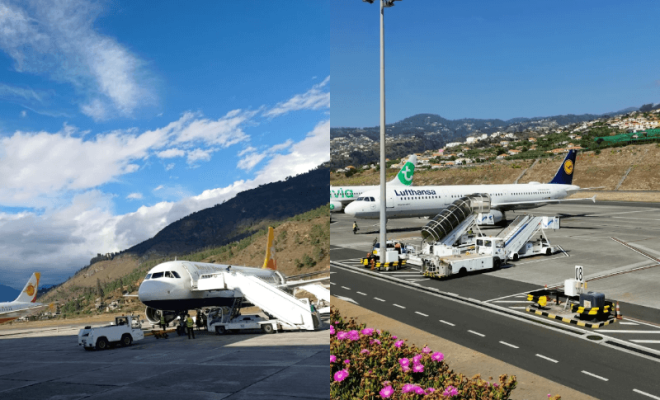
6. Madeira Airport (Cristiano Ronaldo Airport), PortugalLocation: Madeira Island, Portugal

Why it’s dangerous: With a runway partly extended over the Atlantic on pillars, pilots face turbulent winds and challenging approaches over mountains. It’s considered one of Europe’s most difficult airports.

7. Gustaf III Airport, St. BartsLocation: Saint Barthélemy, Caribbean

Why it’s dangerous: Planes must dive over a hilltop traffic circle before touching down on a short runway ending at the beach. Pilots need a steep descent and precision to avoid overshooting into the sea.

8. Juancho E. Yrausquin Airport, Saba Island (Netherlands Antilles)Location: Saba Island, Caribbean

Why it’s dangerous: This airport holds the record for the world’s shortest commercial runway at 400 meters. It’s flanked by cliffs on three sides and the sea on the fourth, leaving no margin for error.

9. Kansai International Airport, JapanLocation: Osaka Bay, Japan

Why it’s dangerous: Built on an artificial island, Kansai faces constant risks of earthquakes, typhoons, and rising sea levels. The isolated location also poses challenges during emergencies.

10. Tribhuvan International Airport, NepalLocation: Kathmandu, Nepal

Why it’s dangerous: Kathmandu’s international airport is surrounded by mountains, making approaches difficult. Fog, air pollution, and unpredictable weather patterns add to the complexity of landings and take-offs. 10 Most Dangerous Airports in the World That Test Even the Best Pilots
Read More........

AI 171 crash preliminary report has found no mechanical or maintenance faults: Air India CEO


New Delhi, (IANS): Air India CEO Campbell Wilson has, in an internal mail to the airline’s staff, stated that the Preliminary Report into the Boeing Dreamliner crash in Ahmedabad has found no mechanical or maintenance issues with the aircraft or engines, and that all mandatory maintenance tasks had been completed.

“There was no issue with the quality of fuel and no abnormality with the take-off roll. The pilots had passed their mandatory pre-flight breathalyser and there were no observations pertaining to their medical status,” the letter, seen by IANS, further states.

Wilson has also said that the report into the AI171 crash “has identified no cause nor made any recommendations, so I urge everyone to avoid drawing premature conclusions as the investigation is far from over.”

He said the airline will continue to co-operate with the investigators to ensure they have everything they need to conduct a thorough and comprehensive enquiry.

“Until a final report or cause is tabled, there will no doubt be new rounds of speculation and more sensational headlines. We must nevertheless remain focused on our task and be true to the values that have powered Air India’s transformation journey over the past three years -- integrity, excellence, customer focus, innovation and teamwork,” Wilson said in the letter.

The Air India CEO has pointed out that the airline’s top priorities are: “standing by the bereaved and those injured, working together as a team, and delivering a safe and reliable air travel experience to our customers around the world.”

He has also said in the letter that the Preliminary Report marked the point at which Air India, along with the world, began receiving additional details about what took place. “Unsurprisingly, it provided both greater clarity and opened additional questions,” he remarked.
Indian travel packages

This also triggered a new round of speculation in the media, and over the past 30 days, there has been an ongoing cycle of theories, allegations, rumours and sensational headlines, many of which have later been disproven, Wilson added. AI 171 crash preliminary report has found no mechanical or maintenance faults: Air India CEO | MorungExpress | morungexpress.com
Read More........

Emotions run high as power outage shuts London's Heathrow


A police helicopter was the only vehicle visible in the sky above Heathrow airport on Friday, as the regular drone of flights went silent after a fire at a power station shuttered Europe's busiest airport.

On the ground, dozens of confused, stranded passengers stood around with their suitcases outside airport hotels. Many who AFP spoke to complained about the cost of shifting their bookings and a lack of information from Heathrow or airlines.

For veteran athlete Kevin Dillon, 70, Heathrow's day-long closure meant he would miss the opening ceremony of the World Masters Athletics Championships in Florida.

The runner, sporting a Great Britain tracksuit, said he had come from Manchester to catch his flight so he could compete.

The authorities are facing questions over how the fire at the electricity substation left such a crucial piece of national infrastructure closed for the day.

"I'm just surprised they didn't have a backup system," Dillon said.

Jake Johnston, from Los Angeles, was set to travel back to the United States on Friday but his airline, Virgin Atlantic, has rebooked his flight for Monday.

The 24-year-old said he and his friends were lucky: they found hotels for around £150 a night ($194).

Since then, several passengers have complained of airport hotels jacking up prices. According to Johnston, when he checked again later, hotel prices had risen to around £600.

- 'Need to be there' -

Bolaji N'gowe was not so optimistic. He was on his way home to Canada after visiting his mother in Lagos, Nigeria, when his flight was diverted from Heathrow to Gatwick airport, south of London.

"I have been in Gatwick since 4:00 am (0400 GMT)," he told AFP at the UK's second-busiest airport, which accepted some flights bound for Heathrow, while others were diverted to Paris, Madrid, Frankfurt and other European cities.

"I'm trying to book another flight... I'm trying to call Air Canada, no one is answering the phone," said N'gowe, adding that the earliest flight he had found was for Sunday.

"Between the ticket and the hotel, I have to spend more that £1,500," he added.

Talia Fokaides was meant to leave London for Athens in the morning to be with her mother, who was due to undergo open-heart surgery.

When she heard Heathrow was closed, she rushed to Gatwick and found a flight to the Greek capital for midday.

"I don't care about the money, I just need to be on a flight and home by the end of the day," Fokaides told AFP, her voice shaking with emotion.

"We were given no info, we were left on our own. I don't understand how it's possible," she added. "I just need to be there."

Some 1,350 flights had been due to land or take off from Heathrow and its five terminals on Friday, according to the flight tracking website Flightradar24.

Heathrow is one of the world's busiest airports and usually handles around 230,000 passengers daily and 83 million every year.

- 'Powerless' -

Mohammed al-Laib, a Tunisian national who works in London, was supposed to go to Dubai to be reunited with his wife, whom he had not seen in months.

AFP | Adrian DENNIS

Heading to the information desk at Gatwick, he said he did not know if another flight would be available.

"I feel powerless," he said.

Meanwhile, 28-year-old Muhammad Khalil had been waiting at London's Paddington station since early morning looking for alternative flights to Pakistan.

He had so far been unsuccessful, with Heathrow the main airport in the UK for long-haul international flights.

Khalil had also hoped to be reunited with his wife after five months. He had been planning the trip for three months.

"I've spent so much money on tickets and everything. I had to take the day off from my job," Khalil told AFP.

"You can't imagine how stressful it is for me."

Callum Burton, 21, from Kent in southern England, was stranded at Newark airport near New York after visiting his girlfriend for his 21st birthday.

Burton told AFP via social media that his flight had boarded and was ready to depart before it was rescheduled for 15 hours later, then cancelled.

He was not expecting to leave until Sunday or Monday, and said that he was "very tired and disappointed".By James Pheby And Alexandra Del Peral Emotions run high as power outage shuts London's Heathrow
Read More........

Airlines to operate record 25,610 flights a week in summer


New Delhi, (IANS): India's commercial airlines will operate 25,610 flights per week during the forthcoming summer season, a 5.5 per cent increase compared to the same period last year, the Directorate General of Civil Aviation (DGCA) said.

The summer season for airlines this year runs from March 30 to October 25. The number of flights in the summer schedule is 2.5 per cent higher than the preceding winter season.

The country's biggest airline, IndiGo, will be operating 467 additional flights a week compared to the same period last year, which represents a 3 per cent increase.

The DGCA statement showed that IndiGo will operate the highest number of weekly domestic flights, with 14,158 departures scheduled, followed by Air India (4,310) and Air India Express (3,375).

Meanwhile, SpiceJet's slots have decreased by 25 per cent from 1,657 departures last year to 1,240 departures this year.

DGCA also highlighted that regional airlines like Alliance Air and Flybig have seen a significant decrease of 41.96 per cent and 30.98 per cent, respectively, in the number of flights.

The new summer schedule showed that out of 129 airports, Ambikapur, Datia, Bidar, Porbandar, Pakyaong, Rewa, and Solapur are new airports proposed by the scheduled airlines, while operations from Azamgarh and Rupsi airports were suspended in the Summer Schedule 2025.

The Navi Mumbai airport and the Noida Airport at Jewar near Delhi have not been included in the schedule. These airports are expected to start operations by October 2025, when the summer schedule transitions to the next winter.

The total number of flights in the schedule is an all-time high and surpasses pre-COVID levels as air traffic grows at a robust pace in Indian skies.

India's aviation sector reflects a stable outlook with domestic air passenger traffic recording a double-digit growth of 11.04 per cent in February this year compared to the same month of the previous year.

According to an ICRA report, domestic air traffic for the 11 months of the current financial year was around 1,551 lakh passengers, which is 7.7 per cent higher than the same period of the previous year and 12.9 per cent higher than the pre-Covid level of 1,338 lakh in 11MFY20.Besides, in the first 10 months of the current financial year (April-January), the international passenger traffic for Indian carriers stood at 280.9 lakh, a year-on-year growth of 14.8 per cent, higher than the pre-Covid level of around 198.8 lakh by 41.3 per cent. Airlines to operate record 25,610 flights a week in summer | MorungExpress | morungexpress.com
Read More........

India and China agree to resume air travel after nearly five years

FILE PHOTO: Travellers push trolleys with their luggage at the departure area of the Indira Gandhi International Airport in New Delhi, India, December 14, 2022. REUTERS/Anushree Fadnavis/File Photo

BEIJING/NEW DELHI (Reuters) -India and China have agreed to resume direct air services after nearly five years, India’s foreign ministry said on Monday, signalling a thaw in relations between the neighbours after a deadly 2020 military clash on their disputed Himalayan border.

Both sides will negotiate a framework on the flights in a meeting that will be held at “early date”, the ministry said after a meeting between India’s top diplomat and his Chinese counterpart.

Tensions soured between the two nations after the 2020 clash, following which India made it difficult for Chinese companies to invest in the country, banned hundreds of popular apps and severed passenger routes, although direct cargo flights continued to operate between the countries.
Relations have improved over the past four months with several high-level meetings, including talks between Chinese President Xi Jinping and Indian Prime Minister Narendra Modi in Russia in October.

On Monday, Chinese Foreign Minister Wang Yi told Indian Foreign Secretary Vikram Misri in Beijing that the two countries should work in the same direction, explore more substantive measures and commit to mutual understanding.

FILE PHOTO: Chinese Foreign Minister Wang Yi in Beijing’s Diaoyutai State Guesthouse on December 13, 2024. GREG BAKER/Pool via REUTERS//File Photo

“Specific concerns in the economic and trade areas were discussed with a view to resolving these issues and promoting long-term policy transparency and predictability,” the Indian foreign ministry statement said in a statement.

Their meeting was the latest between the two Asian powers following a milestone agreement in October seeking to ease friction along their frontier.

Reuters reported in June that China’s government and airlines had asked India’s civil aviation authorities to re-establish direct air links, but New Delhi resisted as the border dispute continued to weigh on ties.

In October, two Indian government sources told Reuters that India would consider reopening the skies and launch fast-tracking visa approvals.

Both nations have also agreed to resume dialogue for functional exchanges step by step and with an early meeting of the India-China Expert Level Mechanism, India’s foreign ministry said.

China and India should commit to “mutual support and mutual achievement” rather than “suspicion” and “alienation,” Wang said during the two officials’ meeting, according to the Chinese foreign ministry’s readout.(Reporting by Liz Lee, Ethan Wang and Yukun Zhang, Tanvi Mehta in New Delhi; editing by Christopher Cushing, Sonali Paul and Mark Heinrich) India and China agree to resume air travel after nearly five years
Read More........

Air India Express cancels over 80 flights due to cabin crew shortage

Air India Express has cancelled more than 80 flights and scores of flights have been delayed as a section of cabin crew members have reported sick to protest against certain policies of the airline management. An Air India Express spokesperson said, the airline is engaging with the cabin crew members to understand the reasons for reporting sick and also apologised for the flight disruptions. Several Air India Express flight services from the four international airports in Kerala have been disrupted since last night, as many cabin crew employees of the carrier have collectively taken sick leave. At the Cochin International Airport, four international flights and a domestic flight to Bengaluru were cancelled by the airline. The affected international services include flights to Sharjah, Bahrain, Dammam, and Muscat. Additionally, Air India Express flights from Muscat, Bahrain, and Dammam scheduled for arrival this evening have also been cancelled. Reports said that in the state capital Thiruvananthapuram, Air India Express flights bound for Sharjah, Dubai, Muscat, and Abu Dhabi were cancelled. In Kozhikode, flights to Doha, Jeddah, Ras Al Khaimah, Dubai, and Kuwait were disrupted, while in Kannur, flights to Muscat, Sharjah, and Abu Dhabi were cancelled. Passengers were caught off guard and became aware of the flight disruptions only upon their arrival at the respective airports. This unexpected situation has left many passengers in a quandary, with many facing the risk of losing their jobs if they are unable to report for duty on time. The airline has offered to accommodate stranded passengers on other flights operated by it, despite the prevailing uncertainty regarding the resumption of flight operations.Air India Express cancels over 80 flights due to cabin crew shortage:
Read More........

Air India Express cancels over 80 flights due to cabin crew shortage

Air India Express has cancelled more than 80 flights and scores of flights have been delayed as a section of cabin crew members have reported sick to protest against certain policies of the airline management. An Air India Express spokesperson said, the airline is engaging with the cabin crew members to understand the reasons for reporting sick and also apologised for the flight disruptions. Several Air India Express flight services from the four international airports in Kerala have been disrupted since last night, as many cabin crew employees of the carrier have collectively taken sick leave. At the Cochin International Airport, four international flights and a domestic flight to Bengaluru were cancelled by the airline.

The affected international services include flights to Sharjah, Bahrain, Dammam, and Muscat. Additionally, Air India Express flights from Muscat, Bahrain, and Dammam scheduled for arrival this evening have also been cancelled. Reports said that in the state capital Thiruvananthapuram, Air India Express flights bound for Sharjah, Dubai, Muscat, and Abu Dhabi were cancelled. In Kozhikode, flights to Doha, Jeddah, Ras Al Khaimah, Dubai, and Kuwait were disrupted, while in Kannur, flights to Muscat, Sharjah, and Abu Dhabi were cancelled.

Passengers were caught off guard and became aware of the flight disruptions only upon their arrival at the respective airports. This unexpected situation has left many passengers in a quandary, with many facing the risk of losing their jobs if they are unable to report for duty on time. The airline has offered to accommodate stranded passengers on other flights operated by it, despite the prevailing uncertainty regarding the resumption of flight operations. Air India Express cancels over 80 flights due to cabin crew shortage
Read More........

Aviation in a ‘purple patch’ amid new plane crunch, AirAsia says

Malaysia-based AirAsia founder Tony Fernandes remains bullish on air travel. MUST CREDIT: Richard Humphries/Bloomberg
The aviation industry is experiencing a “purple patch” with demand for seats far outstripping capacity amid a long wait for new aircraft and a shortage of pilots further discouraging any fresh competition, Tony Fernandes, the founder of low-cost carrier AirAsia, said. Malaysia-based AirAsia for its part is set to witness its “best ever period” with most of the carrier’s 240 planes back in the sky and “airfares at their best,” Fernandes said during an interview near Kuala Lumpur’s international airport on Monday. “I’ve never been this bullish before,” Fernandes, who started AirAsia 23 years ago, said. “Southeast Asia is going through a renaissance period of sensible economics, and that’s a good thing.” On the back of that, AirAsia plans to raise as much as $600 million in coming months, Fernandes said, as he tries to pull off a merger between his two aviation businesses – long-haul carrier AirAsia X Bhd. and short-haul airline AirAsia, which is currently a unit under Fernandes’ more diversified company Capital A Bhd. Following the merger, which is expected to conclude mid-year, the new entity will look to raise up to $400 million via selling equity, Fernandes said. Citigroup Inc. and US advisory bank Evercore Inc. have been appointed to lead the capital raising. A $200 million revenue bond, securitized against revenue from new routes, is also expected to be finalized soon, he said. Fernandes said the merger of the two airlines will create a new firm called AirAsia Group that will subsequently take over AirAsia X’s listing on Bursa Malaysia. The company may also do away with its AirAsia X branding as the aviation businesses consolidate. AirAsia has ambitions to expand its footprint from a predominately Asian airline to a global low-cost carrier with a more extensive network. It plans to start flying to Kazakhstan, its first route in Central Asia, later this year. Fernandes, who has previously spoken about succession at the company he founded, said Monday that he would retain an advisory role at AirAsia Group following the merger. He’ll remain chief executive of Capital A, his other listed company that will ultimately hold all the non-aviation businesses he’s started. Those include Teleport, a logistics company, and Move, an online travel agency that also operates a ride-hailing business. Move is finalizing a $30 million capital raising while Teleport has raised $35 million in debt, he said. The company’s aircraft-maintenance arm, Asia Digital Engineering, has also managed to raise $100 million, Fernandes said. The Financial Times reported in October that Capital A is seeking to raise more than $1 billion in debt and equity and list some of its businesses through a blank-check company in New York. The company said in November that it will seek a Nasdaq listing via a special purpose acquisition company merger with Aetherium Acquisition Corp.“2024 will be a very good year. 2025 will be an amazing year,” Fernandes said. “There’s a lot of growth for us. Aviation in a ‘purple patch’ amid new plane crunch, AirAsia says
Read More........

Boeing staff confused on safety reporting: US study

WASHINGTON - Boeing employees are confused and distrustful of changes to safety reporting systems implemented by the aerospace giant after fatal plane crashes in 2018 and 2019, according to a US report released Monday.

The report pointed to a "disconnect" between senior company management and other Boeing employees and skepticism that safety complaints by workers would not result in retaliation, according to an expert panel appointed by the US Federal Aviation Administration (FAA).

"The procedures and training are complex and in a constant state of change, creating employee confusion especially among different work sites and employee groups," said an executive summary.

The analysis comes as Boeing faces intensified scrutiny following a January 5 Alaska Airlines emergency landing that led to a temporary grounding of some Boeing 737 MAX aircraft.

The US Congress ordered the analysis in a 2020 law after fatal Lion Air and Ethiopian Airline crashes on 737 MAX planes. The report's scope did not include the Alaska Airlines incident, although the summary alluded to "serious quality issues" that surfaced during the report that "amplified" the panel's concerns.

The analysis identified 27 points of concern and offered 53 recommendations, including steps to standardize safety training, enhance transparency in the handling of employee complaints and improve systems to grant pilots more influence on safety and training matters.

The FAA plans to "immediately" undertake a review to determine next steps, the agency said.

"We will continue to hold Boeing to the highest standard of safety and will work to ensure the company comprehensively addresses these recommendations," the FAA said.

Boeing thanked the panel and said it will "carefully review the panel's assessment and learn from their findings," according to a company statement."We've taken important steps to foster a safety culture that empowers and encourages all employees to share their voice," Boeing said. " But there is more work to do." Boeing staff confused on safety reporting: US study
Read More........

Indians advised against travel to Saudi Arabia, Kuwait via UAE


The Embassy of India in Abu Dhabi has advised Indian citizens against travelling to Saudi Arabia and Kuwait via the United Arab Emirates due to "Covid-related restrictions on incoming passengers" imposed in the two countries.

Issued on Monday, an embassy advisory advised the Indian nationals to "ascertain the latest Covid related travel guidelines of their final destination country before embarking on an outward journey from India".

The citizens were also suggested to carry sufficient "personal provisions and funds to cater to any emergent requirements".

The Embassy further advised the Indian nationals who were already in the UAE en route to the two countries, to consider returning home and make their travel plans only when the ongoing restrictions were ease.

The advisory comes after the Consulate General of India in Dubai informed the Embassy that several Indians travelling to Saudi Arabia and Kuwait were still stranded in the UAE.

Since December 2020, at least 600 Indians, who wanted to travel to Saudi Arabia, have been stranded in the UAE, a Consulate official told Khaleej Times.

"Due to the fast-evolving international travel protocols, the missions strongly advise all travellers to avoid going to Saudi Arabia and Kuwait using transit routes to avoid the inconvenience of being stranded in the UAE," the official said.

Earlier, these passengers were provided special travel arrangements by the missions with assistance from the Kerala Muslim Cultural Centre (KMCC) and other social organisations.

The official confirmed that such facilities will no longer be provided. Source: https://southasiamonitor.org/index.php/
Read More........

Indonesian plane goes missing with 59 passengers after take-off


A passenger plane with 59 people onboard has gone missing after take-off from the Indonesian capital Jakarta.

According to BBC, the Sriwijaya Air Boeing 737-500 lost contact en route to Pontianak in West Kalimantan province, officials said.

Flight tracking website Flightradar24.com said the aircraft SJ182 had “disappeared” more than 3,000 meters (10,000ft) in altitude in less than a minute, about 4 minutes after departure from Jakarta.

The transport ministry said search and rescue efforts were underway.

Meanwhile, there are no official confirmations of a crash. The Regent of the Thousand Islands said they had information that “something fell and exploded on Male Island,” according to a report of Indonesian newspaper Merdeka.

Earlier, the Soekarno-Hatta Airport Branch Communications Manager Haerul Anwar said the Sriwijaya aircraft had lost contact around Lancang Island, a part of the Thousand Islands.Source: BBC, DW. Source: https://www.daily-bangladesh.com/
Read More........

The world cuts air travel ties with Britain


By Alex Macheras In an unprecedented development during this final chapter of 2020, over 60 countries from across 5 continents have cut all air travel ties with the UK or banned UK travellers amid immense global concern of a new Covid-19 strain “spreading out of control” in Britain.

Scientists say the new strain is likely more infectious, possibly up to 70% faster in terms of transmission. Jeremy Farrar, a British medical researcher and director of the Wellcome Trust, said that its existence is "worrying and a real cause for concern. Research is ongoing to understand more but acting urgently now is critical. There is no part of the UK and globally that should not be concerned”.

While this new strain of Covid-19 has been found to be in multiple countries, including South Africa and The Netherlands, it’s UK Health Secretary Matt Hancock’s “this new strain is out of control here” comments that has led to 60 countries from 5 continents banning air travel to/from Britain in a bid to keep the new strain out.

In fact, entire countries are shutting down (such as Kuwait, Oman) due to global concern of new Covid-19 strain in the UK.

The overwhelming majority of the 60 countries have cut all air travel and transport ties with Britain, including India, France, Italy, Germany, Austria, Kuwait, Iraq, Hungary, Moldova, Jordan, The Philippines, Belgium, Denmark, Oman, Switzerland, Argentina, Colombia and South Korea, while other countries have banned any travellers who have been in the UK in the last 14 days. Singapore has decided to go as far as to banning any UK traveller from transiting via its Changi Airport hub. Chile, Colombia, Ecuador, El Salvador and Peru all banned flights from the UK.

The last time the world witnessed anything like this is when countries started to cut air travel ties with China at the beginning of this pandemic.

Qatar says arrivals into Doha on flights from the United Kingdom, Denmark, the Netherlands and South Africa must have a reservation in an exclusive quarantine hotel. Passengers will not be permitted to board the aircraft without a UK, DK, NL or ZA exclusive quarantine hotel voucher if your booking was made on or after December 23, 2020. Pre-approved QID resident permit holders are able to apply to travel to Qatar but will need to obtain approval to enter Qatar by applying through the Qatar Portal. Applications for a QID return visa are now open.

The new variant was first detected in September. In November, it made up around a quarter of cases in London. This reached nearly two-thirds of cases in mid-December.

Three things are coming together that mean it is attracting attention: It is rapidly replacing other versions of the virus, it has mutations that affect part of the virus likely to be important, and some of those mutations have already been shown in the lab to increase the ability of the virus to infect cells.

The World Health Organisation is working to understand the extent to which the virus may spread more easily, along with other human behavioural factors that may be driving transmission, Maria van Kerkhove, the body’s technical lead on Covid-19, told the BBC on Sunday. She said that current information suggests that the new variant doesn’t have any impact on the vaccines being rolled out.

Emanuel Macron was the first EU leader to ban travellers from the UK on Sunday, putting in place a 48-hour embargo on all travels. This included freight lorries at Dover, causing disruption to cross-Channel trade – including fresh food supplies.

Other EU countries quickly halted UK flights, as data suggested the new variant could be up to 70% more infectious. Dozens of countries around the world followed Europe's lead – but the US is allowing British visitors with a negative Covid-19 test.

New York Governor Andrew Cuomo had demanded that flights from the UK be halted – but had his request rejected by the federal government, however British Airways and Delta voluntarily agreed that passengers on their flights would be tested prior to departure.

A British Airways spokesman said: “We have agreed to pre-departure testing for passengers on flights from the UK to New York from December 22 in line with the request. We continue to work closely with local health authorities around the world.”

Meanwhile, the growing list of 60 countries (and counting) cutting air travel ties with the UK shows no sign of slowing down, all before – what is usually – a busy holiday period.

*The author is an aviation analyst. Source: https://www.gulf-times.com/
Read More........

Alliance Air delays flight to save four lives


In a humanitarian gesture, Air India's regional subsidiary Alliance Air delayed its Jaipur-Delhi flight to save the lives of four patients, awaiting organ transplants in the national capital. The matter came to light on Sunday, signifying the growing need for "safe and fast" harvested organ transport.

According to Alliance Air, its Jaipur-Delhi flight on Saturday was delayed by half an hour to wait for the arrival of organs donated by a 49-year-old woman in Jaipur that were to be transported to Delhi along with a team of doctors and paramedical staff.

"The retrieved organs to be transported consisted of 2 lungs, 1 liver and 1 kidney and were urgently needed at Delhi to save four lives," the airline said in a statement.

"Collaborative efforts of the Chief Minister's office, the State Organ and Tissue Transplant Organisation (SOTTO), Air India, Alliance Air, the Central Industrial Security Force and Jaipur airport authorities for this humanitarian cause helped in saving 4 lives."

As per the statement, when the passengers on the flight came to know about the reason of flight delay, they waited patiently for the organs to arrive at the airport.

"The organ harvesting surgery, performed at a private hospital in Jaipur, was a complicated one involving retrieval of lungs, kidney and liver and hence was time consuming," the statement said.

"The retrieved organs needed to reach Delhi soon after harvesting... On arriving at the airport, the retrieved organs were rushed through the security check by Alliance Air ground staff." Source: https://southasiamonitor.org
Read More........

Pak airlines may face ban in 188 countries


The Airlines that are being operated in Pakistan may face a ban from flying to 188 countries as the country has failed in their pilot licensing issue and to meet international standards as required by the International Civil Aviation Organisation (ICAO), a report of the Express Tribune said on Sunday. 

The International Civil Aviation Organization (ICAO) could ban PIA airlines and pilots from 188 countries for failing to comply with the rules, the report stated that. 

The ICAO issued a serious warning to the Pakistan Civil Aviation Authority (PCAA) over the safety concerns.

In a letter on November 3, the ICAO stated that PCAA had failed to meet the international standards regarding the personnel licensing and training in relation to the licensing process for pilot.

Regarding the warning, a Pakistan Airlines Pilots Association (Palpa) spokesperson said: "This will have serious consequences and could be a total disaster for Pakistan's aviation industry."

Palpa alleged that it had been raising this issue since June 2020 but unfortunately it was neglected by the authorities concerned.Earlier, due to the licence scam, flag carrier Pakistan International Airlines (PIA) has already been barred from flying to the UK and the European Union. Source: https://www.daily-bangladesh.com/
Read More........

Singapore, Hong Kong to start ‘world first’ air travel bubble


Hong Kong and Singapore will start the long-awaited air travel bubble that will replace quarantine with Covid-19 testing from November 22. 

According to the Bloomberg report, there will be several flights a week on Singapore Airlines Ltd. and Cathay Pacific Airways Ltd. from that date, rising to daily from December 7. A maximum of 200 people will be permitted on each flight and details of the arrangement will be reviewed after one month. 

At a news briefing on Wednesday, Singapore Minister for Transport Ong Ye Kung said that this was the first travel bubble of its type and may be used as a template for other countries, if successful. The travel bubble will help ensure a brighter future for the city-state’s Changi Airport and Singapore Airlines, he said. 

“This policy is not easy to come by,” said Edward Yau Tang-wah, Hong Kong’s commerce and economic development secretary. “Whether the bubble can work and sustain [itself] well will depend on cooperation from all sides, including the participation of residents and their efforts in maintaining social distancing.” 

The coronavirus pandemic has virtually shut down air travel and squeezed tourism-dependent economies. Airlines, among the hardest-hit industries, were forced to ground the majority of flights and seek government help to stay afloat. 

Goh Choon Phong, CEO of Singapore Airlines (SIA), hailed the bubble arrangement, saying: “It paves the way for us to open up in a safe and calibrated way with the necessary testing protocols in place, and provides a promising model for other bilateral arrangements around the world.”

Travellers from both cities must take designated bubble flights and fulfil certain conditions and requirements, including undergoing up to three Covid-19 tests at various stages of the journey.At the start of the scheme, there will be one flight a day into each city carrying 200 passengers, with Cathay Pacific and Singapore operating alternating flights after the launch day. From December 7, the number of flights into each city will be increased to two daily. - South China Morning Post, Bloomberg  Source: https://www.daily-bangladesh.com
Read More........