Amitabh Bachchan says, learning never stops, but outsourcing is the way forward

(Photo : IANS/File)

Mumbai, Megastar Amitabh Bachchan reflected on learning, time, and the rapidly changing nature of work, saying that while every day brings a new lesson, the pace of innovation today often makes it difficult to keep up as one grows older.

Taking to his blog, Big B shared his thought that there is often a sense of regret that certain things could not have been learned years ago.

“Each day is a learning .. and the regret is that what needs to be learnt should have been learnt many many years ago .. the regret is more because what is being learnt now did not exist then .. and now the desire and effort and energy to learn diminishes - with time and age ..”

The star observed that inventions and new systems evolve so rapidly that by the time one begins to understand them, time has already moved on.

“The speed of inventions and fresh new systems is so rapid that , by the the time you are beginning to learn it time has passed (sic).”

Drawing from recent meetings, he said the key takeaway was to get the basics right and then rely on the best and most skilled recent talents to carry the work forward.

He added: “So the take away today from several meetings is to get the basics in place and then hire the best recent talents and experts to carry out the job .. and job done (sic).”

“If you are unaware or not qualified to accomplish a given job .. no issue .. you accept it .. then hire it out to experts of choice and get it done .. the job accepted .. hired out .. and done .. rather than NOT take up a job, because you do NOT know it, but take it and get it done through a hiring process .. yes you employ or deploy the talent , at a cost , but better to do that than not accdept the job in the first place because you are not qualified for it ..”

Calling it a slightly complicated process, Bachchan said clarity eventually comes with time. He concluded by identifying the right term for this approach, outsourcing, where experts handle the work for a fee, while one retains control of the larger project.

“A bit complicated all this .. but in time it all falls into place .. aahh .. got the right expression and word that I was struggling with .. its called OUTSOURCING .. or you OUTSOURCE .. the expert or the knowledged do the work at a fee .. you maintain the job .. but outsourced to the more proficient .. the larger percentage of the commercial remains with you ..”

“The cost of outsourcing , being the commercial consideration that you are deployed with ..(sic)”

“YES .. finally understood .. in my time .. if you did not know the job, you regretted and did not or could not do it .. but now you take up the job, and get it done through OUTSOURCING (sic).”

Expressing relief at finally finding the right word, the veteran actor added that modern tools like ChatGPT make finding such answers quicker and easier than ever before.He concluded: “Oh boy what a relief to have got the term right .. and guess what .. put up the issue on ChatGPT, and within a few seconds the response was before you .. BAADUMBAAA !!!! (sic).” Amitabh Bachchan says, learning never stops, but outsourcing is the way forward | MorungExpress | morungexpress.com
Read More........

True display of belief and passion: Kohli lauds Women in Blue's heroics in WC semifinal


Navi Mumbai: India team celebrate after defeating Australia to qualify for the finals of the ICC Women’s World Cup ODI at DY Patil Stadium in Navi Mumbai on Thursday, October 30, 2025. (Photo: IANS)

New Delhi, (IANS) Indian batting stalwart and former skipper Virat Kohli hailed the Women in Blue for their stunning victory over seven-time champions Australia in the ODI World Cup semifinal, calling it a “true display of resilience, belief, and passion.”

India produced a remarkable performance to defeat Australia by five wickets at the DY Patil Stadium on Thursday, punching their ticket to their third ICC Women's Cricket World Cup Final after 2005 and 2017, when they finished as the runners-up behind Australia and England, respectively.

Reacting to the triumph, Kohli took to social media platform X to applaud the team’s efforts. “What a victory by our team over a mighty opponent like Australia. A great chase by the girls and a standout performance by Jemimah in a big game. A true display of resilience, belief, and passion. Well done, Team India!” he wrote.

Jemimah Rodrigues starred in the chase with a stunning knock under pressure, scoring 127 off 134 deliveries as India chased down a record total of 339 in Women's ODI history.

India's 341/5 in the semifinal is also the second-highest score in a Women's ODI run-chase, after their own 369 all-out against the same team in New Delhi last month.

This is the first time a 300-plus total was gunned down in an ODI World Cup knockout - Men's or Women's. The previous highest had come in the Men's CWC 2015 semifinal: 298 by New Zealand vs South Africa in Auckland.

India will now look to carry the same momentum into the final as they chase their maiden Women’s World Cup title.The tournament hosts India will take on South Africa, featured in a Women's World Cup Final for the first time, on Sunday, meaning a team will claim the coveted trophy for the very first time. True display of belief and passion: Kohli lauds Women in Blue's heroics in WC semifinal | MorungExpress | morungexpress.com
Read More........

UPI impact: India now makes faster payments than any other country, says IMF


New Delhi, (IANS): Thanks to the massive adoption of unified payments interface (UPI) based digital transactions, India now makes faster payments than any other country in the world, an International Monetary Fund (IMF) note has emphasised.

Since its launch in 2016, UPI has grown quickly, while some proxies for cash usage have begun to decline. UPI now processes more than 18 billion transactions per month and dominates other electronic retail payments in India, according to the note titled ‘Growing Retail Digital Payments: The Value of Interoperability.’

UPI is an instant payments platform built over the Immediate Payment Service (IMPS) infrastructure.

UPI has transformed the digital payments landscape in India. Evidence from the platform suggests that interoperability can improve users’ experience of digital payments and expand overall adoption.

“Interoperability directly increases users’ freedom to choose their favourite app, enabling them to take full advantage of the variety and quality of apps available. Interoperability can also facilitate entry by new providers and incentivise existing providers to upgrade their apps, offering indirect benefits to users,” said the IMF note.

As a result, interoperability can make adopting digital payments more attractive for users and hence increase overall adoption relative to a world with only closed-loop alternatives.

Providing infrastructure for interoperable systems, or otherwise supporting interoperability through regulation, could be a promising avenue for countries seeking to transition from cash to digital payments, read the note.

The National Payments Corporation of India (NPCI) launched the Bharat Interface for Money (BHIM) app in late 2016, when total UPI usage was small and there were fewer other providers.

“Indeed, BHIM initially accounted for more than half of payer-side total transaction value, prior to the take-off of apps produced by major fintech firms. This highlights the potential catalytic role of direct public provision of payment apps,” according to the IMF note.

The public sector can help overcome coordination failures — for example, low user adoption because of a lack of high-quality apps, alongside a lack of high-quality apps as a result of low user adoption — and so kick-start an ecosystem, it added.UPI volumes in June grew 32 per cent year-on-year. Transaction value rose 20 per cent compared to June last year. The number of daily UPI transactions rose to 613 million in June from 602 million in May. UPI impact: India now makes faster payments than any other country, says IMF | MorungExpress | morungexpress.com
Read More........

India must aim for $1 trillion ‘Orange Economy’ by 2047: Kiran Mazumdar Shaw


Mumbai, (IANS) The media and entertainment sector contributes $20 billion to the GDP today and we must aim for $100 billion dollar, and eventually, a $1 trillion ‘Orange Economy’ by 2047, which will resonate with the dream of Prime Minister Narendra Modi, global business leader and Biocon founder, Kiran Mazumdar Shaw, has said.

‘Orange Economy’ or the creative economy refers to knowledge-based activities that integrate culture, creativity, technology, and IP to drive economic, social, and cultural development.

The Indian startups involved in creative content sector should think beyond films and build brands, ecosystems, and intellectual property that create global waves, she said during the World Audio Visual and Entertainment Summit (WAVES) 2025 Summit here.

Mazumdar Shaw spoke about the global potential of Indian narratives.

“It’s time for India to create new stories that blend tradition and technology. Just as George Lucas drew inspiration from Indian epics for Star Wars, we can use technology to transform our cultural heritage into global franchises,” she noted.

Touching on India’s demographic and digital strengths, she said that with over a billion smartphones and a tech-savvy Gen Z, India is poised for global innovation.

“But like any blockbuster, success starts small — with an idea, strategy, and relentless focus,” she emphasised.

She drew parallels with her own journey of starting Biocon in a garage and building it into a global biotech force.

Talking about the India’s creative economy, she said that those in the filed should focus on the growth of the so-called ‘Orange Economy’ which has immense potential.

Responding to questions on India’s creative edge, Shaw highlighted the convergence of AR, VR, and immersive experiences as key frontiers.

“The next unicorns won’t just be apps — they will be creators who understand IP, tech, and immersive storytelling,” she noted.She urged startups to embrace originality and persistence, saying “every great idea starts small. What matters is how far you take it. Failure is part of the journey.” India must aim for $1 trillion ‘Orange Economy’ by 2047: Kiran Mazumdar Shaw | MorungExpress | morungexpress.com
Read More........

How Important Is ‘The Human Touch’ in Customer Service as Firms Increasingly Use AI?

A couple of years after its initial boom, artificial intelligence (AI) still remains a huge buzzword in the fintech industry, as every firm looks at a new way of integrating the tech into its infrastructure to gain a competitive edge. Exploring how they are going about doing this in 2025, The Fintech Times is spotlighting some of the biggest themes in AI this February.

AI has taken the world by storm, massively impacting the customer service sector. However, while some organisations may feel that they can replace human workers with technology, the ‘human touch’ remains an important factor for many consumers. But how important is human contact in a world where AI has the potential of a faster, more streamlined customer service experience?

Empathy and critical thinking needed

Allen Bonde the CMO at TreviPay

Perhaps AI’s biggest flaw is its inability to understand a situation from an emotional standpoint. In finance, empathy with someone’s situation is an absolute must and according to Allen Bonde the CMO at TreviPay, the B2B payments firm, this is why the human touch is still needed in a sector turning to AI.

“The human touch remains very important in customer service, even as AI adoption grows. AI can handle repetitive or high-volume tasks, speeding up processes and increasing efficiency, but it lacks the empathy and critical thinking that human interaction provides. Firms should use AI to support, not replace, customer service teams. Doing so can enhance customer experiences by enabling faster responses and better solutions while preserving personal connections. Customers value personalised service, and businesses that blend AI’s strengths with human interaction build stronger trust and loyalty.”

Merging the perks of technology with human emotion


Martin Taylor, co-founder and deputy CEO of Content Guru

Echoing similar views, Martin Taylor, co-founder and deputy CEO of Content Guru, the communications integration provider also noted how the importance of human interaction in AI is something we’re seeing across the globe. While AI is undoubtedly here to stay, he notes that combining its capabilities with the emotion that human employees bring is the key to success.

“Recent findings, both in the UK and the US, reveal that customer satisfaction is at an all-time low; not because organisations have become less capable, but due to rising customer expectations in our ‘real-time’ society. Today, customers expect seamless service regardless of sector, leading to a growing intolerance for anything less than exceptional service.

“AI-assisted workers benefit from a reduction in repetitive tasks such as collecting information around a customer query or searching for associated knowledge articles, the bulk of which can be automated to save time and improve job satisfaction.

“Suddenly, the skills required by a contact centre worker shift from administrative competence to becoming focused on building relationships with customers and delivering empathy, the ‘human touch’ that customers increasingly demand, especially during high-stress calls that are typical of the finance sector. Firms should also be leveraging AI-enabled technology while the customer is waiting in the queue, to capture and analyse the reason that someone is calling, and guide them to the most appropriate available resource.”

Avoiding unnecessary errors – monitoring

Jonathan Moran, head of martech solutions marketing at SAS

Using AI too much has a risk of dehumanising any process in which it is being used. For Jonathan Moran, head of martech solutions marketing at SAS, the AI and analytics company, the firms most likely to succeed are those that that can provide a good customer experience by using AI to the most appropriate limit but keeping humans in the mix.

“Keeping humans in the loop is important not only for those using AI tools, but for those developing them.

“First, empathy must be built in at the foundation – the data input layer. That is, when you receive unstructured data from the customer, data ingestion capabilities must be able to apply sentiment and emotion-based AI and analytics to that data. That way, subsequent interactions and engagement can account for that emotion.

“AI, particularly generative AI, works best as a tool to empower creativity. It can suggest options that human minds may not have considered. The best way to collaborate with AI is to take those suggestions or inputs and add your own flair to them. AI is a powerful tool to augment human capabilities, but it doesn’t replace them.

“Humans need to be thoughtful with the development and deployment of AI within their organisations, or customer-related metrics will suffer. If employees let AI technologies go unmonitored, we know that negative outcomes can occur. A ‘human-in-the-loop’ approach is mandatory with AI.

“If brands use the technology properly, without allowing it to dehumanise processes, introduce or reinforce biases, or become disconnected from personal preferences, then it’s likely to benefit consumers.”

Completely solving an issue

Kelwin Fernandes, co-founder and CEO at NILG.AI

Kelwin Fernandes, co-founder and CEO at NILG.AI, the AI consulting firm, explains that ultimately consumers want to have issues resolved quickly and effectively. They hate being led in circles and the overuse of AI can cause this exact problem: “Users want their concerns to be solved promptly and for good. They don’t want customer service constantly circling the same issues without truly solving the problem.

“AI-enabled customer support tends to overfocus on finding the right sources of information via FAQs and pointing the user toward those sources instead of truly solving the issue. Although it’s a safer approach, it also increases frustration.”

AI actually creates a more satisfactory outcome

Despite the perks of the ‘human touch’ according to Bob Billbruk, CEO, Captjur, the strategic consulting and business aggregation firm, the best way of achieving a more efficient business outcome and satisfactory customer experience lies in AI. He says that removing human emotion can help reach a faster conclusion: “Customer services’ whole goal is a satisfactory resolution to an issue with the customer and client.“Some would argue that using AI actually increases positive customer service outcomes because you remove the human emotional element from the equation – AI only does what the big data analysis tells it to do which it is collecting daily from new customer service calls and chats and getting smarter about how to respond in the most effective way to resolve the issue the most satisfactory way. I think this leads to better and more efficient business outcomes.” How Important Is ‘The Human Touch’ in Customer Service as Firms Increasingly Use AI?
Read More........

World’s largest foodservice company Sysco says Sri Lanka is its heartbeat

Sysco Executive Vice President and Chief Information and Digital Officer Tom Peck
  • Fortune 500 company with $ 76 b in revenue has doubled technology staff in two years
  • Marking 10 years of operations in Sri Lanka with over 1,000 employees, commits to invest further in capacity and capabilities
  • Sets up Sysco Cyber security Operations Centre in Colombo buttressing existing Sysco Technology’s Global 24x7 Operations Command Centre and Sysco’s e-Commerce platforms and operations
  • Stresses SL operation is “mission critical” as Sysco eyes greater share in $ 1 t global food market
  • Sysco LABS awarded Best Exporter Award in ICT sector at Presidential Export Awards for both 2021/22 and 2022/23
A Fortune 500 company and world’s largest foodservice company Sysco says its Sri Lanka operations is “mission critical” and growing two times faster prompting more investments in capacity and capabilities.

Locally known as Sysco LABS and established in 2013, over the past decade and since fully acquired in 2017 it has grown to become Sysco’s largest Global In-House Centre playing a critical technology role to the Group’s 72,000 colleagues, 325 distribution centres and over 725,000 customer locations worldwide.

With $ 76 billion in revenues and ranked within top 60 Fortune companies, Sysco is the global leader in selling, marketing, and distributing food products to restaurants, healthcare, and educational facilities, lodging establishments and other customers who prepare meals away from home.

Sysco International includes operations in the Bahamas, Ireland, Costa Rica, Mexico, the United Kingdom, France, Sweden, Luxembourg, Panama, and Belgium while Sysco’s 16 SYGMA operating companies distribute a full line of food products and a wide variety of non-food products to chain restaurant customer locations.“Sysco Labs is mission critical. It is about 50% of my global employee base. It supports our corporate strategy, which we call the recipe for growth, to grow 1 .5 times faster than the market,” said Sysco Executive Vice President and Chief Information and Digital Officer Tom Peck recently in an interview with the Daily FT. Sysco LABS employee base is over 1,000.

“We do it with great sales tools, great e -commerce tools, great supply chain tools, and a lot of that is built and supported out of Sysco LABS here in Sri Lanka. So said differently, this is almost the heartbeat of my global technology operation across now those 10 different technology functions supporting a global $ 76 billion company,” emphasised Peck.

Sri Lanka houses Sysco Technology’s Global 24x7 Operations Command Centre and the units that build and develop Sysco’s e-Commerce platforms and operations. The latest expansion includes the launch of a Sysco Cyber security Operations Centre, further adding to its diverse portfolio of expertise in the technology field.

Growth has outstripped capacity

Currently operating from two locations, Sysco is keen to move into a fully-fledged single building within the next 24 months. “That growth has outstripped our capacity and we are looking at a new real estate strategy,” Peck said adding “We are very, very committed to continue to grow our presence here.”

Sysco is also planning to bring some of the third party spend to Sri Lanka. “Doubling the size of our presence here is partly through growth and is partly through insourcing some of that work from other consulting companies,” he said.

Sysco LABS has a high rating on Sri Lanka’s human resource pool. “We are thrilled with the talent and the people apart from the excellent location. In my 30 plus career in many countries around the globe and the talent, the support, the collaboration you get from Colombo and Sri Lanka more broadly is the best I have seen,” said Peck who joined Sysco over three years ago.

He said that Sysco has a sense of commitment and pride in being a purpose -driven company beyond just being a technology company. “In our annual employee surveys we are extremely proud that the Sysco LABS team scored higher than the entire company and higher than my global department in what we call our engagement score as well as in supervisor effectiveness. It is all about getting great leaders, great people. We want to give them that caring, purpose -built, career opportunity and culture that we have here,” Peck explained. Sysco also surpassed all its competitors in customer satisfaction scores for digital tools.

Sysco LABS a compelling proposition for those seeking a gainful career

Peck said Sri Lankan universities are producing great talent. “The skills on the team here are amazing. The knowledge of English and collaborative ways of working are amazing.”

He emphasised that being a $ 76 billion company in a $ 1 trillion food market, Sysco offers a compelling proposition for those seeking a gainful career. ”We are on 10 different technology domains and there is so much opportunity here to do different types of technology ranging from software engineering to the security centre to artificial intelligence and everything in between. So there’s a great, great career path,” Peck said.

Sysco LABS is an active member of the Sri Lankan tech and corporate communities, supporting the local IT industry with knowledge sharing and capacity building initiatives while also contributing to the country’s tech talent pipeline through its programs like Project Summit which is designed to accelerate the careers of young engineers.

Sysco LABS was honoured with the prestigious Best Exporter Award in the Information and Communication Technology (ICT) sector at the Presidential Export Awards for both 2021/22 and 2022/23. This achievement recognises Sysco LABS as the foremost contributor to export revenue within the ICT sector, affirming its position as the premier technology corporate in Sri Lanka.

Having marked its first decade successfully, Sysco going forward likes to continue support of the universities. “The partnership we have there is a feeder network for talent that needs to continue and to grow,” he said. The universities need to continue to teach and invest in new technologies.

Peck also likes to see continued acknowledgement and appreciation for the Sysco LABS brand as a great place to work. “We are investing and working to protect that brand. The integrity of the brand, the talent of the brand, the philanthropic, purpose driven belief of the brand,” he said.

Sysco believes that with Sri Lanka having stabilised the economy after unprecedented challenges in 2020-22, an era of growth is welcome. “Stability, peace and prosperity is not only good for the citizens, but for businesses too. Anything that we can do together to help. Sri Lankan prosperity is good for Sysco, our employees, and the country,” Sysco Executive Vice President and Chief Information and Digital Officer Peck added. World’s largest foodservice company Sysco says Sri Lanka is its heartbeat | Daily FT
Read More........

What are the fuel cycle challenges of tripling nuclear capacity?

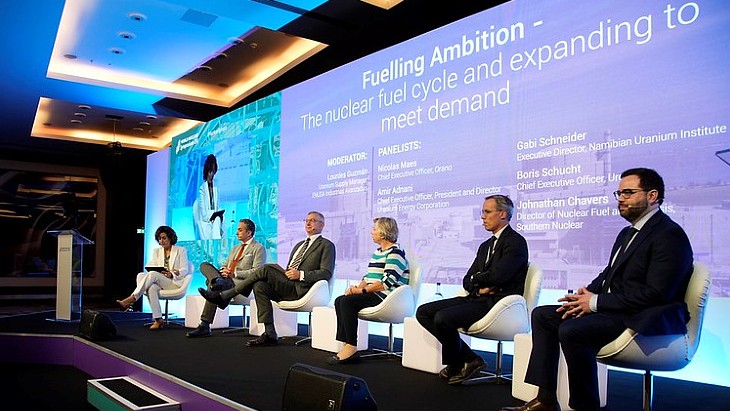
Leading figures from across the fuel cycle say they are ready to meet increased demand, but set out areas where change is required to help make it happen, in a World Nuclear Symposium session. (Image: World Nuclear Association)

The background

More than 120 nuclear energy and technology companies and 25 countries have signed up to the pledge to aim to at least triple global nuclear energy capacity by 2050. One key question is how fuel supplies will be able to expand if such a goal is to be achieved. Here are extracts of what key sector figures said during a discussion on the subject.

Nicolas Maes, CEO Orano

Nicolas Maes said that on mining Orano's current strategy was to expand existing projects, while in the medium term it was "revisiting our exploration policy and the means that we are allocating to exploration ... we believe that there are many areas in this world that have been vastly unexplored". It was also developing "mining techniques to make deposits that were today not so accessible, accessible - or non-conventional deposits that could make sense now". He used the analogy of the idea of "peak oil" saying that it was talked about in the 1920s "people were already fearing they would miss oil, and then techniques developed and they found new deposits and all the rest, and peak oil still hasn't materialised. We believe that in investing in exploration and exploration techniques as well as in mining techniques" that will increase the uranium sources available and will cater for the "medium term", which he categorised as the next 40 to 50 years. For the longer term, he said that recycling was a big focus.

In terms of conversion and enrichment he said that production had been expanded over the past few years - Orano plans to extend enrichment capacity at its Georges Besse II uranium enrichment plant in France, with Maes saying the aim is for first concrete for the extension in October this year, targeting the start of production in 2028. He said expanded capacity required a "massive investment compared to our scale and that can only be done if we've got visibility and the utilities support us in doing that". For LEU and HALEU, he said that the technologies are there but it was "chicken and egg stuff from the market", and transport issues need to addressed. For MOX-fuel based fast breeder and molten salt reactors he said the designers should be "thinking from the very early days about the fuel supply chain because that fuel supply chain doesn't exist yet" and also that "standardisation is key".

He added that, more generally, "we need strong decision-making and timely decision-making from politicians. We need creative financing schemes, and we need the industry to deliver on time and on budget".

Jonathan Chavers, Director of Nuclear Fuel and Analysis, Southern Nuclear

Jonathan Chavers said there was a chicken and egg situation between the suppliers and end users - "utilities desire firm pricing, predictable scheduling. The suppliers want firm contracts before they'll make the capital investments to get you the material you want on the schedule you want" and the question is how to get people "to take the big bet". He highlighted as a success the accident-tolerant fuel programme "where you have policymakers, utilities and suppliers all aligned and working together".

Chavers also focused on the transportation involved in the nuclear fuel supply chain. "Historically, utilities have not paid that much attention to the logistics. We depended on the suppliers just to ensure that things were moving as it needed to and got to the deliveries that we needed," but in reality, uranium mined out of an asset in North America "may cross the Atlantic multiple times before it's in a final fabricated fuel assembly that's put into our nuclear reactors". This means inventories have been built higher to ensure cover for any supply chain disruption "so frankly today we're getting by and we're creating some insurance policies, for lack of a better word" for any logistics disruptions. "If we really have this demand growth and build-out of nuclear capacity do we have the logistics infrastructure in place to support that additional volume that's going to be needed to go back and forth, especially between Europe and the US to ultimately get us to a final fabricated assembly?"

On the question of a single thing to help in terms of the tripling nuclear capacity goal, he said that all those involved in the symposium discussion in London were from different companies and parts of the industry, but were all nuclear professionals, and "we're always just one bad news story away from losing the momentum that we have" so the priority was "safety first and superior performance - as long as we execute on those, all the rest of it will work out".

Boris Schucht, CEO Urenco

Boris Schucht said that the momentum "which is now expressed in the tripling of nuclear is fantastic - that is something we have not seen". There were questions about whether the goal was realistic but, looking at the example of China today and France between 1970 and 2000, it was possible to triple capacity. But the current momentum needed to be maintained, he said and "it should not be a straw fire". It was also necessary for political ambitions to be translated into political action - on people and education, nuclear regulations, financial regulation, supporting the supply chain, the generators "and I think a lot of countries are working on that". The other issue was the industry had to deliver projects on time and on budget.

As with other speakers, Schucht referenced the chicken and egg situation, saying that when it comes to HALEU supplies, Urenco was ready to sign contracts wth advanced and small modular reactor projects. "I want to use the opportunity to motivate our potential new customers in the room and to go ahead ... it's about the whole ecosystem. You need transport packages, you need a lot of things, a lot of regulatory question ... a lot still that we have to develop ... that needs to be based on real contracts on real projects so that we really understand what is needed. So I'm optimistic on it, but we are not yet fully there. We have done the first, I think important step, but that needs to continue."

On the question about key measures to pave the way to capacity expansion, Schucht said that politicians need to continue "to translate the political momentum into political actions, and that's not only about legislation, finding solutions, but also giving long-term guidance to the market, to the industry. We all make decisions that will operate for the next 40, 50, 60 or 70 years" which is hard if "you always have the fear that the next government is taking opposite political decisions".

Gabi Schneider, executive director of the Namibian Uranium Institute

Gabi Schneider said that "during the period of low uranium prices - or the sleeping period as I heard somebody referring to it during the course of this week - we did not sleep, but companies active in Namibia rather used the opportunity, the time that was available to work on their programmes ... there was many a drilling campaign to increase the resource space ... so as a result, now with the situation where the price has reached a level where many projects can come to fruition, all of this work was already done". She said that her "optimistic outlook" was that if all projects come to fruition, "Namibia will be able to, not triple its output, but to more than double the output".

In response to the question of what the most important thing that needs to happen to facilitate a tripling of nuclear capacity by 2050, she said that from an African perspective "I think to reach this goal, we need a lot of uranium. So we need to find a lot more uranium deposits. I think we need a lot more exploration, so it is up to individual countries to put a conducive environment in place ... legal, infrastructure and all the other issues that are required to build world class uranium mines".

Amir Adnani, CEO Uranium Energy Corporation

Amir Adnani said that although it was starting from a low base the USA was currently the "fastest growing jurisdiction for uranium exploration and mining in the world" with potential production growth "to 20 to 25 million pounds per year within five years". He added: "We're seeing this unprecedented need for new suppliers to emerge in our industry. If we're going to truly have the foundations for a global, robust industry it starts with uranium ... historically, in the 1980s the US-led the world in uranium production ... so this is not a lost art and science. The regulatory framework exists ... we have very understanding capital markets in North America that understand this business ... and this unbelievable bipartisan support".He likened his company's strategy during the bear market to someone buying Christmas decorations for the following year in the January sales. He also added that, irrespective of geopolitics, "there has to be a robust domestic answer as well to the fuel cycle - we can't be importing everything" and praised govenment initiatives in the USA whoch have "levelled the playing field with renewables", in terms of the subsidies they had benefited from. What are the fuel cycle challenges of tripling nuclear capacity?:
Read More........

Viewpoint: Providing a platform for young nuclear professionals : Perspectives

Could you tell us about the current IYNC priorities?

Kristine Madden, president of the International Youth Nuclear Congress (IYNC), discusses the key challenges and opportunities for young nuclear professionals in the near future.

IYNC is a global organisation of young nuclear professionals committed to bridging the knowledge gap between generations and fostering international collaboration. Through different initiatives, we not only support professional growth but also enhance public understanding of the potential of nuclear technologies.

Since the last Congress in Japan in 2022, global interest in nuclear energy has continued to grow. Both the International Energy Agency (IEA Net Zero Roadmap: A Global Pathway to Keep the 1.5°C in Reach: 2023 Update) and the Intergovernmental Panel on Climate Change (Global Warming of 1.5°C, 2018) have reported the need for significant increases in nuclear power by 2050. Concurrently, we have observed a global rise in youth's favorable view of the role of nuclear science and technology in achieving net-zero goals. A survey conducted by YOUNGO, the youth constituency of the United Nations Framework Convention on Climate Change, revealed that 60% of young people consider nuclear energy essential for the transition to net-zero, while another 20% feel they lack sufficient information to make a decision for or against it. This shared belief underscores that without nuclear power, the Sustainable Development Goals cannot be realised. Nuclear technologies are indispensable for improving quality of life in areas such as agriculture, medicine, and security. Young professionals are crucial to the industry's future.

So, to answer your question, IYNC's main priorities have not changed.

The three main priorities I would like to highlight include:
  • Knowledge Transfer, Education, and Intergenerational Decision-Making: IYNC is dedicated to providing educational opportunities for young professionals in the nuclear field, promoting knowledge transfer and intergenerational decision-making.
  • Networking and Collaboration: We offer a platform for young nuclear professionals worldwide to connect and collaborate, fostering networking and collaboration across generations.
  • Advocacy and Public Awareness: We are committed to advocating for and raising public awareness about the importance of nuclear technologies today and in the future.
What are the key issues to be discussed at the congress?

The theme of this year's Congress is “Youth Powering the Future.” The event will be held in Abu Dhabi, UAE, from 29 September to 4 October 2024.

At IYNC, we recognise the key role young people play in the development of the global nuclear industry, and with plans for new builds worldwide, we need to make a quantitative leap in attracting and training the next generation of leaders for these future projects. Our supporters - the leaders of the world's nuclear industry - understand this necessity. They collaborate with us not just by providing sponsorship but also by sharing their expertise, offering mentorship, and supporting the growth of the next generation. They do this through opportunities like participating in our Leaders4Nuclear and Innovation4Nuclear initiatives, the IYNC2024 conference, and working with us to open spaces for young people to be part of the decision-making processes.

This year at IYNC2024, we will discuss the role of nuclear technologies in mitigating climate change, explore emerging technologies in the fuel cycle, and develop innovative strategies for resource efficiency. A key focus will be on ensuring the long-term viability of nuclear energy. Additionally, we will, discuss the vast career opportunities for youth in the nuclear sector. We will also provide opportunities for youth to enhance their public speaking skills, integrate IAEA Safeguards-by-Design (SBD) into new designs, and utilise AI through our interactive workshops.

Why is IYNC an important organisation/forum?

IYNC is a vital community for professionals in the nuclear industry, offering a unique platform for knowledge exchange, networking, and professional growth. For over 20 years, we have maintained a consistent schedule of regular meetings, which are crucial for learning from industry leaders and sharing experiences. However, our purpose extends far beyond simply convening regular meetings.

The importance of IYNC lies in its role as a bridge between experienced professionals and those new to the field. By learning from the leaders of the global nuclear industry, participants gain valuable insights and expertise that are essential for navigating the complexities of nuclear technologies. At the same time, our community provides an opportunity for professionals to share their experiences, challenges, and successes, fostering a culture of continuous learning and improvement.

Moreover, IYNC serves as an inclusive forum where diverse motivations for exploring nuclear energy converge, unified by a common goal: creating a cleaner, safer future. Whether driven by environmental concerns, technological curiosity, or a commitment to energy security, our members all share a vision of harnessing nuclear technology for the betterment of society. Through our events, initiatives, and collaborative projects, IYNC plays a critical role in shaping the next generation of nuclear professionals, promoting innovation, and advancing public understanding of nuclear energy's potential.

What is the current situation with nuclear capacity expansion and climate change concerns?

Many existing nuclear power plants are receiving licence extensions, and there is a noticeable increase in new builds as countries work to address the risks posed by climate change. This growth in our community means that IYNC is also expanding its efforts to meet the evolving needs.

I am particularly excited about the shifting perspectives on the role of nuclear power in combating climate change. For the first time, the nuclear industry was invited to YOUNGO’s annual Conference of Youth, held just before COP28, to discuss technological solutions for achieving net zero alongside other youth experts. At the end of their conference, YOUNGO released the Global Youth Statement, which, for the first time, acknowledged nuclear power as a crucial component of the net-zero energy equation. This Statement played a key role in the Global Stocktake, which also recognised nuclear power as a vital energy source.

IYNC is dedicated to fostering conversations that allow young people to explore and understand nuclear energy. Additionally, in collaboration with the Clean Energy Ministerial’s Nice Future Initiative, we have launched a new webinar series called Climate Talks. This series aims to broaden our youth’s understanding of the climate discussion beyond just nuclear energy, recognising that nuclear energy is just one part of the larger solution and empowering our youth is essential in this effort.

How do you support the global nuclear sector through knowledge, contacts and advocacy?

Most IYNC members are involved in nuclear companies, but we’re seeing a growing number of new members from the broader energy and climate sectors. For students and young professionals, we provide opportunities to learn more about nuclear science and technology, as well as explore career opportunities in the field. IYNC thus acts as both a professional hub for exchanging expertise and a stepping stone for career development.

We recently launched the Leaders for Nuclear (L4N) initiative to support young professionals stepping into leadership roles within the sector and to ready young professionals as we work to increase spaces for intergenerational decision making within the sector. The initiative is divided into three specialised tracks: Nuclear Applications, which focuses on advanced nuclear technologies beyond the energy industry; Nuclear Power, which delves into the details of nuclear power generation, management, and new reactor technologies; and Nuclear Safeguards, which tackles the critical areas of nuclear safeguards and non-proliferation. We are currently working with our first cohort of leaders and will present the initial results at IYNC2024 in the UAE.

To further increase accessibility to nuclear technologies, we’ve revamped our website to include the Worldwide Industry Events Hub, a comprehensive calendar of upcoming conferences, events, fellowships, scholarships, and workshops. This resource keeps our followers informed and engaged with the latest industry developments.
Additionally, IYNC co-leads the Nuclear4Climate Initiative, which provides a platform for COP attendees to learn more about nuclear science and technology. Separately, IYNC works with non-nuclear organisations to develop collaborative solutions and facilitate Q&A sessions year-round. This year, we also sent participants to SB06 to explore how we can increase our impact, and we plan to continue focusing on this area.

We’ve also boosted our social media presence to continue to educate the public about nuclear power.

Is Gen Z ready for a key role in nuclear expansion and why?

Every generation is ready if they are well-prepared, and Gen Z is particularly attuned to climate change issues and eager to play a role in addressing them. This generation not only supports nuclear technologies but also has a solid understanding of their applications. They grasp the basic principles of nuclear power plant operations and are aware of the diverse uses of nuclear technology in fields such as agriculture and medicine. Their interest is driven by a genuine curiosity rather than fear.Effective communication with Gen Z is essential, as they are skilled at discerning and filtering information. Within our community, a substantial proportion of our members are in their 20s, actively contributing and sharing their knowledge with enthusiasm. There is no doubt about Gen Z's commitment to advancing nuclear technology and their readiness to engage in meaningful ways.Viewpoint: Providing a platform for young nuclear professionals : Perspectives - World Nuclear News
Read More........

Paris Olympics: Recent success gives me confidence to aim for gold: Boxer Lovlina Borgohain

New Delhi, (IANS) Bronze medallist at the Tokyo Olympic Games, woman boxer Lovlina Borgohain has expressed "confidence" in winning a gold medal in the upcoming Paris Olympics. Borgohain’s confidence is backed by a series of remarkable performances, including a gold medal at the 2023 World Boxing Championships and a silver medal at the 2022 Asian Games.

In a conversation on JioCinema's 'The Dreamers,' she expressed her aspirations to clinch gold at the upcoming edition of the Games. Borgohain’s transition from the Welterweight (69 kg) to the Middleweight (75 kg) category marked a turning point in her career.

“I used to consistently win bronze, but since switching to the 75 kg category, I’ve seen remarkable improvement. Despite initial skepticism about weight gain, it has proven beneficial. I’ve won four consecutive gold medals in the National Games, National Championships, World Championships, and Asian Championships. This success gives me the confidence to aim for Olympic gold,” she said.

Discussing her preparation for Paris 2024, Borgohain emphasised the importance of meticulous planning and dedication. “Every day and every session counts as we approach the Olympics. Setting a target and working diligently towards it motivates me. I structure my training to maximise productivity, ensuring each day brings me closer to my goal of winning gold.”

Reflecting on her journey, Borgohain shared a poignant childhood anecdote that ignited her passion for boxing.

“When I was young, I didn’t know much about boxing. My father, who worked in tea plantations, brought home sweets one Sunday wrapped in a newspaper with an article about Muhammad Ali. That moment sparked my interest in boxing. My journey began with martial arts, and then I moved directly to competing in national boxing, using my martial arts knowledge to guide me," the pugilist said.

Offering advice to aspiring athletes, Borgohain highlighted the critical elements of success. “Discipline, focus, and sacrifice are essential. The journey is fraught with challenges, including injuries, but perseverance is key. Overcoming these obstacles is what makes a champion.”Borgohain, an Arjuna Award winner and Khel Ratna awardee joins the ranks of Vijender Singh and Mary Kom as Indian boxers to win an Olympic medal. As she prepares to compete in the women’s 75kg event at Paris 2024, her recent victories at the 2023 World Boxing Championships and 2022 Asian Boxing Championships solidify her status as a top contender. Paris Olympics: Recent success gives me confidence to aim for gold: Boxer Lovlina Borgohain | MorungExpress | morungexpress.com
Read More........

Euro 2024: 'I'll always give my best for this shirt...', says Ronaldo after penalty miss against Slovenia

Frankfurt, (IANS) Portugal pulled through in their Round of 1 matchup vs Slovenia. The game remained goalless after 120 minutes and it was Diogo Costa who proved to be the hero as the goalkeeper saved three penalties in the shootouts.

Despite the win, a lot of the focus was on Cristiano Ronaldo as the Euros top goalscorer of all-time failed to convert a penalty in the 105th minute of the game and missed the chance to give his side the victory.

"This will be my last Euro, of course. But I’m not moved by this, I’m moved by enthusiasm. I was sorry for the fans. I'll always give my best for this shirt, whether I miss it or not. And I'll do this my whole life. You have to take responsibility," said Ronaldo in the post-game conference.

Following the penalty miss, Ronaldo was seen crying, breaking the hearts of many football fans around the world. The five-time Ballon d’Or winner later went on to turn his disappointment into a smile as he scored a penalty during the shootouts.

"I could have given the national team the advantage, but I didn’t manage it, Oblak saved. I didn’t miss once during the year, when I needed it most Oblak saved.It’s a feeling of sadness and joy at the same time, but the most important thing is the progress, the team deserved it," added the all-time top scorer of the Euros.

Portugal’s win has set up a firecracker bracket in the European Championship. The 2016 winners will take on France in the quarterfinals of the tournament and the winner of the match-up will be facing the winner of the match between Spain and Germany."Slovenia spent almost the entire time defending, the team deserves congratulations, especially our goalkeeper who made three good saves. Even the strongest people have their days, I was down and I was sad because the team needed me," Ronaldo concluded. Euro 2024: 'I'll always give my best for this shirt...', says Ronaldo after penalty miss against Slovenia | MorungExpress | morungexpress.com
Read More........

Sonakshi finds it 'a bit more daunting' to be a business woman

Mumbai, (IANS) Actress Sonakshi Sinha, who has also stepped into the world of business with her nail label, said that being an entrepreneur is a bit more daunting as it doesn’t come “naturally to her.”

Talking about what’s more daunting, being an actress or being a business person, Sonakshi told IANS: “I think acting comes like second nature to me and it has always been like I have learnt everything on the go but I never felt uncomfortable doing anything. Right now as an entrepreneur, that is something very very new.”

“I am again learning the ropes and I am involved as much as I can be. It's something really different for me. I am really loving it. I feel that is a bit more daunting than acting was for me because it doesn’t come naturally.”

The actress added that “business is something I have to learn still and I think I am doing pretty well at that.”

On the personal front, Sonakshi loves listening to music and shared that her playlist is very “diverse.”

“I love to listen to music that sounds good so you can find anything from Hindi film songs to Punjabi music to house music. I love percussion. I love a lot of instrumental songs with just beats,” said Sonakshi.

However, Punjabi music dominates her playlist.“That is something you will find on my playlist. It’s very random list but I do listen to a lot of Punjabi music,” said the actress. Sonakshi finds it 'a bit more daunting' to be a business woman | MorungExpress | morungexpress.com
Read More........

'Not many players in world as lethal as Ronaldo', opines Sunil Chhetri

New Delhi, June 11 (IANS) The 2024 Euros are just around the corner and just like it has been for the past two decades, the spotlight will fall on Cristiano Ronaldo who has often been hailed as Portugal’s greatest player ever.

The 39-year-old has not scored an international goal since November, 2023 and has also been benched a few times for young striker Goncalo Ramos.

Ahead of the tournament, India’s all-time top scorer Sunil Chhetri talked about Ronaldo's role and importance in the team in an exclusive conversation with IANS.

"I hope Ronaldo starts as many games as possible. I would love to see him. I think if there’s one team that can keep him as a number nine and not expect too much defensive work, I don’t mean that he should not or that he does not but I’m saying can expect less is Portugal," Chhetri told IANS.

"It is a star-studded team they're very good at keeping the ball, more than often they're dominating. They are dominant when it comes to keeping the ball more than often. They have some top players so they can afford to have Ronaldo on the box," he added.

Ronaldo is only one of three players in the world to have scored more international goals than Chhetri. He has been the Portugal team's pillar and led them to the 2016 Euro title.

"He might not be doing as many quick turnarounds and quick defensive work, but when you get half a chance, there probably aren't many players in the world as lethal as him. So why not? So I think as a fan, somebody who has learned so much from him the last 20 years, I hope we get to see more of him on the pitch as far as playing 11 is concerned.

"I'm pretty sure the coach is going to pick the best one, but having Ronaldo always gives you an edge because half a chance is a goal when it comes to him," the former Indian skipper said.

Chhetri is the expert panellist on Sony Sports Network's studio show Football Extra for UEFA Euro 2024.

Watch UEFA Euro 2024 from June 15, 12:30 AM IST onwards, live on Sony Sports Ten 2 SD & HD, Sony Sports Ten 3 SD & HD (Hindi), Sony Sports Ten 4 SD & HD (Tamil / Telugu), Sony Sports Ten 5 SD & HD (Malayalam / Bengali). Not many players in world as lethal as Ronaldo', opines Sunil Chhetri | MorungExpress | morungexpress.com
Read More........

Don't Blame Me: Taylor Swift's influence attracts conspiracy theories

WASHINGTON - A Fox News host suggested this week that Taylor Swift is a "front for a covert political agenda," echoing disinformation that has percolated in right-wing circles for months -- and which experts say will likely get worse before the 2024 US election.

The Jesse Watters segment warning Swift could be a "Pentagon asset" offered the latest conspiracy theory exploiting the singer-songwriter's fame and her past support for Democrats such as President Joe Biden.

Attacks targeting Swift in recent months have ranged from personal barbs to accusations of witchcraft and speculation about her political involvement.

"Have you ever wondered why or how she blew up like this? Well, around four years ago, the Pentagon psychological operations unit floated turning Taylor Swift into an asset during a NATO meeting," Watters said Tuesday, resurfacing a clip from a 2019 summit by NATO's cyber defense hub.

But the video's only mention of Swift comes during a presentation on how social influence could counter misinformation, when a researcher unaffiliated with NATO cited the singer as an example of a popular celebrity.

"As for this conspiracy theory, we are going to shake it off," Pentagon deputy press secretary Sabrina Singh told AFP, referencing one of Swift's hits.

Watters also brought up a reported traffic surge on Vote.org in September -- immediately after Swift posted an Instagram story encouraging fans to participate in National Voter Registration Day -- to posit that someone "got to her from the White House or from wherever."

Reached by AFP, Swift publicist Tree Paine pointed to the nonprofit CEO's response to Watters's claims.

"Our partnership with @taylorswift13 is helping all Americans make their voices heard at the ballot box," Andrea Hailey said on X, formerly Twitter. "Not a psy-op or a Pentagon asset."

Watters -- whose primetime show is the second-most watched cable news show in the United States, drawing an average audience of nearly 2.5 million viewers -- conceded later during the segment that he "obviously has no evidence" for the claims.

Fox News declined to comment on the record for this story.

- Exploiting celebrity -

GETTY/Getty Images via AFP/File | JAMIE SQUIRE

Already a megastar, Swift's stature grew in 2023, as she broke music records, performed the highest-grossing music tour in history and began dating American football player Travis Kelce. Time magazine named her Person of the Year.

As Swift's star rose, so did attacks against her. Fringe influencers such as far-right radio host Stew Peters accused her of witchcraft at concerts and claimed she was "responsible for murder" after Kelce appeared in a vaccine ad.

Doctored images shared online falsely linked her to convicted sex offender Jeffrey Epstein, while several conservative commentators have insulted her private life and appearance. Activist Charlie Kirk asked on one podcast if she has "any eggs left."

"The way in which it is happening is very gendered because it is relatively easier to attach incredulous disinformation claims to female celebrities," said Swapnil Rai, an assistant media professor at the University of Michigan.

Claims that Swift is a Democratic operative were bubbling up online before Watters mainstreamed them.

"I SAID IT FROM THE BEGINNING," a top promoter of the QAnon conspiracy theory said after Watters's segment. "Not only is Taylor ADMITTEDLY a satanic witch, but she's also being used as a PENTAGON PSYOP ASSET to swing MANY THOUSANDS of youth votes over to the Democrats."

- 'MAGA vs Swifties' -

Laura Loomer, a far-right former congressional candidate who has repeatedly amplified the "psyop" claims, has said that "2024 will be MAGA vs Swifties."

The superstar is likely to play a role in the election -- albeit not as a "Pentagon asset."

"I cannot think of another celebrity whose endorsement and activities on behalf of a candidate would be more coveted," said David Jackson, a political science professor at Bowling Green State University, adding that he expects more attacks as the election approaches.

The famously tight-lipped Swift remained quiet during former president Donald Trump's 2016 campaign, but she later criticized him and endorsed Biden in 2020.

More recently, she spoke against the Supreme Court's decision to overturn abortion rights, and urged concertgoers to research which politicians support LGBTQ communities and vote against legislation "harmful" to them.

"I suspect that conservatives are concerned about the power she might have to rejuvenate interest among younger Democratic voters," said Johanna Blakley, a media scholar at the University of Southern California.

"Putting a disinformation (or) psyops spin on her role in the election seems like a thoroughly disingenuous effort to undermine and potentially pre-empt Swift's likely endorsement of Biden."

Read More........

Private sector funding key to climate transition, World Bank chief says

WASHINGTON - The World Bank is working to slash how long it takes to get financing projects off the ground as part of a push to speed up and scale up the 79-year-old development lender, its president told AFP on Wednesday. 

It currently takes 27 months, on average, before "the first dollar goes out the door," Ajay Banga said in an interview in his brightly lit office in the Bank's headquarters close to the White House.

"If I can bring it down by one third over the first couple of years, that would be pretty good," he said. "The Bank needs to change and evolve."

Banga, an Indian-born, naturalized US citizen who previously ran the payments company Mastercard, took over the management of the bank in June on a pledge to boost its lending firepower by encouraging greater private investment in the fight against climate change.

In the seven months since, the 64-year-old has made some big changes, altering the development lender's mission statement to include a reference to climate change, and setting up a private sector advisory body to recommend solutions to address the "barriers to private sector investment in emerging markets."

He's also explored new ways to "sweat" the bank's existing balance sheet in order to boost lending capacity without additional funding from donor countries.

On Wednesday, Banga repeated a previous pledge to "fix the plumbing" of World Bank, and said he plans to "create the credibility" needed for the developed world to increase its capital investment in it.

"For that you have to become a better bank. You have to be quicker, faster, more focused on impact, less focused on input," he said. "Then you can say with credibility, 'I'm now ready to absorb more capital.'"

- Climate or development? -

As part of a push to increase its climate financing, the World Bank Group recently raised its target for climate-related projects from 35 percent of its annual financing to 45 percent.

"I think people in the global south recognize very well that you cannot fight poverty without fighting climate change," Banga said. "The only difference is, what do you mean by climate change?"

Whereas the developed world tends to discuss climate change in terms of mitigating carbon emissions, "the developing world tends to speak about climate change as adaptation," he said.

"They see the climate change impact on them in terms of irrigation, rainfall, soil degradation, loss of biodiversity, forestry cover, that kind of thing," he added.

To meet both of these challenges, the World Bank has decided that half of the 45 percent committed to climate financing in the next financial year will go to adaptation, and the other half to mitigation.

"You have to find these compromises, to enable the donors and the receivers to feel that the bank is navigating in the right way," Banga said.

- Growing the pie -

However, even if the Bank succeeds in raising additional capital from its members and squeezing additional dollars from its balance sheet, it is still unlikely to meet the scale of the challenge posed by climate change alone, Banga said.

The World Bank recently estimated that developing countries will need an average of $2.4 trillion each year between now and 2030 in order to address the "global challenges of climate change, conflict, and pandemics."

Given that the Bank's lending commitments in the most recent financial year were less than $130 billion, the only way to get close to this target is by encouraging far greater private sector participation, according to Banga.

To encourage the scale of private financing needed, Banga said he was working to resolve three outstanding issues.

The first is regulatory certainty, so investors have a "line of sight" to a country's longer-term policy priorities.

The second, more complex, challenge is foreign currency risk.

In many cases, private investors looking to invest in emerging economies are unable to hedge against the risk of fluctuations in the value of local currencies, because local markets simply aren't deep and wide enough, Banga said.

"That's the one that we're really trying to work on," he added.

The third issue is how to protect investors better from risks like war and civil unrest.

This task is currently split among three different World Bank Group institutions, and is done on far too small a scale, Banga explained.

If the bank is able to boost the amount of political risk guarantees it can provide, and simplifies access, they could play a significant role in unlocking private capital, he said.

"The reality is that that gap between tens and hundreds of billions to trillions is not a number that the bank can fill," he added.

"That's why you do eventually need the private sector."

da/dw

Read More........

Aviation in a ‘purple patch’ amid new plane crunch, AirAsia says

Malaysia-based AirAsia founder Tony Fernandes remains bullish on air travel. MUST CREDIT: Richard Humphries/Bloomberg
The aviation industry is experiencing a “purple patch” with demand for seats far outstripping capacity amid a long wait for new aircraft and a shortage of pilots further discouraging any fresh competition, Tony Fernandes, the founder of low-cost carrier AirAsia, said. Malaysia-based AirAsia for its part is set to witness its “best ever period” with most of the carrier’s 240 planes back in the sky and “airfares at their best,” Fernandes said during an interview near Kuala Lumpur’s international airport on Monday. “I’ve never been this bullish before,” Fernandes, who started AirAsia 23 years ago, said. “Southeast Asia is going through a renaissance period of sensible economics, and that’s a good thing.” On the back of that, AirAsia plans to raise as much as $600 million in coming months, Fernandes said, as he tries to pull off a merger between his two aviation businesses – long-haul carrier AirAsia X Bhd. and short-haul airline AirAsia, which is currently a unit under Fernandes’ more diversified company Capital A Bhd. Following the merger, which is expected to conclude mid-year, the new entity will look to raise up to $400 million via selling equity, Fernandes said. Citigroup Inc. and US advisory bank Evercore Inc. have been appointed to lead the capital raising. A $200 million revenue bond, securitized against revenue from new routes, is also expected to be finalized soon, he said. Fernandes said the merger of the two airlines will create a new firm called AirAsia Group that will subsequently take over AirAsia X’s listing on Bursa Malaysia. The company may also do away with its AirAsia X branding as the aviation businesses consolidate. AirAsia has ambitions to expand its footprint from a predominately Asian airline to a global low-cost carrier with a more extensive network. It plans to start flying to Kazakhstan, its first route in Central Asia, later this year. Fernandes, who has previously spoken about succession at the company he founded, said Monday that he would retain an advisory role at AirAsia Group following the merger. He’ll remain chief executive of Capital A, his other listed company that will ultimately hold all the non-aviation businesses he’s started. Those include Teleport, a logistics company, and Move, an online travel agency that also operates a ride-hailing business. Move is finalizing a $30 million capital raising while Teleport has raised $35 million in debt, he said. The company’s aircraft-maintenance arm, Asia Digital Engineering, has also managed to raise $100 million, Fernandes said. The Financial Times reported in October that Capital A is seeking to raise more than $1 billion in debt and equity and list some of its businesses through a blank-check company in New York. The company said in November that it will seek a Nasdaq listing via a special purpose acquisition company merger with Aetherium Acquisition Corp.“2024 will be a very good year. 2025 will be an amazing year,” Fernandes said. “There’s a lot of growth for us. Aviation in a ‘purple patch’ amid new plane crunch, AirAsia says
Read More........

Telecom Italia approves US fund's bid for network

ROME - Telecom Italia on Sunday approved an offer by US investment fund KKR for its fixed-line network, infuriating its main shareholder which vowed to contest the "illegal" decision.

The Italian telecommunications operator is seeking to sell its fixed network to pare down a huge debt pile that stands at more than 26 billion euros ($28-billion).

TIM said its board had approved the deal, whose value could reach 22 billion euros and which would reduce the debt by "around 14 billion euros".


Its main shareholder, French media giant Vivendi, has opposed selling the network and valued it at 31 billion euros, saying KKR's previous bids were far too low.

Vivendi said it would "use all legal means at its disposal" to contest TIM's "illegal" decision.

It had previously threatened to launch legal action if the KKR offer was approved without being submitted to an extraordinary general assembly of shareholders, where Vivendi would carry considerable weight.

"The rights of Telecom Italia shareholders are being trampled on," Vivendi added.

TIM chief executive Pietro Labriola welcomed the board's "historic decision" and said he remained open to dialogue, particularly with the "biggest shareholders".

The Italian government is already the second-largest shareholder in TIM, which was privatised in 1997.

Prime Minister Giorgia Meloni's government intends to take a stake of up to 20 percent in the fixed-line network, viewing it as strategic infrastructure.

After months of suspense, TIM's board in June approved the start of exclusive negotiations with KKR.

The board rejected a lower offer from the Italian Caisse des Depots and Australian fund Macquarie Asset Management, worth around 19.3 billion euros.

If the deal goes through, TIM will become the first major operator in Europe to sell its fixed network on its domestic market to slash debt.The debt load is hampering TIM's efforts to invest in rolling out fibre optic networks, where Italy is lagging behind other advanced economies.Telecom Italia approves US fund's bid for network
Read More........

Google’s plan to talk about caste bias led to ‘division and rancor’

FILE PHOTO: A sign is pictured outs a Google office near the company’s headquarters in Mountain View, California, U.S., May 8, 2019. REUTERS/Paresh Dave/File Photo
The rising Hindu nationalist movement that has spread from India through the diaspora has arrived inside Google, according to employees and an activist on caste bias. In April, Thenmozhi Soundararajan, the founder and executive director of Equality Labs – a nonprofit that advocates for Dalits, or members of the lowest-ranked caste – was scheduled to give a talk to Google News employees for Dalit History Month. But Google employees began spreading disinformation, calling her “Hindu-phobic” and “anti-Hindu” in emails to the company’s leaders, documents posted on Google’s intranet and mailing lists with thousands of employees, according to copies of the documents as well as interviews with Soundararajan and current Google employees who spoke on the condition of anonymity because of concerns about retaliation. Soundararajan appealed directly to Google CEO Sundar Pichai, who comes from an upper-caste family in India, to allow her presentation to go forward. But the talk was canceled, leading some employees to conclude that Google was willfully ignoring caste bias. Tanuja Gupta, a senior manager at Google News who invited Soundararajan to speak, resigned over the incident, according to a copy of her goodbye email posted internally Wednesday and viewed by The Washington Post. Soundararajan – who has given talks on caste at Microsoft, Salesforce, Airbnb, Netflix, and Adobe – said Equality Labs began receiving speaking invitations from tech companies in the wake of the George Floyd protests. “Most institutions wouldn’t do what Google did. It’s absurd. The bigoted don’t get to the set the pace of conversations about civil rights,” she said. Longtime observers of Google’s struggles to promote diversity, equity and inclusion say the fallout fits a familiar pattern. Women of color are asked to advocate for change. Then they’re punished for disrupting the status quo. In Gupta’s goodbye email, she questioned whether Google wanted its diversity efforts to succeed. “Retaliation is a normalized Google practice to handle internal criticism, and women take the hit,” she wrote. Gupta was one of the organizers behind the 2018 Google Walkout, in which 20,000 Google employees around the world briefly walked out of their offices to protest the company’s mishandling of sexual harassment. The other organizers have already left the company. In a statement, Google spokesperson Shannon Newberry wrote, “Caste discrimination has no place in our workplace. We also have a very clear, publicly shared policy against retaliation and discrimination in our workplace.” “We also made the decision to not move forward with the proposed talk which – rather than bringing our community together and raising awareness – was creating division and rancor,” Newberry wrote. Equality Labs, based in Oakland, Calif., advocates for the civil rights of the caste formerly referred to as “untouchables” in a millennia-old system of social hierarchy that originated with Hinduism in India, but has proliferated to different religions across South Asia. Many Indians have moved to the United States to work in tech companies, and several Big Tech CEOs are of Indian origin, including Pichai, Microsoft’s Satya Nadella and Twitter’s Parag Agrawal. Some employees allege the patterns of discrimination have been replicated within Silicon Valley companies. Soundararajan, who is Dalit, spent years convincing policy teams at social media companies to include caste as a protected category in their hate speech policies. In meetings, company representatives seemed to have little understanding about caste, even though it impacted hate speech in their biggest markets, she said. So Equality Labs had to gather data and help social media companies develop cultural competency on caste. The group took the same research-driven approach to examining caste bias in the workplace. Through its advocacy on content moderation, Equality Labs developed a strong network of Dalit tech workers. After the California Department of Fair Employment and Housing (DFEH) filed a lawsuit against Cisco alleging caste discrimination, their phone lines were flooded with reports about bias and the group once again began collecting data. (Although U.S. employment law does not explicitly prohibit caste-based discrimination, the DFEH argues caste is a protected under existing statutes. Caste is a protected category in India, however. This leaves companies such as Google and Cisco, which have offices in both countries, with different standards for discrimination.) After the Google Walkout, Gupta went on to successfully advocate for ending forced arbitration both in Congress and inside Google, where she is also known for her work on diversity. Last September, Gupta was approached by two Google employees about the caste discrimination they had witnessed at the company, she wrote in her departure note. That prompted her to invite Soundararajan to present at a speaker series Gupta hosted on diversity, equity and inclusion for Google News. For the presentation, Soundararajan hoped to talk to the 60 or so Google employees scheduled to attend – who work in product and engineering in News and Search – about caste equity in newsrooms, building on a talk she delivered at Google’s Cloud Next event in November 2021. She planned to explain the makeup of mainstream Indian publications and the importance of highlighting Dalit journalists when reporting on issues such as climate change or elections, because of the insight they could bring from the perspective of the most vulnerable. Two days before Soundararajan’s presentation, seven Google employees sent emails to company leaders and Gupta “with inflammatory language about how they felt harmed and how they felt their lives were at risk by the discussion of caste equity,” according to emails sent by Gupta. Some of the complaints “copied content from known misinformation sites to malign the reputation of the speaker,” Gupta’s emails said – sites and organizations that have targeted academics in the United States and Canada who are critical of Hindu nationalism or caste hierarchy. These online campaigns can spook institutions unfamiliar with the politics of caste, Soundararajan said. “They ask, ‘Are there people in their own community that disagree with them? Maybe this is a battle we don’t want to get into.’ ” Google had previously vetted Soundararajan to give a similar talk, but executives postponed her presentation to the Google News team. Then the controversy within Google migrated to an 8,000-person email group for South Asian employees, according to three current employees. After Gupta posted a link in the email group to a petition to reinstate the talk, respondents argued that caste discrimination does not exist, that caste is not a thing in the United States, and that efforts to raise awareness of these issues in the United States would sow further division. Some called caste equity a form of reverse discrimination against the highest-ranked castes because of India’s affirmative action system for access to education and government jobs. Others said people from marginalized castes lack the education to properly interpret Hindu scriptures around castes. To Soundararajan, Google was long overdue for a conversation on caste equity. Pichai, the CEO, “is Indian and he is Brahmin and he grew up in Tamil Nadu. There is no way you grow up in Tamil Nadu and not know about caste because of how caste politics shaped the conversation,” Soundararajan told the Post. “If he can make passionate statements about Google’s [diversity equity and inclusion] commitments in the wake of George Floyd, he absolutely should be making those same commitments to the context he comes from where he is someone of privilege.” Soundararajan said Pichai has not responded to letter she sent him in April. Google declined to comment. According to Gupta’s letter and Soundararajan, the decision to cancel the talk came from Gupta’s boss, Cathy Edwards, a vice president of engineering, who had no experience or expertise in caste. In a Google Meet video call in mid-May after the talk was canceled, Soundararajan said Edwards acknowledged that Google had subjected her to a level of vetting no previous speaker had to endure. Google declined to make Edwards available to comment. Soundararajan warned that this level of scrutiny would mean that no Dalit would be allowed to speak on caste. She compared it to not letting an abuse survivor speak about the #MeToo movement. Edwards acknowledged the challenge, but said she had to deal with people crying on the other side of the line, Soundararajan said. Amid all the controversy, Gupta and Soundararajan posted on YouTube a version of the talk they had intended to give. During the video call, Edwards said she watched the talk and thought it was amazing.(This article was available on The Washington Post Syndicated Service on June 2, 2022) Source: https://www.newsindiatimes.com/
Read More........