
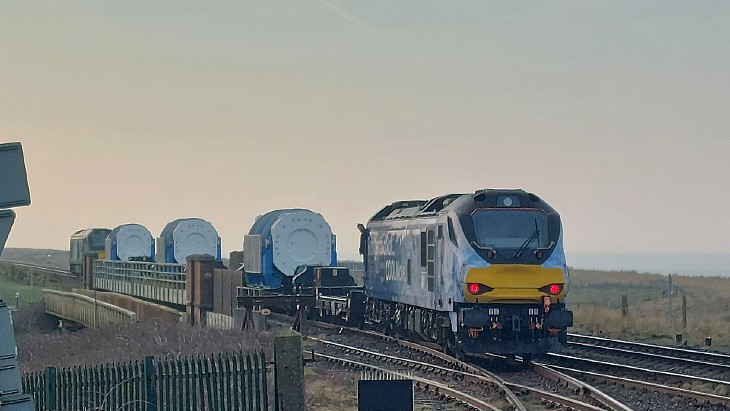
 (Image: Sellafield Ltd)
The second of three planned shipments of high-level radioactive waste has left the Sellafield site in northwest England and is being transported by rail and sea to its destination at the Isar interim storage facility in Germany.
Seven flasks containing the vitrified residues - the radioactive waste has been transformed into a stable glass-like form - travelled by rail to the port of Barrow-in-Furness before being loaded on to Pacific Grebe, a specialist nuclear transport vessel operated by the UK's Nuclear Transport Solutions, which set sail on Wednesday.
The first shipment, of six flasks each with 28 containers of high level waste, to Biblis, took place in 2020.
The waste comes from the reprocessing and recycling of Germany's used nuclear fuel at the Sellafield site, with Nuclear Transport Solutions saying: "Vitrified Residue Returns are a key component of the UK’s strategy to repatriate high- level waste from the Sellafield site, fulfil overseas contracts and deliver on government policy."
According to Germany's Federal Office for the Safety of Nuclear Waste Management (BASE) the transport licence was approved in December, with the repatriation of German waste a binding requirement under international law.
In its guide to the waste it says that until 2005 German utilities shipped used fuel from nuclear power plants to La Hague in France and Sellafield in the UK for reprocessing: "The resulting liquid waste was then melted down into glass and has since been gradually returned to Germany. The last shipment of this waste from France was returned in November 2024." There is one more shipment planned, after the current one, from the UK to complete the repatriation.
The federal office issued a licence in April 2023 for the storage of the vitrified waste at the Isar interim storage facility, which is licensed to hold a maximum of 152 casks of high-level radioactive waste and "according to current plans, there will be 28 fewer high-level waste casks there than originally intended, including the casks containing the vitrified waste".
According to German nuclear specialist GNS: "The waste is massively shielded from external radiation. In the reprocessing plant, the waste is mixed with liquid silicate glass and poured into cylindrical stainless steel containers, which are then sealed tightly after hardening. These containers, filled with the hardened glass mixture, are called "glass moulds". For transport and storage, the moulds are placed in ... massive, more than 100-tonnes cast iron and stainless steel containers, which have been proven in extensive tests to provide both strong shielding and to be safe under extreme conditions."
Until 2011 reprocessed waste was sent to the Gorleben interim storage facility in Lower Saxony, where 108 casks of vitrified radioactive waste have been stored, which was "already a large proportion of the total waste to be returned from reprocessing". According to BASE, as part of the Site Selection Act of 2013 to seek a repository for high-level radioactive waste, the remaining vitrified waste abroad was to be stored in interim storage facilities at nuclear power plant sites.
"The aim was to avoid giving the impression that Gorleben had already been chosen as the site for a final storage facility during the open-ended search for a repository site. In 2015, the federal government, the federal states and the utility companies agreed to store the remaining radioactive waste in Biblis, Brokdorf, Niederaichbach (Isar nuclear power plant) and Philippsburg," BASE says.
France's Orano completed the 13th and final rail shipment from France of vitrified high-level nuclear waste, to Philippsburg, in Germany in November 2024. In total 5310 tonnes of German used fuel was processed at Orano's La Hague plant up to 2008. The inter-governmental agreement governing those operations included a provision that the equivalent in mass and radioactivity of the waste contained in the used fuel elements must be returned to Germany.Until March 2011 Germany obtained a quarter of its electricity from nuclear energy, using 17 reactors. Following the Fukushima Daiichi accident eight reactors were closed immediately and the rest were scheduled to be closed by the end of 2022. Following the start of the Russia-Ukraine war, there was a brief extension for the last three operating nuclear power reactors - Isar 2, Emsland and Neckarwestheim 2 - but they closed in April 2023. Second-last high level waste shipment departs UK for Germany


