€631bn ‘Made for Germany’ initiative presents major opportunity for telcos


Major investments planned by both the private and public sectors could see connectivity flourish

This week, a consortium of 61 German companies have announced the launch of the ‘Made for Germany’ initiative, aimed at streamlining private sector dialogue with government and roadblocks for investment.

According to a shared press release, the initiative aims to create “a key point of contact for the government, working to define priorities, develop targeted measures and implement reforms effectively”. This, the companies say, will help to boost Germany as an economic hub and create a stable and inviting investment landscape for investors.

The 61 private companies participating in the initiative include major players from a wide variety of industries, from banking and automotive to semiconductors and pharmaceuticals. The full list of initiative members can be found here.

The initiative is supported by a collective pledge to invest €631 billion by 2028, demonstrating the companies’ continual commitment to the growth of the national economy.

The investments reportedly includes a mix of both planned and new capital investments and R&D efforts, although exactly how much of the total comprises new commitments is unclear.

“Germany needs a new operating system – one focused on growth, technology, and competitiveness. The time for change is now. Government and business must forge a new kind of partnership and take joint responsibility for society,” said Roland Busch, the CEO of Siemens. “This initiative embodies that spirit of solidarity and stands for a fresh start: with less bureaucracy, and more innovation. Germany is home to world-class companies, has a strong industrial base, and exceptional talent. We have everything it takes to reclaim a leading economic role – especially in digitalization and artificial intelligence.”

Busch’s reference to ‘joint responsibility’ should not come as a surprise given the recent pressure on the German government to make its investment landscape more appealing. In fact, the initiative’s announcement follows major government reforms to debt handling announced earlier this year. These reforms focus primarily on revising the strict borrowing rules that were introduced after the 2008 global financial crisis, removing what has been described as a ‘fiscal straitjacket’ on Germany’s economic growth.

In parallel, the government also pledged to create a €500 billion infrastructure fund to modernise the nation’s infrastructure and bolster national defence. Industries targeted for this funding include energy, transport, R&D, education, and healthcare.

“We are facing one of the largest investment initiatives that we have seen in Germany in recent decades,” said German Chancellor Friedrich Merz at a news conference announcing the ‘Made for Germany’ initiative. “The investment tasks we are facing cannot be achieved by public budgets alone. On the contrary, the lion’s share must be provided by private investors.”

But what does this all mean for the German telecoms sector?

While Deutsche Telekom and United Internet (1&1) are the only explicitly telecoms companies directly listed as participating in the ‘Made for Germany’ initiative, the sector as a whole has much to gain from its creation. When combined with the newly created infrastructure fund, the German market can expect €1 trillion to be poured into infrastructure and industrial projects in the coming years, all of which will need to be backed by the provision of high quality connectivity. This opportunity will be particularly acute around heavy industries like the automotive sector, where digitalisation efforts to expand the use of robotics, IoT, and AI will rely on high capacity low-latency connectivity – at least, that is what the telcos will argue.

At the same time, the reduction in bureaucratic hurdles and closer public–private cooperation could allow for the further acceleration of fibre rollouts, an area where Germany still significantly lags behind the rest of Europe.

In short, as the German public and private sectors grow more closely aligned on investment, German telcos will strive to position themselves key enablers of national digital transformation, without whom economic growth will remain unattainable.How is the German connectivity market changing in 2025? Join the discussion at Connected Germany live in Munich €631bn ‘Made for Germany’ initiative presents major opportunity for telcos | Total Telecom
Read More........

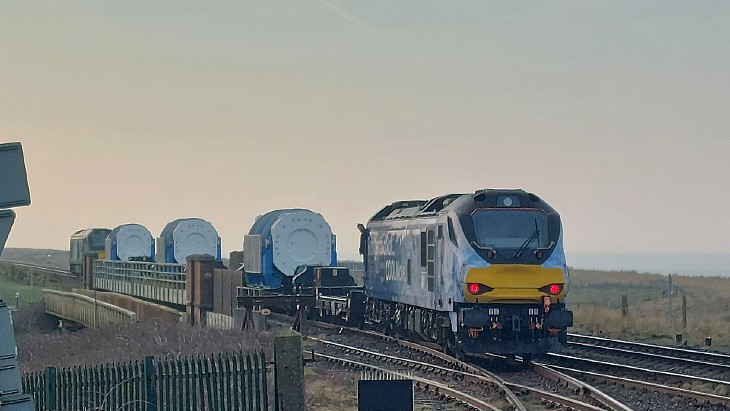
Second-last high level waste shipment departs UK for Germany

(Image: Sellafield Ltd)

The second of three planned shipments of high-level radioactive waste has left the Sellafield site in northwest England and is being transported by rail and sea to its destination at the Isar interim storage facility in Germany.

Seven flasks containing the vitrified residues - the radioactive waste has been transformed into a stable glass-like form - travelled by rail to the port of Barrow-in-Furness before being loaded on to Pacific Grebe, a specialist nuclear transport vessel operated by the UK's Nuclear Transport Solutions, which set sail on Wednesday.

The first shipment, of six flasks each with 28 containers of high level waste, to Biblis, took place in 2020.

The waste comes from the reprocessing and recycling of Germany's used nuclear fuel at the Sellafield site, with Nuclear Transport Solutions saying: "Vitrified Residue Returns are a key component of the UK’s strategy to repatriate high- level waste from the Sellafield site, fulfil overseas contracts and deliver on government policy."

According to Germany's Federal Office for the Safety of Nuclear Waste Management (BASE) the transport licence was approved in December, with the repatriation of German waste a binding requirement under international law.

In its guide to the waste it says that until 2005 German utilities shipped used fuel from nuclear power plants to La Hague in France and Sellafield in the UK for reprocessing: "The resulting liquid waste was then melted down into glass and has since been gradually returned to Germany. The last shipment of this waste from France was returned in November 2024." There is one more shipment planned, after the current one, from the UK to complete the repatriation.

The federal office issued a licence in April 2023 for the storage of the vitrified waste at the Isar interim storage facility, which is licensed to hold a maximum of 152 casks of high-level radioactive waste and "according to current plans, there will be 28 fewer high-level waste casks there than originally intended, including the casks containing the vitrified waste".

According to German nuclear specialist GNS: "The waste is massively shielded from external radiation. In the reprocessing plant, the waste is mixed with liquid silicate glass and poured into cylindrical stainless steel containers, which are then sealed tightly after hardening. These containers, filled with the hardened glass mixture, are called "glass moulds". For transport and storage, the moulds are placed in ... massive, more than 100-tonnes cast iron and stainless steel containers, which have been proven in extensive tests to provide both strong shielding and to be safe under extreme conditions."

Until 2011 reprocessed waste was sent to the Gorleben interim storage facility in Lower Saxony, where 108 casks of vitrified radioactive waste have been stored, which was "already a large proportion of the total waste to be returned from reprocessing". According to BASE, as part of the Site Selection Act of 2013 to seek a repository for high-level radioactive waste, the remaining vitrified waste abroad was to be stored in interim storage facilities at nuclear power plant sites.

"The aim was to avoid giving the impression that Gorleben had already been chosen as the site for a final storage facility during the open-ended search for a repository site. In 2015, the federal government, the federal states and the utility companies agreed to store the remaining radioactive waste in Biblis, Brokdorf, Niederaichbach (Isar nuclear power plant) and Philippsburg," BASE says.

France's Orano completed the 13th and final rail shipment from France of vitrified high-level nuclear waste, to Philippsburg, in Germany in November 2024. In total 5310 tonnes of German used fuel was processed at Orano's La Hague plant up to 2008. The inter-governmental agreement governing those operations included a provision that the equivalent in mass and radioactivity of the waste contained in the used fuel elements must be returned to Germany.Until March 2011 Germany obtained a quarter of its electricity from nuclear energy, using 17 reactors. Following the Fukushima Daiichi accident eight reactors were closed immediately and the rest were scheduled to be closed by the end of 2022. Following the start of the Russia-Ukraine war, there was a brief extension for the last three operating nuclear power reactors - Isar 2, Emsland and Neckarwestheim 2 - but they closed in April 2023. Second-last high level waste shipment departs UK for Germany
Read More........

'Lost year': Germany electric car sales go into reverse

Sales of new electric vehicles in Germany plunged last year, official figures showed Monday, as a slow switch to battery-powered cars deepened the woes of the country's flagship auto industry.

Just 380,609 EVs were registered in 2024 in Europe's largest auto market, 27.4 percent fewer than in the previous year, the KBA federal transport authority said.

After years of growth, demand for battery-powered cars lost momentum as the German economy has struggled and key subsidies were withdrawn.

The slump in EV sales amounted to a "lost year for electro-mobility", said EY analyst Constantin Gall.

AFP/File | Ronny HARTMANN

The sudden end of the support programme in 2023 amid a government budget crisis had led to "massive uncertainty among potential buyers", he said.

High prices for new EV models, still patchy charging infrastructure and range limitations were putting off new buyers in Germany, he said.

The drop in EV sales led an overall decline in the German car market, which has struggled to recover since the coronavirus pandemic.

Some 2.8 million new cars were sold in 2024 in Europe's top economy, one percent fewer than in the previous year.

- Industry struggles -

AFP/File | Jens Schlueter

Weak demand for new cars at home has compounded the challenges facing Germany's auto industry, alongside high production costs and rising competition from China.

Europe's biggest carmaker Volkswagen announced a deal with unions at the end of last year to reduce production capacity in Germany by some 730,000 units and cut 35,000 jobs.

The drastic cuts were needed to put the core Volkswagen brand on a sustainable footing and to fund investments in the manufacturer's struggling electric strategy, the group said.

AFP/File | John MACDOUGALL

The difficulties at VW did not stop it from keeping the top spot in sales with 536,888 new registrations in Germany.

Chinese manufacturers who have gobbled up market share in their domestic market and spooked European producers have yet to make major inroads in Germany.

Combined, brands such as BYD, XPeng and MG Roewe sold some 25,000 units in Germany.

Tesla's market share also dropped to 1.3 percent from 2.2 percent, as the US electric vehicle maker shifted only 38,000 units in Germany.

AFP/File | Ina FASSBENDER

The overall slump in electric car sales in Germany saw battery-powered vehicles lose market share relative to traditional combustion engines and hybrid cars.

Electric cars made up 13.5 percent of sales in 2024, down from 18.4 percent in the previous year.

Sales of hybrid cars rose by 12.7 percent to almost 950,000 as consumers looked to hedge their bets with cars than can run on both electricity and fossil fuel.

- Subsidy scheme -

Gall said "strong impulses" were needed to kickstart the electric car market.

AFP/File | WANG Zhao

A new support programme could provide a "significant boost" to sales of battery-powered cars, he said, but remained uncertain about the outlook as Germany is headed for new elections on February 23.

Chancellor Olaf Scholz, whose government scrapped the previous subsidy scheme, has called on the campaign trail for a new support programme on the European level.

Opposition politicians have also called for the ailing auto industry to get more assistance, while criticising European plans to phase out combustion engines.

Manufacturers could cut prices themselves as they look to shift more EVs and stay on track to meet stricter EU emissions targets coming into force in 2025, Gall said.

AFP/File | Ina FASSBENDER

Progress in bringing down EV prices could lead to a rise in sales, but the sector would struggle to rise above volumes seen in 2023, he said.

A "hoped-for paradigm shift" in consumer preferences had yet to come, Gall added. "For large parts of the population, combustion engines remain significantly more popular than electric cars."By Sebastien Ash 'Lost year': Germany electric car sales go into reverse
Read More........