Industry giants call for joint action on subsea cable security

Industry leaders have called for governments to better protect subsea cables amid rising security threats

A group of leading European telecoms and infrastructure providers has called on the EU, UK, and NATO to step up joint efforts to protect subsea cable infrastructure, warning of growing threats to systems critical for Europe’s connectivity and security.

In a joint letter, signatories including GlobalConnect, Vodafone, Orange, Telecom Italia Sparkle, and Alcatel Submarine Networks emphasised the importance of a coordinated response to recent hybrid threats, including recent incidents in the Baltic and North Seas.

The group stresses that subsea cables are vital to Europe’s “connectivity, competitiveness, defence readiness, and economic stability”, and call for increased collaboration between public authorities and industry stakeholders across borders.

The letter backs the EU Action Plan on Cable Security, describing it as a “clear approach to further increase the resilience and security of subsea cables”. It also supports the European Commission’s intention to work with industry to define Critical Projects of European Interest (CPEIs) and deploy protection and surveillance technologies.

“We welcome in particular the reference made to the instrumental aspect of the Connected Europe Facility (CEF),” the letter states, adding that “instruments of the UK authorities and of NATO could strengthen the momentum if coordinated effectively.”

The group urges decision-makers to develop harmonised, risk-based security practices and to treat the entire subsea cable ecosystem as critical infrastructure. They also highlight the need for streamlined governance and permitting processes to accelerate action.

Back in January, a Russian vessel used for gathering intelligence and mapping the UK’s critical underwater infrastructure, unexpectedly passed through British waters. The UK Defence Secretary John Healey called the incident “another example of growing Russian aggression”.

“I also want President Putin to hear this message: we see you, we know what you are doing, and we will not shy away from robust action to protect this country,” he said.

However, many in the industry remain cautious about attributing recent cable outages to sabotage. Most damage, they point out, is still caused by accidents. Speaking to The Tech Capital Magazine, an executive at Ciena said that “a cable deliberately damaged and one damaged by accident is going to look the same when you drag it up to repair it and investigate.”

“If the goal is to impact internet services in a rival country, cutting one subsea cable is unlikely to have much of an effect,” echoed Mike Conradi, co-chair of the international telecoms and digital infrastructure lead at global law firm DLA Piper.

“To seriously impact a country like the UK, multiple cables would have to be cut simultaneously, at which point the action becomes less sabotage and a more overt attack. In this scenario, a higher-profile target would make more sense,” he continued. The letter closes with a clear message to European and transatlantic policymakers: “By acting now, we can safeguard the networks that underpin our shared future.” Industry giants call for joint action on subsea cable security
Read More........

Second-last high level waste shipment departs UK for Germany

(Image: Sellafield Ltd)

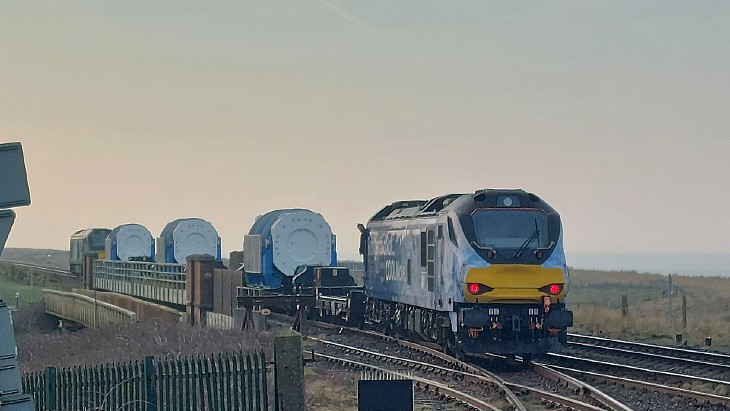
The second of three planned shipments of high-level radioactive waste has left the Sellafield site in northwest England and is being transported by rail and sea to its destination at the Isar interim storage facility in Germany.

Seven flasks containing the vitrified residues - the radioactive waste has been transformed into a stable glass-like form - travelled by rail to the port of Barrow-in-Furness before being loaded on to Pacific Grebe, a specialist nuclear transport vessel operated by the UK's Nuclear Transport Solutions, which set sail on Wednesday.

The first shipment, of six flasks each with 28 containers of high level waste, to Biblis, took place in 2020.

The waste comes from the reprocessing and recycling of Germany's used nuclear fuel at the Sellafield site, with Nuclear Transport Solutions saying: "Vitrified Residue Returns are a key component of the UK’s strategy to repatriate high- level waste from the Sellafield site, fulfil overseas contracts and deliver on government policy."

According to Germany's Federal Office for the Safety of Nuclear Waste Management (BASE) the transport licence was approved in December, with the repatriation of German waste a binding requirement under international law.

In its guide to the waste it says that until 2005 German utilities shipped used fuel from nuclear power plants to La Hague in France and Sellafield in the UK for reprocessing: "The resulting liquid waste was then melted down into glass and has since been gradually returned to Germany. The last shipment of this waste from France was returned in November 2024." There is one more shipment planned, after the current one, from the UK to complete the repatriation.

The federal office issued a licence in April 2023 for the storage of the vitrified waste at the Isar interim storage facility, which is licensed to hold a maximum of 152 casks of high-level radioactive waste and "according to current plans, there will be 28 fewer high-level waste casks there than originally intended, including the casks containing the vitrified waste".

According to German nuclear specialist GNS: "The waste is massively shielded from external radiation. In the reprocessing plant, the waste is mixed with liquid silicate glass and poured into cylindrical stainless steel containers, which are then sealed tightly after hardening. These containers, filled with the hardened glass mixture, are called "glass moulds". For transport and storage, the moulds are placed in ... massive, more than 100-tonnes cast iron and stainless steel containers, which have been proven in extensive tests to provide both strong shielding and to be safe under extreme conditions."

Until 2011 reprocessed waste was sent to the Gorleben interim storage facility in Lower Saxony, where 108 casks of vitrified radioactive waste have been stored, which was "already a large proportion of the total waste to be returned from reprocessing". According to BASE, as part of the Site Selection Act of 2013 to seek a repository for high-level radioactive waste, the remaining vitrified waste abroad was to be stored in interim storage facilities at nuclear power plant sites.

"The aim was to avoid giving the impression that Gorleben had already been chosen as the site for a final storage facility during the open-ended search for a repository site. In 2015, the federal government, the federal states and the utility companies agreed to store the remaining radioactive waste in Biblis, Brokdorf, Niederaichbach (Isar nuclear power plant) and Philippsburg," BASE says.

France's Orano completed the 13th and final rail shipment from France of vitrified high-level nuclear waste, to Philippsburg, in Germany in November 2024. In total 5310 tonnes of German used fuel was processed at Orano's La Hague plant up to 2008. The inter-governmental agreement governing those operations included a provision that the equivalent in mass and radioactivity of the waste contained in the used fuel elements must be returned to Germany.Until March 2011 Germany obtained a quarter of its electricity from nuclear energy, using 17 reactors. Following the Fukushima Daiichi accident eight reactors were closed immediately and the rest were scheduled to be closed by the end of 2022. Following the start of the Russia-Ukraine war, there was a brief extension for the last three operating nuclear power reactors - Isar 2, Emsland and Neckarwestheim 2 - but they closed in April 2023. Second-last high level waste shipment departs UK for Germany
Read More........