Beijing consumers mull spending habits as tariffs kick in


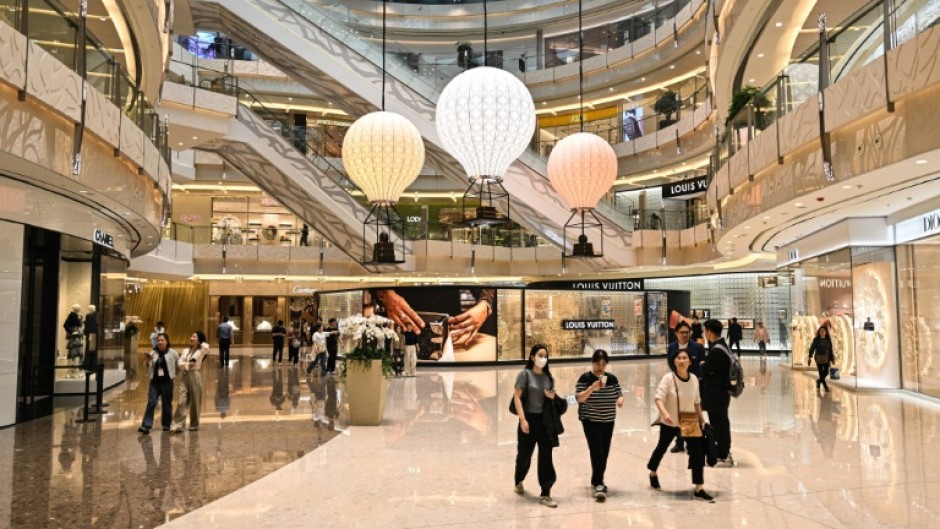
Chinese consumers in Beijing mulled their their spending habits and said they are prepared to forego American brands if that means avoiding the pinch from the escalating trade war with Washington.

Some worried prices of their favorite products could escalate after US President Donald Trump's tariffs came into force Wednesday.

Outside a shopping mall in central Beijing, massage therapist Gao Xin, 26, listened to music on his iPhone and considered whether his next device would have to be a different brand.

"I have always used (US products) in the past, including the (phone) I use now, but if there is really a big wave of price increases, I may choose domestic ones."

Tariffs levied by both Beijing and Washington stand to have a complex impact on prices of goods from around the world as supply chains are hit by higher costs of components or equipment.

But prominent American brands like Apple -- even though it produces phones in China -- are an easy target for anxiety about price hikes caused by the trade war.

Nearby, a man sporting Oakley sunglasses said he would switch to a non-US brand if his favourite products became more expensive.

AFP | Pedro PARDO

China imported around $163 billion-worth of goods from the United States in 2024 -- 6.3 percent of the Asian country's imports.

After a tit-for-tat volley between Washington and Beijing, China faces cumulative tarrifs of 104 percent -- the highest imposed by Trump's sweeping assault on global trade.

"It's very worrying," said lawyer Yu Yan, 54, adding that she sees echoes of the Great Depression in recent events.

"The economy may fall into a depression, which is something we all don't want to see," she told AFP.

China's economy is already struggling from a property crisis, low consumption and high government debt.

The new tariffs could hurt the country's goal of achieving around five percent growth this year, Nomura analysts said last week.

- Heating up -

Stock markets around the world tumbled as Trump's measures against dozens of trading partners came into effect.

Some countries dispatched envoys to Washington to negotiate, while China -- Washington's top economic rival but also a major trading partner -- vowed to take "firm and forceful" steps.

Retaliatory duties of 34 percent are due to take effect just after midnight.
AFP | HECTOR RETAMAL

In Beijing, massage therapist Gao said he saw the tariffs that Beijing and Washington were lobbing at each other as "a means of intimidation".

"I think there will definitely be an impact, but for most ordinary people, I don't think it will be a big problem, unless you are doing some foreign trade," he said.

Tech professional Sun Fanxi said reading about the tit-for-tat measures made her nervous.

"I'm scared that (tariffs) will lead to a real hot war," the 27-year-old said. "That would be bad for everyone."

But she added that no matter what happens, she fully supports her country's moves.

"If the country wants us to do something, then so be it," she said.By Sam Davies Beijing consumers mull spending habits as tariffs kick in
Read More........

The US and China have reached a temporary truce in the trade wars, but more turbulence lies ahead

Peter Draper, University of Adelaide and Nathan Howard Gray, University of Adelaide

Defying expectations, the United States and China have announced an important agreement to de-escalate bilateral trade tensions after talks in Geneva, Switzerland.

The good, the bad and the ugly

The good news is their recent tariff increases will be slashed. The US has cut tariffs on Chinese imports from 145% to 30%, while China has reduced levies on US imports from 125% to 10%. This greatly eases major bilateral trade tensions, and explains why financial markets rallied.

The bad news is twofold. First, the remaining tariffs are still high by modern standards. The US average trade-weighted tariff rate was 2.2% on January 1 2025, while it is now estimated to be up to 17.8%. This makes it the highest tariff wall since the 1930s.

Overall, it is very likely a new baseline has been set. Bilateral tariff-free trade belongs to a bygone era.

Second, these tariff reductions will be in place for 90 days, while negotiations continue. Talks will likely include a long list of difficult-to-resolve issues. China’s currency management policy and industrial subsidies system dominated by state-owned enterprises will be on the table. So will the many non-tariff barriers Beijing can turn on and off like a tap.

China is offering to purchase unspecified quantities of US goods – in a repeat of a US-China “Phase 1 deal” from Trump’s first presidency that was not implemented. On his first day in office in January, amid a blizzard of executive orders, Trump ordered a review of that deal’s implementation. The review found China didn’t follow through on the agriculture, finance and intellectual property protection commitments it had made.

Unless the US has now decided to capitulate to Beijing’s retaliatory actions, it is difficult to see the US being duped again.

Failure to agree on these points would reveal the ugly truth that both countries continue to impose bilateral export controls on goods deemed sensitive, such as semiconductors (from the US to China) and processed critical minerals (from China to the US).

Moreover, in its so-called “reciprocal” negotiations with other countries, the US is pressing trading partners to cut certain sensitive China-sourced goods from their exports destined for US markets. China is deeply unhappy about these US demands and has threatened to retaliate against trading partners that adopt them.

A temporary truce

Overall, the announcement is best viewed as a truce that does not shift the underlying structural reality that the US and China are locked into a long-term cycle of escalating strategic competition.

That cycle will have its ups (the latest announcement) and downs (the tariff wars that preceded it). For now, both sides have agreed to announce victory and focus on other matters.

For the US, this means ensuring there will be consumer goods on the shelves in time for Halloween and Christmas, albeit at inflated prices. For China, it means restoring some export market access to take pressure off its increasingly ailing economy.

As neither side can vanquish the other, the likely long-term result is a frozen conflict. This will be punctuated by attempts to achieve “escalation dominance”, as that will determine who emerges with better terms. Observers’ opinions on where the balance currently lies are divided.

Along the way, and to use a quote widely attributed to Winston Churchill, to “jaw-jaw is better than to war-war”. Fasten your seat belts, there is more turbulence to come.

Where does this leave the rest of us?

Significantly, the US has not (so far) changed its basic goals for all its bilateral trade deals.

Its overarching aim is to cut the goods trade deficit by reducing goods imports and eliminating non-tariff barriers it says are “unfairly” prohibiting US exports. The US also wants to remove barriers to digital trade and investments by tech giants and “derisk” certain imports that it deems sensitive for national security reasons.

The agreement between the US and UK last week clearly reflects these goals in operation. While the UK received some concessions, the remaining tariffs are higher, at 10% overall, than on April 2 and subject to US-imposed import quotas. Furthermore, the UK must open its market for certain goods while removing China-originating content from steel and pharmaceutical products destined for the US.

For Washington’s Pacific defence treaty allies, including Australia, nothing has changed. Potentially difficult negotiations with the Trump administration lie ahead, particularly if the US decides to use our security dependencies as leverage to wring concessions in trade. Japan has already disavowed linking security and trade, and their progress should be closely watched.

The US has previously paused high tariffs on manufacturing nations in South-East Asia, particularly those used by other nations as export platforms to avoid China tariffs. Vietnam, Cambodia and others will face sustained uncertainty and increasingly difficult balancing acts. The economic stakes are higher for them.

They, like the Japanese, are long-practised in the subtle arts of balancing the two giants. Still, juggling ties with both Washington and Beijing will become the act of an increasingly high-wire trapeze artist.The Conversation

Peter Draper, Professor, and Executive Director: Institute for International Trade, and Jean Monnet Chair of Trade and Environment, University of Adelaide and Nathan Howard Gray, Senior Research Fellow, Institute for International Trade, University of Adelaide

This article is republished from The Conversation under a Creative Commons license. Read the original article.

Read More........