Birth rates are declining in most of the world, including Australia. Here’s why that really matters

Liz Allen, Australian National University

Birth rates have been declining worldwide since the peak of the post-second world war baby boom. Birth rates have now reached below replacement in most of the world, including Australia. Put simply, populations on average aren’t replacing themselves.

Everyone from Elon Musk to Italian Prime Minister Giorgia Meloni, to the pope have opinions on declining total fertility (or birth) rates – the average number of births per woman.

Overpopulation has dominated popular discourse since the 1960s. While fears of overpopulation remain, especially tied to immigration, concerns have shifted to depopulation and the related economic and national security issues.

Overpopulation fears to depopulation woes

In his 1968 book The Population Bomb, Paul Ehrlich warned the 1970s would bring “people, people, people, people” and an overpopulation “cancer” resulting in famine and war. Human extinction was imminent, we were warned.

Overpopulation-associated human extinction has not come to be.

The global total fertility rate has more than halved since 1950. Average birth rates for OECD countries now sit at 1.46 births per woman, well below the 2.1 required for generational replacement.

World population decline is projected by the mid-2080s. China is now in its fourth year of population decline. South Korea has been declining since 2019 with its near-global record low birth rates. Germany has seen deaths outnumber births since 1972. Japan, Greece, Italy, Cuba and Thailand are also among those in the depopulation club.

Without immigration, the United Kingdom would also see population decline, with deaths outnumbering births. Australia is about a generation away from the same fate. Immigration controls have seen depopulation in Canada.

Birth rates a solution to the ageing ‘problem’

Enormous advancements since the 1950s, mostly in health and medical technologies like immunisation, mean humans are living longer. We’re also having fewer children, and as a result populations are ageing.

An ageing population is a mark of success and human ingenuity, but economic systems tend to view ageing societies as problematic.

Workers and working-aged people are essential to maintain a healthy economy. Individual income taxpayers are the top source of federal government revenue in Australia. Too few people of working age replacing those retiring can seriously undermine economic wellbeing, forcing governments to do more service provision with less financial resources.

Below-replacement fertility and its implications for government bottom lines have resulted in Australian politicians calling on Australians to have more babies. “Have one for mum, one for dad, and one for the country”, treasurer Peter Costello famously said in 2004.

In 2020, former prime minister Tony Abbott suggested the wrong kind of women were having children, calling on “middle class” women to have more. Talking the budget, treasurer Jim Chalmers in 2024 said it would be “better if birth rates were higher”.

Human catastrophe of low birth rates

People are increasingly saying the choice to have children is constrained by external factors. Worldwide, around one-in-five surveyed by the United Nations said fears about the future would or has resulted in them having fewer children than they wanted.

Housing affordability, economic stability, gender inequality and climate change present insurmountable barriers for having a much-wanted family.

The lack of choice to have children in below-replacement regions, I’d argue is indeed a human catastrophe. How is it that we’ve allowed society to become so hostile that children are out of the question for so many who want them?

The intergenerational bargain is well and truly corrupted.

We are confronted with the tough question of who will care for us with the children gone.

Can a human catastrophe be avoided?

The burden of having a family falls on working-aged people, especially women.

A baby bonus or one-off payment is unlikely to change people’s minds and increase the total fertility rate; such payments merely change timing. Instead, increasing total fertility rates requires a comprehensive suite of measures from a policy perspective.

Tackling the big four big domains of housing, the economy, gender and climate encompass issues such as

  • secure, affordable and appropriate housing
  • employment and income security
  • accessible childcare
  • social and workplace gender equality
  • climate change action.

People of childbearing age aren’t being hedonistic when making family and fertility decisions. They’re not thinking about themselves, they’re actually thinking about the future world and weighing what that might look like for prospective children.

Loss of hope among people of childbearing age, including fears of being left behind, contribute to overall concerns about an insecure future.

Not only is the human catastrophe of low births rates reflecting more widespread concerns, such as insecurity, it could also be undermining social cohesion.

Rather than an exploding bomb of overpopulation, the world faces an economic and social implosion due to lacking substantive supports necessary to help raise much-wanted children.

Surely it’s beyond time we ask people what they actually need – and give it to them.The Conversation

Liz Allen, Demographer, POLIS Centre for Social Policy Research, Australian National University

This article is republished from The Conversation under a Creative Commons license. Read the original article.

Read More........

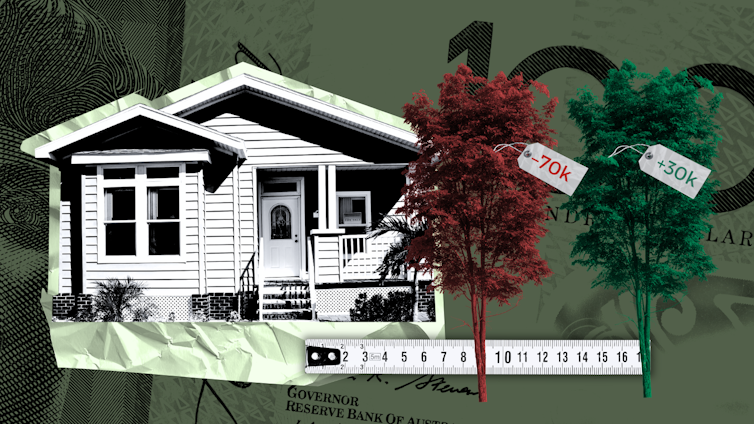
One street tree can boost Sydney house prices by $30,000 – or cost $70,000 if it’s too close: new study

A single street tree can potentially increase an average Sydney house price by A$30,000, our new research shows. This echoes past research showing street trees not only help boost property prices, but offer other benefits, from improved scenery and privacy to increased shade.

But there’s a catch. Our analysis, published in the international Cities journal, also found that if a street tree is too close, it can actually reduce the selling price by more than $70,000.

Our study looked at more than 1,500 house sales in the City of Sydney from 2021 to 2024, then matched those with detailed council data on nearly 50,000 public trees.

After accounting for other, better known price factors – number of bedrooms, bathrooms, car parking, land size, proximity to the CBD, transport, schools and more – we found trees can be associated with higher house prices. But that price boost only occurred when the trees were about 10–20 metres from a home, such as across the street or near the frontage.

In contrast, trees planted too close – within a 10m radius from the centre of the property – were actually associated with lower sale prices.

This matters beyond Sydney. Every Australian capital city has set tree-planting goals, such as the City of Sydney’s target for 23% tree canopy cover in 2030 and 27% in 2050. Yet many will struggle to meet them, with some facing resistance from residents. Our research explains why tree placement will be crucial if we ever want to meet those targets.

What’s new about this research

Past studies in Perth, as well as several cities in the United States and Canada, have consistently shown trees tend to increase property values.

But what we didn’t know before now was where the benefits stop and the costs begin.

Our study identifies a clear “not in my backyard” (NIMBY) boundary, of around 10m, within which street trees’ economic value turns negative.

That finding is important, because that’s when resident resistance to street trees is likely to be strongest.

This is a first study of its kind to quantify the economic value of public trees by taking advantage of using individual tree-level data managed by the City of Sydney from 2023.

It allowed us to measure tree effects at the finest possible distance from the centre of property: under 10m, 10–20m, 20–50m, 50–100m, and beyond 100m. This is something previous studies could not do when relying on satellite or street imagery.

How tree location affects price

We controlled for all the usual factors that influence house prices, including property features and location amenities. This meant we could measure the impact of trees after accounting for everything else.

We found that distance matters. In dollar terms, one additional tree within 10m of the centre of a property reduced its value by 2.96%. An average home sold in the City of Sydney from 2021 to 2024 was worth $2,613,000 – so that reduction worked out to be a $70,290 cost.

Given the average lot size of 176m² in the City of Sydney, the distance from the centre of an average property to its boundary is typically about 8m.

But if a tree was located 10-20 metres away, it increased the value by about 1.16%, worth an average of $30,310.

If the tree was further than 20 metres away, we found no price difference.

The new study identified a clear ‘not in my backyard’ (NIMBY) boundary, within which street trees’ can actually hit house prices. Belle Co/Pexels, CC BY

This show a clear proximity effect. Trees being too close to a house are a cost risk; trees at a moderate distance are a valued feature; and trees further away are neutral and just part of the neighbourhood amenity.

Our study used more precise data than ever before to calculate the distance between street trees and the centre of each property.

But future research could take this further by measuring the distance from each tree to the house. It could also incorporate resident surveys to better understand how people perceive and value trees near their homes.

Why trees being too close matters

Street trees like these are much loved – but can have hidden downsides, such as damage from roots or branches. Jo Quinn/Unsplash, CC BY

It makes sense that people may see trees close to home as a financial risk.

Trees can cause structural damage to buildings and infrastructure, increase fire hazards, and safety concerns from falling branches.

Rather than dismissing residents’ concerns as NIMBYism, they should be seen as rational market responses to maintenance risks, structural damage, and amenity loss.

Planting plans need resident support

Every Australian capital city has adopted “urban forest” or tree planting strategies, many of them aiming to hit 30-40% canopy cover in coming decades. For example, the City of Melbourne’s target is 40% canopy cover by 2040, while Brisbane City Council is aiming for 50% shade for residential footpaths and bikeways by 2031.

However, there are doubts about whether many of those targets will be met.

There are good reasons for governments to invest in urban trees, as they can protect us from extreme heat and help as a response to climate change. But resistance from homeowners can undermine these policies.

Our research shows residents are more likely to welcome street trees if they’re planted not too close, and not too far, from their homes.

* Thanks to the coauthors of this paper, Qiulin Ke and Bin Chi from University College London.The Conversation

Song Shi, Associate Professor, Property Economics, University of Technology Sydney

This article is republished from The Conversation under a Creative Commons license. Read the original article.

Read More........