The world’s carbon emissions continue to rise. But 35 countries show progress in cutting carbon

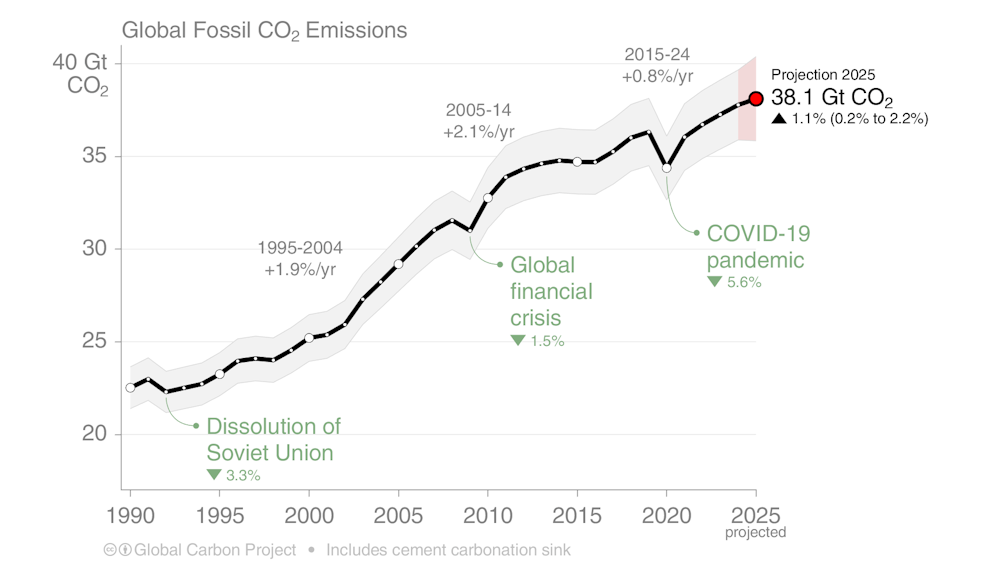
Global fossil fuel emissions are projected to rise in 2025 to a new all-time high, with all sources – coal, gas, and oil – contributing to the increase.

At the same time, our new global snapshot of carbon dioxide emissions and carbon sinks shows at least 35 countries have a plan to decarbonise. Australia, Germany, New Zealand and many others have shown statistically significant declines in fossil carbon emissions during the past decade, while their economies have continued to grow. China’s emissions have also been been growing at a much slower pace than recent trends and might even be flat by year’s end.

As world leaders and delegates meet in Brazil for the United Nations’ global climate summit, COP30, many countries that have submitted new emissions commitments to 2035 have shown increased ambition.

But unless these efforts are scaled up substantially, current global temperature trends are projected to significantly exceed the Paris Agreement target that aims to keep warming well below 2°C.

These 35 countries are now emitting less carbon dioxide even as their economies grow. Global Carbon Project 2025, CC BY-NC-ND

Fossil fuel emissions up again in 2025

Together with colleagues from 102 research institutions worldwide, the Global Carbon Project today releases the Global Carbon Budget 2025. This is an annual stocktake of the sources and sinks of carbon dioxide worldwide.

We also publish the major scientific advances enabling us to pinpoint the global human and natural sources and sinks of carbon dioxide with higher confidence. Carbon sinks are natural or artificial systems such as forests which absorb more carbon dioxide from the atmosphere than they release.

Global CO₂ emissions from the use of fossil fuels continue to increase. They are set to rise by 1.1% in 2025, on top of a similar rise in 2024. All fossil fuels are contributing to the rise. Emissions from natural gas grew 1.3%, followed by oil (up 1.0%) and coal (up 0.8%). Altogether, fossil fuels produced 38.1 billion tonnes of CO₂ in 2025.

Not all the news is bad. Our research finds emissions from the top emitter, China (32% of global CO₂ emissions) will increase significantly more slowly below its growth over the past decade, with a modest 0.4% increase. Emissions from India (8% of global) are projected to increase by 1.4%, also below recent trends.

However, emissions from the United States (13% of global) and the European Union (6% of global) are expected to grow above recent trends. For the US, a projected growth of 1.9% is driven by a colder start to the year, increased liquefied natural gas (LNG) exports, increased coal use, and higher demand for electricity.

EU emissions are expected to grow 0.4%, linked to lower hydropower and wind output due to weather. This led to increased electricity generation from LNG. Uncertainties in currently available data also include the possibility of no growth or a small decline.

Fossil fuel emissions hit a new high in 2025, but the growth rate is slowing and there are encouraging signs from countries cutting emissions. Global Carbon Project 2025, CC BY-NC-ND

Drop in land use emissions

In positive news, net carbon emissions from changes to land use such as deforestation, degradation and reforestation have declined over the past decade. They are expected to produce 4.1 billion tonnes of carbon dioxide in 2025 down from the annual average of 5 billion tonnes over the past decade. Permanent deforestation remains the largest source of emissions. This figure also takes into account the 2.2 billion tonnes of carbon soaked up by human-driven reforestation annually.

Three countries – Brazil, Indonesia and the Democratic Republic of the Congo – contribute 57% of global net land-use change CO₂ emissions.

When we combine the net emissions from land-use change and fossil fuels, we find total global human-caused emissions will reach 42.2 billion tonnes of carbon dioxide in 2025. This total has grown 0.3% annually over the past decade, compared with 1.9% in the previous one (2005–14).

Carbon sinks largely stagnant

Natural carbon sinks in the ocean and terrestrial ecosystems remove about half of all human-caused carbon emissions. But our new data suggests these sinks are not growing as we would expect.

The ocean carbon sink has been relatively stagnant since 2016, largely because of climate variability and impacts from ocean heatwaves.

The land CO₂ sink has been relatively stagnant since 2000, with a significant decline in 2024 due to warmer El Niño conditions on top of record global warming. Preliminary estimates for 2025 show a recovery of this sink to pre-El Niño levels.

Since 1960, the negative effects of climate change on the natural carbon sinks, particularly on the land sink, have suppressed a fraction of the full sink potential. This has left more CO₂ in the atmosphere, with an increase in the CO₂ concentration by an additional 8 parts per million. This year, atmospheric CO₂ levels are expected to reach just above 425 ppm.

Tracking global progress

Despite the continued global rise of carbon emissions, there are clear signs of progress towards lower-carbon energy and land use in our data.

There are now 35 countries that have reduced their fossil carbon emissions over the past decade, while still growing their economy. Many more, including China, are shifting to cleaner energy production. This has led to a significant slowdown of emissions growth.

Existing policies supporting national emissions cuts under the Paris Agreement are projected to lead to global warming of 2.8°C above preindustrial levels by the end of this century.

This is an improvement over the previous assessment of 3.1°C, although methodological changes also contributed to the lower warming projection. New emissions cut commitments to 2035, for those countries that have submitted them, show increased mitigation ambition.

This level of expected mitigation falls still far short of what is needed to meet the Paris Agreement goal of keeping warming well below 2°C.

At current levels of emissions, we calculate that the remaining global carbon budget – the carbon dioxide still able to be emitted before reaching specific global temperatures (averaged over multiple years) – will be used up in four years for 1.5°C (170 gigatonnes remaining), 12 years for 1.7°C (525 Gt) and 25 years for 2°C (1,055 Gt).

Falling short

Our improved and updated global carbon budget shows the relentless global increase of fossil fuel CO₂ emissions. But it also shows detectable and measurable progress towards decarbonisation in many countries.

The recovery of the natural CO₂ sinks is a positive finding. But large year-to-year variability shows the high sensitivity of these sinks to heat and drought.

Overall, this year’s carbon report card shows we have fallen short, again, of reaching a global peak in fossil fuel use. We are yet to begin the rapid decline in carbon emissions needed to stabilise the climate.The Conversation

Pep Canadell, Chief Research Scientist, CSIRO Environment; Executive Director, Global Carbon Project, CSIRO; Clemens Schwingshackl, Senior Researcher in Climate Science, Ludwig Maximilian University of Munich; Corinne Le Quéré, Royal Society Research Professor of Climate Change Science, University of East Anglia; Glen Peters, Senior Researcher, Center for International Climate and Environment Research - Oslo; Judith Hauck, Helmholtz Young Investigator group leader and deputy head, Marine Biogeosciences section at the Alfred Wegener Institute, Universität Bremen; Julia Pongratz, Professor of Physical Geography and Land Use Systems, Department of Geography, Ludwig Maximilian University of Munich; Mike O'Sullivan, Lecturer in Mathematics and Statistics, University of Exeter; Pierre Friedlingstein, Chair, Mathematical Modelling of Climate, University of Exeter, and Robbie Andrew, Senior Researcher, Center for International Climate and Environment Research - Oslo

This article is republished from The Conversation under a Creative Commons license. Read the original article.

Read More........

World's richest 10% caused two thirds of global warming: study


The world's wealthiest 10 percent of individuals are responsible for two thirds of global warming since 1990, researchers said on Wednesday.

How the rich consume and invest has substantially increased the risk of deadly heatwaves and drought, they reported in the first study to quantify the impact of concentrated private wealth on extreme climate events.

"We link the carbon footprints of the wealthiest individuals directly to real-world climate impacts," lead author Sarah Schoengart, a scientist at ETH Zurich, told AFP.

"It's a shift from carbon accounting toward climate accountability."

Compared to the global average, for example, the richest one percent contributed 26 times more to once-a-century heatwaves, and 17 times more to droughts in the Amazon, according to the findings, published in Nature Climate Change.

Emissions from the wealthiest 10 percent in China and the United States which together account for nearly half of global carbon pollution each led to a two-to-threefold rise in heat extremes.

Burning fossil fuels and deforestation have heated Earth's average surface by 1.3 degrees Celsius, mostly during the last 30 years.

Schoengart and colleagues combined economic data and climate simulations to trace emissions from different global income groups and assess their impact on specific types of climate-enhance extreme weather.

The researchers also emphasised the role of emissions embedded in financial investment rather than just lifestyle and personal consumption.

"Climate action that doesn't address the outsized responsibilities of the wealthiest members of society risk missing one of the most powerful levers we have to reduce future harm," said senior author Carl-Friedrich Schleussner, head of the Integrated Climate Impacts Research Group at the International Institute for Applied Systems Analysis near Vienna.

- Billionaires tax -

Owners of capital, he noted, could be held accountable for climate impacts through progressive taxes on wealth and carbon-intensive investments.

Earlier research has shown that taxing asset-related emissions is more equitable than broad carbon taxes, which tend to burden those on lower incomes.

Recent initiatives to increase taxes on the super-rich and multinationals have mostly stalled, especially since Donald Trump regained the White House.

Last year, Brazil -- as host of the G20 -- pushed for a two-percent tax on the net worth of individuals with more than $1 billion in assets.

Although G20 leaders agreed to "engage cooperatively to ensure that ultra-high-net-worth individuals are effectively taxed," there has been no follow-up to date.

In 2021, nearly 140 countries agreed on work toward a global corporate tax for multinational companies, with nearly half endorsing a minimum rate of 15 percent, but those talks have stalled as well.

Almost a third of the world's billionaires are from the United States more than China, India and Germany combined, according to Forbes magazine.

According to anti-poverty NGO Oxfam, the richest 1 percent have accumulated $42 trillion in new wealth over the past decade.

It says the richest one percent have more wealth than the lowest 95 percent combined.

Read More........

Improvement in air quality with decline in pollution levels in India: World Air Quality Report


New Delhi, (IANS) The World Air Quality Report 2024 by Swiss air quality technology company IQAir reveals a positive trend in India’s air quality, despite ongoing challenges.

According to the report, India now ranks as the fifth most polluted country globally in 2024, a notable improvement from its third-place ranking in 2023.

The country also recorded a 7 per cent decline in PM2.5 concentrations, which dropped from 54.4 micrograms per cubic metre in 2023 to 50.6 micrograms per cubic metre in 2024.

While 13 of the world’s 20 most polluted cities are in India, including Byrnihat, Delhi, and Faridabad, this decline signals a step in the right direction for addressing air pollution.

Delhi, which remains the most polluted capital city in the world, saw little change in its air quality, with an annual PM2.5 concentration of 91.6 micrograms per cubic metre in 2024, almost identical to 92.7 in 2023.

Despite these challenges, India’s progress in reducing air pollution is noteworthy. The decline in PM2.5 levels indicates that the country is making strides in combating air pollution, thanks to various measures aimed at improving air quality. These efforts include improving data collection on air quality, expanding cleaner energy solutions, and enhancing public transportation networks.

However, experts such as former WHO chief scientist and health ministry advisor Soumya Swaminathan emphasise the need for continued and increased action to combat air pollution.

Swaminathan suggests that solutions such as promoting the use of LPG over biomass, expanding public transport, and providing stronger subsidies for low-income families could further reduce pollution and improve public health.

While air pollution remains a significant health concern, with an estimated 1.5 million deaths annually linked to PM2.5 exposure, India’s efforts to reduce pollution are making a positive impact. The decline in PM2.5 concentrations is a promising development, and continued action will be essential to achieve even cleaner air for all.With these efforts in place, India is heading toward improving its air quality and reducing the health risks associated with air pollution, providing hope for a healthier future. Improvement in air quality with decline in pollution levels in India: World Air Quality Report | MorungExpress | morungexpress.com
Read More........

The LA fires have prompted a reckoning for the insurance industry – Australian premiums could soar as a result

A series of wildfires in Los Angeles County have caused widespread devastation in California, including at least 24 deaths and the destruction of more than 12,000 homes and structures. Thousands of residents have been evacuated, and the danger isn’t over yet.

Some estimates have put the cost of the damage and economic loss at between A$400 billion and A$450 billion, of which only A$32 billion is insured.

This is a stark illustration of the insurance protection gap – the difference between insured and uninsured losses. As California rebuilds, it means the bill for uninsured losses will fall on the property owners themselves and public funds.

These catastrophic fires should ring alarm bells in Australia, where global ripple effects are likely to force up our own insurance premiums. Most importantly, we must grapple with and prepare for the grim prospect of our own similar disaster.

Uninsurable homes

California’s insurance protection gap has grown as the state experiences increasingly devastating wildfires year-on-year.

In response to growing risk, escalating insurance claims, and rising reinsurance and construction costs, at least a dozen of the largest property insurers, making up 80% of the Californian market, have withdrawn from offering wildfire coverage or have restricted new policies.

In March 2024, State Farm, the United States’ largest property insurer, announced it would not be renewing about 72,000 policies in selected California postcodes deemed too risky to insure for wildfire.

These included 1,626 homes in Pacific Palisades, the scene of one of the most damaging recent fires.

For insurers, it’s simply becoming too expensive to do business in California.

What are the other options?

This has led to surging demand for alternative protection options. One, the California FAIR Plan, is a state-legislated collaboration between insurers.

The FAIR plan exists to provide a wildfire policy for those who have had policies refused by other insurance companies. But it’s a deliberately “bare-bones” policy.

Homeowners who want cover for additional structures, for theft and liability, or for other perils need to buy an additional top-up.

Residential payouts are capped at US$3 million (A$4.8 million), leaving many people underinsured.

Demand for the California FAIR Plan has skyrocketed since 2019, up 164%.

This increased demand for protection and the billions of dollars in loss we’ve just seen have raised concerns these wildfires may bankrupt California’s insurer of last resort.

The insurance protection gap is not unique to California. Some 15% of Australian households already face extreme insurance stress – a situation in which it costs four weeks or more of pretax income to buy an insurance policy.

Insurance for insurers

Premiums in Australia may soar even higher after the LA wildfires. Here’s why.

To cover large-scale losses like the 2022 floods in Australia, insurance companies buy a reinsurance policy in the global market. Essentially, they take out their own large insurance policies to help pay out the mass claims after a disaster.

The cost of global reinsurance capital goes up around the world as risk rises, losses increase, and the costs of reconstruction rise. Reinsurance payments for wildfire in California will therefore create a ripple effect in all insurance markets.

The global reinsurance market isn’t the only thing likely to push premiums higher in Australia. There’s also our own climate uncertainty and increasing risk of disaster.

Future extreme weather and the losses it may cause are becoming harder to predict. Where uncertainty rises, so do premiums, as insurers and reinsurers increase their capital reserving for potential losses.

Alarmingly, California’s crisis is a reminder that wildfires are not just a problem in rural areas or on the fringes of cities. Furthermore, these losses can even occur in winter, not just during the “wildfire season”.

A timely warning

Australia may have been fortunate enough to avoid a catastrophic citywide fire so far. But the intensification of bushfire seasons could ultimately create a similar insurance crisis here.

We’ve had our own sobering warnings in the past.

The 2003 Canberra bushfires destroyed more than 500 homes in suburban areas. In 2021, the Wooroloo fire destroyed 86 homes on Perth’s northeastern fringe.

In 2019, the Gospers Mountain mega-blaze came dangerously close to advancing on Sydney’s urban heart. A timely southerly wind change held it back.

It pays to check your coverage

What are the implications of this disaster for Australian insurance policyholders? Are there any meaningful actions we can take?

First, insured Australians should check what their policy covers and what is excluded. Greater clarification over exclusions was recommended in a recent parliamentary inquiry into the 2022 floods.

Meanwhile, policyholders should review the terms and conditions in their product disclosure statement (PDS). If you’re unsure about what a particular policy covers, contact your insurer prior to renewal.

Beyond checking or upgrading coverage, Australians can take steps to make their homes more bushfire resilient.

Last year, the Resilient Building Council partnered with the federal government to launch a free app homeowners can use to assess their fire resilience and earn premium reductions from participating insurers by making improvements.

Above all, Australians need to be aware that under a changing climate, we may be more at risk from fire than we realise, even in our biggest cities.The Conversation

Paula Jarzabkowski, Professor in Strategic Management, The University of Queensland; Katie Meissner, Postdoctoral Research Fellow, The University of Queensland; Rosie Gallagher, Postdoctoral research fellow, UQ Business School, The University of Queensland, and Tyler Riordan, Postdoctoral Research Fellow, The University of Queensland

This article is republished from The Conversation under a Creative Commons license. Read the original article.

Read More........

World still split over money as clock ticks on COP29

BAKU - A fresh draft of a climate pact unveiled Thursday at COP29 failed to break an impasse over money, with time running for nations to reach a long-sought trillion-dollar finance agreement.

The UN climate summit in Azerbaijan is supposed to conclude on Friday but the latest draft only underlines divisions as nations return to the negotiating table.

"As for the text overall, I'm not going to sugarcoat it -- it is clearly unacceptable as it stands now," said EU climate commissioner Wopke Hoekstra.

"I am sure there's not a single ambitious country that thinks this is nearly good enough".

The nearly 200 countries in Baku are supposed to agree on a new target to replace the $100 billion a year that rich nations pledged for poorer ones to fight climate change.

Many developing countries are pushing for $1.3 trillion, mostly from government coffers, though wealthy nations have balked at such demands and insisted private money helps meet any final goal.

The latest draft recognises that developing countries need a commitment of at least "USD [X] trillion" per year, leaving out the crucial exact figure sought in Baku.

Ali Mohamed, the chair of the African Group of Negotiators, an important negotiating bloc, said the "elephant in the room" was the missing concrete number.

"This is the reason we are here... but we are no closer and we need the developed countries to urgently engage on this matter," said Mohamed, who is also Kenya's climate envoy.

Other key sticking points -- including who contributes and how the money is raised and delivered -- were left unresolved in the slimmed-down 10-page document.

Many nations have also expressed concern that a pledge to move away from fossil fuels made at last year's COP28 was being neglected in Baku.

- 'Two extreme ends' -

Ireland's climate minister Eamon Ryan insisted negotiations on finance were "advancing" in backroom discussions.

"This text is not the final text, that is clear. It will be quite radically different. But I think there is room for further agreement," he told AFP.

Norway's climate minister also offered a rosier view: "The deadline isn't here yet," he told AFP.

The draft entrenches the broad and opposing positions of developed and developing countries that have largely persisted since COP29 opened over a week ago.

Developed countries want all sources of finance, including public money and private investment, counted toward the goal, and for wealthy countries not obligated to pay, like China, to chip in.

Developing countries want the money to mostly come from rich government budgets in the form of grants or money without strings attached, not loans that add to national debt.

"The new finance text presents two extreme ends of the aisle without much in between," said Li Shuo, director of the China climate hub at the Asia Society Policy Institute.

- 'An insult' -

Hoekstra said the European Union still needed clarity over what elements in the deal would be counted toward the eventual finance goal.

"I'm sorry to say, there's a lot of work ahead for us, for the presidency, for all parties involved," he said.

The EU and the United States, two of the biggest providers of climate finance, have resisted pressure to put a figure on the table until the shape of the deal was clearer.

"The fact there is no number specified for the climate finance goal is an insult to the millions of people on the frontlines bearing the brunt of climate change impacts," said Greenpeace's Jasper Inventor.

Mohamed Adow, a Kenyan climate activist, said developing countries "need a cheque but all we have right now is a blank piece of paper".

By 2035, developing countries excluding China are estimated to need $1.3 trillion a year in outside financial assistance to reduce emissions and build resilience to climate change.

Joe Thwaites from the Natural Resources Defense Council said Azerbaijan as the COP29 presidency would "need to propose an option three that bridges the two".

COP29 lead negotiator Yalchin Rafiyev told AFP last week that the rule of climate negotiations was that everybody leave "equally unhappy".

bur-np/lth/ach

By Nick Perry And Julien MivielleAFP  World still split over money as clock ticks on COP29
Read More........

Need to invest in air pollution solutions for global prosperity: UN

Nairobi, (IANS) The world marked the fifth annual International Day of Clean Air for blue skies on Saturday, with calls for investment in clean air solutions as air pollution is increasingly causing public health, environmental, and economic problems.

More than 99 per cent of humanity is now breathing polluted air, leading to more than eight million annual deaths, including more than 700,000 children under five.

Dirty air disproportionately affects more vulnerable populations such as women, children and older people.

Air pollution has become the second leading risk factor for early death globally, overtaking tobacco for adults and second only to malnutrition for children under five. Yet despite the already high and still rising economic, environmental and existential impact of air pollution, which each year costs the world $8.1 trillion in health damages alone, less than one per cent of international development funding is dedicated to tackling it.

In addition to this silent killer’s toll on human health, “pollution is also choking economies and heating up our planet, adding fuel to the fire of the climate crisis,” UN Secretary-General António Guterres said in his message for the day, which the UN General Assembly designated as a day to champion clean air causes in 2019.

Led by the UN Environment Programme (UNEP), this year’s theme focuses on amplifying global calls to invest in #CleanAirNow to ensure a healthier and more prosperous future for people and the planet.

“Investing in clean air requires actions by both government and businesses to phase out fossil fuels, strengthen air quality monitoring, enforce air quality standards, boost renewable energy, transition to clean cooking, build sustainable transport and sustainable waste management systems, clean up supply chains, and reduce harmful emissions, including methane,” the UN Secretary-General said.

Ahead of Clean Air Day, the UNEP-convened Climate and Clean Air Coalition (CCAC) launched AQMx, a global air quality management platform, on September 5 in response to calls from countries for greater regional knowledge sharing and action on improving air quality that led to a resolution at this year’s UN Environment Assembly ( UNEA-6) talks.

UNEP Executive Director Inger Andersen used her Clean Air Day message to call for greater investment in air pollution solutions in all societies, and an end to the violation of every human being’s fundamental right to breathe clean air.

“We are asking nations, regions and cities to establish robust air quality standards by backing renewable energy and sustainable transport, holding industry to account with strict emission standards, and integrating air quality into climate action,” she said.

“We are asking for strong funding through redirecting fossil fuel subsidies, through grants or microloans for cleaner cooking technologies, and through serious private sector engagement and investment,” she said.

“We are asking for collective action, from international development initiatives to individuals that can make small changes in their own lifestyles,” she added.

Events across the world marked the International Day of Clean Air for blue skies: South Africa held a two-day conference, and UNEP supported a webinar to highlight how African cities can avoid open burning of waste.

There were high-level discussions in Asia featuring youth voices from across the continent, and a celebration on the site of a former steel mill in Beijing that was transformed into an outdoor Olympic Games area to tackle air pollution.

The good news is that air pollution is preventable, and people around the world are stepping up to address the crisis.Proving that change is possible, some cities have slashed air pollution levels, while countries have committed to reducing methane -- a potent air pollutant also driving global warming -- through the Global Methane Pledge and developed integrated plans to comprehensively tackle air pollution. Need to invest in air pollution solutions for global prosperity: UN | MorungExpress | morungexpress.com
Read More........

60 million americans under alert as heat wave hits US Midwest states


A heat wave brought record-high temperatures to US Midwest states this week, with more than 60 million people included in alerts over the conditions.

The US National Weather Service (NWS) said a late-season high-pressure system over cities in the Midwest regions, such as Chicago, Des Moines, and Topeka, has left them experiencing rare extreme heat for a long period of time. The NWS warned the public of the combined dangers of heat and humidity associated with heat waves. US Midwest states have set up several public cooling centres in preparation for the dangerous heat.

According to the US Centres for Disease Control and Prevention, extreme heat together with humidity is one of the leading weather-related killers in the United States. Every year, approximately 1,220 people in the country are killed due to extreme heat. 60 million americans under alert as heat wave hits US Midwest states
Read More........

Japan issues emergency warnings issued for Kagoshima as typhoon nears


Tokyo, (IANS): Japan's weather agency on Wednesday issued emergency warnings for storms and high waves in Kagoshima prefecture, calling for top-level alerts among residents as powerful typhoon Shanshan approaches Japan.

The Japan Meteorological Agency (JMA) told a press conference that the maximum alert was issued due to unprecedented storms and expected record-breaking rainfall, Xinhua news agency reported.

It also noted the possibility of issuing a heavy rain emergency warning for the prefectures of Kagoshima and Miyazaki.

As of Wednesday noon, the 10th typhoon of the year was located 90 kilometres south-southwest of Yakushima Island in Kagoshima prefecture and slowly moving northward.

It had a central pressure of 935 hectopascals, packing winds at a maximum speed of 180 kph around its centre, and a maximum instantaneous wind speed of 252 kph.

The JMA also called for extreme precautions against windstorms, landslides, flooding, and overflowing rivers. Source: https://www.morungexpress.com/japan-issues-emergency-warnings-issued-for-kagoshima-as-typhoon-nears
Read More........

Japan Issues Megaquake Advisory After 7.1 Magnitude Earthquake

The Japanese Meteorological Agency has issued a megaquake advisory after a 7.1 magnitude quake rocked Japan, as part of the Nankai Trough Earthquake Extra Information protocol. It has also lifted all tsunami advisories. The Japan Meteorological Agency said the possibility of a mega earthquake is higher than usual. Earlier, Miyazaki Port in the southern Miyazaki Prefecture was hit by 50 centimetres of tsunami waves after the quake. Local media reported that no abnormalities were found in nuclear plants near the quake-hit area. It said, after the quake, the Kyushu Shinkansen bullet train service was halted.Japan Issues Megaquake Advisory After 7.1 Magnitude Earthquake
Read More........

Polish ministry approves plans for Rolls-Royce SMRs

How a Rolls-Royce SMR might look (Image: Rolls-Royce SMR)

Polish industrial group Industria's plan to construct a power plant based on Rolls-Royce's small modular reactor (SMR) has been approved by the Ministry of Climate and Environment.

Industria submitted its application for a decision-in-principle in December last year to Polish Climate and Environment Minister Paulina Hennig-Kloska. The application concerns the construction of a nuclear power plant using Rolls-Royce SMR technology - a 470 MWe design based on a small pressurised water reactor - and a used nuclear fuel storage facility as an integral part of the power plant.

On 10 May, Hennig-Kloska issued the ministry's decision-in-principle, saying that she believes the investment would be in the public interest and in line with Poland's energy and climate policies. The application was positively assessed by the Head of the Internal Security Agency and the Minister of State Assets.

The decision-in-principle represents official state approval for the planned investment in accordance with the assumptions and concept presented by the company. It is the first decision in the process of administrative permits for investments in nuclear power facilities in Poland that an investor may apply for. Obtaining it entitles Industria to apply for a number of further administrative arrangements, such as a siting decision or construction licence.

"Today's decision-in-principle by Poland's Environment Minister is extremely positive news and allows us to advance our commercial and technical discussions on the deployment of Rolls-Royce SMR power plants in Poland," said Rolls-Royce SMR's Director of Strategy and Business Development Alan Woods. "Poland is one of a number of key export opportunities for Rolls-Royce SMR as we look to build on our progress in the UK and exploit the important competitive advantage our SMR design has over its competitors."

Last year, state-owned Industria - part of Industrial Development Agency JSC (IDA) - selected Rolls-Royce SMR technology to fulfil the zero-emission energy goals of the Central Hydrogen Cluster in Poland and as part of their plans to produce 50,000 tonnes of low-carbon hydrogen every year.

In July 2023, Industria signed a letter of intent with the Kostrzyn-Słubicka Special Economic Zone SA (KSSSE) regarding cooperation on the location of a modular power plant based on Rolls-Royce SMR technology in the areas covered by the KSSSE.

Poland's Ministry of Climate and Environment issued a decision-in-principle in July last year on copper and silver producer KGHM Polska Miedź SA's plan to construct a NuScale VOYGR modular nuclear power plant with a capacity of 462 MWe consisting of six modules, each with a capacity of 77 MWe.

In December, the ministry issued decisions-in-principle to Orlen Synthos Green Energy for the construction of power plants based on GE Hitachi Nuclear Energy's BWRX-300 SMR at six locations. A total of 24 BWRX-300 reactors are planned at the sites.

The ministry has also issued decisions-in-principle for the construction of two large nuclear power plants: one for a 3750 MWe plant in Pomerania using Westinghouse's AP1000 technology, the other for a plant comprising two South Korean-supplied APR1400 reactors in the Patnów-Konin region.Researched and written by World Nuclear News. Polish ministry approves plans for Rolls-Royce SMRs : New Nuclear - World Nuclear News
Read More........

Powerful 6.3 magnitude quake jolts Croatia


A strong earthquake in central Croatia has killed at least one person – a girl, injured many and caused considerable damage to buildings in Petrinja, a town southeast of the capital Zagreb.

The earthquake was felt throughout the country on Tuesday, as well as in neighbouring Serbia, Bosnia and Herzegovina and as far away as Graz in southern Austria.

Croatian state broadcaster HRT confirmed the girl died in the earthquake. The child’s age or other details were not immediately available.

“The centre of Petrinja as it used to be no longer exists,” HRT said in its report. “One girl died and there are injuries and people inside collapsed buildings.”

Petrinja Mayor Darinko Dumbovic said in a statement broadcast by HRT TV: “My town has been completely destroyed, we have dead children.

“This is like Hiroshima – half of the city no longer exists.”

Petrinja is about 60km (37 miles) from Zagreb.

Al Jazeera reported a boy and his father being pulled from a car buried in the rubble.

The European Mediterranean Seismological Center said the 6.3 magnitude earthquake hit 46km (17 miles) southeast of Zagreb. The same area was struck by a 5.2 quake on Monday.

Blanka, a resident of Sisak city, about 8.5 miles (14km) from Petrinja, was inside a shop when the earthquake struck.

“Everything collapsed, all of our things are inside,” she told Al Jazeera. “I don’t know what to expect. I am still shaking, I can still feel the earthquake.”

Croatian Red Cross said it was responding to a “very serious” situation in Petrinja following the earthquake.

Croatian media said people were injured by the quake, but could not initially say how many amid the confusion and downed phone lines.

Croatian seismologist Kresimir Kuk described the earthquake as “extremely strong”, far stronger than another one that hit Zagreb and nearby areas in spring.

He warned people to keep out of potentially shaky, old buildings and move to the newer areas of the city because of the aftershocks.

In Zagreb, people ran out into the streets and parks in fear. Many reportedly were leaving the city, ignoring a travel ban imposed because of the coronavirus outbreak.

Stephen Hicks, a seismologist at Imperial College in London, tweeted: “We can probably expect a quite strong shaking and hence some damage to buildings from this earthquake.”

Slovenia’s Krsko nuclear power plant was shut down as a precaution, the plant’s spokeswoman said Tuesday.“I can confirm the preventive shutdown,” spokeswoman Ida Novak Jerele told AFP. Source: https://www.daily-bangladesh.com

Read More........

NZ PM Ardern declares ‘climate emergency’


New Zealand’s Prime Minister Jacinda Ardern moves a motion in the Parliament House in Wellington, New Zealand, to declare a climate emergency, Wednesday, December 2, 2020; Photo: AFP/Mark Mitchell

New Zealand Prime Minister Jacinda Ardern declared a “climate emergency” on Wednesday, telling the Parliament that urgent action was needed for the sake of future generations.

“The science on climate change was clear and New Zealand had to acknowledge the threat,” Ardern said.

The center-left leader said the challenges posed by global warming meant parliament’s declaration — an act undertaken by more than a dozen other countries — was warranted.

“In those cases where we do issue declarations, it is often where there is a threat to life, a threat to the property, and civil defence emergencies,” she told Parliament.

“If we do not respond to climate change, we will continue to have these emergencies on our shores.”

Lawmakers passed the largely symbolic emergency declaration by 76 votes to 43 after Ardern urged them to back the move.

“Vote in favor of this declaration, be on the right side of history, be part of the solution we must collectively deliver for the next generation,” she said.

Britain’s parliament became the first in the world to declare a climate emergency, passing the motion in May last year, followed closely by Ireland.

However, New Zealand’s center-right opposition National Party rejected the climate emergency declaration, labeling it “virtue signaling”.

“It can do harm in making people think that by declaring an emergency something has happened, when it hasn’t,” National leader Judith Collins told Radio New Zealand, saying: “It’s quite false and misleading.”

Ardern, last year, announced New Zealand to become carbon neutral by 2050 and to generate all its energy from renewable sources by 2035. She has also halted all new offshore oil and gas exploration in New Zealand
waters.However, critics say that Ardern’s government has not done enough to enhance New Zealand’s “clean, green” reputation since she took office in 2017 after campaigning strongly on environmental issues. Source: https://www.daily-bangladesh.com/
Read More........

Cyclone ‘Nivar’ to hit Tamil Nadu, Puducherry after midnight

Add caption

Coastal Tamil Nadu and Puducherry are bracing for cyclonic storm ‘Nivar’ — which has intensified into a “severe cyclonic storm” and expected to intensify further, moving towards the southeast coast — is likely to hit the coast by midnight or early tomorrow, India’s Met department said.

According to the Met department, the cyclone could hit the coast between Mamallapuram in Tamil Nadu — 56 km from the state capital Chennai — and Karaikal in Puducherry. 

Meanwhile, cyclone ‘Nivar’ has brought with it heavy rain and strong winds in coastal Tamil Nadu and Puducherry. 

Prime Minister Narendra Modi on Tuesday tweeted to assure the Tamil Nadu and Puducherry governments of all possible support.It is to be mentioned that the “super cyclone” Amphan ravaged several districts of South Bengal in May and killed more than 90 people. The cyclone caused large-scale destruction to property, flattening villages, destroying farms and leaving thousands without electricity. Source: https://www.daily-bangladesh.com/
Read More........

Is the climate conducive for a change?

The Paris Summit brought out a global agreement on curtailing the global warming. How much change is the treaty actually going to bring on mother earth?
Mona: All eyes were on Paris second time around in a month’s time. Only the top world leaders gathered the second time to save the earth. Paris Summit was extended by a day as 196 parties sat together to form a global agreement on the reduction of climate change. Two weeks of intense negotiations led to a deal to limit the rise in global temperature to less than 2C. India emerged a key player at the talks. Young turks from Chandigarh share their reflections on the treaty.

  • Too good to be true: The United Nations Climate Change Conference 2015 (COP 21) comes across a goody goody deal for all nations from developed to developing, including the US, China, India and Iceland but it’s not comprehensive. While the aim is noble, who does what, when and how remains largely unlettered in order to curtail the rising temperature. It’s tougher for developing nations than the developed, for while we have to carry on development, industry being a significant key player in it; and, also cut our carbon footprint at the same time. Mostly so as majority of our huge population still lives in villages, we are still dependent on coal, thermal power and also unaware of what all the deal is about.— Pankaj Thakur, B Tech Electronics and computer science: 
  • Wait and watch: One good thing that comes out of COP 21 is that funds would be transferred to India but what remains to be seen is if they would put it to the intended use. While it is relatively easier for advanced nations to put regulations in practice, in developing countries the major thrust is on basic infrastructure, lifting its population above poverty level. Though the summit aims at cutting global warming, ‘how’ remains to be seen. The US and China, the most polluting countries in the world, though have pledged their support to the cause, it isn’t going to be an easy game either for them to follow the agreed guidelines. — Anil Sharma, B Sc, Biotech: 
  • How and when of it: Paris Climate Talks paved way for us to take responsibility for having disturbed the ecological balance and reversing it. The agreement keeps in mind the holistic view and has different expectations from countries in different stages of development. Like China is allowed to peak its industrial capacity before it joins hand with advanced countries to play a responsible part. But when and how is still fuzzy. The treaty looked good on paper but I was quite dejected reading an article today on how even if every Intended Nationally Determined Contributions (INDCs) follow the norms, we still wouldn’t be able to curtail global warming as aimed. — Sarthak Negi, B Tech Mechanical engineering: 
  • A tall order: Global warming is a real challenge and you see not even the half of the world is bothered about it. Advanced nations and its citizens who have been there and seen all are now acting in tandem to protect the earth but look at the scene in India or many African countries. While our indigenous ways helped preserving nature and maintaining balance, modern ways of the world have played havoc with the traditional lifestyle. In race to have a good life, how a country like India is going to fall in line of the guidelines of (COP 21) seems a tall order. — Rajinder Saini, M Sc Physics. Source: http://www.tribuneindia.com/
Read More........

US to work with India, China on climate change

US President Barack Obama talks with Prime Minister Narendra Modi during a meeting at the UN conference on climate change COP21 on November 30, 2015 at Le Bourget, on the outskirts of the French capital Paris. —AFP
Washington, December 1, Responding to Prime Minister Narendara Modi's "not our fault" message on climate change, the US said President Barack Obama has signalled a willingness to work with India and China for an ambitious climate change agreement. Obama had "very constructive" meetings on Monday with Modi and Chinese President Xi Jinping in on the sidelines on Paris Climate Summit, deputy National Security Advisor Ben Rhodes told reporters in Paris. "Now, today, very deliberately, President Obama wanted to send a signal with his meetings that we were going to work with China and work with India to pursue an ambitious agreement here in Paris," he said, according to a White House transcript. The US had helped to mobilise "a truly global effort" over the course of the last seven years with a recognition that "we needed to bring together the entire world, including major emerging economies like China and India", Rhodes said. "Given the fact that they are more and more the source of carbon emissions, clearly we have felt throughout the course of this administration that China and India need to be a part of the solution," he said. "I think you heard Prime Minister Modi reiterate with the President his commitment to pursuing an ambitious agreement," Rhodes said, noting, "India has put forward its own targets." In his meeting with Modi, Obama said "that he certainly understands that whether it's India or another developing country, there has to be a focus on making sure that countries can continue to lift people out of poverty." "We have a recognition, of course, that you have hundreds of millions of Indians who don't even have access to electricity," Rhodes said. "At the same time, however, we can pursue an ambitious climate agreement even while India pursues an ambitious development policy," he said. "And, in fact, we can pursue the types of solutions that can meet both climate and development challenges." Noting that Modi had later joined Obama at the US Mission Innovation event, Rhodes said this "demonstrates a recognition on the part of India and other countries" about making investments in basic research. "If we are financing both from the public sector but also from the private sector renewable sources of energy, that has the ability to help us raise our ambitions in terms of reducing our emissions, but also can, frankly, be a source of development for countries like India and other countries around the world." "So I think, with Prime Minister Modi, there was a recognition and a commitment to pursuing an ambitious agreement here in Paris." In both meetings, Obama clearly "made the point that addressing the challenge of climate change and pursuing sustainable economic development that lifts people out of poverty around the world are not competitive goals." "In fact, they can be mutually reinforcing. And I think US leadership in working with our traditional allies but also working with China and India is going to be essential to getting a good deal here in Paris," Rhodes said. As Obama himself acknowledged "advanced economies have important responsibilities, that the whole world has to be a part of this," he said. "And you can't have a bifurcation of our commitments in these various areas that prevents consensus." Asked to draw a metaphor for how there's the tie between the war on terror and climate change, Rhodes said: "They're very different threats, but they're both very serious. And we have to deal with both them." "And I think the one common thread is the fact that we need the world with us in this effort. —IANS. Source: Article
Read More........

Proud Of Dhruv In Flood Ops: HAL

HAL Statement: HAL-produced helicopters – Dhruv, Cheetah/Chetak – played a leading role in the biggest ever helicopter based rescue operation of Indian defence forces in flood and rain-hit areas of Uttarakhand recently. These copters deployed over flood and landslide affected areas in Uttarakhand performed effectively in dropping paratroopers, evacuating stranded people and in supply of food and medicines. The helicopters made hundreds of sorties in the high risk zone overcoming strong winds, visibility and with virtually no space for landing on high terrains. HAL teams were positioned at Deharadun and Delhi to ensure logistic support for the rescue operations. Dhruv which can carry 16 passengers was the star performer. On many occasions, due to incessant rain IAF pilots could only use Dhruv as it was unsafe for other copters to land. Dhruv helicopters flew for nearly 630 hours during the operation and Cheetah/Chetak flew 520 hours. "The indigenous helicopters pressed into service by the Army and the Air Force in flood-hit areas have proved their mettle in carrying out rescue and relief operations in highly inaccessible areas. We are proud of it", says Dr. R.K. Tyagi, Chairman, HAL. HAL designed, developed and produced Dhruv helicopters have been delivered to the Indian Army, Air Force, Navy and the Coast Guard. They are also exported. The civil version of Dhruv has been certified by the DGCA and delivered to ONGC, Govt of Jharkand and the BSF. The advanced technology features incorporated in the design of Dhruv include hingeless main rotor and bearingless tail rotor; integrated dynamic system encompassing main gear box and upper controls in a single housing; higher powered Shakti engines; integrated architecture display system (glass cockpit); duplex automatic flight control system; redundancy with twin engine, dual hydraulics and controls; 30 min dry running capability of gear boxes; crashworthy bottom structure, landing gear, crew seat and fuel tanks with self-sealing capability; extensive use of composite material on fuselage and rotor system; integration of role and optional equipments such as rescue hoist, stretchers and cargo-hook. Dhurv also has advanced avionics (communication, navigation & surveillance), electrical mission systems. All this makes Dhruv, a versatile multi-mission, multi-role helicopter capable of operating in all-weather and extreme climate conditions ensuring high degree of reliability and survivability. Based on the expertise of Dhruv, HAL undertook the Design & Development of Light Combat Helicopter (LCH) and Light Utility Helicopter (LUH). Source: Indian Defence Goal
Read More........

BRICS summit delivers tangible results, Singh meets Putin & Invites the Chinese Premiere

The leaders of five major emerging economies on Wednesday wrapped up their latest round of summit in the South African city of Durban to promote their partnership for development, integration and industrialization. It is the first time for the BRICS nations, namely Brazil, Russia, India, China and South Africa, to hold their leaders' meeting on the continent of Africa. China Pledges to Enhance BRICS Cooperation While addressing the summit in his keynote speech, Chinese President Xi Jinping called on all BRICS members to work hand in hand for common development. He pledged that China would strengthen cooperation with other members to make economic growth of BRICS countries more robust and their cooperation better-structured and more productive. BRICS cooperation not only brings benefits to the peoples of the five countries, but also contributes to promoting democracy in international relations, Xi said. He said all members should manage their own affairs well by growing the economy and improving people's lives, strengthen coordination of macroeconomic policies, reform the international monetary and financial systems, and promote trade and investment liberalization and facilitation. They should jointly participate in the setting of international development agenda and make global development more balanced, he said. BRICS countries should work hard to boost cooperation in economy and trade, finance, infrastructure, movement of people and other fields, Xi said. He also called for improving global economic governance and increasing the say and representation of BRICS countries, and urged the BRICS nations to move toward the goal of integrated market, multi-tiered financial network, connectivity by land, air and sea, and greater cultural exchanges. Tangible Results: At the summit, the five BRICS members have achieved a number of tangible results, and agreed to expand their future cooperation to more sectors, according to a statement issued after the meeting. The most tangible outcomes, among others, is that the leaders have agreed to establish a development bank for mobilizing resources for infrastructure and sustainable development projects in the BRICS, as well as other emerging and the developing nations. The BRICS leaders believed that the bank serves as a supplement to the existing efforts of multilateral and regional financial institutions for global growth and development, adding that the initial contribution to the bank should be sustainable and sufficient. Meanwhile, the members also agreed to explore the construction of a financial safety net through the creation of a Contingent Reserve Arrangement (CRA). The leaders said the idea would help BRICS countries forestall short-term liquidity pressures, provide mutual support and further strengthen financial stability.  In the statement, the countries also expressed their common aspiration to
improve global economic governing make them more representative and to reflect the "growing weight" of the BRICS and other developing nations, adding that the leadership selection of international financial institutions should be open, transparent and merit-based. Additionally, the BRICS nations would explore the possibility of strengthening their cooperation between their state-owned firms, and promote the dialogues among the small and medium-sized companies. They would also consider to expand their cooperation to more sectors including public diplomacy, anti-corruption, drug control, youth exchanges, tourism, energy and sports. Also in the statement, the leaders of the BRICS countries voiced their opinions on a series of international hotspots including peace in the Middle East, Iranian nuclear issue, and the situation in Syria, Mali, Central African Republic, the Democratic Republic of Congo and Afghanistan. Cooperative Partnership between BRICS & Africa: Also on Wednesday, the leaders of the BRICS members and some African countries, after the summit, discussed their cooperation at the first BRICS Leaders-Africa Dialogue Forum, which is under the theme "Unlocking Africa's potential: BRICS and Africa cooperation on infrastructure." While addressing the forum, Chinese President Xi Jinping said the dialogue between leaders of BRICS and African countries reflected the political will of both sides to realize equality and inclusiveness and seek common development. Xi said the Chinese government is willing to form a cooperative partnership for transnational and trans-regional infrastructure, and help the African nations with the consultation, planning, feasibility research and project design of promoting interconnections and resource censor. He also promised to help Africa to train 300 managing and technical personnel specialized in the field of infrastructure, and encourage Chinese enterprises and financial institutions to participate in the building and operating the infrastructure. The Chinese leader also reaffirmed China's promise to give zero-tariff treatment to 97 percent of the tariff items of exports to China from the least developed nations having diplomatic ties with China. Other leaders of the BRICS nations said the BRICS countries would like to forge a cooperative partnership with Africa, and help Africa in constructing its infrastructure. The African leaders said Africa needs to strengthen its infrastructure, promote integration and industrialization, and lift over-all competitiveness and the capacity for sustainable development. The African nations are willing to set up with the BRICS members a cooperative partnership that highlights mutual support, mutual benefit and win-win results, said the leaders. Source: China.org.cnPutin meets with Indian Prime Minister Singh "on theВладимир Путин россия индия премьер-министр Индии Манмохан Синх сингх
sidelines" of BRICS summit: BRICS is an alliance for economic cooperation between Brazil, Russia, India, China and South Africa – hence the abbreviation. At the meeting, Mr. Putin suggested to Mr. Singh to exchange opinions on acute issues of relations between the two counties and of the world’s political life. “High-ranking Russian and Indian officials meet very often,” Mr. Putin said. “This gives us an opportunity to maintain friendly relations and to control the situation in every sphere of these relations.” The Indian Prime Minister thanked the Russian President for his personal contribution in partnership between the two countries. “When you came to India in December,” Mr. Singh said, “we had a good opportunity to discuss many aspects of relations between our two countries. I am very satisfied with the results of those talks.” “At present, India and Russia are actively cooperating in the sphere of security, in atomic energy and in many other spheres,” Manmohan Singh continued. “The mechanism of annual summits allows to have very detail discussions of all aspects of cooperation between our two countries and global political problems.” Finance ministers of the BRICS countries unable to reach agreement on development bank - Russia’s Finance Ministry Head: Finance  ministers of the BRICS countries  yet unable to reach agreement on keyАнтон Силуанов
questions concerning creation of the BRICS development bank – Head of Russia’s Finance Ministry Anton Siluanov said at a press conference in South African Durban. The parties also failed to reach an agreement on whether the BRICS members' involvement in the bank's management will be proportionate to the size of their contributions or whether they will manage it on a parity basis regardless of their contributions, he said. "We considered this issue today. A list of questions has been compiled to be answered, that is, the capital and the management mechanism, and also whether those who contribute more will have preferences or whether decisions will be made through a consensus. We agreed on the whole that we will continue working on establishing a BRICS bank after the unsettled issues are answered," Siluanov told journalists on the sidelines of a BRICS summit on Tuesday. The parties agreed to continue addressing these issues at the next meetings of the BRICS finance ministers, Siluanov said. It was agreed preliminarily that the establishment of a new bank would require each country's contribution of $2 billion, he said. "This is not a small amount of money. It will be not easy for us to discuss this at the parliament, and not only for us but also for the other countries. Therefore, this was discussed as an idea, and there are positive reviews on it, and we will continue working on a mechanism of its implementation," he said. BRICS agree on establishingбрикс страна национальная валюта россия индия китай юар бразилия деньги финансы
Bank of Development: The initial capital of the BRICS bank of development is expected to amount not less than $50 billion. It is not clear how the stakes will be distributed between the states. Durban is to host the BRICS summit on Wednesday. Besides the economic issues the leaders of BRICS are to discuss urgent international issues such as the Syrian crisis. Russia’s President Vladimir Putin has already arrived to Durban for talks. BRICS countries have agreed on establishing their Bank of Development (single financial institution for Brazil, Russia, India, China and South Africa), South Africa’s Finance Minister Pravin Gordhan said in Durban Tuesday. The initial capital of the BRICS bank of development is expected to amount not less than $50 billion. It is not clear how the stakes will be distributed between the states. Durban is to host the BRICS summit on Wednesday. Besides the economic issues the leaders of BRICS are to discuss urgent international issues such as the Syrian crisis. Russia’s President Vladimir Putin has already arrived to Durban for talks. Source: Voice of Russia, Singh meets Chinese President Xi Jinping :Durban: Prime Minister Manmohan Singh on Wednesday met Chinese President Xi Jinping during the summit of the BRICS nations - Brazil, Russia, India, China and South Africa - in Durban, South Africa. This was the first structured high-level contact between the two countries since the change of leadership in China. The meeting lasted for 45 minutes. Speaking to reporters after the meeting, Dr Singh said India values its ties with China. "The bilateral relationship with China is of great importance. As Prime Minister of India, it has been my great privilege to interact regularly with the Chinese relationship over the last decade. I hope to intensify such dialogue and communications with you and the new leadership of China to put our relations on an even higher growth trajectory," Dr Singh said. The two leaders discussed all contentious issues, including the boundary and Chinese dams along the Brahmaputra River. Chinese President was all praise
for Dr Singh for his statesmanship and was hopeful that he would continue to improve ties between both the countries. Mr Jinping said relationship with India is important to China. "The Chinese President, in fact, himself told Dr Singh that he knew about the good bonding our prime minister shared with his predecessors," an Indian official said. Mr Jinping invited Dr Singh to China and the Prime Minister too invited the Chinese Premiere to New Delhi. Both the leaders have accepted each other's invitations; the dates are yet to be worked out. Mr Jinping had last week propounded five proposals for improving bilateral ties with India. These included keeping aside differences on various issues while improving mutual ties and accommodation of each other's concerns while dealing with "core interests". He had also suggested that peace and tranquility should be maintained on the boundary pending settlement of the issue. Fifth BRICSA map highlighting the BRICS countries
BRICS is an international political organisation of leading emerging economies, arising out of the inclusion of South Africa into the BRICImage Link Wikimedia
Summit Declaration and action plan: Leaders of the BRICS nations, namely Brazil, Russia, India, China and South Africa wrapped up their latest round of summit Wednesday in South African city of Durban. The following is the full text of the declaration and action plan of the summit: Fifth BRICS Summit, Durban: 27 March 2013: BRICS and Africa: Partnership for Development, Integration and Industrialisation: eThekwini Declaration: 1. We, the leaders of the Federative Republic of Brazil, the Russian Federation, the Republic of India, the People's Republic of China and the Republic of South Africa, met in Durban, South Africa, on 27 March 2013 at the Fifth BRICS Summit. Our discussions took place under the overarching theme, "BRICS and Africa: Partnership for Development, Integration and Industrialization." The Fifth BRICS Summit concluded the first cycle of BRICS Summits and we reaffirmed our commitment to the promotion of international law, multilateralism and the central role of the United Nations (UN). Our discussions reflected our growing intra-BRICS solidarity as well as our shared goal to contribute positively to global peace, stability, development and cooperation. We also considered our role in the international system as based on an inclusive approach of shared solidarity and cooperation towards all nations and peoples. 2. We met at a time which requires that we consider issues of mutual interest and systemic importance in order to share concerns and to develop lasting solutions. We aim at progressively developing BRICS into a full-fledged mechanism of current and long-term coordination on a wide range of key issues of the world economy and politics. The prevailing global governance architecture is regulated by institutions which were conceived in circumstances when the international landscape in all its aspects was characterized by very different challenges and opportunities. As the global economy is being reshaped, we are committed to exploring new models and approaches towards more equitable development and inclusive global growth by emphasizing complementarities and building on our respective economic strengths. 3. We are open to increasing our engagement and cooperation with non-BRICS countries, in particular Emerging Market and Developing Countries (EMDCs), and relevant international and regional organizations, as envisioned in the Sanya Declaration. We will hold a Retreat together with African leaders after this Summit, under the theme, "Unlocking Africa's potential: BRICS and Africa Cooperation on Infrastructure." The Retreat is an opportunity for BRICS and African leaders to discuss how to strengthen cooperation between the BRICS countries and the African Continent. 4. Recognizing the importance of regional integration for Africa's sustainable growth, development and poverty eradication, we reaffirm our support for the Continent' s integration processes. 5. Within the framework of the New Partnership for Africa's Development (NEPAD), we support African countries in their industrialization process through stimulating foreign direct investment, knowledge exchange, capacity-building and diversification of imports from Africa. We acknowledge that infrastructure development in Africa is important and recognize the strides made by the African Union to identify and address the continent's infrastructure challenges through the development of the Program for Infrastructure Development in Africa (PIDA), the AU NEPAD Africa Action Plan (2010-2015), the NEPAD Presidential Infrastructure Championing Initiative (PICI), as well as the Regional Infrastructure Development Master Plans that have identified priority infrastructure development projects that are critical to promoting regional integration and industrialization. We will seek to stimulate infrastructure investment on the basis of mutual benefit to support industrial development, job-creation, skills development, food and nutrition security and poverty eradication and sustainable development in Africa. We therefore, reaffirm our support for sustainable infrastructure development in Africa. 6. We note policy actions in Europe, the United States and Japan aimed at reducing tail-risks in the world economy. Some of these actions produce negative spillover effects on other economies of the world. Significant risks remain and the performance of the global economy still falls behind our expectations. As a result, uncertainty about strength and durability of the recovery and the direction of policy in some major economies remains high. In some key countries unemployment stays unusually elevated, while high levels of private and public indebtedness inhibit growth. In such circumstances, we reaffirm our strong commitment to support growth and foster financial stability. We also underscore the need for appropriate action to be taken by advanced economies in order to rebuild confidence, foster growth and secure a strong recovery. 7. Central Banks in advanced economies have responded with unconventional monetary policy actions which have increased global liquidity. While this may be consistent with domestic monetary policy mandates, major Central Banks should avoid the unintended consequences of these actions in the form of increased volatility of capital flows, currencies and commodity prices, which may have negative growth effects on other economies, in particular developing countries. 8. We welcome the core objectives of the Russian Presidency in the G20 in 2013, in particular the efforts to increased financing for investment and ensure public debt sustainability aimed at ensuring strong, sustainable, inclusive and balanced growth and job creation around the world. We will also continue to prioritize the G20 development agenda as a vital element of global economic stability and long-term sustainable growth and job creation. 9. Developing countries face challenges of infrastructure development due to insufficient long-term financing and foreign direct investment, especially investment in capital stock. This constrains global aggregate demand. BRICS cooperation towards more productive use of global financial resources can make a positive contribution to addressing this problem. In March 2012 we directed our Finance Ministers to examine the feasibility and viability of setting up a New Development Bank for mobilizing resources for infrastructure and sustainable development projects in BRICS and other emerging economies and developing countries, to supplement the existing efforts of multilateral and regional financial institutions for global growth and development. Following the report from our Finance Ministers, we are satisfied that the establishment of a New Development Bank is feasible and viable. We have agreed to establish the New Development Bank. The initial contribution to the Bank should be substantial and sufficient for the Bank to be effective in financing infrastructure. 10. In June 2012, in our meeting in Los Cabos, we tasked our Finance Ministers and Central Bank Governors to explore the construction of a financial safety net through the creation of a Contingent Reserve Arrangement (CRA) amongst BRICS countries. They have concluded that the establishment of a self-managed contingent reserve arrangement would have a positive precautionary effect, help BRICS countries forestall short-term liquidity pressures, provide mutual support and further strengthen financial stability. It would also contribute to strengthening the global financial safety net and complement existing international arrangements as an additional line of defence. We are of the view that the establishment of the CRA with an initial size of 100 billion U.S. dollars is feasible and desirable subject to internal legal frameworks and appropriate safeguards. We direct our Finance Ministers and Central Bank Governors to continue working towards its establishment. 11. We are grateful to our Finance Ministers and Central Bank Governors for the work undertaken on the New Development Bank and the Contingent Reserve Arrangement and direct them to negotiate and conclude the agreements which will establish them. We will review progress made in these two initiatives at our next meeting in September 2013. 12. We welcome the conclusion between our Export-Import Banks (EXIM) and Development Banks, of both the "Multilateral Agreement on Cooperation and Co-financing for Sustainable Development" and, given the steep growth trajectory of the African continent and the significant infrastructure funding requirements directly emanating from this growth path, the "Multilateral Agreement on Infrastructure Co-Financing for Africa." 13. We call for the reform of International Financial Institutions to make them more representative and to reflect the growing weight of BRICS and other developing countries. We remain concerned with the slow pace of the reform of the IMF. We see an urgent need to implement, as agreed, the 2010 International Monetary Fund (IMF) Governance and Quota Reform. We urge all members to take all necessary steps to achieve an agreement on the quota formula and complete the next general quota review by January 2014. The reform of the IMF should strengthen the voice and representation of the poorest members of the IMF, including Sub-Saharan Africa. All options should be explored, with an open mind, to achieve this. We support the reform and improvement of the international monetary system, with a broad-based international reserve currency system providing stability and certainty. We welcome the discussion about the role of the SDR in the existing international monetary system including the composition of SDR's basket of currencies. We support the IMF to make its surveillance framework more integrated and even-handed. The leadership selection of IFIs should be through an open, transparent and merit-based process and truly open to candidates from the emerging market economies and developing countries. 14. We emphasize the importance of ensuring steady, adequate and predictable access to long term finance for developing countries from a variety of sources. We would like to see concerted global effort towards infrastructure financing and investment through the instrumentality of adequately resourced Multilateral Development Banks (MDBs) and Regional Development Banks (RDBs). We urge all parties to work towards an ambitious International Development Association(IDA)17 replenishment. 15. We reaffirm our support for an open, transparent and rules-based multilateral trading system. We will continue in our efforts for the successful conclusion of the Doha Round, based on the progress made and in keeping with its mandate, while upholding the principles of transparency, inclusiveness and multilateralism. We are committed to ensure that new proposals and approaches to the Doha Round negotiations will reinforce the core principles and the developmental mandate of the Doha Round. We look forward to significant and meaningful deliverables that are balanced and address key development concerns of the poorest and most vulnerable WTO members, at the ninth Ministerial Conference of the WTO in Bali. 16. We note that the process is underway for the selection of a new WTO Director-General in 2013. We concur that the WTO requires a new leader who demonstrates a commitment to multilateralism and to enhancing the effectiveness of the WTO including through a commitment to support efforts that will lead to an expeditious conclusion of the DDA. We consider that the next Director-General of the WTO should be a representative of a developing country. 17. We reaffirm the United Nations Conference on Trade and Development' s (UNCTAD) mandate as the focal point in the UN system dedicated to consider the interrelated issues of trade, investment, finance and technology from a development perspective. UNCTAD's mandate and work are unique and necessary to deal with the challenges of development and growth in the increasingly interdependent global economy. We also reaffirm the importance of strengthening UNCTAD's capacity to deliver on its programs of consensus building, policy dialogue, research, technical cooperation and capacity building, so that it is better equipped to deliver on its development mandate. 18. We acknowledge the important role that State Owned Companies (SOCs) play in the economy and encourage our SOCs to explore ways of cooperation, exchange of information and best practices. 19. We recognize the fundamental role played by Small and Medium-Sized Enterprises (SMEs) in the economies of our countries. SMEs are major creators of jobs and wealth. In this regard, we will explore opportunities for cooperating in the field of SMEs and recognize the need for promoting dialogue among the respective Ministries and Agencies in charge of the theme, particularly with a view to promoting their international exchange and cooperation and fostering innovation, research and development. 20. We reiterate our strong commitment to the United Nations (UN) as the foremost multilateral forum entrusted with bringing about hope, peace, order and sustainable development to the world. The UN enjoys universal membership and is at the center of global governance and multilateralism. In this regard, we reaffirm the need for a comprehensive reform of the UN, including its Security Council, with a view to making it more representative, effective and efficient, so that it can be more responsive to global challenges. In this regard, China and Russia reiterate the importance they attach to the status of Brazil, India and South Africa in international affairs and support their aspiration to play a greater role in the UN. 21. We underscore our commitment to work together in the UN to continue our cooperation and strengthen multilateral approaches in international relations based on the rule of law and anchored in the Charter of the United Nations. 22. We are committed to building a harmonious world of lasting peace and common prosperity and reaffirm that the 21st century should be marked by peace, security, development, and cooperation. It is the overarching objective and strong shared desire for peace, security, development and cooperation that brought together BRICS countries. 23. We welcome the twentieth Anniversary of the World Conference on Human Rights and of the Vienna Declaration and Program of Action and agree to explore cooperation in the field of human rights. 24. We commend the efforts of the international community and acknowledge the central role of the African Union (AU) and its Peace and Security Council in conflict resolution in Africa. We call upon the UNSC to enhance cooperation with the African Union, and its Peace and Security Council, pursuant to UNSC resolutions in this regard. We express our deep concern with instability stretching from North Africa, in particular the Sahel, and the Gulf of Guinea. We also remain concerned about reports of deterioration in humanitarian conditions in some countries. 25. We welcome the appointment of the new Chairperson of the AU Commission as an affirmation of the leadership of women. (more) 26. We express our deep concern with the deterioration of the security and humanitarian situation in Syria and condemn the increasing violations of human rights and of international humanitarian law as a result of continued violence. We believe that the Joint Communique of the Geneva Action Group provides a basis for resolution of the Syrian crisis and reaffirm our opposition to any further militarization of the conflict. A Syrian-led political process leading to a transition can be achieved only through broad national dialogue that meets the legitimate aspirations of all sections of Syrian society and respect for Syrian independence, territorial integrity and sovereignty as expressed by the Geneva Joint Communique and appropriate UNSC resolutions. We support the efforts of the UN-League of Arab States Joint Special Representative. In view of the deterioration of the humanitarian situation in Syria, we call upon all parties to allow and facilitate immediate, safe, full and unimpeded access to humanitarian organizations to all in need of assistance. We urge all parties to ensure the safety of humanitarian workers. 27. We welcome the admission of Palestine as an Observer State to the United Nations. We are concerned at the lack of progress in the Middle East Peace Process and call on the international community to assist both Israel and Palestine to work towards a two-state solution with a contiguous and economically viable Palestinian state, existing side by side in peace with Israel, within internationally recognized borders, based on those existing on 4 June 1967, with East Jerusalem as its capital. We are deeply concerned about the construction of Israeli settlements in the Occupied Palestinian Territories, which is a violation of international law and harmful to the peace process. In recalling the primary responsibility of the UNSC in maintaining international peace and security, we note the importance that the Quartet reports regularly to the Council about its efforts, which should contribute to concrete progress. 28. We believe there is no alternative to a negotiated solution to the Iranian nuclear issue. We recognize Iran's right to peaceful uses of nuclear energy consistent with its international obligations, and support resolution of the issues involved through political and diplomatic means and dialogue, including between the International Atomic Energy Agency (IAEA) and Iran and in accordance with the provisions of the relevant UN Security Council Resolutions and consistent with Iran's obligations under the Treaty on the Non-Proliferation of Nuclear Weapons(NPT). We are concerned about threats of military action as well as unilateral sanctions. We note the recent talks held in Almaty and hope that all outstanding issues relating to Iran' s nuclear program will be resolved through discussions and diplomatic means. 29. Afghanistan needs time, development assistance and cooperation, preferential access to world markets, foreign investment and a clear end-state strategy to attain lasting peace and stability. We support the global community's commitment to Afghanistan, enunciated at the Bonn International Conference in December 2011, to remain engaged over the transformation decade from 2015-2024. We affirm our commitment to support Afghanistan' s emergence as a peaceful, stable and democratic state, free of terrorism and extremism, and underscore the need for more effective regional and international cooperation for the stabilization of Afghanistan, including by combating terrorism. We extend support to the efforts aimed at combating illicit traffic in opiates originating in Afghanistan within the framework of the Paris Pact. 30. We commend the efforts of the AU, the Economic Community of West African States (ECOWAS) and Mali aimed at restoring sovereignty and territorial integrity of Mali. We support the civilian efforts of the Malian Government and its international community partners in realizing the transitional program leading up to the presidential and legislative elections. We emphasize the importance of political inclusiveness and economic and social development in order for Mali to achieve sustainable peace and stability. We express concern about the reports of the deterioration in humanitarian conditions in Mali and call upon the international community to continue to cooperate with Mali and its neighboring countries in order to ensure humanitarian assistance to civilian population affected by the armed conflict. 31. We are gravely concerned with the deterioration in the current situation in the Central African Republic (CAR) and deplore the loss of life. We strongly condemn the abuses and acts of violence against the civilian population and urge all parties to the conflict to immediately cease hostilities and return to negotiations. We call upon all parties to allow safe and unhindered humanitarian access. We are ready to work with the international community to assist in this endeavor and facilitate progress to a peaceful resolution of the conflict. Brazil, Russia and China express their sympathy to the South African and Indian governments for the casualties that their citizens suffered in the CAR. 32. We are gravely concerned by the ongoing instability in the Democratic Republic of the Congo (DRC). We welcome the signing in Addis Ababa on 24 February 2013 of the Peace, Security and Cooperation Framework for the Democratic Republic of the Congo and the Region. We support its independence, territorial integrity and sovereignty. We support the efforts of the UN, AU and sub-regional organizations to bring about peace, security and stability in the country. 33. We reiterate our strong condemnation of terrorism in all its forms and manifestations and stress that there can be no justification, whatsoever, for any acts of terrorism. We believe that the UN has a central role in coordinating international action against terrorism within the framework of the UN Charter and in accordance with principles and norms of international law. In this context, we support the implementation of the UN General Assembly Global Counter-Terrorism Strategy and are determined to strengthen cooperation in countering this global threat. We also reiterate our call for concluding negotiations as soon as possible in the UN General Assembly on the Comprehensive Convention on International Terrorism and its adoption by all Member States and agreed to work together towards this objective. 34. We recognize the critical positive role the Internet plays globally in promoting economic, social and cultural development. We believe it's important to contribute to and participate in a peaceful, secure, and open cyberspace and we emphasize that security in the use of Information and Communication Technologies (ICTs) through universally accepted norms, standards and practices is of paramount importance. 35. We congratulate Brazil on hosting the UN Conference on Sustainable Development (Rio+20) in June 2012 and welcome the outcome as reflected in "The Future we Want," in particular, the reaffirmation of the Rio Principles and political commitment made towards sustainable development and poverty eradication while creating opportunities for BRICS partners to engage and cooperate in the development of the future Sustainable Development Goals. 36. We congratulate India on the outcome of the 11th Conference of the Parties to the United Nations Conference on Biological Diversity (CBD COP11) and the sixth meeting of the Conference of the Parties serving as the Meeting of the Parties to the Cartagena Protocol on Biosafety. 37. While acknowledging that climate change is one of the greatest challenges and threats towards achieving sustainable development, we call on all parties to build on the decisions adopted in COP18/CMP8 in Doha, with a view to reaching a successful conclusion by 2015, of negotiations on the development of a protocol, another legal instrument or an agreed outcome with legal force under the Convention applicable to all Parties, guided by its principles and provisions. 38. We believe that the internationally agreed development goals including the Millennium Development Goals (MDGs) address the needs of developing countries, many of which continue to face developmental challenges, including widespread poverty and inequality. Low Income Countries (LICs) continue to face challenges that threaten the impressive growth performance of recent years. Volatility in food and other commodity prices have made food security an issue as well as constraining their sources of revenue. Progress in rebuilding macro-economic buffers has been relatively slow, partly due to measures adopted to mitigate the social impact of exogenous shocks. Many LICs are currently in a weaker position to deal with exogenous shocks given the more limited fiscal buffers and the constrained aid envelopes, which will affect their ability to sustain progress towards achieving the MDGs. We reiterate that individual countries, especially in Africa and other developing countries of the South, cannot achieve the MDGs on their own and therefore the centrality of Goal 8 on Global Partnerships for Development to achieve the MDGs should remain at the core of the global development discourse for the UN System. Furthermore, this requires the honoring of all commitments made in the outcome documents of previous major international conferences. 39. We reiterate our commitment to work together for accelerated progress in attaining the Millennium Development Goals (MDGs) by the target date of 2015, and we call upon other members of the international community to work towards the same objective. In this regard, we stress that the development agenda beyond 2015 should build on the MDG framework, keeping the focus on poverty eradication and human development, while addressing emerging challenges of development taking into consideration individual national circumstances of developing countries. In this regard the critical issue of the mobilization of means of implementation in assisting developing countries needs to be an overarching goal. It is important to ensure that any discussion on the UN development agenda, including the "Post 2015 Development Agenda" is an inclusive and transparent inter-Governmental process under a UN-wide process which is universal and broad based. 40. We welcome the establishment of the Open Working Group on the Sustainable Development Goals (SDGs), in line with the Rio+20 Outcome Document which reaffirmed the Rio Principles of Sustainable Development as the basis for addressing new and emerging challenges. We are fully committed to a coordinated inter-governmental process for the elaboration of the UN development agenda. 41. We note the following meetings held in the implementation of the Delhi Action Plan: . Meeting of Ministers of Foreign Affairs on the margins of UNGA. . Meeting of National Security Advisors in New Delhi. . Meetings of Finance Ministers, and Central Bank Governors in Washington DC and Tokyo.. Meeting of Trade Ministers in Puerto Vallarta. . Meetings of Health Ministers in New Delhi and Geneva. 42. We welcome the establishment of the BRICS Think Tanks Council and the BRICS Business Council and take note of the following meetings which were held in preparation for this Summit: . Fifth Academic Forum . Fourth Business Forumx. Third Financial Forum 43. We welcome the outcomes of the meeting of the BRICS Finance Ministers and Central Bank Governors and endorse the Joint Communique of the Third Meeting of the BRICS Trade Ministers held in preparation for the Summit. 44. We are committed to forging a stronger partnership for common development. To this end, we adopt the eThekwini Action Plan. 45. We agree that the next summit cycles will, in principle, follow the sequence of Brazil, Russia, India, China and South Africa. 46. Brazil, Russia, India and China extend their warm appreciation to the Government and people of South Africa for hosting the Fifth BRICS Summit in Durban. 47. Russia, India, China and South Africa convey their appreciation to Brazil for its offer to host the first Summit of the second cycle of BRICS Summits, i.e. the Sixth BRICS Summit in 2014 and convey their full support thereto. eThekwini Action Plan: 1. Meeting of BRICS Ministers of Foreign Affairs on the margins of UNGA. 2. Meeting of BRICS National Security Advisors. 3. Mid-term meeting of Sherpas and Sous-Sherpas. 4. Meetings of Finance Ministers and Central Bank Governors in the margins of G20 meetings, WB/IMF meetings, as well as stand-alone meetings, as required. 5. Meetings of BRICS Trade Ministers on the margins of multilateral events, or stand-alone meetings, as required. 6. Meeting of BRICS Ministers of Agriculture and Agrarian Development, preceded by a preparatory meeting of experts on agro-products and food security issues and the Meeting of Agriculture Expert Working Group. 7. Meeting of BRICS Health Ministers and preparatory meetings. 8. Meeting of BRICS Officials responsible for population on the margins of relevant multilateral events. 9. Meeting of BRICS Ministers of Science and Technology and meeting of BRICS Senior Officials on Science and Technology. 10. Meeting of BRICS Cooperatives. 11. Meetings of financial and fiscal authorities in the margins of WB/IMF meetings as well as stand-alone meetings, as required. 12. Meetings of the BRICS Contact Group on Economic and Trade Issues (CGETI). 13. Meeting of the BRICS Friendship Cities and Local Governments Cooperation Forum. 14. Meeting of the BRICS Urbanization Forum. 15. Meeting of BRICS Competition Authorities in 2013 in New Delhi. 16. 5th Meeting of BRICS Heads of National Statistical Institutions. 17. Consultations amongst BRICS Permanent Missions and/or Embassies, as appropriate, in New York, Vienna, Rome, Paris, Washington, Nairobi and Geneva, where appropriate. 18. Consultative meeting of BRICS Senior Officials in the margins of relevant sustainable development, environment and climate related international fora, where appropriate. New areas of cooperation to be explored, - BRICS Public Diplomacy Forum. - BRICS Anti-Corruption Cooperation. - BRICS State Owned Companies/State Owned Enterprises. - National Agencies Responsible for Drug Control. - BRICS virtual secretariat. - BRICS Youth Policy Dialogue. - Tourism.- Energy.- Sports and Mega Sporting Events.  Source: China.org.cn
Read More........