Maruti Suzuki's green push, unveils concept FUTURO-e

Maruti Suzuki's green push, unveils concept FUTURO-e, Greater Noida: A view of the BMW pavilion surrounded by visitors at the Auto Expo 2018 in Greater Noida on February 12, 2018. (IANS File Photo)

NEW DELHI, (IANS): Maruti Suzuki on Wednesday unveiled its concept electric vehicle 'FUTURO-e' at the Auto Expo 2020 here.

The concept model is an SUV coupe and a company statement said that the "futuristic electric coupe-style concept vehicle will bring a fresh global design perspective to the Indian landscape".

Speaking at the global premier of FUTURO-e, Kenichi Ayukawa, Managing Director and CEO, Maruti Suzuki India Limited said: "The key highlight of the 15th edition of the Auto Expo is our resolve to bring greener technologies for mass adoption." Other major attractions of Maruti Suzuki at the expo would include an all new Vitara Brezza and a new IGNIS.

Vitara Brezza that debuted in Auto Expo 2016 will get a new look and the much awaited petrol BS6 engine in Auto Expo 2020.

"Redefining the premium compact SUV segment, the new IGNIS will be presented in an upgraded SUV-like smart design with enhanced toughness," the statement said.

The new IGNIS will come with a stylish new exterior design, state-of-the-art technology and a spacious cabin, it added.

Maruti Suzuki will display 17 vehicles at the expo, including Celerio, S-Presso, WagonR, Swift, Dzire, Baleno, Ertiga, S-Cross, Ciaz S, XL6 and Swift Hybrid (Japan model). Maruti Suzuki's green push, unveils concept FUTURO-e | MorungExpress | morungexpress.com
Read More........

Tata Motors unveils futuristic `Ziptron' electric mobility technology

  • Tata Motors on Thursday unveiled a state-of-the-art electric vehicle technology ‘Ziptron’, which will power a range of aspirational Tata electric cars, starting with a new launch in the fourth quarter of the current financial year. 
  • The new technology will form the basis of Tata Motors’ future EVs, and with it the auto major will ramp up its presence in the electric vehicle segment. The new technology, branded ‘Ziptron’, will first be used on a model set for launch in early 2020.
  • “Ziptron, a soon to be introduced EV powertrain technology, is a building block towards Tata Motors’ consistent strive for commonality, to drive economies of scale and to make new technologies affordable for the Indian consumers. It embodies distinctive characteristics: efficient high voltage system, zippy performance, long range, fast charging capability, battery with warranty of 8 years, and adherence to IP67 standard,” Tata Motors stated in a release.
  • Tata Motors says Ziptron has been developed keeping Indian climatic and traffic conditions in mind, and also addresses typical EV buyers' concerns of performance, range and safety. 
  • While Tata Motors has not revealed final specifications as yet, company spokespersons announced that cars built with Ziptron will have a “minimum range of 250km” and will support fast charging. The battery pack comprises lithium-ion cells and features liquid cooling to maintain the ideal operating temperature. The battery pack comes in a high-strength steel casing and boasts an IP67 rating, assuring highest standards for waterproofing and dust protection. Tata Motors will offer a standard eight-year warranty on the battery pack and motor.
  • The high-voltage 300V-plus permanent magnet synchronous electric motor also promises to be leagues ahead of the 72V AC induction-type motor on the Tigor EV in performance and output. The motor will come mated to a single-ratio transmission that has been optimised for Indian traffic. Ziptron cars will also feature drive modes to give drivers the option to maximise range or enhance performance.
  • Speaking at the launch, Guenter Butschek, CEO and MD, Tata Motors said the state-of-art technology brand `Ziptron’ has been designed in-house while utilising the group’s global engineering network. 
  • “At the heart of our future EV line-up, this technology will deliver a thrilling driving experience to our customers aspiring to go-green. Rigorously tested across 1 million kms, Ziptron technology is well proven, advanced and reliable. With this technology, we hope to usher in a new wave of eMobility in India and accelerate faster adoption of EVs, supporting the government’s vision,” he added.
  • Connected technology will also be part of the package on Tata’s upcoming electric cars giving buyers remote access to vehicle health, status and location reports.
  • Ziptron technology comprises a highly efficient permanent magnet AC motor providing superior performance on demand. It also offers best in industry dust and water proof battery system meeting IP67 standards. Further, Ziptron utilises smart regenerative braking to charge the battery while on the drive, the company stated. 
  • Along with Ziptron, Tata Motors also rolled out the Ziptron Freedom 2.0 campaign. This campaign aims at highlighting how this technology breaks existing barriers and provides freedom from pollution, addresses range anxiety, and offers electrifying driving performance. Source: https://www.domain-b.com
Read More........

JLR unveils driverless electric mobility concept

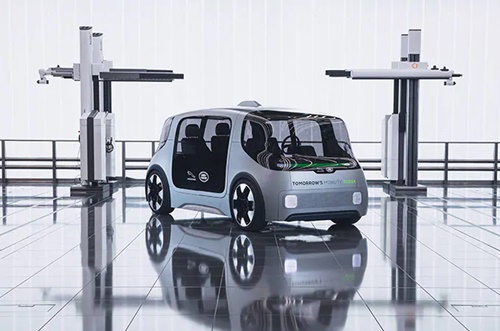
Jaguar Land Rover Ltd (JLR) on Tuesday unveiled its driverless electric vehicle concept Project Vector at Coventry on Tuesday. The concept vehicle for an autonomous, electric, connected urban mobility is slated to begin its pilot run in the UK from next year.

  • Developed at the UK’s National Automotive Innovation Centre (NAIC), located at the University of Warwick, JLR’s Project Vector aims at achieving a future of zero emissions, zero accidents and zero congestion – through its products, services and across its facilities.
  • As the next stage, the Project Vector concept will showcase an advanced, flexible, multi-use electric vehicle that is ‘autonomy-ready’.
  • The compact vehicle concept is built on a flexible flat-floor platform which houses all battery and drivetrain components. The concept vehicle measures four meters in length and can accommodate different seating configurations.
  • The concept electric vehicle can be used for personal, shared and commercial applications such as last mile deliveries, the company said in a statement on Wednesday.
  • “Jaguar Land Rover understands the trends shaping modern societies. Project Vector shows Jaguar Land Rover as a leader in innovation to make our societies safer and healthier, and the environment cleaner. Through this project, we are collaborating with the brightest minds in academia, supply chain and digital services, to create connected, integrated mobility systems – the fundamental building blocks for Destination Zero,” Jaguar Land Rover chief executive officer, Sir Ralf Speth commented. 
  • “Project Vector is precisely the brave and innovative leap forward needed to deliver on our mission.”
  • Project Vector is part of JLR’s ‘destination zero mission’, which envisions zero emissions, zero accidents and zero congestion, it said.
  • It will also address the wider landscape of mobility, from how customers connect with mobility services, to the infrastructure required to enable fully integrated, autonomous vehicles in our cities. 
  • “The megatrends of urbanisation and digitalisation make connected urban mobility systems necessary and inevitable. Shared and private vehicles will share spaces with and be connected to public transit networks, so you can travel on demand and autonomously. That is a complex task, best achieved by working together with partners across the spectrum of vehicles, infrastructure, and the digital world,” Tim Leverton, project director, said.
  • JLR will collaborate with Coventry City Council and the West Midlands Combined Authority to plan a mobility service from late 2021, as a living laboratory for future mobility on the streets of Coventry.
  • The NAIC, touted as one of Europe’s largest automotive research and development (R&D) facilities, was officially inaugurated by the Prince of Wales on Tuesday. Besides Project Vector, JLR, along with Tata Motors and the Warwick Manufacturing Group (WMG), showcased several other mobility concepts.
  • The vehicles and concepts showcased included Tata Motors’ Nexon EV, the 7-seater multi-purpose vehicle Hexa with self-drive features, JLR’s prototype of self-driving Jaguar I-Pace and Land Rover Discovery ADAS (advanced driver assist systems).
  • “At NAIC, academics, manufacturers and suppliers will develop a smart, safe transport infrastructure that integrates autonomous vehicles and public transport; design zero emissions vehicles powered by smart-chargers and renewable energy and discover material and digital manufacturing innovations that will eliminate waste," added Speth. Source: https://www.domain-b.com
Read More........

Brits print out disposable low-cost drone

A low-cost drone has been built with the help of a 3D printer, media confirm. Engineers from University of Sheffield in the UK have created and tested a low-coast unmanned aerial vehicle (UAV) using a new and cheap technique. The aircraft is 1.5m wide.
The UAVs are usually created by large manufacturers, as their construction is expensive and complex. The achievement of the UK researchers could make the craft a more sight. Researches from the Advanced Manufacturing research Centre carried out a test flight of the vehicle earlier this week. The manufacturing cost of the drone has not yet been released, but its researchers said that it was significantly lower than that of large drone-dedicated companies. The university’s engineers are now developing an electric fan propulsion system that will simplify the drone’s control. They also plan to develop a GPS control system or a camera, controlled by an operator wearing person-view googles. Sheffield’s drone was built with the use of a technique called fused deposition modeling (FDM), and is made of a polymer called thermoplastic. This method is slower than other printing techniques, including selective laser sintering (SLS). Without using lasers, the FDM method results in fewer costs. However, the costs depend on the material used, the size of the craft and the printer used. “By understanding the capability of the FDM process and associated software, we were able to manipulate the design to contain a number of unique features as well as preventing build deformation. All parts required for the airframe can be combined onto a single build within the Fortus 900 machine, taking less than 24 hours with ABS-M30 material,” Mark Cocking, additive manufacture development engineer, said. Low production costs might make 3D unmanned aircraft more disposable. They can be sent on one-way flights for delivery, search or reconnaissance purposes. FDM printers use two kinds of materials. The first is called the “modelling material” and is what the object is ultimately made of once complete. A second, “supporting material”, acts as a scaffolding to support the object during the printing process. The polymer craft could be built and deployed in remote situations, potentially within as little as 24 hours, the engineers say. The Sheffield UAV is made up of nine parts printed separately that are snapped together. It weighs less than 2kg (4.4lb) and is made from thermoplastic. The engineers are currently looking at ways to use nylon as the printing material, in place of plastic, which would make the UAV 60 percent stronger, without increasing its weight.“Following successful flight testing, we are working to incorporate blended winglets and twin ducted fan propulsion. We are also investigating full on-board data logging of flight parameters, autonomous operation by GPS, and control by surface morphing technology,” Dr. Garth Nicholson, the Head of the project, said Facebook founder Mark Zuckerberg revealed yesterday that Facebook is similarly working on drones, satellites and lasers to deliver the internet to underdeveloped countries. He is eager to deliver the internet to “the next 3 billion people” - and revealed the firm has hired experts in solar power that can keep drones flying for months at a time. Voice of Russia, Daily Mail. Source: http://sputniknews.com/
Read More........

Ssangyong Motor Unveils Tivoli Long Body Concept Car

By Lee Kyung-H0 (info@koreatimes.com): Ssangyong Motor unveiled its concept car XLV-Air and XAV-Adventure at the Frankfurt Motor Show 2015. The XLV-Air is a mass-production concept car which is developed ahead of the releasing of the compact SUV Tivoli Long Body. The concept car expresses the power of the nature and its dynamics on the basis of Ssangyong Motor’s design philosophy “Nature-born 3Motion.” Its powertrain portfolio includes a 1.6-liter gasoline and diesel which comply with the Euro 6 gas emission standards, while featuring the combination of six-speed automatic and manual transmission, with the optional 4W drive system. The XAV-Adventure is a concept car with its design embodying the respect for Ssangyong’s flagship SUV Korando and re-interpretation of traditional off-roader. In the meantime, Ssangyong Motor used the Frankfurt Motor Show as a place to announce the official sales launch of the Tivoli Diesel in Europe. By the end of this year, Ssangyong Motor plans to make an entry into eight new European markets, including Denmark, Finland, and three Baltic states, bringing the total number of countries where it is engaged in marketing, up to 122 from current 114. vSource: http://www.koreaittimes.com/
Read More........

Peugeot Exalt Digitally Modified to Look Production-Ready Car

The recently revealed Exalt show car is a stunner, a good-looking motor even by the high design standards Peugeot enforces upon itself when it comes to concepts. The automaker has a very long history of striking and/or beautiful concepts, but the Exalt is special because it doesn’t look a million miles away from production. That’s why it didn’t take much for Cavalino to turn the Exalt into something you could believably see in a Peugeot showroom. The headlights and grille are different, the rims appear to be from the 508 sedan and the paint is no longer two-tone, but that’s about as far as the modifications go, by the looks of it. He also added door handles the lack of which would have been very noticeable… But all this brings uncertain thoughts to mind. Peugeot is said to be bringing the Exalt concept to China, which may or may not mean anything by itself, but I think it could also sit very nicely at the top of the automaker’s Euro range. It probably would not sell terribly well, not be the best to drive and be quiet expensive (think of it as a modern Pug equivalent of the stunning, but not really recommendable Citroen C6). However, the five or six people that would buy it would defend it to death and get a nice profit return in a few decades’ time when the grandkids sell it on to a museum. By Andrei NedeleaThanks to Cavalino for the Render Source: Carscoops
Read More........

Ferrari's Imaginary Maserati Quattroporte Rival Rendered

Take a good look at the digitally-created four-door Ferrari you see here, because it will probably never happen, at least not during the reign of signiore di Montezemolo who is adamant they need to keep sales figures down to preserve exclusivity. The rendering is of an imaginary rival to the Maserati Quattroporte, featuring the headlights from the FF (the most practical car in their range) and an elongated shape that is so atypical for a modern Ferrari. As an actual, real model, its creator X-Tomi says it would sit above the Maserati, being a more powerful, more exclusive model in its own right. I'd add that it would also most likely feature the unique all-wheel drive system borrowed from the FF, rather than the Maserati system, again, to preserve exclusivity. Not a bad idea to take the time and dream up a modern Ferrari sedan, but don’t expect to see one in the coming decade, looking at the way things are going now. By Andrei NedeleaDesigner: X-Tomi Source: Carscoops
Read More........

Eye on future, India mulls options for nuclear-powered aircraft carrier

Nothing projects raw power like an aircraft carrier prowling on the high seas, capable of unleashing strike fighters against an adversary in a jiffy. A nuclear-powered carrier can make the punch even deadlier with much longer operational endurance. With its first indigenous aircraft carrier (IAC) set to be "launched" at Cochin Shipyard on August 12, and sea trials of the first nuclear submarine INS Arihant to begin shortly after, India is now examining the possibility of having a nuclear-powered 65,000-tonne carrier in the future. Navy vice-chief Vice Admiral RK Dhowan on Thursday said a "detailed study" was underway on the "size, type of aircraft and their launch and recovery systems, propulsion" and the like for the IAC-II project. "Yes, we are also considering nuclear propulsion. All options are being studied. No final decision has been taken," he said. There are huge cost issues with nuclear-powered carriers, which can easily take upwards of $10 billion to build. The Royal British Navy is reverting to carriers propelled by gas turbines/diesel-electric systems from nuclear ones. However, the US has 11 Nimitz-class "super-carriers" — each an over 94,000-tonne behemoth powered by two nuclear reactors and capable of carrying 80-90 fighters - to project power around the globe. China, too, is now looking at nuclear-powered carriers after inducting its first conventional carrier — the 65,000-tonne Liaoning — last September. So, while Navy may want a nuclear-powered carrier, it will ultimately have to be a considered political decision. The force, however, is firm about its long-term plan to operate three carrier-battle groups (CBGs). "One carrier for each (western and eastern) seaboard and one in maintenance," said Vice Admiral Dhowan. But, even two CBGs will be possible only by 2019. The 40,000-tonne IAC, to be christened INS Vikrant, will be ready for induction only by December 2018, as was first reported by TOI. "Design and construction of a carrier has many challenges. Around 75% of the IAC structure has now been erected. India joins only four countries — the US, Russia, the UK and France - capable of building a carrier over 40,000-tonne," he said. The 44,570-tonne INS Vikramaditya - or the Admiral Gorshkov carrier now undergoing sea trials after a $2.33-billion refit in Russia - in turn will be ready by end-2013 instead of the original August 2008 deadline. Vice Admiral Dhowan admitted India's solitary carrier, the 28,000-tonne INS Viraat, will soldier on till 2018 due to these long delays. The 54-year-old INS Viraat is left with just 11 Sea Harrier jump-jets to operate from its deck. The 45 MiG-29K naval fighters, being procured from Russia for over $2 billion, can operate only from Vikramaditya and IAC. The 260-metre-long IAC, whose construction finally began in November 2006, will be able to carry 12 MiG-29Ks, eight Tejas light combat aircraft and 10 early-warning and anti-submarine helicopters on its 2.5-acre flight deck and hangars. It will have a crew of 160 officers and 1,400 sailors. Powered by four American LM2500 gas turbines, the IAC will have an endurance of around 7,500 nautical miles at a speed of 18 knots. Source: Defenseblog-njs
Read More........

Want to 3D Print the NSX Concept and Other Honda Studies?


.Subscribe
Even though it will probably take a while (but not as long as you may think) for 3D Printers to become a common household item, automakers are preparing themselves for this technological breakthrough. After Porsche, Honda has also shared three-dimensional (3D) data for exterior designs of some of its models. In the Japanese automaker's case, it is providing 3D Print info for five concepts from the past, including the 2013 NSX sports coupe, the 2007 Puyo, the 2003 Kiwami Fuel-Cell study, the 1999 Fuya-Jo kei car and the 1994 FSR/ Honda claims that the data, which is offered for free under a Creative Commons license, allows users to easily replicate the concept studies using a household 3D printer, which turns a digital
model into a three-dimensional solid object using successive layers of material laid down in different shapes. The 3D Print initiative is part of a new global branding project that highlights' "Honda's unique approaches and thoughts toward the 'art of manufacturing'", and it follows the "Super ultra daydreams" spot that made its debut at the start of Honda's press conference at the Tokyo Motor Show last year. You can download the 3D Print data at Honda's dedicated site hereSource: Article
Read More........

BMW Virtual Glasses can Turn Anybody Into a Mechanic

Over the past few decades, the trend within the automotive industry has been to separate the owner of a car from the operations associated with maintaining it and fixing it whenever something goes awry. However, it seems that there may be hints of a reverse process, re-embracing the customer hands-on approach, as BMW revealed augmented reality glasses that turn anybody into a fast-thinking mechanic. As the video posted below eloquently shows, when you wear said glasses, and designate a part that needs to be removed, they will then begin highlighting what needs to be taken apart in order to reach the problem component, also showing the correct way to go about doing it. Written instructions are also displayed, and audible ones can be enabled too. In theory, you could be a total noob and instantly look like you know what you’re doing. Animations will be also be implemented in order to show the user’s progress on the various separate tasks that need to be tackled. Check out the video below, if you think this is a bit too futuristic and doesn’t yet work. Please note that it’s actually a very old video, first posted some six years ago, and we don’t really know how much progress has been made, if any, since then… (hence the poor quality). By Andrei Nedelea Story References: Daily Mail via BMWblogSource:  Carscoops
Read More........

A different model for DRDO

Setting up a Defence R&D Commission will make little difference by way of increasing self-reliance in defence systems and equipment, but it will increase the autonomy of functioning of the DRDO laboratories There is hardly any lecture or discussion on the Defence Research and Development Organisation (DRDO) and the Defence Ministry more broadly in which a call is not given for the setting up of a Defence R&D Commission “on the pattern of” the Atomic Energy Commission and the Space Commission. The rationale for such a proposal is that it would enable the DRDO to have steeply increased autonomy and more administrative and financial powers and, thereby, to be more effective.
However, those who so argue are rarely aware of the detailed organisational structure and managerial practices of the two existing commissions. This article is intended to bring out those structures and practices.
First and foremost, the Cabinet Minister for those commissions is no less than the Prime Minister himself. So, the chairmen of those commissions have direct access to the very head of government. There is not even a Minister of State in between. Where such a Minister of State has been brought into the picture, his only role is to lighten the burden of the Prime Minister in answering parliamentary questions and other matters related to Parliament. The commission chairmen meet the Prime Minister whenever they want to and also submit files directly to him/her. This gives both chairmen unrivalled power. Second, the commissions are small and compact and the membership is at a very high level e.g. both the principal secretary to the Prime Minister and the cabinet secretary are invariably members of the commissions. As for scientists, not only is the chairman an eminent atomic/space scientist or engineer, but he is also the secretary of the executive arm of the commission concerned viz. the departments of atomic energy or space. The members (R&D) of the commissions are usually the directors of the largest or principal R&D centre of the atomic energy and space programmes respectively viz. the Bhabha Atomic Research Centre (BARC) and the Vikram Sarabhai Space Centre (VSSC). To give the commissions the semblance of not being entirely “in-house affairs,” one eminent scientist from outside the atomic and space programmes is also made a member. But most often the scientist concerned has little detailed knowledge of the atomic or space programmes. So, the commissions are, in fact, wholly in-house structures de-facto.Continuity till realisation Third, and very importantly, exactly what projects the departments or R&D centres concerned should take up and how the entire atomic and space programmes should be structured in terms of goals, modalities, sequences, costs and time frames of realisation are defined by the chairman and the member (R&D) as an internal process. In other words, the programme goals are chosen and then attempted to be achieved by the same people. We thus have a situation of a “self-fulfilling prophesy.” There is no one to ask, for example, why there should be a Chandrayaan programme related to the Moon, or, the Mars mission and/or whether we, as a nation, should not set ourselves a different set of goals. This may be contrasted with the situation of the DRDO which has users external to it viz. the defence services and it is those services who define and set programme and project goals.Success and failure Fourth, as the goals of the atomic energy and space programmes are set totally internally, there is none to hold the commissions and departments concerned accountable for failures or project delays or escalations in project costs of a very large magnitude, e.g. the prototype fast breeder reactors in the case of atomic energy and the GSLV (Geosynchronous Satellite Launch Vehicle) in the case of space. In contrast, in the case of the DRDO, the defence service concerned and the Secretary (Finance) in the Defence Ministry call in such circumstances not only for project reviews but, on occasions, for project termination and the going in for the import of the weapon system concerned, quite apart from massive pillorying of the DRDO. Fifth, in atomic energy and space whether one should go in for import or pursue further R&D on a badly delayed project is a decision taken by an entity that is both designer and developer and user rolled into one. For example, if Chandrayaan succeeds or fails, there are no external consequences or implications. However, in the case of defence systems under design and development by the DRDO in one of its laboratories, the consequences of success or failure have a direct bearing on national security and the credibility of the DRDO in the eyes of the Defence Minister and all other elements of the Defence Ministry. Finally, and partly related, is the fact that the DRDO is doing its design and development under the overhang of constant lobbying by foreign suppliers, that the defence system concerned is either too complex and difficult for the DRDO to release or that the DRDO will need much more time to develop it, whereas they can supply the system to the defence service concerned practically off the shelf! Such a situation just does not arise in the case of atomic energy or space. To sum up: setting up a defence R&D commission will make little difference by way of increasing self-reliance in defence systems and equipment, or changing for the better the relations between the DRDO and the defence services because of the fundamental dynamics of that relationship. What it can achieve, however, is to increase the administrative and financial powers of the DG, DRDO and the autonomy of functioning of the DRDO laboratories. Though a more modest achievement, it may still make it worthwhile to have a commission for the DRDO. Source: Article
Read More........

Opel Releases Second Teaser Image of the Monza Concept, Reminds Us of Past Frankfurt Studies

The Frankfurt Motor Show (September 12-22) is quickly approaching and automakers are starting to uncover their premieres to be displayed at Europe’s largest car show. Opel has confirmed the Monza Concept for Frankfurt, a coupe whose face we’re already familiar with. Now, the German carmaker released a second teaser image of the car showing the front end once again, although this time it has been more generous with the lighting. The Monza Concept is a preview of things to come at Opel in the future, especially as far as the design is concerned. The Monza features an evolution of Opel’s design philosophy of “Sculptural Artistry meets German Precision”, albeit now favoring “lithe athleticism rather than pure muscle power.” “The Monza Concept is our vision of Opel’s future in pure form,” said Opel CEO Dr. Karl-Thomas Neumann. Although the German carmaker keeps silent about the study’s technical characteristics, previous reports say the car is rear-wheel drive and may be underpinned by the architecture of the Cadillac ATS. The study is tipped to spawn a production version from 2016 that will be powered by Cadillac ATS gasoline engines, plus Opel diesels in Europe. The roadgoing version of the Monza Concept may also be badged a Buick in the United States. The Monza study respects Opel’s tradition of presenting “ground-breaking” concept cars at the IAA. Opel says it prides itself for having been the first carmaker in Europe that built a study in its own design facilities (instead of having a coach-builder make it) – the 1965 Experimental GT, which premiered in Frankfurt. The study for an affordable sports car became a reality as the 1968 Opel GT, marking another premiere as the first European concept car ever to go into series production. More IAA studies from Opel followed over the years: the 1969 Opel CD Gran Turismo, the futuristic 1975 Opel GT2, the 1981 TECH 1 research vehicle that previewed the design of the Opel Omega, the 1983 Opel Junior city car, the eco-friendly 1999 Opel G90, the versatile 2001 Frogster Concept or the 2003 Insignia which previewed Opel’s current design language. Opel’s more recent IAA concept cars are the 2007 Flextreme Concept hybrid and the 2011 Opel RAK e experimental car. Source: Carscoops
Read More........

New Shelby Cobra Design Study Looks Like a Viper Killer

For more than five decades now, the classic AC Cobra, more commonly known as Shelby Cobra in the United States, has captured the imagination of many drivers and car enthusiasts alike, having earned its place in automotive history. Super powerful yet as light as a feather (or so to speak), the Cobra was never a car for the faint hearted. Ford itself attempted to resurrect the Cobra with a concept in 2004 featuring a 6.4-liter V10 thumping out 605 horsepower, but it never came into fruition production-wise. Today, Detroit native and industrial design student Daniel Couttolenc emailed us a new concept he made for a Shelby Cobra of the 21st century, a car that in our view, could offer Ford the halo sports car it's been looking for ever since the death of the GT 40, placing it against the Corvette and even more so, the Chrysler Group's SRT Viper. "The project objective is to design a new Shelby Cobra. One that remains true to its racing DNA," says Couttolenc. "Designed for the current racing enthusiast. The design needs to merge cohesively both; the original Shelby Cobra design cues and Ford´s current design language." The design blends the traditional styling elements and shapes of the classic Cobra with Ford's new philosophy as portrayed in the Evos Concept. Designer Daniel CouttolencSource: Carscoops
Read More........

Dutch Students Take 0-100 KM/H Sprint Record with Homemade EV

If there’s one thing the Tesla Model S has taught us is that electric cars can punch well above their horsepower rating when it comes to acceleration. However, it’s not the most relevant example, and for that we must go to the Netherlands, where a team of students from the Delft University of Technology managed to make an electric single-seater with only 135 hp go from 0-62 mph or 0-100 km/h in 2.15 seconds. In doing so, they took the world record for the fastest accelerating EV, which originally stood at 2.68 seconds. They made the job of beating the record easy for themselves, though, fitting the DUT12 with four independent electric motors, and only making it carry around a total weight of 320 lbs / 145 kg. It’s purpose-built to just shoot off the line with no real wheelspin if the tarmac is dry. Chances are it’s probably geared for acceleration only, so it tops out very quickly, but we’d like to see that race car-like suspension system being put to good use, because when adding in the sticky tires, the DUT12 shouldn’t be half-bad around the corners either. Check it out in the videos below. By Andrei NedeleaStory References: tudelftSourc; Carscoops
Read More........

Life and diary of Anna Frank: Video Game

Анна Франк
The life story of Anna Frank whose name became one of the symbols of European Jews’ tragedy during the Nazi time and World War II transformed into video games, one of which was created by young German designer Kira Resari.
That’s how her tragic life looks on a display: Anna is sitting at a table at her shelter in Amsterdam and reading. She needs to go upstairs to bring some potatoes for dinner but she hesitates as it’s dangerous because it’s October 20, 1942. Anna and her family are Jews. Nazis could find them at any time and deport to Germany. “By the example of Anna Frank I wanted people to feel what a person forced to live and interact with six or seven people in a less than 50-square-meters room. Besides, during the game you realize that all your actions have certain and sometimes very serious repercussions because you can’t cancel them,” Resari says. This computer game that only exists as a piIot sample is 25-year-old Kira Resari’s bachelor’s degree work. His teacher gave him the idea. The main moments of Anne Frank’s life story remain unchanged, so it will be impossible to save Anne Frank from deportation. The action develops during one day only. Resari believes that computer games, just like books and films, may touch upon the subjects of the Holocaust and WW2. Swiss publicist Yves Kugelmann, a member of the council of the Anne Frank Foundation, does not quite share his opinion. "We live at an age of technological domination. Ever after the TV appeared people started asking if there was any point in expatiating on this subject and if we have the right to do so. I believe that we have this right. Another problem is how to do this and here a lot of questions remain unanswered." The Swiss publicist believes that it is impossible to communicate the contents of this book in its entirety. "We believe that promoting those events, not only in the case of Anne Frank, is a controversial issue because the equipment is in the limelight anyway. At the same time, the sophistication and the whole point of those texts are lost." Very few people have had a chance to test this game so far, apart from the teachers from Macromedia University for Media and Communication. At present Kira Resari is looking for sponsors. As soon as a sponsor appears the game designer will promote his game as a cultural asset because he says that cultural centres may be interested in his product. Source: Voice Of Russia
Read More........

New Ferrari F150 to Cost €1.0/$1.3 Million Before Taxes, Fresh Rendering Previews its Looks

You can now forget about that 0.0001 percent chance you thought you might have of being able to own Ferrari's next masterpiece, which we have come to know as the F150-codenamedreplacement of the Enzo. A new report from Autoweek citing "people familiar to the matter" says the new Ferrari hypercar will have a pre-tax starting price of around €1 million (US$1.33 million at today's currency rates). Add the taxes, and you're looking at €1.21 million or $1.6 million, if you live in Italy. According to the same sources, Ferrari will build 499 examples (that pretty much kills your chances even if you did have a couple of million dollars on the side for a racing day), which is 100 more than the Enzo, in order to satisfy growing demand in Asia, and particularly in China. In typical Ferrari fashion, the Italians would not confirm pricing and volumes, nor would they share more pictures, even though they have already revealed the car to potential customers, leaving us to wait until the Geneva Motor Show to get a glimpse of the 950-horsepower V12 Hybrid model. Well, at least of the real thing, because designer Josiah LaColla is offering us a digital look at the car through these renderings. "These images are my best guess- and using a slew of references ranging from the cracks in the mule-car camouflage to Ferrari's latest form language and the infamous leaked plaque, it's indeed an educated guess," he wrote on his blog. "Taking a step away from other rendered speculations, this version makes an attempt to get into Pininfarina's shoes, keeping the body as clean as possible while integrating all the necessary ventilation," he added. Renderings Courtesy of Josiah LaColla via WorldcarfansSource: Carscoops
Read More........

Davos 2013 - An Insight, An Idea with Marissa Mayer

An insight, an idea: Erik Schatzker, Marissa Mayer
DAVOS/SWITZERLAND, 25JAN13 - Erik Schatzker (L), Anchor and Editor-at-Large, Bloomberg Television, USA and Marissa Mayer (R), Chief Executive Officer, Yahoo, USA; Young Global Leader prepare for the session 'An insight, an idea with Marissa Mayer' at the Annual Meeting 2013 of the World Economic Forum in Davos, Switzerland, January 25, 2013. Marissa Ann Mayer is President and CEO of Yahoo!. Previously, she was a long-time executive and key spokesperson for Google. Mayer was ranked number 14 on the list of America's most powerful businesswomen of 2012 by Fortune magazine. Wikipedia
Read More........

Mercedes-Benz Brings the Golf Cart Into the 21st Century with New Concept

Behold Mercedes-Benz's vision of what a modern - or rather scratch that, a futuristic Golf Cart should look like. This conceptual model was crafted at the Mercedes-Benz Advanced Design Center in Carlsbad, California, with designers using input from golfers from all over the world. The all-electric model, which to be honest, looks like something that Smart would have come up with, has two seats and removable lightweight doors. It ditches the conventional steering wheel for a joystick mounted on the center console that can be operated by either passenger, while it also includes all vital features for regular road use such as indicators, headlamps and taillights – just in case someone wants to drive it home. "It has the latest in modern technology," says Margarete Wies, Head of the Mercedes-Benz Advanced Design Center. "Using touch screen monitors, virtually all aspects of the cart can be controlled without extra buttons. Simplicity is the key. Intuition and pure form can maybe best describe the cart." Speaking of tech features, some of the other highlights include the head-up display integrated into the windscreen that can also be used to show the course layout, the current status of the game or weather information when the vehicle is stationary, an AIRSCARF neck-level heating system for the seats (borrowed from Merc's roadsters) and the so-called "fore button" to quickly warn other players of a misplaced shot. In addition, aside from manual charging, the Golf Car's batteries can be kept continuously charged by a solar module integrated into the roof. While a concept, Mercedes did not completely strike out the idea of a production model: "Although the Mercedes-Benz Vision Golf Cart is only a design study so far, there are no doubt many players who would like to see the cart become reality, bringing its fresh ideas and thus more fun, more innovation and more comfort to moving around on the golf course," said the carmaker in a statement. Source: Carscoops
Read More........

Spied: BMW Gets to Work on Next Generation 5-Series


Much in the same way as humans and animals, automobiles are also tied to the vicious cycle of life and death. At the same time that the first examples of the facelifted BMW 5-Series F10 sedan, F11 Touring and F07 Gran Turismo models are arriving in dealerships across the world, the engineering minds in Munich have started field tests of the car that will gradually replace them starting from late 2016 or early 2017. Our spy photographers nabbed one of the very first camouflaged prototypes of the next generation 5-Series in Touring (station wagon) shape as it was being transferred on a delivery truck. It's too early and there are too many dummy panels on the test car to know definite details, butthe new 5er is expected to benefit from a weight reduction and new tech features, all while evolving the design of the current model. By the time the next 5-Series arrives, further advancements in the field of hybrid powerplants and electric motors will allow BMW to expand its range as well. Photo Credits: CarPix for CarScoop, Source: Carscoops
Read More........

Leak hints at China's design for next-gen stealth bomber

FP: You're looking at what some people are speculating is China's design for a stealth bomber. It may look like a simple model right now. But these Chinese models have a habit of turning into working airplanes. And if that happens in this case, watch out. Because it could potential give these Chinese the ability to penetrate deep, deep into enemy territory without the opponents ever knowing what hit them. Remember, designs very similar to China's J-31 stealth fighter and its Li Jian stealthy-ish drone appeared as trade show models only two years before full-size versions of the planes were revealed in the past year. The latest plane resembles a cross between Russia's PAK DA stealth bomber design, it'sT-50 PAK FA stealth fighter and Northrop's YF-23 Black Widow -- the stealth jet that lost the contest to be the world's first fifth-generation fighter to Lockheed Martin's YF-22 Raptor. (The cockpit also resembles this fictional monstrosity.) What could such a plane be used for? It would likely serve as a penetrating bomber designed to keep an enemy far from China's shores by sneaking past enemy radar and attacking enemy bases and ships with cruise missiles. Some have speculated that China'sJ-20, which is huge for a fighter, was meant to fulfill this role; similar to a stealthy version of the F-111 Aardvark or F-15E Strike Eagle. However, we're seeing the J-20 conducting flight tests with air-to-air missiles; a possible indication that it may be a high-speed interceptor -- similar to the Soviet Union's giant MiG-25 Foxbat and MiG-31 Foxhound interceptors -- designed to steak out and shoot down approaching bombers. Chinese Web forums claim the new stealth bomber might have a length of 91-feet and a wingspan of 72-feet. This is smaller than all of the U.S. and Russia's strategic bombers such as the B-1 Lancer or Tu-22M but slightly larger than the U.S.'s F-15E Strike Eagle tactical bomber. The jet is also rumored to have an operational radius of just under 2000-miles. It should be pointed out that earlier rumors about China investing in a fleet of Russian-designed Tu-22M supersonic bombers were reportedly untrue. Rather than field the supersonic jets, China is developing a new version of its H-6 bomber -- which is based on the Soviet Tu-16 Badger that was designed in the 1950s and retired by Russia in the early 1990s. Chinese military officials have even said that buying a 1970s-design like the Tu-22M makes little sense given the fact that U.S. radars could spot the planes coming from a long way off. This could be taken as a hint that the PLA navy or air force recognizes the need for a stealthy-bomber capable of keeping adversaries at bay. Basically, it costs a ton of money and time to develop and field an effective bomber force. It's not just the cost of building and buying stealth planes. The Chinese will need to develop an entire support network of maintenance crews, basing infrastructure capable of handling the planes, a large aerial tanker fleet to refuel them and perhaps most importantly learning how to effectively use them. One interesting thing to note about the design shown above is that its engine exhaust outlets appear to be square -- a stealthier design than the traditional round nozzles seen on China's current version of stealthy planes. This could be a sign that China is making progress in the extremely challenging art of jet engine design. This could also be an indication that it will be a long time before China gets the technological knowhow to develop this aircraft. Current reports indicate that China has a long way to go when it comes to engine-making. Source: Deep Blue Horizon
Read More........