Delhi Police creates 'green corridor' for live heart passage from airport to hospital


The Delhi Traffic Police on Thursday played an instrumental role in providing a green corridor to a human heart after it received an emergent request from the All India Institute of Medical Sciences (AIIMS) in which it was informed that a human heart under VAD (Ventricular Assist Device) is being flown from Vadodara to Delhi for a heart transplant surgery by a flight at 2:30 pm at Terminal 2 of IGI airpot for which a fast-moving green corridor is required from T-2 to AIIMS to avoid wastage of time.

Police swung into action and immediately deputed officers and a green corridor for the passage of ambulance carrying the 'live heart' were planned. The traffic inspectors piloted the ambulance throughout the route of 18.5 km from T-2 to AIIMS. It took 12 minutes for the heart to reach the destination, which would have otherwise taken anything between 35 and 40 minutes.

"This is the least anyone can do to save a precious life," said Joint CP, Traffic, Manish Kumar Agrawal.

The heart transplant saved the life of 20-year-old critically ill youth at AIIMS.

"The boy's heart had stopped functioning for which he had to undergo an urgent transplant. We arranged the heart of a 16-year-old brain dead patient in Vadodara which was flown to Delhi immediately and was transported in a very short time from the airport to AIIMS," an AIIMS spokesperson informed.

The boy underwent the transplant and has been saved, the spokesperson added.

The AIIMS officials also said that credit for this life-saving operation also goes to the Delhi Police whose pro-activeness enabled the live heart to reach the hospital on time. Source: https://southasiamonitor.org/
Read More........

Delhi virus cases dip but more states impose curbs

Delhi

Agencies/ New Delhi recorded fewer than 1,000 coronavirus cases for the first time in seven weeks yesterday, even as more states imposed restrictions to halt the spread of the pandemic.
India last week became the third country after the United States and Brazil to hit 1mn cases but many experts say that with testing rates low, the true number could be much higher.
More than 28,000 people have died, with Maharashtra, home to Mumbai and its teeming slums, suffering the highest death toll followed by the national capital and Tamil Nadu.
Prime Minister Narendra Modi’s government imposed one of the world’s strictest lockdowns in late March, but it has been steadily eased in recent months to lessen the devastating economic impact.
But, independently from the federal government, individual states have been tightening restrictions as case numbers have soared – including in Bengaluru, Bihar and parts of Kerala and Tamil Nadu.
On Monday authorities in West Bengal, home to about 90mn people, imposed a strict lockdown two days a week beginning tomorrow.
“The state government feels that the efforts to break the chain of Covid-19 spread have to be initiated in a strong manner,” the state’s home secretary Alapan Bandopadhyay said.
All government and private offices will be closed and there will be no public transport.
Private vehicles will be allowed for essential needs only.
The small northeastern state of Sikkim, bordering Tibet, on Monday also ordered a lockdown until July 27.
Delhi has offered a rare piece of good news, however, with the crisis easing since June, when hospitals and morgues in the sprawling megacity appeared close to collapse.
Monday’s count of 954 new infections in the city marked the first time the daily tally was under 1,000 in 49 days, and was down from a peak of almost 4,000 in late June.
A study testing antibodies of a random sample of people in the national capital published yesterday showed almost one in four people in the city have been infected with the coronavirus, 
According to the result of the survey, 23.48% of the 21,387 people whose blood samples were tested had Covid-19 antibodies, a government statement said.
The study, which was conducted by the National Centre for Disease Control, showed that the infection rate in New Delhi was much higher than the number of confirmed cases indicated.
For a city with an approximate population of 20mn, the total number of cases at a 23.4% rate should stand around 4.7mn.
But Delhi currently has a total of 123,747 cases, less than 1% of its population.
The government said the difference indicated that a “large number of infected persons remain asymptomatic” and commended “proactive efforts” like lockdown measures to prevent the spread of infection.
As only 23.48% of people were affected in Delhi six months into the epidemic, a significant proportion of the population remained vulnerable and containment and preventive measures needed to continue with the same vigour, the government added. Source: https://www.gulf-times.com/
Read More........

Covid-positive journalist jumps to death from hospital

Covid
  • IANS/New Delhi: A 37-year-old journalist, who had tested positive for the coronavirus, jumped to death from the fourth floor of Delhi’s All India Institute of Medical Sciences yesterday, officials said.
  • He died at 3.35pm, nearly one-and-a-half hour after jumping from the hospital’s trauma centre .
  • The journalist was admitted to the Covid ward of the trauma centre on June 24 after he had tested positive for the virus.
  • Hospital authorities said he was making significant progress and had planned to shift him to the general ward yesterday.
  • According to an AIIMS statement, the journalist ran from Ward No 1 of the trauma centre to the fourth floor, broke the windowpane and jumped.
  • The hospital said the attendants tried to stop him.
  • “He was immediately moved to the trauma centre’s ICU where he was intubated, and resuscitation was tried, but unfortunately he succumbed to his injuries,” the statement said.
  • The hospital also said that the journalist bouts of hallucination during the treatment and said it could have been because of a brain surgery he had in March.
  • He is survived by his wife and two children.
  • He was a principal correspondent of a leading Hindi daily and used to cover health and civic bodies in Delhi.
  • Meanwhile, a Goa police constable who recovered from Covid-19 and rejoined duty at Mormugao police station was given a hero’s welcome yesterday.
  • Director General of Police Mukesh Kumar Meena tweeted a short video of Manjunath Yaragatti being given a guard of honour by his colleagues, who also showered marigold petals.
  • “PC Manjunath Yaragatti returns to a warm welcome by his colleagues at PS Mormugao. He has recovered from Covid and is as fit as always. Remember, we are fighting the disease not the infected,” Meena tweeted.
  • Nearly 50 police personnel, including around 30 from the Ponda police station in South Goa district alone, have tested positive for Covid-19.
  • l Former Tamil Nadu minister and senior All India Anna dravida Munnetra Kazhagam leader B Valarmathi yesterday tested positive for the coronavirus infection and has been admitted to a private hospital in Chennai, an official said.
  • Valarmathi is the chairman of the Tamil Nadu Textbook and Educational Services Corp and AIADMK’s literary wing secretary.
  • According to a hospital official, Valarmathi’s condition is stable.
  • She is the sixth AIADMK leader to be infected with the coronavirus.
  • Earlier, five lawmakers, including Higher Education Minister K P Anbalagan had tested positive for the virus.
  • l Veteran Karnataka Congress leader B Janardhana Poojary tested positive for the coronavirus. 
  • “Poorjary, 83, is under treatment at a private hospital in Mangaluru after he tested positive for Covid on Sunday,” party leader Ravi Gowda told IANS.
  • Mangaluru is about 360km west of Bengaluru.
  • “Poojary is better and responding to treatment. Specialist doctors are attending on him in view of his advanced age,” Gowda said.
  • Poojary’s son J Santhosh said his father’s condition was stable and there was no cause for worry as he was asymptomatic.
  • According to party sources, Poojary seems to have contracted the infection from his daughter-in-law, who tested positive for the virus recently.
  • Poojary was former federal minister of state for finance in the Indira Gandhi government from 1982-84 and the Rajiv Gandhi government from 1984-87.
  • He was also the federal minister for rural development from 1987-89 in the Congress government.  Source: https://www.gulf-times.com/
Read More........

CM Kejriwal says situation in Delhi alarming, may need Army help

Delhi chief minister Arvind Kejriwal today said the situation in Delhi has become “alarming” after the toll in the communal violence over the Citizenship Amendment Act (CAA) in northeast Delhi rose to 20. Kejriwal flagged concern that the Army might have to be called in as police is “unable to control it”.
  • Kejriwal said the situation has become “alarming”, adding that he is writing to union home minister Amit Shah. “I have been in touch with large number of people whole night. Situation alarming. Police, despite all its efforts, unable to control situation and instill confidence (sic),” Kejriwal tweeted. “Army shud (should) be called in and curfew imposed in rest of affected areas immediately. Am writing to Hon’ble HM to this effect,” he added. 
  • The Delhi Police late on Tuesday issued shoot-at-sight orders in four areas of northeast Delhi — Bhajanpura, Maujpur, Khureji Khas and Chand Bagh — where looting, arson and rioting of unprecedented scale were reported throughout the day even as the toll in the violence over the Citizenship Amendment Act (CAA) climbed to 24 on Wednesday. 
  • The orders were issued after the union home ministry appointed SN Shrivastava, a 1985-batch IPS officer, as Special Commissioner (Law and Order), Delhi. 
  • Police also cleared the Jaffrabad metro station of women anti-CAA protests camping there since Saturday, leading to counter-agitations on Sunday that triggered the violence. 
  • The flare-up after Monday night with incidents of arson, looting and setting vehicles and shops on fire in several localities like Chand Bagh, Bhajanpura, Gokulpuri, Maujpur, Kardampuri and Jaffrabad also saw pitched battles between members of two groups who hurled petrol bombs and even opened fire. 
  • National Security Adviser (NSA) Ajit Doval marched through the affected areas late last night and also took stock of the situation, sources said.
  • According to Guru Teg Bahadur Hospital authorities, the number of dead has risen to 20 while the number of injured has gone up to 189, although the situation at the hospital “seems to be settling”. 
  • The toll from communal violence over the CAA has risen from 13 on Tuesday to 20 today (Wednesday), PTI quoted Medical Superintendent of GTB Hospital, Sunil Kumar, as saying.
  • Police struggled to check the rioters who ran amok on streets, burning and looting shops, pelting stones and thrashing people, as the communal flare-up over the CAA escalated in north-east Delhi.
  • Earlier, at least four bodies were brought to the Guru Teg Bahadur (GTB) Hospital from the Lok Nayak Jai Prakash Narayan Hospital (LNJP) Hospital, a senior official said. Later, while interacting with reporters, GTB MS said, from Tuesday midnight it is a “trickle of patients and not a gush of injured persons as was earlier”. 
  • There are people with several kinds of injuries, including from gunshots, while many sustained trauma from jumping from rooftops to escape violence, he said, adding that many received head injuries, as well. “We are fully prepared with doctors, nurses, paramedics, consumables, linen and other paraphernalia and hoping that the situation won’t worsen from here,” he said. 
  • Asked if the victims have been identified, Kumar said, “Many people have been identified, some are yet to be”.
  • Meanwhile, Section 144 was imposed in parts of the city and shoot-at-sight orders were in place in northeast Delhi as of Tuesday evening. Home minister Amit Shah held a three-hour meeting with top MHA officials and Delhi Police representatives to take stock of the situation.
  • At midnight, Delhi Police Special Commissioner Satish Golcha said the protesters have left the Jaffarabad metro station and added that the Maujpur Chowk was also clear. "Now, 66 Futa road is absolutely clear of all protests," he said. Earlier, there were reports of stone pelting in Laxmi Nagar, however, the mob dispersed shortly later.
  • Home minister Amit Shah cancelled his planned trip to Kerala and held a three-hour meeting with Delhi Police and home ministry officials. Newly appointed Special Commissioner of Police SN Srivastava was also present. The meeting lasted for three hours and according to sources, heads are expected to roll over Delhi violence. Shah has held three meetings over the past 24 hours.
  • National Security Advisor (NSA) Ajit Doval took stock of the situation in the national capital. Doval held a meeting with Delhi Police officials and chaired a meeting at DCP north-east office. Source: https://www.domain-b.com/
Read More........

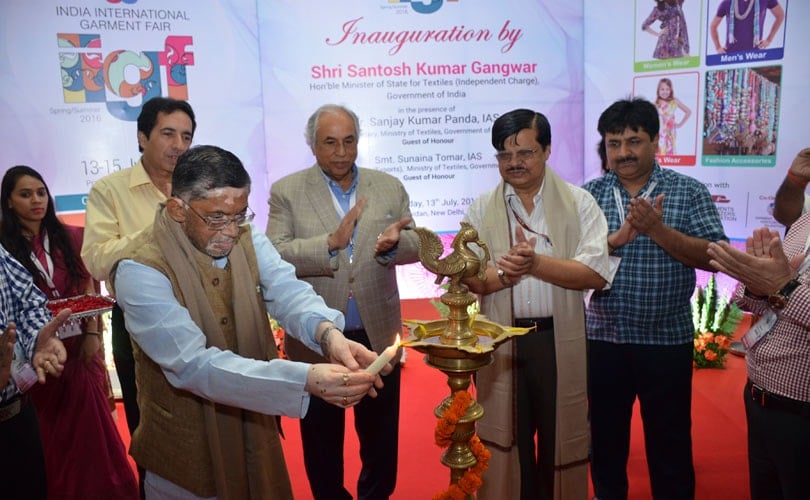
Textile Minister inaugurates 55th IIGF in New Delhi

Textile Minister inaugurates 55th IIGF in New Delhi
Sujata Sachdeva: The 55th edition of India International Garment Fair 2015 (IIGF) was inaugurated by Santosh Kumar Gangwar, Minister of State for Textiles at the Pragati Maidan in New Delhi on Monday. In his inaugural speech, Gangwar highlighted the need to strengthen apparel exports. A three day annual fair is being held till July 15, 2015. Also present at the inauguration were Sanjay Kumar Panda, Secretary Textiles, Sunaina Tomar, JS Exports, Virender Uppal, Chairman AEPC, Sudhir Sekhri, Chairman (EP), Puneet Kumar, Secretary General AEPC, Executive Committee Members, among others. Emphasis on inclusive growth: In his speech Gangwar said “Given its employment and export intensity, apparel industry plays a significant role in realising the vision of ‘Make in India’. The new government under the leadership of Prime Minister Narendra Modi has emphasised on the economic vision based on boosting manufacturing, growing exports and generating more and more employment. The idea is to embark on the path of inclusive and participatory growth,” he said.  Appreciating the efforts of fair organisers in bringing together a large number of exporters to the event, while attracting reputed overseas buyers, Gangwar said his ministry would continue to provide support for organising IIGF, as this industry provides large employment and earns precious foreign exchange for the country. Panda pointed out that the 55th IIGF is the largest garment show in South Asia, covering apparel and fashion accessories, encompassing a vast exhibition area of around 17,256 square meters. The objective is to showcase latest garment and fashion accessory trends. “This sector being the highest employment provider in the manufacturing sector has a much bigger role and responsibility. India has the significant advantage of a young population offering huge potential for a demographic dividend by getting gainful employment in this sector with just three months of training,” he added. Rise in exhibitors and buyers: With more than 400 exhibitors this edition of IIGF has seen a remarkable increase in the number exhibitors from several states such as Rajasthan, Tamil Nadu, Maharashtra, West Bengal, etc. “The 55th IIGF has attracted 305 buyers from across globe, of which 202 are from the traditional markets and 103 are from non-traditional markets. 2,921 buyers have already registered for the fair. This is an indication that buyers have started showing faith and see India as a safe and compliant destination for sourcing garments,” informed Uppal. IIGF is being organised by AEPC in association with AEMA, GEA and CMAI as partner associations and GEAR as the co-organisers. Buyers from across EU, Asia, USA, Brazil, UK,US, etc, are participating. Big buyers including One Jeanswear Group from USA, Grupo Hotelshops, Mexico, PJSC Melon Fashion Group from Russia, The Original Factory Shop from UK, Cortefiel from Spain, among others are all there. Source: Article
Read More........

Atal Bihari Vajpayee,Madan Mohan Malviya to be conferred with Bharat Ratna

PM expresses delight at Bharat Ratna conferred on Pt. Madan Mohan Malaviya and Shri Atal Bihari Vajpayee
            Videos            Books           Collection            Wiki             Speech      |      Books           Videos            Wiki            Speech
Former Prime Minister Atal Bihari Vajpayee and educationist Madan Mohan Malviya were on Wednesday chosen for the country's highest civilian award Bharat Ratna. The announcement came ahead of Vajpayee's 90th birthday on Thursday. A meeting of the Union Cabinet was convened in Delhi today where the was taken. "The President has been pleased to award Bharat Ratna to Pandit Madan Mohan Malviya(posthumously) and to Atal Bihari Vajpayee," a press communique from Rashtrapati Bhavan said. One of India's most charismatic leaders, Vajpayee is lauded as a statesman  and has been often described as the moderate face of BJP. Vajpayee, who has been ailing for sometime, has been credited for taking bold initiatives, notable being the attempt to bridge Indo-Pak differences. India's longest serving prime minister outside of Congress party, Vajpayee's detractors called him "mask" of the RSS. Several BJP leaders and
MPs, including Murli Manohar Joshi, have demanded that the top honour be awarded to Vajpayee. NDA partner Shiv Sena too came out in support of conferring Bharat Ratna to the first BJP Prime Minister. An educationist with a vision, Malviya's main achievement was the establishment of the Banaras Hindu University. Born on December 25, 1861, Malviya was catapulted into the political arena immediately after his first moving speech at the second Congress session held in Kolkata in 1886. He was President of INC in 1909 and 1918. Malviya is also remembered for his stellar role in the Independence movement and his espousal of Hindu nationalism. He was one of the initial leaders of the right-wing Hindu Mahasabha. The recommendation for Bharat Ratna is made by the Prime Minister himself to the President. No formal recommendation for this is necessary. Source: The Asian AgeImage: flickr.com
Read More........

Nargis Fakhri as the showstopper of Ashima Leena s Collection

The fourth edition of Aamby Valley India Bridal Fashion Week in association with AZVA at the Hotel
Grand, New Delhi on day 4 will showcase Ashima Leena’s collection that seeks to celebrate an esoteric romance, woven in silken thread and beaten metallic gold. Their offering strives to seal the spell of an opulent past into clothes for today’s contemporary princess, as illustrated by ingeniously stitched dhoti-pants which transform into a sari, cleverly overlapped sheers, and saris and lehngas stitched and draped in innovative styles. The collection aims to resurrect a beatific architectural legacy with renderings in different mediums. Ashima Leena say , “It gives us great pleasure to be a part of the first edition of India Bridal Week in New Delhi, we’re sure that Fashion One International will soon be synonymous with Indian bridal luxury and deliver a stellar event in the coming weeks.”Source: ArticleImage
Read More........

The Story of Agni-V And it's Advancement

Agni-V shows India's intention to become major power: report: Beijing: As India gears up to test its 5000 km range Agni-V missile in February next year, Chinese official media here said that the "killer" missile with potential to reach several cities in China showed New Delhi's intention to become major power in the region. “Indian officials and scientists claimed that their Agni-V missile is the 'killer' for a certain country, which obviously shows the intention of seeking regional balance of power,” said an article in the state-run People Daily titled 'Risks behind India's military build up'. It added that India has strategic ambitions and hopes to play an important role in world affairs, "so it cannot tolerate these internal and external security environment constraints". “It is the Indian goal to continue to strengthen the military and possess a military clout that matches its status as a major power,” said the write-up in the daily, which is the official organ of the ruling Communist Party of China (CPC). “However, how many missiles is enough is a question for all governments in the missile era,” it said. Chinese media reported the last month's successful test flight of the 3000 km range Agni-IV missile. DRDO Director-General V K Saraswat had announced that Agni -V will be test fired in February. Defence analysts say that the two together has the potential to reach several top Chinese cities, though far off regions could still be out of range for Indian missiles. Analysts say that while short range missile Agni-I and II are regarded as Pakistan-specific, Agni-III, IV and V are perceived to be China-specific. For its part China already has a variety of long and medium range missiles which according to US media reports were deployed in Tibet and Xinjiang provinces. US Department of Defence Report on Chinese military said last year that China has now replaced older liquid-fuelled, nuclear capable CSS-3 IRBMs with more advanced and survivable solid-fuelled CSS-5 MRBMs. The People's Daily also carried a similar write up last month terming India's decision to beef-up defence preparedness at borders with China with one lakh troops as a 'sensitive move'. "It will result in a tense situation in the region and harm India's own interests. Increasing troops on the border area is always a sensitive move and it is especially sensitive to increase troops on a disputed border area," it said. "In an era when precision-guided weapons are developing rapidly, everyone with common sense knows that concentrated troops could be eliminated easily," it said. Today's write up referred to India's plan to spend USD 8. 2 billion equipment from foreign countries to improve its defence capabilities in the 11th plan. "The Sweden Stockholm International Peace Research Institute said in a recent report hat India has become the world's largest arms importer, a veritable arsenal made up of imports from many different countries," it said. Courtesy: Indian ExpressIndia develops Agni-VI nuclear-capable ballistic missile: After Agni-V missile's strategic success, India is currently developing another long-range nuclear- capable Agni-VI 
ballistic missile capable of carrying multiple warheads, local media reported Saturday. "Agni-V is major strategic defense weapon. Now we want to make Agni-VI which would be a force multiplier," India's state-owned Defense Research and Development Organisation chief V.K. Saraswat was quoted by 'The Times of India' newspaper as saying in the southern city of Bangalore Friday. The missile will allow one weapon system to take out several targets at a time, the report said. "It will have force multiplier capability... which would enable us to deliver many payloads at the same time using only one missile. Work is on in this area and designs have been completed. We are now in the hardware realisation phase," the DRDO chief said. India had successfully testfired Agni-V ballistic missile, with a strike range of 5,500 kms, in April last year. Endi. Courtesy: China.org.cnIndia Fires a Message to China Says Wall Street Journal: India successfully test-fired a ballistic missile that has the range to reach Beijing and Shanghai. The WSJ's Deborah Kan speaks with editor Margherita Stancati on what it means for China-India relations. Courtesy: Wall Street Journal:  Signs of an Asian Arms Buildup in India’s Missile Test: New York TimesBy launching the Agni 5, a ballistic missile capable of reaching Beijing and Shanghai, India joined a small club
                   
of nations with long-range nuclear capability, including China, Britain, France, Russia, Israel and the United States. Courtesy: Nytimes, India displays new long-range missile in parade:  NEW DELHI, Jan 26, 2013 - India wheeled out a new  long-range nuclear missile that can hit anywhere in China and warned rival Pakistan not to take its friendship "for granted" as it celebrated its Republic Day with a big parade Saturday. India successfully tested last April the Agni V missile, which has a range of 5,000 kilometers (3,100 miles) and can strike across the Chinese mainland and even hit targets as far away as Europe. The first appearance in the annual parade of the Agni V -- seen as marking a significant upgrade of India's nuclear deterrent -- came along with the display of other military hardware acquired as part of a  massive modernisation drive costing tens of billions of dollars. The parade along New Delhi's ceremonial Rajpath, or
King's Avenue, also included floats marking India's rich diversity and a tableau marking 100 years of Indian cinema wrapped in reels of film and embossed with movie names. Large areas of the capital were sealed off for the celebrations -- a traditional show of patriotic fervour -- where Bhutan's king Jigme Khesar Namgyel Wangchuck was the chief guest. India's shorter-range Agni I and II were developed with rival Pakistan in mind, while later versions reflect India's focus on China as well. India and China have prickly ties and a legacy of mistrust stemming from a brief border war in 1962. On the eve of Republic Day, marking proclamation of India's constitution, President Pranab Mukherjee told Pakistan in his annual nationwide televised address that New Delhi's hand of friendship should "not be taken for granted". His speech, aired again on Saturday, came amid a ceasefire which took hold last week in disputed Kashmir after the nations agreed to halt cross-border firing that has threatened to unravel a fragile peace process. "We believe in peace on the border and are always ready to offer a hand in the hope of friendship... but this hand should not be taken for granted," he said. Before the ceasefire, Pakistan said three of its soldiers died in firing by Indian troops along a de facto border dividing Kashmir between the two nations. India, in turn, accused Pakistani troops of killing two of its soldiers, one of whom was beheaded, and the Himalayan region remains on edge. India and Pakistan have fought three wars since partition in 1947, two of them over Kashmir, a territory which both claim. Snipers manned rooftops along the route of the parade in New Delhi while helicopters monitored the area from above. Tens of thousands of security forces were deployed in the capital and country for the holiday celebrated across India to mark when the nation's constitution took effect. In his speech, president Mukherjee also said it was time for India to "reset its moral compass" following the gang-rape and murder of a student last month that ignited nationwide demonstrations to press for better safety for women. The death of the 23-year-old woman, "who was a symbol of all that new India strives to be", had shattered the nation's complacency, he said. "We lost more than a valuable life -- we lost a dream" and "we must look deep into our conscience and find out where we have faltered", he
said. Courtesy: Washington-News ‘Agni-V has 8,000-km range’ Chinese military experts feel: Beijing (IANS): Chinese military experts feel that there is more to India's successful long-range nuclear-capable missile Agni-V than what New Delhi is saying. A Chinese researcher said the missile "actually has the potential to reach targets 8,000 kilometers away". Du Wenlong, a researcher at China's PLA Academy of Military Sciences, told the Global Times that the Agni-V "actually has the potential to reach targets 8,000 kilometers away". Du added that "the Indian government had deliberately downplayed the missile's capability in order to avoid causing concern to other countries". India on Thursday test-fired the Agni-V missile that it said can accurately hit targets more than 5,000 km away. With this launch, India entered an exclusive club of nations that have this capability. Zhang Zhaozhong, a professor with the People's Liberation Army National Defense University, told the Global Times that according to China's standard, an ICBM should have a range of at least 8,000 km. "The Agni-V's range could be further enhanced to become an Inter-Continental Ballistic Missile," he said. Global Times, a state-run daily, said Thursday India may have missiles that can reach most parts of China but stands "no chance in an overall arms race" with the country. The article, "India being swept up by missile delusion", noted that India has moved rapidly in developing missile technology. Criticising India, it said the country "is still poor and lags behind in infrastructure construction, but its society is highly supportive of developing nuclear power and the West chooses to overlook India's disregard of nuclear and missile control treaties". It stressed that India "should not overestimate its strength". "Even if it has missiles that could reach most parts of China, that does not mean it will gain anything from being arrogant during disputes with China. India should be clear that China's nuclear power is stronger and more reliable. For the foreseeable future, India would stand no chance in an overall arms race with China," it warned. Courtesy: The Hans India, India successfully test fires Agni-V, takes a giant stride Says: Hindustan Times, PTI, Dhamara, India on Thursday conducted the maiden test of its indigenously developed nuclear capable Agni-V ballistic missile with a strike range of over 5,000 km, from the Wheeler Island off Odisha coast. The three stage, solid propellant missile was test-fired from a mobile launcher from the launch complex-4 of the Integrated Test Range (ITR) at about 8:05am, defence sources said. Soon after the maiden launch took place, Agni-V witnessed a smooth and perfect vertical lift-off from the launcher and analysis was done to assess its health parameters after retrieval of date from all the sophisticated wide range of communication network systems, they said. The test-fire of the first of its kind missile, which was originally scheduled for Wednesday, had to be postponed at the last moment due to bad weather marked by rains and heavy lightning, the sources said. The trial of Agni-V, considered to be of the category of Inter-Continental Ballistic Missile (ICBM), demonstrates giant strides taken by India in its integrated missile development programme. Only the United States, Russia, France and China possess the capability to operate an ICBM at present. "The sleek missile, within a few seconds of its blast-off from the Island launch pad roared majestically into the sky leaving behind it's trajectory, a trail of thin orange and white smoke before disappearing," said an eyewitness to the launch, conducted amid light drizzle. The surface-to-surface Agni-V is capable of striking a target more than 5,000 km away. It is about 17 meter long and two metre wide with launch weight of around 50 tonnes. The sophisticated missile can carry a nuclear warhead of more than one tonne. After achieving successful results from the first development trial of Agni-IV, which has a strike range of more than 3,500 km, from the same launch pad on November 15, 2011, preparation for Agni-V test had gathered momentum. Scientists of Defence Research and Development Organisation (DRDO) associated with this project were busy for a couple of years to test launch the new missile in a possible suitable time. Unlike other missiles of indigenously built Agni series, the latest one - Agni-V - is the most advanced version having several new technologies incorporated in it in terms of navigation and guidance, warhead and engine. India has at present in its armoury of Agni series, Agni-I with 700 km range, Agni-II with 2,000 km range, Agni-III and Agni-IV, with 2,500 km to more than 3,500 km range. Thursday's trial was aimed at putting India into an exclusive club of nations possessing such long-range ballistic missile technologies. DRDO chief VK Saraswat had recently said the missile was being integrated at various facilities for the test launch. The maiden test-fire was witnessed by military officials, scientists and other agencies which participated in its development. DRDO plans to conduct more such tests of the missile over the next one year after studying and analysing the parameters achieved in each subsequent trial. On the timeline fixed for fully developing Agni-V, Saraswat had said another year of testing would be involved. Courtesy: Hindustan Times DRDO: Agni-V is a nuclear-capable inter-continental ballistic missile: Agni - V is a solid fueled intermediate - range ballistic missile under development by DRDO of India. It will greatly expand India's reach to strike targets up to 5,000 km away. Missile tests are expected to begin in February 2012. Courtesy: World Defence NewsAgni-V Missile is on Fire, Capable of Reaching China: India joined the elite list of nations with intercontinental nuclear weapon capabilities when Agni-V was successfully test-fired. This success means a great deal for Indians. With a strike range of over 5000 kms, this ballistic missile is capable of reaching deep into China and Europe. The Agni-V uses a guidance system consisting of a Ring laser gyroscope and an inertial navigational system, optionally augmented by GPSCourtesy SatguideThe ‘Missile Woman’ behind India’s test launch,  By  Pratap  Chakravarty:  The ‘Missile Woman’  behind India’s test launch Tessy Thomas juggles domestic duties with her day job — as India’s top ballistic missile expert Hailed as a trail blazer in male-dominated India, Tessy Thomas juggles domestic duties with her day job — as the country’s top ballistic missile expert. Ms Thomas was project director for the Agni V long-range nuclear-capable missile which was test-fired last week in a major military advance that will enable India to hit all rival China’s cities for the first time. Celebrated as "Missile Woman" in the local media, she has lent a new and unusual face to the secretive world of India’s Defence Research and Development Organisation. But while the woman from southern Kerala state has changed perceptions of her profession and challenged tradition along the way, she says she remains a doting wife and mother at home. "In Indian culture, we feel women are also supposed to be taking care of the home, so a little bit of challenges are there," she says. "But all my lady colleagues are doing the same. It was slightly tough, but I could do it by balancing my time between home and work. Although i t was tough when my son was in school." Not all of her female colleagues have risen to such a position of prominence, though. The Agni V was a prestige project for India. Its 5000km range is seen as vital for national defence and another demonstration of the nation’s rising power. Indian President Pratibha Patil, another woman in a prominent position, commented after the launch that "the work of Thomas in the Agni programme would hopefully inspire more women in choosing careers in science". In January, Prime Minister Manmohan Singh said Ms Thomas was an example of a "woman making her mark in a traditionally male bastion and decisively breaking the glass ceiling". Ms Thomas joined the Defence Research and Development Organisation in 1988 and went on to work for APJ Abdul Kalam, the architect of the national missile programme who later became India’s president. Her initial focus was on guidance systems, and the first Agni variant was flight-tested in 1989. Her stewardship of the Agni V came after the first launch of the 3500km -range Agni III in 2006. Ms Thomas insists there is no gender discrimination in the predominantly male organisation, where about 200 female colleagues work in its dozens of ordnance factories and research facilities: "I always felt like a scientist and (the organisation) never made me feel otherwise. Besides, science does not recognise who is making the inputs." Ms Thomas says she decided to go into missiles — for her they are instruments of peace due to their deterrence value — after watching rocket tests from a launch centre near her home. "As school children we used to go on picnics to watch the rocket tests and I would be fascinated. Besides, I was always interested in science and mathematics." Such is her passion that she named her college-age son Tejas — after India’s indigenously built light combat aircraft. Between her kitchen at home in the southern city of Hyderabad and poring over complex telemetry data at work, Ms Thomas, who holds an engineering doctorate, has now set herself another challenge. "I am currently working on mission and guidance (systems) of the multiple independent re-entry vehicle," referring to proposed new technology to deliver multiple warheads. Courtesy: BusinessDayAgni-V – a ticket to the
ClubInterview with Dr. Raja Mohan of the Observer Research Foundation in New Delhi, India: What does the successful test of Agni-V signify for India? I think the Agni-V test is a part of Indian effort to build a clearable, minimum deterrent. So, this would involve by necessity the development of a long-range missile. I think it is an incremental, slow advances in India’s overall nuclear weapons program. And it is not directed against anyone but it certainly brings China within the range. And it will eventually give India the capability for a deterrence against China. It is not directed against China in any political sense. Do I get it right that India’s strategy is no strike first? Yes. So, it wants to develop a range of weapons but in small numbers so that it has the road mobile long-range missile, it has an underwater submarine launched missile and it has a deliver weapons. So, it wants to develop a small rangewhich will serve as a credible minimum deterrent. Now if we look at the Pakistani test, what kind of missile have they tested? I think the Pakistani thing doesn’t change anything. The Pakistanis had a deterrence against India for so long but even short-range missiles will do it for them. I think with the testing Pakistan and its army is merely showing that they are also in the game. But it makes no difference to India because they’ve had this deterrent against India for the last two decades. And India’s problem is not the number of Pakistani nuclear weapons, and it is not about the range of its missiles, the problem for India is that Pakistan uses terrorism, under the cover of nuclear deterrent supports terrorism. That is India’s security problem not the Pakistani arsenal. You got to understand this point that our nuclear deterrent would not be in a position to support terrorist organizations in India. Like Russia and China have nuclear weapons but that doesn’t complicate the political relationship. Similarly India acquiring nuclear weapons, I don’t think it is going to change the dynamic of India-China relations which are now on a positive track. But in the case of Pakistan, they use the nuclear deterrent to support cross border terrorism. So, that is different set of issues. Various experts, many are pointing to a kind of buildup of tension. There is no tension at all. In fact our relationships with China are looking up. Indian and Chinese political leaders on recent meetings have agreed to expand the bilateral relationship. So, for the first time we see an expanded engagement between India and China. Similarly on the Pakistani side, at least the Pakistan’s civilian leadership is very keen to expand economic cooperation with India. So, we are beginning to see some good signs in the India-Pakistan relationship as well. So, just to sum it up. Do I get it right that this missile becomes just another deterrence factor and it would actually help build up more constructive relationship between India and China, is my understanding correct? Yes, absolutely. In fact I think in it enables to feel more confident, enables to engage more with China. So, once there is no balance and harmony at the military level I think it will open the door for more economic, political and security cooperation between India and China. Dr. Raja Mohan, thank you so much. And just to remind you our guest speaker was Dr. Raja Mohan of the Observer Research Foundation in New Delhi, India. Yekaterina KudashkinaCourtesy: Voice Of Russia
Read More........

India-Pakistan ties hit new low as Sarabjit dies; state-level cremation Friday (Roundup)

New Delhi/Lahore, May 2 (IANS) Indian death row prisoner Sarabjit Singh died in a Pakistani hospital early Thursday, succumbing to his injuries six days after being attacked by his fellow inmates in jail and pushing the fraught India-Pakistan equation to a new low. His body was being brought by a special Air India flight sent to Lahore by the Indian authorities.At 12.45 a.m. Pakistan time (1.15 a.m. IST), Lahore's Jinnah hospital announced that Sarabjit was dead, bringing an end to a 23-year saga that began on a fateful August day in 1990 when he crossed over to Pakistan. Following his death, the authorities in New Delhi and Punjab announced a number of measures, including state-level honours at his cremation, financial assistance to the family and government jobs to both his daughters. While Pakistan declared him a terrorist and convicted him for blasts in Lahore and Multan that left 14 dead, his family claimed that the devoted brother, husband and father from a poor rural family in Punjab had crossed over in an inebriated state when he was just 26. Sarabjit will be cremated in his hometown Bhikhiwind in Punjab's border district of Tarn Taran Friday, amid great anger in the town. A number of leaders are expected to attend the cremation. Sarabjit's family, which was in New Delhi, reached Bhikhiwind, 50 km from Amritsar, by helicopter Thursday evening. Scores of local residents gathered at the helipad to meet them and walked with them to their house. Angry residents of Bhikhiwind held protests Thursday and kept the entire town shut. Shops and educational institutions also remained closed. Protestors gathered at various places and condemned the "cowardly" act by Pakistani authorities which led to Sarabjit's death. Residents of the town mourned his death and said the Indian and Pakistani governments could have saved him. Punjab Chief Minister Parkash Singh Badal announced three-day mourning for Saranjit and said that he would be given a state-level funeral. He announced government jobs for Sarabjit's two daughters of Sarabjit and financial assistance of Rs.1 crore. The union government also announced assistance of Rs.25 lakh to the distraught family. Most of the years since were spent in anonymity but in death, Sarabjit - who had been brutally assaulted with bricks and plates in Lahore's Kot Lakhpat jail April 26 and had slipped into a deep coma - became the latest bone of contention between the troubled neighbours. India's ministry of external affairs did not mince its words either and said Sarabjit's death was "put simply, the killing of our citizen while in the custody of Pakistani jail authorities". From Prime Minister Manmohan Singh to the Bharatiya Janata Party (BJP), leaders across the political spectrum expressed their deep anguish at the untimely death of the 49-year-old. "I am deeply saddened by the passing away of Sarabjit Singh. He was a brave son of India who bore his tribulations with valiant fortitude," the prime minister said. "It is particularly regrettable that the government of Pakistan did not heed the pleas of the government of India, Sarabjit's family and of civil society in India and Pakistan to take a humanitarian view of this case," the prime minister added. Expressing deep shock and sorrow at the death of Sarabjit Singh, both houses of parliament Thursday condemned the "inhuman treatment" meted out to him in a Pakistani jail. "This house expresses its deep sense of shock and sorrow on the demise of Sarabjit Singh, an Indian citizen in Jinnah Hospital, Lahore, in Pakistan, after he was brutally assaulted by fellow inmates in a Pakistani jail," said identical statements read in both houses. The statement was read out by Speaker Meira Kumar in the Lok Sabha, and Chairman Hamid Ansari in the Rajya Sabha. "The house condemns the inhuman treatment meted out to Sarabjit Singh in a Pakistani jail and hopes the culprits will be brought to book," said the resolution. As a string of VIPs, including Home Minister Sushilkumar Shinde and Congress vice president Rahul Gandhi, went to pay their condolences to Sarabjit's sister Dalbir Kaur, the BJP upped the ante and demanded that diplomatic relations with Pakistan be scaled down. "The level of diplomatic relations should be scaled down and for the time being Indian high commissioner to Pakistan should be called back," BJP president Rajnath Singh said. Attacking the government on the emotive issue, others spoke out too, including Trinamool Congress' Mamata Banerjee who said: "This is the result of bad handling of the case." But Dalbir Kaur, Sarabjit's doughty sister who waged a long and hard battle to highlight her brother's case, asked all political parties to come together and strengthen the government's hands. "He was martyred for India. (Pakistan President Asif Ali) Zardari killed him because of elections," Dalbir Kaur told reporters here. She said: "The entire country should come together. I appeal to all parties to strengthen the hands of Prime Minister Manmohan Singh and Home Minister Sushilkumar Shinde." Dalbir Kaur, who along with Sarabjit's wife and daughters returned from Pakistan Wednesday claiming they were not being given information on his condition, claimed Sarabjit had written to her that Pakistani authorities had asked him to undergo training in terror camps. She also alleged a prominent Pakistani human rights activist had demanded money from her to secure Sarabjit's release, and demanded the visas of all visiting Pakistani activists be cancelled. Source: News Track India
Read More........

'Rahul Gandhi as PM: Oh yes, any day'

New Delhi: Prime Minister Manmohan Singh on Friday dismissed as a "useless" the debate over two power centres even as he did not rule out his accepting the third term. "This is the creation of the media. It is a useless debate," he told reporters here when asked about the issue of two power centres coming into focus after senior Congress leader Digvijay Singh raked it up recently. Watch: PM dismisses two power centre debate Digvijay Singh had said the two power centres -- one the Congress president Sonia Gandhi and another the prime minister -- had not worked well and should not be repeated. Congress officially rejected this contention of Digvijay Singh and said it was an "ideal model" for future also. When asked whether he would accept the third term as prime minister, Manmohan Singh said, "It is a hypothetical question... We are yet to complete this term." The current term of the government will end in May next year. Asked whether he was ruling himself out, he said, "I am not ruling it in, I am not ruling it out." Queried whether he would welcome Rahul Gandhi as the prime minister, Manmohan Singh replied, "Oh yes, anyday." Gandhi, who was appointed as vice president of Congress in January, has been reluctant to join the government. Even on Thursday he dubbed as "irrelevant" the questions over whether he would become the prime minister. The prime minister, who was interacting with the mediapersons at Rashtrapati Bhavan after presentation of Padma Awards, was also asked to comment on Rahul Gandhi's speech at the CII on Thursday to which he remarked, "excellent". Source: News-Bullet
Read More........

BRICS summit delivers tangible results, Singh meets Putin & Invites the Chinese Premiere

The leaders of five major emerging economies on Wednesday wrapped up their latest round of summit in the South African city of Durban to promote their partnership for development, integration and industrialization. It is the first time for the BRICS nations, namely Brazil, Russia, India, China and South Africa, to hold their leaders' meeting on the continent of Africa. China Pledges to Enhance BRICS Cooperation While addressing the summit in his keynote speech, Chinese President Xi Jinping called on all BRICS members to work hand in hand for common development. He pledged that China would strengthen cooperation with other members to make economic growth of BRICS countries more robust and their cooperation better-structured and more productive. BRICS cooperation not only brings benefits to the peoples of the five countries, but also contributes to promoting democracy in international relations, Xi said. He said all members should manage their own affairs well by growing the economy and improving people's lives, strengthen coordination of macroeconomic policies, reform the international monetary and financial systems, and promote trade and investment liberalization and facilitation. They should jointly participate in the setting of international development agenda and make global development more balanced, he said. BRICS countries should work hard to boost cooperation in economy and trade, finance, infrastructure, movement of people and other fields, Xi said. He also called for improving global economic governance and increasing the say and representation of BRICS countries, and urged the BRICS nations to move toward the goal of integrated market, multi-tiered financial network, connectivity by land, air and sea, and greater cultural exchanges. Tangible Results: At the summit, the five BRICS members have achieved a number of tangible results, and agreed to expand their future cooperation to more sectors, according to a statement issued after the meeting. The most tangible outcomes, among others, is that the leaders have agreed to establish a development bank for mobilizing resources for infrastructure and sustainable development projects in the BRICS, as well as other emerging and the developing nations. The BRICS leaders believed that the bank serves as a supplement to the existing efforts of multilateral and regional financial institutions for global growth and development, adding that the initial contribution to the bank should be sustainable and sufficient. Meanwhile, the members also agreed to explore the construction of a financial safety net through the creation of a Contingent Reserve Arrangement (CRA). The leaders said the idea would help BRICS countries forestall short-term liquidity pressures, provide mutual support and further strengthen financial stability.  In the statement, the countries also expressed their common aspiration to
improve global economic governing make them more representative and to reflect the "growing weight" of the BRICS and other developing nations, adding that the leadership selection of international financial institutions should be open, transparent and merit-based. Additionally, the BRICS nations would explore the possibility of strengthening their cooperation between their state-owned firms, and promote the dialogues among the small and medium-sized companies. They would also consider to expand their cooperation to more sectors including public diplomacy, anti-corruption, drug control, youth exchanges, tourism, energy and sports. Also in the statement, the leaders of the BRICS countries voiced their opinions on a series of international hotspots including peace in the Middle East, Iranian nuclear issue, and the situation in Syria, Mali, Central African Republic, the Democratic Republic of Congo and Afghanistan. Cooperative Partnership between BRICS & Africa: Also on Wednesday, the leaders of the BRICS members and some African countries, after the summit, discussed their cooperation at the first BRICS Leaders-Africa Dialogue Forum, which is under the theme "Unlocking Africa's potential: BRICS and Africa cooperation on infrastructure." While addressing the forum, Chinese President Xi Jinping said the dialogue between leaders of BRICS and African countries reflected the political will of both sides to realize equality and inclusiveness and seek common development. Xi said the Chinese government is willing to form a cooperative partnership for transnational and trans-regional infrastructure, and help the African nations with the consultation, planning, feasibility research and project design of promoting interconnections and resource censor. He also promised to help Africa to train 300 managing and technical personnel specialized in the field of infrastructure, and encourage Chinese enterprises and financial institutions to participate in the building and operating the infrastructure. The Chinese leader also reaffirmed China's promise to give zero-tariff treatment to 97 percent of the tariff items of exports to China from the least developed nations having diplomatic ties with China. Other leaders of the BRICS nations said the BRICS countries would like to forge a cooperative partnership with Africa, and help Africa in constructing its infrastructure. The African leaders said Africa needs to strengthen its infrastructure, promote integration and industrialization, and lift over-all competitiveness and the capacity for sustainable development. The African nations are willing to set up with the BRICS members a cooperative partnership that highlights mutual support, mutual benefit and win-win results, said the leaders. Source: China.org.cnPutin meets with Indian Prime Minister Singh "on theВладимир Путин россия индия премьер-министр Индии Манмохан Синх сингх
sidelines" of BRICS summit: BRICS is an alliance for economic cooperation between Brazil, Russia, India, China and South Africa – hence the abbreviation. At the meeting, Mr. Putin suggested to Mr. Singh to exchange opinions on acute issues of relations between the two counties and of the world’s political life. “High-ranking Russian and Indian officials meet very often,” Mr. Putin said. “This gives us an opportunity to maintain friendly relations and to control the situation in every sphere of these relations.” The Indian Prime Minister thanked the Russian President for his personal contribution in partnership between the two countries. “When you came to India in December,” Mr. Singh said, “we had a good opportunity to discuss many aspects of relations between our two countries. I am very satisfied with the results of those talks.” “At present, India and Russia are actively cooperating in the sphere of security, in atomic energy and in many other spheres,” Manmohan Singh continued. “The mechanism of annual summits allows to have very detail discussions of all aspects of cooperation between our two countries and global political problems.” Finance ministers of the BRICS countries unable to reach agreement on development bank - Russia’s Finance Ministry Head: Finance  ministers of the BRICS countries  yet unable to reach agreement on keyАнтон Силуанов
questions concerning creation of the BRICS development bank – Head of Russia’s Finance Ministry Anton Siluanov said at a press conference in South African Durban. The parties also failed to reach an agreement on whether the BRICS members' involvement in the bank's management will be proportionate to the size of their contributions or whether they will manage it on a parity basis regardless of their contributions, he said. "We considered this issue today. A list of questions has been compiled to be answered, that is, the capital and the management mechanism, and also whether those who contribute more will have preferences or whether decisions will be made through a consensus. We agreed on the whole that we will continue working on establishing a BRICS bank after the unsettled issues are answered," Siluanov told journalists on the sidelines of a BRICS summit on Tuesday. The parties agreed to continue addressing these issues at the next meetings of the BRICS finance ministers, Siluanov said. It was agreed preliminarily that the establishment of a new bank would require each country's contribution of $2 billion, he said. "This is not a small amount of money. It will be not easy for us to discuss this at the parliament, and not only for us but also for the other countries. Therefore, this was discussed as an idea, and there are positive reviews on it, and we will continue working on a mechanism of its implementation," he said. BRICS agree on establishingбрикс страна национальная валюта россия индия китай юар бразилия деньги финансы
Bank of Development: The initial capital of the BRICS bank of development is expected to amount not less than $50 billion. It is not clear how the stakes will be distributed between the states. Durban is to host the BRICS summit on Wednesday. Besides the economic issues the leaders of BRICS are to discuss urgent international issues such as the Syrian crisis. Russia’s President Vladimir Putin has already arrived to Durban for talks. BRICS countries have agreed on establishing their Bank of Development (single financial institution for Brazil, Russia, India, China and South Africa), South Africa’s Finance Minister Pravin Gordhan said in Durban Tuesday. The initial capital of the BRICS bank of development is expected to amount not less than $50 billion. It is not clear how the stakes will be distributed between the states. Durban is to host the BRICS summit on Wednesday. Besides the economic issues the leaders of BRICS are to discuss urgent international issues such as the Syrian crisis. Russia’s President Vladimir Putin has already arrived to Durban for talks. Source: Voice of Russia, Singh meets Chinese President Xi Jinping :Durban: Prime Minister Manmohan Singh on Wednesday met Chinese President Xi Jinping during the summit of the BRICS nations - Brazil, Russia, India, China and South Africa - in Durban, South Africa. This was the first structured high-level contact between the two countries since the change of leadership in China. The meeting lasted for 45 minutes. Speaking to reporters after the meeting, Dr Singh said India values its ties with China. "The bilateral relationship with China is of great importance. As Prime Minister of India, it has been my great privilege to interact regularly with the Chinese relationship over the last decade. I hope to intensify such dialogue and communications with you and the new leadership of China to put our relations on an even higher growth trajectory," Dr Singh said. The two leaders discussed all contentious issues, including the boundary and Chinese dams along the Brahmaputra River. Chinese President was all praise
for Dr Singh for his statesmanship and was hopeful that he would continue to improve ties between both the countries. Mr Jinping said relationship with India is important to China. "The Chinese President, in fact, himself told Dr Singh that he knew about the good bonding our prime minister shared with his predecessors," an Indian official said. Mr Jinping invited Dr Singh to China and the Prime Minister too invited the Chinese Premiere to New Delhi. Both the leaders have accepted each other's invitations; the dates are yet to be worked out. Mr Jinping had last week propounded five proposals for improving bilateral ties with India. These included keeping aside differences on various issues while improving mutual ties and accommodation of each other's concerns while dealing with "core interests". He had also suggested that peace and tranquility should be maintained on the boundary pending settlement of the issue. Fifth BRICSA map highlighting the BRICS countries
BRICS is an international political organisation of leading emerging economies, arising out of the inclusion of South Africa into the BRICImage Link Wikimedia
Summit Declaration and action plan: Leaders of the BRICS nations, namely Brazil, Russia, India, China and South Africa wrapped up their latest round of summit Wednesday in South African city of Durban. The following is the full text of the declaration and action plan of the summit: Fifth BRICS Summit, Durban: 27 March 2013: BRICS and Africa: Partnership for Development, Integration and Industrialisation: eThekwini Declaration: 1. We, the leaders of the Federative Republic of Brazil, the Russian Federation, the Republic of India, the People's Republic of China and the Republic of South Africa, met in Durban, South Africa, on 27 March 2013 at the Fifth BRICS Summit. Our discussions took place under the overarching theme, "BRICS and Africa: Partnership for Development, Integration and Industrialization." The Fifth BRICS Summit concluded the first cycle of BRICS Summits and we reaffirmed our commitment to the promotion of international law, multilateralism and the central role of the United Nations (UN). Our discussions reflected our growing intra-BRICS solidarity as well as our shared goal to contribute positively to global peace, stability, development and cooperation. We also considered our role in the international system as based on an inclusive approach of shared solidarity and cooperation towards all nations and peoples. 2. We met at a time which requires that we consider issues of mutual interest and systemic importance in order to share concerns and to develop lasting solutions. We aim at progressively developing BRICS into a full-fledged mechanism of current and long-term coordination on a wide range of key issues of the world economy and politics. The prevailing global governance architecture is regulated by institutions which were conceived in circumstances when the international landscape in all its aspects was characterized by very different challenges and opportunities. As the global economy is being reshaped, we are committed to exploring new models and approaches towards more equitable development and inclusive global growth by emphasizing complementarities and building on our respective economic strengths. 3. We are open to increasing our engagement and cooperation with non-BRICS countries, in particular Emerging Market and Developing Countries (EMDCs), and relevant international and regional organizations, as envisioned in the Sanya Declaration. We will hold a Retreat together with African leaders after this Summit, under the theme, "Unlocking Africa's potential: BRICS and Africa Cooperation on Infrastructure." The Retreat is an opportunity for BRICS and African leaders to discuss how to strengthen cooperation between the BRICS countries and the African Continent. 4. Recognizing the importance of regional integration for Africa's sustainable growth, development and poverty eradication, we reaffirm our support for the Continent' s integration processes. 5. Within the framework of the New Partnership for Africa's Development (NEPAD), we support African countries in their industrialization process through stimulating foreign direct investment, knowledge exchange, capacity-building and diversification of imports from Africa. We acknowledge that infrastructure development in Africa is important and recognize the strides made by the African Union to identify and address the continent's infrastructure challenges through the development of the Program for Infrastructure Development in Africa (PIDA), the AU NEPAD Africa Action Plan (2010-2015), the NEPAD Presidential Infrastructure Championing Initiative (PICI), as well as the Regional Infrastructure Development Master Plans that have identified priority infrastructure development projects that are critical to promoting regional integration and industrialization. We will seek to stimulate infrastructure investment on the basis of mutual benefit to support industrial development, job-creation, skills development, food and nutrition security and poverty eradication and sustainable development in Africa. We therefore, reaffirm our support for sustainable infrastructure development in Africa. 6. We note policy actions in Europe, the United States and Japan aimed at reducing tail-risks in the world economy. Some of these actions produce negative spillover effects on other economies of the world. Significant risks remain and the performance of the global economy still falls behind our expectations. As a result, uncertainty about strength and durability of the recovery and the direction of policy in some major economies remains high. In some key countries unemployment stays unusually elevated, while high levels of private and public indebtedness inhibit growth. In such circumstances, we reaffirm our strong commitment to support growth and foster financial stability. We also underscore the need for appropriate action to be taken by advanced economies in order to rebuild confidence, foster growth and secure a strong recovery. 7. Central Banks in advanced economies have responded with unconventional monetary policy actions which have increased global liquidity. While this may be consistent with domestic monetary policy mandates, major Central Banks should avoid the unintended consequences of these actions in the form of increased volatility of capital flows, currencies and commodity prices, which may have negative growth effects on other economies, in particular developing countries. 8. We welcome the core objectives of the Russian Presidency in the G20 in 2013, in particular the efforts to increased financing for investment and ensure public debt sustainability aimed at ensuring strong, sustainable, inclusive and balanced growth and job creation around the world. We will also continue to prioritize the G20 development agenda as a vital element of global economic stability and long-term sustainable growth and job creation. 9. Developing countries face challenges of infrastructure development due to insufficient long-term financing and foreign direct investment, especially investment in capital stock. This constrains global aggregate demand. BRICS cooperation towards more productive use of global financial resources can make a positive contribution to addressing this problem. In March 2012 we directed our Finance Ministers to examine the feasibility and viability of setting up a New Development Bank for mobilizing resources for infrastructure and sustainable development projects in BRICS and other emerging economies and developing countries, to supplement the existing efforts of multilateral and regional financial institutions for global growth and development. Following the report from our Finance Ministers, we are satisfied that the establishment of a New Development Bank is feasible and viable. We have agreed to establish the New Development Bank. The initial contribution to the Bank should be substantial and sufficient for the Bank to be effective in financing infrastructure. 10. In June 2012, in our meeting in Los Cabos, we tasked our Finance Ministers and Central Bank Governors to explore the construction of a financial safety net through the creation of a Contingent Reserve Arrangement (CRA) amongst BRICS countries. They have concluded that the establishment of a self-managed contingent reserve arrangement would have a positive precautionary effect, help BRICS countries forestall short-term liquidity pressures, provide mutual support and further strengthen financial stability. It would also contribute to strengthening the global financial safety net and complement existing international arrangements as an additional line of defence. We are of the view that the establishment of the CRA with an initial size of 100 billion U.S. dollars is feasible and desirable subject to internal legal frameworks and appropriate safeguards. We direct our Finance Ministers and Central Bank Governors to continue working towards its establishment. 11. We are grateful to our Finance Ministers and Central Bank Governors for the work undertaken on the New Development Bank and the Contingent Reserve Arrangement and direct them to negotiate and conclude the agreements which will establish them. We will review progress made in these two initiatives at our next meeting in September 2013. 12. We welcome the conclusion between our Export-Import Banks (EXIM) and Development Banks, of both the "Multilateral Agreement on Cooperation and Co-financing for Sustainable Development" and, given the steep growth trajectory of the African continent and the significant infrastructure funding requirements directly emanating from this growth path, the "Multilateral Agreement on Infrastructure Co-Financing for Africa." 13. We call for the reform of International Financial Institutions to make them more representative and to reflect the growing weight of BRICS and other developing countries. We remain concerned with the slow pace of the reform of the IMF. We see an urgent need to implement, as agreed, the 2010 International Monetary Fund (IMF) Governance and Quota Reform. We urge all members to take all necessary steps to achieve an agreement on the quota formula and complete the next general quota review by January 2014. The reform of the IMF should strengthen the voice and representation of the poorest members of the IMF, including Sub-Saharan Africa. All options should be explored, with an open mind, to achieve this. We support the reform and improvement of the international monetary system, with a broad-based international reserve currency system providing stability and certainty. We welcome the discussion about the role of the SDR in the existing international monetary system including the composition of SDR's basket of currencies. We support the IMF to make its surveillance framework more integrated and even-handed. The leadership selection of IFIs should be through an open, transparent and merit-based process and truly open to candidates from the emerging market economies and developing countries. 14. We emphasize the importance of ensuring steady, adequate and predictable access to long term finance for developing countries from a variety of sources. We would like to see concerted global effort towards infrastructure financing and investment through the instrumentality of adequately resourced Multilateral Development Banks (MDBs) and Regional Development Banks (RDBs). We urge all parties to work towards an ambitious International Development Association(IDA)17 replenishment. 15. We reaffirm our support for an open, transparent and rules-based multilateral trading system. We will continue in our efforts for the successful conclusion of the Doha Round, based on the progress made and in keeping with its mandate, while upholding the principles of transparency, inclusiveness and multilateralism. We are committed to ensure that new proposals and approaches to the Doha Round negotiations will reinforce the core principles and the developmental mandate of the Doha Round. We look forward to significant and meaningful deliverables that are balanced and address key development concerns of the poorest and most vulnerable WTO members, at the ninth Ministerial Conference of the WTO in Bali. 16. We note that the process is underway for the selection of a new WTO Director-General in 2013. We concur that the WTO requires a new leader who demonstrates a commitment to multilateralism and to enhancing the effectiveness of the WTO including through a commitment to support efforts that will lead to an expeditious conclusion of the DDA. We consider that the next Director-General of the WTO should be a representative of a developing country. 17. We reaffirm the United Nations Conference on Trade and Development' s (UNCTAD) mandate as the focal point in the UN system dedicated to consider the interrelated issues of trade, investment, finance and technology from a development perspective. UNCTAD's mandate and work are unique and necessary to deal with the challenges of development and growth in the increasingly interdependent global economy. We also reaffirm the importance of strengthening UNCTAD's capacity to deliver on its programs of consensus building, policy dialogue, research, technical cooperation and capacity building, so that it is better equipped to deliver on its development mandate. 18. We acknowledge the important role that State Owned Companies (SOCs) play in the economy and encourage our SOCs to explore ways of cooperation, exchange of information and best practices. 19. We recognize the fundamental role played by Small and Medium-Sized Enterprises (SMEs) in the economies of our countries. SMEs are major creators of jobs and wealth. In this regard, we will explore opportunities for cooperating in the field of SMEs and recognize the need for promoting dialogue among the respective Ministries and Agencies in charge of the theme, particularly with a view to promoting their international exchange and cooperation and fostering innovation, research and development. 20. We reiterate our strong commitment to the United Nations (UN) as the foremost multilateral forum entrusted with bringing about hope, peace, order and sustainable development to the world. The UN enjoys universal membership and is at the center of global governance and multilateralism. In this regard, we reaffirm the need for a comprehensive reform of the UN, including its Security Council, with a view to making it more representative, effective and efficient, so that it can be more responsive to global challenges. In this regard, China and Russia reiterate the importance they attach to the status of Brazil, India and South Africa in international affairs and support their aspiration to play a greater role in the UN. 21. We underscore our commitment to work together in the UN to continue our cooperation and strengthen multilateral approaches in international relations based on the rule of law and anchored in the Charter of the United Nations. 22. We are committed to building a harmonious world of lasting peace and common prosperity and reaffirm that the 21st century should be marked by peace, security, development, and cooperation. It is the overarching objective and strong shared desire for peace, security, development and cooperation that brought together BRICS countries. 23. We welcome the twentieth Anniversary of the World Conference on Human Rights and of the Vienna Declaration and Program of Action and agree to explore cooperation in the field of human rights. 24. We commend the efforts of the international community and acknowledge the central role of the African Union (AU) and its Peace and Security Council in conflict resolution in Africa. We call upon the UNSC to enhance cooperation with the African Union, and its Peace and Security Council, pursuant to UNSC resolutions in this regard. We express our deep concern with instability stretching from North Africa, in particular the Sahel, and the Gulf of Guinea. We also remain concerned about reports of deterioration in humanitarian conditions in some countries. 25. We welcome the appointment of the new Chairperson of the AU Commission as an affirmation of the leadership of women. (more) 26. We express our deep concern with the deterioration of the security and humanitarian situation in Syria and condemn the increasing violations of human rights and of international humanitarian law as a result of continued violence. We believe that the Joint Communique of the Geneva Action Group provides a basis for resolution of the Syrian crisis and reaffirm our opposition to any further militarization of the conflict. A Syrian-led political process leading to a transition can be achieved only through broad national dialogue that meets the legitimate aspirations of all sections of Syrian society and respect for Syrian independence, territorial integrity and sovereignty as expressed by the Geneva Joint Communique and appropriate UNSC resolutions. We support the efforts of the UN-League of Arab States Joint Special Representative. In view of the deterioration of the humanitarian situation in Syria, we call upon all parties to allow and facilitate immediate, safe, full and unimpeded access to humanitarian organizations to all in need of assistance. We urge all parties to ensure the safety of humanitarian workers. 27. We welcome the admission of Palestine as an Observer State to the United Nations. We are concerned at the lack of progress in the Middle East Peace Process and call on the international community to assist both Israel and Palestine to work towards a two-state solution with a contiguous and economically viable Palestinian state, existing side by side in peace with Israel, within internationally recognized borders, based on those existing on 4 June 1967, with East Jerusalem as its capital. We are deeply concerned about the construction of Israeli settlements in the Occupied Palestinian Territories, which is a violation of international law and harmful to the peace process. In recalling the primary responsibility of the UNSC in maintaining international peace and security, we note the importance that the Quartet reports regularly to the Council about its efforts, which should contribute to concrete progress. 28. We believe there is no alternative to a negotiated solution to the Iranian nuclear issue. We recognize Iran's right to peaceful uses of nuclear energy consistent with its international obligations, and support resolution of the issues involved through political and diplomatic means and dialogue, including between the International Atomic Energy Agency (IAEA) and Iran and in accordance with the provisions of the relevant UN Security Council Resolutions and consistent with Iran's obligations under the Treaty on the Non-Proliferation of Nuclear Weapons(NPT). We are concerned about threats of military action as well as unilateral sanctions. We note the recent talks held in Almaty and hope that all outstanding issues relating to Iran' s nuclear program will be resolved through discussions and diplomatic means. 29. Afghanistan needs time, development assistance and cooperation, preferential access to world markets, foreign investment and a clear end-state strategy to attain lasting peace and stability. We support the global community's commitment to Afghanistan, enunciated at the Bonn International Conference in December 2011, to remain engaged over the transformation decade from 2015-2024. We affirm our commitment to support Afghanistan' s emergence as a peaceful, stable and democratic state, free of terrorism and extremism, and underscore the need for more effective regional and international cooperation for the stabilization of Afghanistan, including by combating terrorism. We extend support to the efforts aimed at combating illicit traffic in opiates originating in Afghanistan within the framework of the Paris Pact. 30. We commend the efforts of the AU, the Economic Community of West African States (ECOWAS) and Mali aimed at restoring sovereignty and territorial integrity of Mali. We support the civilian efforts of the Malian Government and its international community partners in realizing the transitional program leading up to the presidential and legislative elections. We emphasize the importance of political inclusiveness and economic and social development in order for Mali to achieve sustainable peace and stability. We express concern about the reports of the deterioration in humanitarian conditions in Mali and call upon the international community to continue to cooperate with Mali and its neighboring countries in order to ensure humanitarian assistance to civilian population affected by the armed conflict. 31. We are gravely concerned with the deterioration in the current situation in the Central African Republic (CAR) and deplore the loss of life. We strongly condemn the abuses and acts of violence against the civilian population and urge all parties to the conflict to immediately cease hostilities and return to negotiations. We call upon all parties to allow safe and unhindered humanitarian access. We are ready to work with the international community to assist in this endeavor and facilitate progress to a peaceful resolution of the conflict. Brazil, Russia and China express their sympathy to the South African and Indian governments for the casualties that their citizens suffered in the CAR. 32. We are gravely concerned by the ongoing instability in the Democratic Republic of the Congo (DRC). We welcome the signing in Addis Ababa on 24 February 2013 of the Peace, Security and Cooperation Framework for the Democratic Republic of the Congo and the Region. We support its independence, territorial integrity and sovereignty. We support the efforts of the UN, AU and sub-regional organizations to bring about peace, security and stability in the country. 33. We reiterate our strong condemnation of terrorism in all its forms and manifestations and stress that there can be no justification, whatsoever, for any acts of terrorism. We believe that the UN has a central role in coordinating international action against terrorism within the framework of the UN Charter and in accordance with principles and norms of international law. In this context, we support the implementation of the UN General Assembly Global Counter-Terrorism Strategy and are determined to strengthen cooperation in countering this global threat. We also reiterate our call for concluding negotiations as soon as possible in the UN General Assembly on the Comprehensive Convention on International Terrorism and its adoption by all Member States and agreed to work together towards this objective. 34. We recognize the critical positive role the Internet plays globally in promoting economic, social and cultural development. We believe it's important to contribute to and participate in a peaceful, secure, and open cyberspace and we emphasize that security in the use of Information and Communication Technologies (ICTs) through universally accepted norms, standards and practices is of paramount importance. 35. We congratulate Brazil on hosting the UN Conference on Sustainable Development (Rio+20) in June 2012 and welcome the outcome as reflected in "The Future we Want," in particular, the reaffirmation of the Rio Principles and political commitment made towards sustainable development and poverty eradication while creating opportunities for BRICS partners to engage and cooperate in the development of the future Sustainable Development Goals. 36. We congratulate India on the outcome of the 11th Conference of the Parties to the United Nations Conference on Biological Diversity (CBD COP11) and the sixth meeting of the Conference of the Parties serving as the Meeting of the Parties to the Cartagena Protocol on Biosafety. 37. While acknowledging that climate change is one of the greatest challenges and threats towards achieving sustainable development, we call on all parties to build on the decisions adopted in COP18/CMP8 in Doha, with a view to reaching a successful conclusion by 2015, of negotiations on the development of a protocol, another legal instrument or an agreed outcome with legal force under the Convention applicable to all Parties, guided by its principles and provisions. 38. We believe that the internationally agreed development goals including the Millennium Development Goals (MDGs) address the needs of developing countries, many of which continue to face developmental challenges, including widespread poverty and inequality. Low Income Countries (LICs) continue to face challenges that threaten the impressive growth performance of recent years. Volatility in food and other commodity prices have made food security an issue as well as constraining their sources of revenue. Progress in rebuilding macro-economic buffers has been relatively slow, partly due to measures adopted to mitigate the social impact of exogenous shocks. Many LICs are currently in a weaker position to deal with exogenous shocks given the more limited fiscal buffers and the constrained aid envelopes, which will affect their ability to sustain progress towards achieving the MDGs. We reiterate that individual countries, especially in Africa and other developing countries of the South, cannot achieve the MDGs on their own and therefore the centrality of Goal 8 on Global Partnerships for Development to achieve the MDGs should remain at the core of the global development discourse for the UN System. Furthermore, this requires the honoring of all commitments made in the outcome documents of previous major international conferences. 39. We reiterate our commitment to work together for accelerated progress in attaining the Millennium Development Goals (MDGs) by the target date of 2015, and we call upon other members of the international community to work towards the same objective. In this regard, we stress that the development agenda beyond 2015 should build on the MDG framework, keeping the focus on poverty eradication and human development, while addressing emerging challenges of development taking into consideration individual national circumstances of developing countries. In this regard the critical issue of the mobilization of means of implementation in assisting developing countries needs to be an overarching goal. It is important to ensure that any discussion on the UN development agenda, including the "Post 2015 Development Agenda" is an inclusive and transparent inter-Governmental process under a UN-wide process which is universal and broad based. 40. We welcome the establishment of the Open Working Group on the Sustainable Development Goals (SDGs), in line with the Rio+20 Outcome Document which reaffirmed the Rio Principles of Sustainable Development as the basis for addressing new and emerging challenges. We are fully committed to a coordinated inter-governmental process for the elaboration of the UN development agenda. 41. We note the following meetings held in the implementation of the Delhi Action Plan: . Meeting of Ministers of Foreign Affairs on the margins of UNGA. . Meeting of National Security Advisors in New Delhi. . Meetings of Finance Ministers, and Central Bank Governors in Washington DC and Tokyo.. Meeting of Trade Ministers in Puerto Vallarta. . Meetings of Health Ministers in New Delhi and Geneva. 42. We welcome the establishment of the BRICS Think Tanks Council and the BRICS Business Council and take note of the following meetings which were held in preparation for this Summit: . Fifth Academic Forum . Fourth Business Forumx. Third Financial Forum 43. We welcome the outcomes of the meeting of the BRICS Finance Ministers and Central Bank Governors and endorse the Joint Communique of the Third Meeting of the BRICS Trade Ministers held in preparation for the Summit. 44. We are committed to forging a stronger partnership for common development. To this end, we adopt the eThekwini Action Plan. 45. We agree that the next summit cycles will, in principle, follow the sequence of Brazil, Russia, India, China and South Africa. 46. Brazil, Russia, India and China extend their warm appreciation to the Government and people of South Africa for hosting the Fifth BRICS Summit in Durban. 47. Russia, India, China and South Africa convey their appreciation to Brazil for its offer to host the first Summit of the second cycle of BRICS Summits, i.e. the Sixth BRICS Summit in 2014 and convey their full support thereto. eThekwini Action Plan: 1. Meeting of BRICS Ministers of Foreign Affairs on the margins of UNGA. 2. Meeting of BRICS National Security Advisors. 3. Mid-term meeting of Sherpas and Sous-Sherpas. 4. Meetings of Finance Ministers and Central Bank Governors in the margins of G20 meetings, WB/IMF meetings, as well as stand-alone meetings, as required. 5. Meetings of BRICS Trade Ministers on the margins of multilateral events, or stand-alone meetings, as required. 6. Meeting of BRICS Ministers of Agriculture and Agrarian Development, preceded by a preparatory meeting of experts on agro-products and food security issues and the Meeting of Agriculture Expert Working Group. 7. Meeting of BRICS Health Ministers and preparatory meetings. 8. Meeting of BRICS Officials responsible for population on the margins of relevant multilateral events. 9. Meeting of BRICS Ministers of Science and Technology and meeting of BRICS Senior Officials on Science and Technology. 10. Meeting of BRICS Cooperatives. 11. Meetings of financial and fiscal authorities in the margins of WB/IMF meetings as well as stand-alone meetings, as required. 12. Meetings of the BRICS Contact Group on Economic and Trade Issues (CGETI). 13. Meeting of the BRICS Friendship Cities and Local Governments Cooperation Forum. 14. Meeting of the BRICS Urbanization Forum. 15. Meeting of BRICS Competition Authorities in 2013 in New Delhi. 16. 5th Meeting of BRICS Heads of National Statistical Institutions. 17. Consultations amongst BRICS Permanent Missions and/or Embassies, as appropriate, in New York, Vienna, Rome, Paris, Washington, Nairobi and Geneva, where appropriate. 18. Consultative meeting of BRICS Senior Officials in the margins of relevant sustainable development, environment and climate related international fora, where appropriate. New areas of cooperation to be explored, - BRICS Public Diplomacy Forum. - BRICS Anti-Corruption Cooperation. - BRICS State Owned Companies/State Owned Enterprises. - National Agencies Responsible for Drug Control. - BRICS virtual secretariat. - BRICS Youth Policy Dialogue. - Tourism.- Energy.- Sports and Mega Sporting Events.  Source: China.org.cn
Read More........