TerraPower and Seaborg sign Korean cooperation agreements

(Image: South Gyeongsang province)

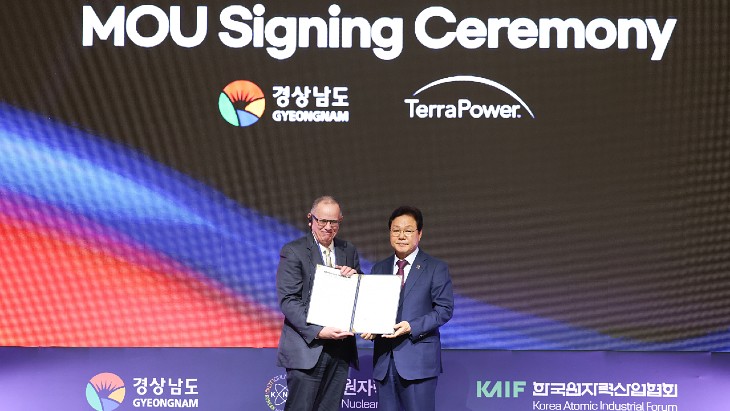
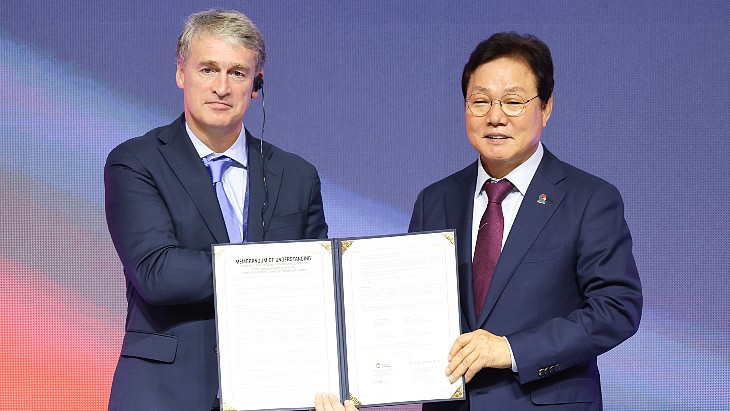
The Governor of South Gyeongsang Province has signed agreements with TerraPower and Seaborg for cooperation in the design and production of next-generation nuclear power plants and research and development in the region.

The agreements were signed at the Gyeongnam Small Modular Reactor International Conference, with the province saying it hoped the agreements would strengthen the region's position in the sector and provide opportunities to participate in technology development.

Governor Park Wan-soo said in his opening remarks, at what was the first such conference: "Recently, cutting-edge industries such as artificial intelligence and big data are developing rapidly, and the demand for electricity is increasing worldwide. In the midst of these changes, small modular reactors, or SMRs, a carbon-free energy source that is stable and sustainable, are attracting attention from around the world. Last June, our province established a comprehensive plan to foster nuclear power ... and announced that it would invest KRW2.6 trillion (USD1.8 billion) by 2032 and foster the nuclear power industry, including the development of SMR technology.

"The government's will to revitalise the nuclear power ecosystem and Gyeongsangnam's efforts to foster SMRs will combine to make Gyeongsangnam a true global centre of the SMR industry. I hope that this international conference will serve as an opportunity for the development of all industries, including SMRs, in Korea, and that Korea and Gyeongnam will become leaders in the global SMR industry through cooperation with leading global companies."

Danish firm Seaborg has growing links with South Korea (Image: South Gyeongsang province)

Seaborg's design is for modular compact molten salt reactor (CMSR) power barges equipped with between two and eight 100 MWe reactors, with an operational life of 24 years. Instead of having solid fuel rods that need constant cooling, the CMSR's fuel is mixed in a liquid salt that acts as a coolant, which means that it will simply shut down and solidify in case of emergency. In May, it signed a memorandum of understanding with the Korea Atomic Energy Research Institute "to combine their research and development strengths" to advance nuclear technology.

TerraPower, whose chairman and founder is Bill Gates, broke ground in June in the USA on its first Natrium project, for a 345 MWe sodium-cooled fast reactor with a molten salt-based energy storage system - which can boost the system's output to 500 MW of power when needed, allowing it to integrate seamlessly with renewable resources. The is being built near a retiring coal-fired plant.More than 300 people from a wide range of global and Korean firms and organisations attended the event. South Gyeongsang Province is investing a total of KRW16 billion (USD11.5 million) from 2023 to 2026 to build the 'Gyeongnam Nuclear Industry Comprehensive Support Centre' to foster the nuclear power plant manufacturing industry and support companies within the energy industry as part of the aim of becoming a hub for the SMR industry. TerraPower and Seaborg sign Korean cooperation agreements
Read More........

From India to South Korea, crypto exchanges under regulatory lens


Seoul, (IANS): The financial regulator here said on Tuesday it will soon launch an inspection of virtual asset exchanges to check for any illegal or unfair transactions, as India cracks down on crypto platforms.

The planned inspection will be the first of its kind since the country introduced tougher rules against illegal trading of virtual assets in July under the new Virtual Asset Users Protection Act, which enabled maximum punishment of life imprisonment for those who gain more than 5 billion won ($3.7 million) through illegal transactions.

The Financial Supervisory Service (FSS) said it will inspect two South Korean won-based cryptocurrency exchanges, considering what it called "unusual cases" detected in earlier reviews, reports Yonhap news agency.

There are said to be a total of four Korean won-based exchanges in the country.

In addition, three more cryptocurrency exchanges and one cryptocurrency wallet provider will come under the planned inspection, as well as any other exchanges when and if any problems or complaints are filed against them, the FSS added.

The inspection will check for any illegal or suspicious transactions, but will also seek to make sure the exchanges and related businesses are complying with regulations that include protection of virtual assets and keeping records of virtual asset transactions, according to the financial regulator.

"The FSS will establish market order through stern punishment against illegal activities that may be identified in the process of its inspection, and will push for the revision of regulations if necessary by identifying the areas in the system where improvements are needed," it said.

In India, the government country has put robust anti-money laundering rules and a tax structure for cryptocurrencies in place, and the Enforcement Directorate (ED) has been busting fake cryptocurrency rackets across the country.In 2022, the Indian government introduced a 30 per cent tax on virtual currencies and a 1 per cent deduction for every crypto transaction. From India to South Korea, crypto exchanges under regulatory lens | MorungExpress | morungexpress.com
Read More........

Polling underway in South Korea to elect new Parliament

Polling is underway in South Korea to elect a new Parliament. About 44 million people are eligible to vote for its 300-member National Assembly. The outcome of today’s polls will also set the tone for the remaining years of Yoon Suk-yeol’s presidency. The election comes nearly two years after conservative President Yoon Suk Yeol won the 2022 presidential election defeating Lee Jae-myung of the Democratic Party by just 0.73 per cent – the slimmest margin in South Korean history. South Korea has a powerful presidential system, checked and balanced by the assembly which can pass or stop bills. The parliament is currently dominated by the Democratic Party which holds 142 out of 297 seats.Polling underway in South Korea to elect new Parliament

Read More........

Twitch to shut down in SKorea over 'seriously' high fees


WASHINGTON - US-based streaming platform Twitch said Wednesday it would stop its service in South Korea in February because of "seriously high" network costs, dealing a blow to millions of users in one of the heartlands of e-sports.

The Amazon-owned company said in a statement signed by CEO Dan Clancy that costs were 10 times higher than most other countries, making it impossible to continue operating.

South Korea allows internet service providers to charge data-heavy companies like Twitch extra fees, which has already led to a long dispute with Netflix.

Big telecom firms in Europe have pushed for a similar deal, which they call "fair share", but an EU consultation concluded in October that the idea was not popular.

Twitch said it had tried to lower its costs by reducing the maximum video quality but it was still losing money and would pull out of the country on February 27.

"The cost of running Twitch in South Korea is currently seriously high," said the statement.

- 'Stellar player' -

Twitch, acquired by Amazon in 2014 for close to $1 billion, gained significant traction among gamers in South Korea.

The firm does not publish user numbers but it was widely reported in 2021 to have six million users in South Korea, more than four percent of its global total.

The country is known for its passionate, competitive, and dedicated gaming community, as well as its megastar Faker -- a gamer hailed as the Michael Jordan of e-sports.

"We would like to reiterate that this was a very difficult decision, and one that all of us at Twitch are deeply saddened by," the company's Wednesday statement said.

"South Korea has always been a stellar player in the global e-sports community and will continue to do so."

Shares in South Korean video streaming service Afreeca TV, Twitch's competitor, soared almost 30 percent in afternoon trading in Seoul.

Some of the country's Twitch users were devastated by the news.

One streamer, yummy_2 said: "It feels like losing my job right now."

- Biden vs Trump -

Netflix was the first major international firm to cry foul over South Korea's rules on network fees, getting entangled in lawsuits with SK Broadband, one of South Korea's biggest internet service providers.

However, the two firms announced in September they would drop the legal cases and would now instead "collaborate as partners for the future".

While the usage fees are a boon to telecom companies, they are bitterly opposed by tech platforms around the world.

European lawmakers and digital rights activists also argue such an arrangement could break rules on net neutrality, whereby telecoms firms are barred from selling faster internet speeds to particular companies.The issue has been at the heart of a years-long dispute in the United States with former President Donald Trump rolling back net neutrality rules and his successor Joe Biden struggling to restore them. Twitch to shut down in SKorea over 'seriously' high fees
Read More........

N Korea stole $300m in crypto to fund nukes: UN report


A confidential UN report claimed that North Korea has stolen more than $300 million worth of cryptocurrencies through cyberattacks in recent months to support its banned nuclear and ballistic missile programmes. -Reports AFP

Compiled by a panel of experts monitoring sanctions on Pyongyang, the report said the country’s “total theft of virtual assets from 2019 to November 2020 is valued at approximately $316.4 million”, citing a UN member state. 

Financial institutions and exchanges were hacked to generate revenue for Pyongyang’s nuclear and missile development, said the report, which was seen by AFP. 

The vast majority of the proceeds came from two thefts late last year. 

The North is known to operate an army of thousands of well-trained hackers who have attacked firms, institutions and researchers in South Korea and elsewhere. 

It has also been accused of exploiting its cyber capabilities for financial gain. 

The North is under multiple sets of international sanctions over its banned nuclear weapons and ballistic missile programmes, which have made rapid progress under leader Kim Jong Un. 

A summit between Kim and then-US President Donald Trump in Hanoi in February 2019 broke down over sanctions relief and what Pyongyang would be willing to give up in return. 

Nuclear talks have been stalled ever since, while the North showed off several new missiles at military parades in October and last month when Kim pledged to strengthen his nuclear arsenal.

The UN panel said it was investigating a September 2020 hack against a cryptocurrency exchange that resulted in $281 million worth of cryptocurrencies being stolen. 

A second cyberattack siphoned off $23 million a month later.

“Preliminary analysis, based on the attack vectors and subsequent efforts to launder the illicit proceeds strongly suggests links to the DPRK,” the report said, using the initials for the North’s official name.

Pyongyang’s cyberwarfare abilities first came to global prominence in 2014 when it was accused of hacking into Sony Pictures Entertainment as revenge for “The Interview”, a satirical film that mocked leader Kim.

The attack resulted in the posting of several unreleased movies as well as a vast trove of confidential documents online.

The North is also blamed for a huge, $81 million cyber-heist from the Bangladesh Central Bank, as well as the theft of $60 million from Taiwan’s Far Eastern International Bank.

The North’s hackers have allegedly stepped up campaigns to raise funds by attacking cryptocurrency exchanges as the value of bitcoin and other cybercurrencies soared.

They were blamed for the 2017 WannaCry global ransomware cyberattack, which infected some 300,000 computers in 150 nations encrypting user files and demanding hundreds of dollars from their owners for the keys to get them back.Pyongyang has denied the accusations, saying it has “nothing to do with cyber-attacks”. - AFP Source:https://www.daily-bangladesh.com
Read More........

South Korea to Push for SPADGMS, minesweepers deal with India

The $ 3 billion Self Propelled Air Defence Gun Missile System (SPAD-GMS) deal is expected to be part of discussions between the Indian Army Chief Gen MM Naravane and the top brass of South Korea. In the SPAD-GMS, South Korea’s Hanhwa Defence had emerged as the lowest bidder beating the Russian competitor. In line with the government’s `Act East Policy’ and to explore avenues for further expansion of the military ties, the Indian Army Chief Naravane has left on a three-day visit to South Korea on Monday (December 28, 2020). He will be holding talks with his counterpart – the army chief and chairman of Joint Chiefs of Staff as well as the minister of defence. He will also meet with South Korea’s minister of Defence Acquisition Planning Administration (DAPA). The army chief’s visit to South Korea’s capital Seoul comes close on the heels of his recently concluded visit to the UAE and the Kingdom of Saudi Arabia. While in South Korea, the Indian Army chief will go to the Korea Combat Training Centre in Gangwon province and Advance Defence Development (ADD) facility which are located at Daejeon.Both countries have elevated their bilateral relations to Special Strategic Partnership in 2015. India and South Korea have been in discussions for several military platforms and weapons, especially naval shipbuilding. In 2019, the South Korean company Daewoo Shipbuilding & Marine Engineering had responded to Indian Navy’s Expression of Interest (EoI) for six advanced conventional submarines under Project-75I (India). And KSS-3 submarine for the Rs 45,000 crore proposal of the Indian Navy. The Project 75I is expected to be processed under the Strategic Partnership Model (SP), and the submarines will be built in India through technology transfer. As reported earlier, the OEM will have to tie up with an Indian company for manufacturing under the Make in India initiative. South Korea considers India as a serious power and a key partner within the region and India looks at South Korea a major partner under the `Act East Policy’. Both countries have last year inked a logistics agreement, which is going to help the Indian Navy while operating in the Indo-Pacific Region and in interoperability. What Was The Army Looking For In The Self Propelled Air Defence Gun Missile System? In 2013, the Indian Army had floated a requirement for five regiments of a self-propelled air defence gun-missile system. The 104 units were budgeted at approximately $2.5 billion. Each unit having twin 30 mm cannons. There are four short-range missiles fitted on a tracked chassis. Why Are They Needed? Because they can help in protecting critical installations and areas which can be hit by drones, helicopters or low-flying aircraft. And, as has been reported by Financial Express Online, the South Korean Company Hanwha Defence had emerged as the lowest bidder by beating two Russian contenders. The decision to scrap the whole deal was taken by the Ministry of Defence on the grounds that the specifications mentioned are now dated. The South Korean company is willing to transfer technology to Indian company either L&T or any other Indian company for the manufacturing of this missile system. What Is The Indian Army Looking For? These SPAD-GMS are expected to replace 1360 obsolete Bofors L 70 40mm single barrel and Soviet-era ZU-23-2 towed 23 mm twin-barrel weapon systems of the Indian Army. And the Indian Army needs almost five regiments of the guns. These guns can be deployed with the forces and be relocated based on the threat perception. Mine-Counter Measure Vessels (MCMVs) For The Indian Navy When the Army chief talks with the military brass and the minister, there could be some forward movement in the negotiations for 12 mine-counter measure vessels (MCMVs) for the Indian Navy. These are to be built at the Indian Goa Shipyard through Transfer of Technology (ToT), under the `Make in India’ initiative. South Korean Company Kangnam Corporation and Italian shipbuilder M/s Intermarine had responded to the MoD RFI (Request for Information) for the MCMVs. These MCMVs are required on an urgent basis to fill gaps in the navy’s mine warfare capability. The discussions with the South Korean Company Kangnam Corporation was stalled due to certain issues related to the indigenous content as well as the terms and conditions of ToT. Why Do Navies Need Minesweepers? These are deployed to help secure the harbours by locating and destroying underwater mines and are considered vital for keeping critical sea lanes safe. India’s Act East Policy The Chief of Army Staff had accompanied Foreign Secretary Harsh Vardhan Shringla to a visit to Myanmar. During that visit in October, the Indian side announced its decision to supply an attack submarine to the Myanmar Navy and to further enhance military cooperation between the two countries. This was followed by Army Chief’s three-day visit in November to Nepal. The visit to the Himalayan neighbour had significant diplomatic overtones. During his visit to South Korea in 2019, the defence minister Rajnath Singh had invited the top defence majors to participate in various defence projects in India. The companies which specialize in military platforms in South Korea are allowed to Transfer Technology as there are no laws to stop the transfer. They are keen to work with the Indian private sector companies under a joint venture.///Indiandefencenews/Source: Defenseblog-njs.blogspot.com
Read More........

Kim Jong Un marks New Year with visit to family tomb


Kim visited the Kumsusan Palace of the Sun, where the bodies of his father and grandfather are preserved under glass.

North Korean leader Kim Jong Un marked the arrival of 2021 with a handwritten letter to the country’s citizens and a visit the tomb of his father and grandfather. 

However, there was no immediate indication he would give a speech as he has done in previous years. 

In the letter, Kim offered thanks to the people for having trusted and supported the ruling Party even in the “difficult” times, state news agency KCNA reported on Friday. 

The North Korean leader has previously apologised for failing to fulfil promises of economic improvement and for the hardships citizens have endured as a result of international sanctions and strict measures aimed at preventing a coronavirus outbreak. 

“In the new year, too, I will work hard to bring earlier the new era in which the ideals and desires of our people will come true,” Kim wrote, according to KCNA. 

North Korea has said it has no confirmed cases of coronavirus, although officials in South Korea and the United States say that is unlikely. 

Its economy has been strained by self-imposed border lockdowns and other strident measures to prevent an outbreak. 

In contrast to many other countries around the world, huge crowds turned out to ring in the new year with a concert and fireworks show. Most of those who gathered in the main square of the North Korean capital Pyongyang were wearing face masks. 

As the clock struck midnight, Kim, as well as other senior leaders visited the Kumsusan Palace of the Sun, where the bodies of his father and grandfather - the previous rulers of North Korea - are preserved under glass.Kim was also accompanied by delegates to the Eighth Party Congress, a rare political gathering that is due to be held early this month, KCNA reported. Source: https://www.daily-bangladesh.com
Read More........

Chatroom sex abuse ringleader jailed for 40yrs


A South Korean court has sentenced the mastermind of one of the country’s biggest online sex abuse rings to 40 years in jail. 

Cho Ju-bin was found guilty of running a group that blackmailed girls into sharing sexual videos that were then posted in pay-to-view chatrooms.

Citing a district court in Seoul on Thursday, CNN reported that the accused had distributed a wide range of sexually explicit content. Cho Ju-bin created these offensive contents by tempting and blackmailing many victims.

CNN also reported that people used to be members of the chatrooms of the Telegram app in exchange for money. At least 10,000 people used the chatrooms, with some paying up to $1,200 (Tk 101,390) for access. Some 74 people, including 16 underage girls, were exploited.

Meanwhile, Cho violated the law to protect children from sexual abuse. He used to earn money by selling these exploiting videos.Online sexual harassment has caused quite a stir in South Korea. The name of the accused was not disclosed at the beginning. However, Cho’s name was revealed in the petition signed by 5 million people of the country. Source: https://www.daily-bangladesh.com/
Read More........

S Korea tops in 10 most automated countries


According to the data of the International Federation of Robotics, within four years the units of installed industrial robots have been jumped to 113 from 74 as the pace of industrial automation is accelerating across much of the developed world. 

It has been reported that there was a total of 74 installed industrial robots per 10,000 employees globally in 2016 while that increased to 113 across the manufacturing sector by 2020. 

Asia now has a robot density of 118 units per 10,000 workers with pushing the Europe and Americas back for carrying the figures of 114 and 103 respectively. 

South Korea leads the way in the use of robots, with 855 installed per 10,000 employees, followed by Japan (364) and Germany (346), however, China is one of the countries recording the highest growth levels in industrial automation. 

Let's have a look at the 10 countries with the highest density of robot workers.

No 1 South Korea (855)
No 2 Japan (364) 
No 3 Germany (346)
No 4 Sweden (277)
No 5 United States (228) 
No 6 Italy (212)
No 7 Belgium/Luxembourg(tie) (211)
No 8 Spain (191)
No 9 China (187)
No 10 France (177)

Read More........

Kim’s sister appears in public for 1st time since July


This undated picture released from North Korea’s official Korean Central News Agency (KCNA) on October 2, 2020, shows North Korean leader Kim Jong Un and sister Kim Yo Jong visiting fields in Kimhwa County, Kangwon province; Photo: AFP

North Korean leader Kim Jong Un’s sister Kim Yo Jong made her first appearance in state media since July, an absence that speculated her power was “clipped” after she led a contentious pressure campaign against South Korea.

Kim Yo Jong joined her brother and a handful of top cadres on a tour to inspect reconstruction work to repair damage caused by massive flooding in recent weeks, the state’s Korean Central News Agency reported Friday.

The political analysts predicted that Kim Yo Jong is likely to be the successor to her brother Kim Jong Un during his prolonged absence in April raised questions about his health conditions.

She was last mentioned in state media when she joined her brother on an inspection tour of a chicken farm, which included a glimpse of her picking up a cigarette butt from her brother.

“The listing of the accompanying officials in today’s report indicates that she has not been demoted,” said Rachel Minyoung Lee, an independent political analyst who used to work for the US government in areas related to North Korea.

According to Bloomberg, Kim Yo Jong’s political status rose at the beginning of the year where she was a key player on policies toward the country’s two biggest adversaries, the US and South Korea. 

A leading South Korean newspaper, the Chosun, reported in recent days that “she might even visit President Donald Trump before the presidential election in a show of support”.

Kim Yo Jong led a series of threats and provocations against South Korea that culminated with Pyongyang in June blowing up a joint liaison office north of the border built-in 2018 as a symbol of reconciliation between the two countries still “technically” at war. 

Just as soon as it looked like more was on the way, her brother reversed course in late June and halted plans to step up provocations.

In July, she issued a message saying that North Korea had no intention of holding a meeting with Trump, calling on him to change his policy of applying sanctions against the state.

After that, she was seen absent from two key meetings in August of the ruling Workers’ Party which raised speculation that “she had fallen out of favor”. – Bloomberg. Source: https://www.daily-bangladesh.com
Read More........

Korea punishes TikTok for data mishandling

In this file photo illustration, the logo of social media application TikTok is displayed on the screen of an iPhone, in Arlington, Virginia. TikTok has been caught up in the escalating dispute between the United States and China, with the Chinese-owned firm accused of acting as a surveillance tool for Beijing, an allegation it denies. AFP-Yonhap

By Kim Yoo-chul: The country's top telecom regulator fined Chinese video-sharing platform TikTok 186 million won ($155,000) over the app operator's mismanagement of user data, with the regulator chief Han Sang-hyuck calling it a "problematic company."

The Korea Communications Commission (KCC) said Wednesday the regulator's decision to impose the fine was based on its thorough internal investigation that uncovered TikTok's violation of local telecommunication laws.

"The KCC can confirm TikTok didn't get parental consent when collecting personal data for users younger than 14. Plus, TikTok didn't notify its users of its overseas transfer of personal data. While TikTok had promised children under the age of 14 wouldn't be able to use its service, it didn't operate a proper online age verification process," the KCC said in a statement, adding the telecom regulator also found TikTok collected data on at least 6,007 children under the age of 14 registered to the service between May 31, 2017, and Dec. 6 last year.

TikTok also transferred Korean user data to servers in the United States and Singapore without prior notice, the regulator said. With regard to the KCC's request for the latest updates on its data privacy policies, TikTok said personal information of its Korean users is being managed by cloud-computing service operators in the U.S. and Singapore.

The KCC notified TikTok of the decision Wednesday. The regulator also requested TikTok correct "all problems found" within 30 days. "The KCC ordered TikTok to immediately stop its practice of violating local telecommunication laws."

A few hours after the KCC announcement, one TikTok user in China claimed Korean K-pop stars' TikTok accounts had been deleted. TikTok accounts of some K-pop stars are still active, but some officials didn't rule out the possibility that more K-pop stars' TikTok accounts will be deleted.

Amid intense scrutiny over TikTok as a potential national security risk in the United States, top Washington officials said the United States is considering banning the use of TikTok and other Chinese social media apps such as WeChat.

White House trade adviser Peter Navarro recently claimed TikTok is one of the biggest forms of censorship in mainland China. He further alleged that "all of the data that goes into those mobile apps that kids have so much fun with and seem so convenient, it goes right to servers in China, right to the Chinese military, the Chinese Communist Party and the agencies which want to steal our intellectual property."

Launched by Chinese internet upstart ByteDance, TikTok has been working to distance itself from its Chinese association through efforts such as storing data in the United States and Singapore as well as overhauling its corporate structure, industry officials said. It remains to be seen whether or not Korean companies will join hands with Washington's calls to boycott TikTok, after Wells Fargo and Amazon asked employees to remove TikTok from their mobile phones.

As of last year, TikTok had 3.4 million users here, according to industry tracker WiseApp. Source https://www.koreatimes.co.kr
Read More........

US 'strongly' supports inter-Korean cooperation: Biegun

Foreign Minister Kang Kyung-wha, right, talks with U.S. Deputy Secretary of State Stephen Biegun at the Ministry of Foreign Affairs in Seoul, Wednesday. / Joint press corps

US envoy has no intention to contact NK side during Seoul visit

By Kang Seung-woo

U.S. special representative to North Korea Stephen Biegun said Wednesday that the Trump administration "strongly" stands behind the government's efforts to promote inter-Korean exchanges and cooperation.

His remarks came amid lingering speculation that Washington is uncomfortable with Seoul's independent push for inter-Korean ties, as the U.S. government has repeatedly insisted that such cooperation proceed in lockstep with progress in denuclearizing North Korea.

Biegun, who doubles as the deputy secretary of state, also said contacting North Korean officials was not the purpose of his Seoul visit this time, brushing away speculations of any possible contact.

"The United States strongly supports inter-Korean cooperation and we believe this plays an important component in creating a more stable environment on the Korean peninsula," Biegun told reporters following a meeting with his South Korean counterpart Lee Do-hoon, the special representative for Korean Peninsula Peace and Security Affairs, at the foreign ministry in Seoul, where he also sat down with Foreign Minister Kang Kyung-wha and Vice Minister Cho Sei-young earlier in the day.

"We look forward to fully supporting the government of Korea as it advances its goals with North Korea in inter-Korean cooperation," he added.

His remarks come as the Moon Jae-in administration is set to adopt a harder drive for independent inter-Korean exchanges and cooperation with the North, as evidenced by Friday's reshuffle of his diplomacy and national security teams, which he filled with so-called pro-North Korea figures including National Intelligence Service (NIS) director nominee Park Jie-won, a key figure in arranging the first inter-Korean summit in 2000.

Along with Park, Im Jong-seok, a former presidential chief of staff who has called for independent yet aggressive actions to improve stalled inter-Korean relations, and Suh Hoon, Moon's first NIS chief who was also involved in the 2000 inter-Korean summit, have also joined the teams as a special adviser for diplomatic and security affairs and director of the National Security Office, respectively.

Despite the U.S.' supportive stance toward inter-Korean exchanges and cooperation, Biegun failed to go into details as he parried question about the South Korea-U.S. working group. The group, set up in November 2018 to coordinate issues regarding the North, has been under siege recently for allegedly hindering progress in inter-Korean ties due to its "excessively harsh" standards adopted on the North.

Going tit-for-tat

On Biegun's visit to Seoul, North Korea said it would not meet him during his three-day stay here ― a stance announced twice, first by North Korean Vice Foreign Minister Choe Son-hui last Saturday and then again by North Korean Foreign Ministry North America Department head Kwon Jong-gun, Tuesday, hours before the American envoy's arrival in Seoul.

Their statements came amid growing speculation that Biegun could have been carrying a message from U.S. President Donald Trump for the North, which may have included an offer to hold another summit ahead of the U.S. presidential election in November.

In response, Biegun paid them back.

"Let me clarify one thing. I've seen some press comments of late that North Koreans are not prepared to meet with me on this visit. It's somewhat strange because we did not request a visit with North Koreans. Let me be absolutely clear. We did not request a visit. This visit is to meet with our close allies. With South Koreans we had excellent discussions," he told reporters.

"I also want to be very clear on one point. I do not take my direction from Vice Minister Choe Son-hui nor for that matter do I take it from Ambassador (John) Bolton. I take my guidance from the conclusion of several meetings that President Trump and Chairman Kim (Jong-un) had over the last two years."

However, Biegun left room for negotiations with the North, saying the U.S. looks forward to continuing its work for a peaceful outcome on the Korean Peninsula.

"When Chairman Kim appoints a counterpart to me, who is prepared and empowered to negotiate on these issues, they will find us ready at that very moment," he said.

"I believe this is very much possible."Source: https://www.koreatimes.co.kr 
Read More........

Korea's real estate policy fiasco

Seoul tops list of apartment price growth among major cities

By Lee Min-hyung

Since his inauguration in May, 2017, President Moon Jae-in and his administration have been waging a war against real estate speculation by employing all possible measures focused on punitive taxation and lending regulations.

With the lofty goal of offering homes to more people at affordable prices, their policy initiatives have been considered to have had good intentions but the attempts have not come to fruition as they defy the basic market principle of supply and demand.

Experts said that if the government continues to focus on suppressing demand without supplying more homes in the capital where most Koreans want to live, it will freeze trading and distort the market, eventually fueling pent-up demand and a further hike in home prices over the long term.

The side effects of the government's ineffective real estate policies are manifested in the latest data comparing apartment prices in major cities around the world.

Apartment prices in Seoul have posted the largest growth for the past three years among those from other mega-cities; a result of the government's "reckless" regulations that have distorted the market.

According to Numbeo, the world's largest cost of living database, apartment prices in downtown Seoul have skyrocketed 56.6 percent over the three-and-a-half years since the end of 2016.

This was the biggest increase, surpassing that from the so-called "superstar" cities ― such as New York, Paris, London, Munich and Tokyo.

As of July 1, the average apartment prices per 3.3 square meters in downtown Seoul came in at 65.5 million won ($54,800), the third largest after city-states, Hong Kong and Singapore, according to the data.

The steep rise in prices here is one of the biggest headaches for the government, as the authorities have failed to stabilize the soaring costs of apartments even after imposing 22 sets of strong real estate regulations over the past three years.

Economists argue that the Moon administration should let go of its "regulation-driven" real estate policies, and stop introducing additional ones focusing on "restraining" demand.

"The key lies in controlling the supply and demand in a more market-friendly manner," Yonsei University economist Sung Tae-yoon said. "Current real estate policies are going against market principles, so the government should change its years-long approach toward this issue."

The remarks reflect on the government's distorted sets of regulations with the focus on controlling demand by de facto disallowing ordinary citizens to get mortgages. The government has argued such steps were aimed at stabilizing the market against real estate speculators.

But the economist refuted this claim, saying the move has ended up bringing about a boomerang effect on non-homeowners, including those in their 30s and younger.

"The regulations blocked young people with small seed money and those living in a rented apartments from purchasing their own homes," he said. "They fell victim to the real estate policies, and this is not a move in the right direction. The authorities need to consider shifting their approach."

With the apartment prices rising steeply, regulations only amplify the sense of crisis among non-homeowners that they need to purchase apartments before prices go up even further.

The atmosphere has in recent years surfaced across the nation because Seoul apartment prices have jumped every time the government announced new regulations. To make matters worse, the authorities are showing no sign of changing their botched approaches to real estate policy, and only hint at introducing "unceasing" regulations with the blind belief that regulatory measures are the "cure-all" to stabilize the market.

Myongji University professor of real estate Kwon Dae-jung urged the government to follow market logic, and stop seeking to suppress it with regulations.

"Increasing the housing supply in Seoul is the only step the government can take to stabilize the market," he said. "The number of homes to be supplied in the capital will decline to 20,000 in 2021, compared to this year's 41,000."

"If the supply declines and the economy bounces back next year, housing prices will definitely go up," he said. On top of that, massive market liquidity is flowing into the real estate market, raising the possibility over the housing market bubble, Kwon added.

He also said the nation's prolonged low interest rate continues to act as a negative factor in stabilizing the market. The government needs to come up with measures to redirect the liquidity into areas other than real estate.

But the key should lie in expanding the supply of apartments in Seoul, he said. Toward this end, he advised the government to consider easing regulations on the upper story limit for apartment blocks. This does not allow any new apartments to exceed 35 floors.

Despite the previous botched real estate regulations, the land ministry introduced its 22nd set of regulations Friday with the focus on imposing more taxes on owners of multiple homes. But the government did not get down to brass tacks this time ― again ― as the measures have nothing to do with increasing the housing supply and helping non-homeowners.

Gyeonggi Province Governor Lee Jae-myung also criticized the Moon administration for its failure in real estate policies.

"Regulations on loans and housing transactions cannot be a fundamental solution from a longer-term perspective and can only introduce balloon effects," Lee said.

He claimed the government needs to collect more real estate taxes from homeowners' unearned income when making apartment transactions. Source: https://www.koreatimes.co.kr
Read More........

Satellite imagery showing activity at suspected N. Korean nuclear facility: CNN

Captured from CNN website

New satellite imagery reveals a previously undeclared North Korean facility that experts suspect could be used to build nuclear warheads, CNN reported Wednesday.

The images, captured by Planet Labs and analyzed by experts at the Middlebury Institute of International Studies, show an active facility in the village of Wollo-ri near Pyongyang, the report said.

"It has all the signatures of a North Korean nuclear facility ― security perimeter, on-site housing, monuments to unpublicized leadership visits, and an underground facility.

And it sits right next to a bottled water factory that has none of those characteristics," Jeffrey Lewis, a professor at the institute, was quoted as saying.

"The big thing that sticks out is all the vehicle traffic ― cars, trucks, shipping containers. This factory is very active. That activity has not slowed down ― not during negotiations and not now. It's still making nuclear weapons," he told CNN.

Nuclear negotiations between Washington and Pyongyang have stalled, with the two sides wide apart on the scope of North Korea's denuclearization and sanctions relief from the U.S.

CNN said the facility was identified in 2015 by researchers at the James Martin Center for Nonproliferation Studies, but Lewis and his fellow researchers chose not to publicize it because they could not determine its role in North Korea's nuclear program.

With the site's name and function being published in an upcoming book by North Korea expert Ankit Panda, Lewis and his colleagues decided to disclose the location and other details in their own forthcoming report, CNN said.

"We'd been looking at this site for a long time and knew it was associated with the nuclear program. When Ankit Panda asked me if we knew about a site near someplace called Wollo-ri that was involved in making nuclear weapons, it all clicked," Lewis was quoted as saying.

Panda writes in his book, "Kim Jong Un and the Bomb," that the facility is believed to be primarily associated with building warheads and could also serve as a storage location for those weapons should North Korean leader Kim Jong-un need to disperse his stockpile "for better responsiveness in a crisis," according to CNN. (Yonhap) Source: https://www.koreatimes.co.kr
Read More........

N. Korea, US remain apart over summit


By Yi Whan-woo: North Korean leader Kim Jong-un's powerful sister downplayed the possibility of another summit between her brother and U.S. President Donald Trump this year, saying it was "unnecessary" and "useless."

Kim Yo-jong
The statement by Kim Yo-jong, the North's de facto No. 2, came after U.S. Secretary of State Mike Pompeo said Thursday he was "very hopeful" about resuming talks with North Korea including a summit between the leaders of the two countries.

"This is my personal opinion but any summit between the U.S. and North Korea will not take place this year," Kim Yo-jong said in a statement carried by the Korean Central News Agency. "As long as there is no decisive change in the U.S. position, a summit between the DPRK and the U.S. is unnecessary and useless this year, and in the future at least for us."

Kim's view reiterates Pyongyang's declarations that it would not "gift" an additional summit, following the previous three from 2018 to 2019, to Trump if it does not get something substantial in return.

The U.S. has been rejecting the North's demand to lift sanctions before Pyongyang begins any denuclearization.

Kim, however, said, her view does not mean the North is "not going to denuclearize, but that we cannot denuclearize now."

She also left door open for dialogue in the future, saying "a surprise thing may still happen" depending upon the "judgment and decision" of the two top leaders.

The framework of sanctions relief for denuclearization, according to Kim, should be changed to a resumption of North Korea-U.S. negotiations for the "withdrawal of hostilities" and the U.S. should take "major steps."

"It is entirely up to the U.S. whether or not they will fall into a messy situation and face trouble," she said, adding, "The U.S. will be worried they might receive a Christmas gift near the elections."

In Washington, D.C., Thursday, Pompeo said the U.S. was continuing its efforts to re-establish dialogue with Pyongyang when asked about whether another Kim-Trump summit would be possible before the U.S. presidential election in November.

"We're very hopeful that we can continue to have this conversation, whether that's at levels beneath the summit, or, if it's appropriate and there is a useful activity to take place, to have senior leaders get back together as well," he said.

He, however, declined to provide specifics, by saying, "As for who, how and timing, I just don't want to talk about that today." Source: https://www.koreatimes.co.kr
Read More........

Donald Trump, Kim Jong Un pledge to denuclearise North Korea

US President Donald Trump and North Korean leader Kim Jong Un today issued a joint statement pledging to work towards complete denuclearisation of the Korean peninsula and Washington committing to provide security guarantees to North Korea
The process of denuclearisation (of Korean peninsula) would happen “very, very quickly”, adding that he had formed a “special bond” with Kim Jong Un and the relationship with North Korea would be very different, Trump said after his meeting with Kim.
“President Trump committed to provide security guarantees to the DPRK and Chairman Kim Jong Un reaffirmed his firm and unwavering commitment to complete denuclearisation of the Korean Peninsula,” said a joint statement issued after their historic summit in Singapore.
US Secretary of State Mike Pompeo and North Korean officials would hold follow-up negotiations “at the earliest possible date”, the statement said.
The joint statement, however, did not give any details on how denuclearisation would be achieved. Nor did it make any mention of the international sanctions imposed on North Korea, for pursuing its nuclear weapons programme.
There was also no reference to the signing of a final peace treaty. While South Korea and North Korea also had earlier pledged to solve all issues peacefully, the two sides that fought the 1950-53 Korean War, in which millions of people died, are technically still at war.
Without a formal agreement among the two Koreas and their backers there could only be a truce and no formal end to the conflict.
However, the two sides had agreed to recovering the remains of prisoners of war and those missing in action and repatriating them.
If the two sides abide by the joint statement, that itself could fundamentally change the security landscape of Northeast Asia and make the world safer.
Ahead of signing the joint statement, Trump described it as a “comprehensive” document, while Kim said the two leaders had a historic meeting “and decided to leave the past behind. The world will see a major change.”
Trump said he had formed a “very special bond” with Kim and that relationship with North Korea would be very different.
“People are going to be very impressed and people are going to be very happy and we are going to take care of a very dangerous problem for the world,” Trump said.
Asked whether he would invite Kim to the White House, Trump said: “Absolutely, I will.”
He called Kim “very smart” and a “very worthy, very hard negotiator.”
“I learned he’s a very talented man. I also learned that he loves his country very much.”
In fact, Trump said the summit at the Capella hotel on Singapore’s Sentosa, a resort island with luxury hotels, had gone “better than anybody could have expected”.Source :https://www.domain-b.com/
Read More........

Samsung launches 5G Galaxy Tab S6 in South Korea

Samsung has officially launched a fifth generation Galaxy Tab S6, a 5G variant of its Tab S6 tablet, which is also the world’s first 5G tablet.
The Samsung S6 5Gg Tab is virtually unchanged from the original Wi-Fi and LTE models, with one exception that it incorporates a Snapdragon X50 5G modem – the S6 tab had no modem on the Wi-Fi model, while there was an X24 LTE modem on the LTE version. The Galaxy Tab S6 5G is currently priced at 999,900 won (roughly $848 or around Rs60,000) and will only be available in South Korea, for now. The S6 5G Tab also come in a single configuration with 6GB of RAM and 128GB of storage. The rest of the specs, including the 10.5-inch OLED HDR panel, Snapdragon 855 processor, and stylus, remain unchanged. There's no word on international releases, although that might hinge on carrier support. A 5G version of an existing tablet would be a low-priority item, and Samsung might decide that it's easier to roll out the Galaxy Tab S6 5G on a country-by-country basis. Galaxy Tab S6 gives more personal PC experience without a PC. The ultra-slim Galaxy Tab S6, 2-in-1 performs like a laptop with the mobility of a tablet. The 2-in-1 is an all-in-one that instantly transform an Android tablet into a PC-like experience when the keyboard is attached with built-in trackpad. The fast mobile processor helps to rapidly switch between apps and tasks or immerse yourself in graphic-intensive games. Plus, get PC-caliber internal RAM. The Galaxy Tab S6 comes with the S Pen that lets the user pause and skip at the press of the button. In addition, it allows one to mark up papers, sign docs and take notes. The S Pen even attaches magnetically for easy storage and charging. The tab also offers a spectacular edge-to-edge Super AMOLED display, superior graphics and quad speakers tuned by AKG—all on a 2-in-1 that only weighs about a pound. With up to 15 hours on a full charge, the Galaxy Tab S6 allows one to create and edit all day, while enjoying continuous browsing and streaming. A fast-charging battery also allows quick recharge. With Bixby Voice Assistant, one can look up recipes, skip to the next song, check movie times and more just speaking to it — even from across the room, thanks to a far-field mic. When you’re ready to unlock, simply touch the in-display fingerprint scanner and you’re in. The tab is equipped with a wide 13MP and ultra-wide 5MP dual cameras, besides the 8MP front camera that can be used to video chat, collaborate and present. The Galaxy S6 Tab comes with 128GB or 256GB of built-in memory for all of photos, videos, games and go-to apps. When needed more space, the storage can be expanded up to 512GB with a microSD card. Samsung also announced the completion of an agreement to acquire TeleWorld Solutions (TWS), a network services provider headquartered in Chantilly, VA. The TWS leadership team will continue to manage the business and, together with Samsung, will address the network upgrade cycle occurring in the US. With network builds associated with 5G and 4G LTE enhancements advancing in the US, the acquisition will also address the need for end-to-end support in delivering network solutions. The combination will help network operators accelerate and simplify rollouts of 5G networks across the US. TWS, a privately owned company, will operate as a wholly owned subsidiary of Samsung Electronics America, Inc. The service offerings and customers of TWS complement Samsung’s growth among networks infrastructure clients. With competencies in radio frequency (RF) and network design service—as well as installation, testing, and optimization services—TWS will continue to serve its existing customers and clients they currently support with Samsung. The TWS leadership team will continue to manage the business and, together with Samsung, address the network upgrade cycle occurring in the U.S. “The acquisition of TWS will enable us to meet mobile carriers’ growing needs for improving their 4G and 5G networks, and eventually create new opportunities to enhance our service capabilities to our customers,” said Paul Kyungwhoon Cheun, Executive Vice President and Head of Networks Business at Samsung Electronics. “Samsung will continue to drive innovation in communications technology, while providing optimization services for network deployments that accelerate U.S. 5G network expansion.” “Everyone at TeleWorld Solutions is excited to be part of the Samsung family,” said Shervin Gerami, CEO of TeleWorld Solutions. “The advent of 5G and the amount of new spectrum coming into the U.S. market requires scale and innovation for the next generation of wireless technologies. Joining forces with Samsung will accelerate innovation to help our customers fulfill their needs for network strategy, deployment, and automation.”Source: https://www.domain-b.com
Read More........

Samsung launches world's first foldable glass phone, Galaxy Z Flip

The Galaxy Z Flip, the company’s latest futuristic flagship, features a first-of-its-kind foldable glass display that allows the user to capture, share and experience content. “When folded, the Galaxy Z Flip is a stylish and compact palm-sized device. When unfolded, it’s a full-sized phone whose stunning, 6.7-inch Infinity Flex Display –Samsung’s first to feature a 21.9:9 aspect ratio – offers users truly seamless multitasking, a company website release stated. The key highlight of Galaxy Z Flip is its bendable glass as it is for the first time that a brand has used thin bendable glass in a phone. The Galaxy is also the first foldable phone from Samsung to feature a clamshell design. The device takes on the new Moto Razr foldable phone and will bring back memories of style associated with flip phones. For the first time in mobile phones, Samsung has used thin glass over a flexible display. The Galaxy Z Flip features Samsung’s proprietary bendable Ultra Thin Glass (UTG). This glass layer makes the device look sturdy and the screen less delicate. Also, repairing the display becomes easier as for deep scratches, just changing the glass layer instead of the entire display will do. The thin glass layer in Galaxy Z Flip prevents the crease from appearing more prominent. Like in the Galaxy Fold, the plastic screen tends to develop a crease at the place where it folds giving an ugly look. Having a glass layer on the screen prevents this crease (due to the fold) from appearing more prominent.
Samsung Galaxy Z Flip comes with a 6.7-inch screen which folds in almost half. It also features a 6.7-inch FHD+ Dynamic AMOLED Infinity Flex Display with an aspect ratio of 21.9:9 and pixel density of 425 ppi. There is a small cover display with which you can change music, click selfies when the Galaxy Z Flip is folded There is a small cover display on the outside which measures 1.06-inch. You can use that small touch display to change music, click selfies when the Galaxy Z Flip is folded. You can get notifications as well on the cover display when the device is folded. Samsung Galaxy Z Flip can stay open at different angles like a laptop screen. The Galaxy Z Flip can stay open at a range of angles, like a laptop screen using the Hideaway Hinge system. There’s a new sweeper technology, which uses nylon fibers crafted by micro-height-cutting technology to repel dirt and dust. Samsung has worked with Google to design a new Flex mode for the phone. When the device is free-standing, the display automatically splits into two 4-inch screens so you can easily view images, content or videos on the top half of the display, and control them on the bottom half. For example, you can watch and navigate YouTube – stream on the top while searching for other videos, reading descriptions and writing comments on the bottom. Samsung Galaxy Z Flip is powered by a Qualcomm Snapdragon 855+ processor with 8GB of RAM and 256GB of internal storage and runs Android 10-based OneUI interface with backing from a 3,300mAh battery. Samsung Galaxy Z Flip comes with a total of three cameras The main display comes with a punch hole notch which hides the 10MP selfie camera. On the outside, there is a dual camera setup with a 12MP ultra wide sensor with F2.2 aperture and a 12MP wide-angle primary camera with F1.8 aperture, OIS, up to 8X digital zoom. The device can also be folded to 90-degrees and placed on a table to shoot videos or photos. The device comes with a capacitive fingerprint sensor on the side. There is no headphone jack and Samsung is providing USB Type-C earphones inside the box. Galaxy Z Flip is likely to be priced lower than Samsung’s first folding phone Galaxy Fold in India, although there is no official launch date yet. The device is priced at $1,380 in the US and is expected to cost less than Rs1,00,000 in India at that rate.Source: https://www.domain-b.com
Read More........

North Korea's Kim Jong Un reaches South Korea for historic summit with Moon

[North Korean leader Kim Jong Un, left, crosses the border into South Korea, along with South Korean President Moon Jae-in for their historic face-to-face talks, in Panmunjom. (Korea Broadcasting System via AP)]

Goyang (South Korea): With a single step over a weathered, cracked slab of concrete, North Korean leader Kim Jong Un made history Friday by crossing over the world’s most heavily armed border to greet his rival, South Korean President Moon Jae-in, for talks on North Korea’s nuclear weapons. Kim then invited Moon to cross briefly north with him before they returned to the southern side.

Those small steps must be seen in the context of the last year — when the United States, its ally South Korea and the North seemed at times to be on the verge of nuclear war as the North unleashed a torrent of weapons tests — but also in light of the long, destructive history of the rival Koreas, who fought one of the 20th century’s bloodiest conflicts and even today occupy a divided peninsula that’s still technically in a state of war.

It was all smiles Friday as Moon grasped Kim’s hand and led him along an blindingly red carpet into South Korean territory, where school children placed flowers around their necks and an honor guard stood at attention for inspection.

Beyond the surface, however, it’s still not clear whether the leaders can make any progress in closed-door talks on the nuclear issue, which has bedeviled US and South Korean officials for decades. North Korea’s nuclear and missile tests last year likely put it on the threshold of becoming a legitimate nuclear power. North Korea claims it has already risen to that level.

Kim’s news agency said that the leader would “open-heartedly” discuss with Moon “all the issues arising in improving inter-Korean relations and achieving peace, prosperity and reunification of the Korean peninsula” in a “historic” summit. It’s the first time one of the ruling Kim leaders has crossed over to the southern side of the Demilitarized Zone since the Korean War ended in 1953.

The greeting of the two leaders was planned to the last detail. Thousands of journalists were kept in a huge conference center well away from the summit, except for a small group of tightly-controlled pool reporters at the border. Moon stood near the Koreas’ dividing line, moving forward the moment he glimpsed Kim appearing in front of a building on the northern side. They shook hands with the border line between them. Moon then invited Kim to cross into the South; Kim invited Moon into the North, and they then took a ceremonial photo facing the North and then another photo facing the South.

Two fifth-grade students from the Daesongdong Elementary School, the only South Korean school within the DMZ, greeted the leaders and gave them flowers. Kim and Moon then saluted an honor guard and military band, and Moon introduced Kim to South Korean government officials. Kim returned the favor with the North Korean officials accompanying him. They were to take a photo inside the Peace House, where the summit was to take place, in front of a painting of South Korea’s Bukhan Mountain, which towers over the South Korean Blue House presidential mansion.

Nuclear weapons will top the agenda, and Friday’s summit will be the clearest sign yet of whether it’s possible to peacefully negotiate those weapons away from a country that has spent decades doggedly building its bombs despite crippling sanctions and near-constant international opprobrium.

Expectations are generally low, given that past so-called breakthroughs on North Korea’s weapons have collapsed amid acrimonious charges of cheating and bad faith. Skeptics of engagement have long said that the North often turns to interminable rounds of diplomacy meant to ease the pain of sanctions — giving it time to perfect its weapons and win aid for unfulfilled nuclear promises.

Advocates of engagement say the only way to get a deal is to do what the Koreas will try Friday: Sit down and see what’s possible.

Moon, a liberal whose election last year ended a decade of conservative rule in Seoul, will be looking to make some headway on the North’s nuclear program in advance of a planned summit in several weeks between Kim and US President Donald Trump.

Kim, the third member of his family to rule his nation with absolute power, is eager, both in this meeting and in the Trump talks, to talk about the nearly 30,000 heavily armed US troops stationed in South Korea and the lack of a formal peace treaty ending the Korea War — two factors, the North says, that make nuclear weapons necessary.

North Korea may also be looking to use whatever happens in the talks with Moon to set up the Trump summit, which it may see as a way to legitimize its declared status as a nuclear power.

One possible outcome Friday, aside from a rise in general goodwill between the countries, could be a proposal for a North Korean freeze of its weapons ahead of later denuclearization.

Seoul and Washington will be pushing for any freeze to be accompanied by rigorous and unfettered outside inspections of the North’s nuclear facilities, since past deals have crumbled because of North Korea’s unwillingness to open up to snooping foreigners.

South Korea, in announcing Thursday some details of the leaders’ meeting, acknowledged that the most difficult sticking point between the Koreas has been North Korea’s level of denuclearization commitment. Kim has reportedly said that he wouldn’t need nuclear weapons if his government’s security could be guaranteed and external threats were removed.

Whatever the Koreas announce Friday, the spectacle of Kim being feted on South Korean soil will be something to behold.

Kim and Moon will be enjoying each other’s company in the jointly controlled village of Panmunjom near the spot where a defecting North Korean soldier recently fled south in a hail of bullets fired by his former comrades. Source:  ummid.com
Read More........

ROK, DPRK leaders promise to meet more often

ROK President Moon Jae-in (2nd L) meets with top leader of the DPRK Kim Jong Un (2nd R) at the Peace House, a building on the ROK side of Panmunjom, April 27, 2018. [Photo/Xinhua]

Leaders of the Republic of Korea (ROK) and the Democratic People's Republic of Korea (DPRK) promised to meet more often after Friday's summit, a senior official with ROK's Blue House told reporters at noon.

ROK President Moon Jae-in and top DPRK leader Kim Jong Un held formal, closed-door talks for over an hour and a half in the morning at the Peace House, on the ROK side of Panmunjom which has divided the Korean Peninsula since the end of the 1950-53 Korean War.

Before the formal talks, Moon greeted Kim right in front of the military demarcation line (MDL). Moon led Kim across the MDL into the ROK side of Panmunjom, and then Kim invited Moon to step into the DPRK side. They then returned to the ROK side together.

Yoon Young-chan, Moon's senior press secretary, told reporters at the Panmunjom press center that Moon crossed over to the DPRK side as Kim suggested after Moon expressed the hope that he can once set foot on the DPRK territory.

It was an unscheduled event for the official welcoming ceremony which included the inspection of an honor guard.

While Moon and Kim were being escorted by a traditional ROK honor guard to the Panmunjom square on the ROK side, Moon told Kim that if the DPRK leader visits the presidential compound in Seoul, he could show much more excellent performances.

Kim replied to Moon that if Moon invites him to the Blue House, he will accept it.

During a chat at the Peace House reception room before the formal talks, Moon said he would like to visit Mount Paektu via the DPRK route. Kim said that if Moon comes, he will make Moon conveniently visit the DPRK mountain.

After the formal talks, Kim returned to the DPRK side of Panmunjom for a lunch break. The second round of formal talks between them, to be followed by a banquet, will take place in the afternoon. Source: China.org.cn
Read More........