Time to move beyond billboards: Australia’s tourism strategy needs to embrace the personal

Australia continues to rely on billboard-style and cinematic advertising to promote itself as a destination. This approach, used for decades, presents a national image built around iconic sites and curated visuals.

While this style may appeal to tourism bodies because of the celebrity-fronted content and central control, it is increasingly out of step with how modern travellers plan their journeys.

In 2025, travellers are scrolling TikTok, watching Instagram reels, and browsing peer reviews. Tourism campaigns should meet people where they are.

Authenticity beats curated content

Social media is a central source of travel inspiration, particularly for Gen Z and millennials, according to a global survey of 20,000 respondents across all age groups.

Almost 90% of young travellers discover new destinations through TikTok, and 40% say they have booked a trip directly because of something they saw on the platform.

What matters most is not just reach, but trust.

Influencers shape behaviour from desire to booking and post-trip sharing. Their impact rests on perceived authenticity. Real people telling stories resonate more than stylised ads.

Storytelling sits at the heart of this shift, and tourism providers can engage in this form of storytelling, too. Airbnb’s Host Stories campaign invites hosts to share personal narratives through short videos and blog posts.

By highlighting real hosts and their daily lives, marketing moves beyond selling places and instead emphasises authentic, locally rooted connections that resonate with travellers.

It introduces travellers to places through personal experience, grounded in local knowledge and genuine connection.

User-generated content builds trust

A 2025 study found user-generated content enhances emotional connection and perceived authenticity with potential tourists.

Stumbling on a friend’s holiday photo or a short travel video in their feed can increase the appeal of a destination. Unlike traditional advertising, which requires deliberate placement, peer content can influence simply by appearing in everyday browsing.

Australia has used participatory storytelling before. One powerful example is Tourism Queensland’s 2009 Best Job in the World campaign, which invited applicants from around the world to compete for a six-month caretaker role on Hamilton Island in the Great Barrier Reef. All they had to do was submit a short video explaining why they were the right candidate.

The campaign went viral, attracting over 34,000 applicants from 200+ countries, millions of website hits and global media overage.

Its success was driven less by who eventually got the job and more by the anticipation and unusual premise. It stood out because of simplicity and inclusivity, inviting real people to be part of the narrative.

Yet, 16 years on, Australia’s national tourism campaigns still rely on cinema ads, billboards and polished TV commercials built around icons such as Uluru and the Sydney Harbour Bridge.

From storytelling to story-sharing

The long-running Inspired by Iceland campaign consistently encourages locals to share authentic travel memories, cultural insights and personal stories.

Iceland Hour, launched in June 2010, saw schools, parliament and businesses pause for a coordinated social media push. Citizens and international supporters posted more than 1.5 million positive, personal messages across social media in a single week.

The campaign helped rebuild confidence after the Eyjafjallajökull volcanic eruption, and contributed to a 20% year-on-year rise in tourist arrivals.

Finland’s Rent a Finn campaign, launched in 2019, embraced a similarly human-centred approach. Showcasing ordinary people rather than cinematic landscapes, the campaign reached 149 countries, contributed €220 million in additional tourism revenue and reinforced Finland’s reputation as the “world’s happiest country”.

The United Kingdom’s Great Chinese Names for Great Britain campaign in late 2014 invited Chinese audiences to propose Mandarin nicknames for 101 British landmarks.

Suggested names, such as “Strong Man Skirt Party” for a kilted parade or “Stone Guardians” for Hadrian’s Wall, were featured on Google Maps and Wikipedia.

The campaign attracted more than 13,000 submissions, sparked widespread engagement on Chinese social media and was followed by a 27% increase in visits from China. It was worth an estimated £22 million boost to the UK economy.

Storytelling as a sustainability strategy

Participatory storytelling is not only more engaging, it can also be more sustainable.

Japan’s Hidden Gems campaign redirects tourist traffic away from overcrowded areas like Kyoto and Tokyo by spotlighting lesser-known destinations through locally led narratives. These stories promote slower travel, distribute benefits more evenly and reduce pressure on fragile ecosystems.

Australia faces a similar challenge. Our global image is still anchored to a handful of spectacular but vulnerable icons.

Yet tourism is about more than selfies in front of sandstone or coral. By inviting regional communities and visitors to tell their stories, we could shift attention beyond brochure highlights and encourage deeper, more diverse engagement.

There is also a strong economic case for prioritising emotional connection. Research shows when travellers form personal bonds with a place – through memorable, localised experiences – they are more likely to return, recommend it to others and stay longer.

Tourism is a relationship, not a product

Visitors are not passive consumers of postcard moments but active contributors to a shared story.

Australia’s tourism strategy should reflect this. This could mean amplifying visitor photos and videos on official platforms, inviting local communities to co-design campaigns, and drawing on authentic user-generated content rather than polished advertising and cinematic masterpieces.

That means letting go of perfection, embracing authenticity and trusting that the people who come here, as well as the people who live here, have stories worth sharing.The Conversation

Katharina Wolf, Associate Professor in Strategic Communication, Curtin University

This article is republished from The Conversation under a Creative Commons license. Read the original article.

Read More........

A US startup plans to deliver ‘sunlight on demand’ after dark. Can it work – and would we want it to?

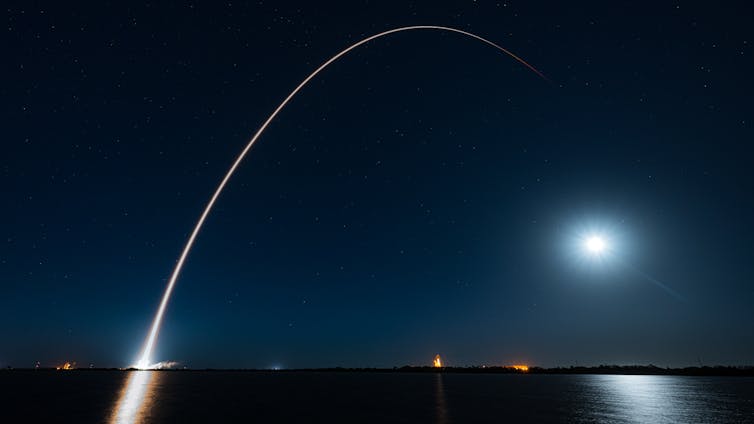
Can a new satellite constellation create sunlight on demand? SpaceX/Flickr, CC BY-ND Michael J. I. Brown, Monash University and Matthew Kenworthy, Leiden University

A proposed constellation of satellites has astronomers very worried. Unlike satellites that reflect sunlight and produce light pollution as an unfortunate byproduct, the ones by US startup Reflect Orbital would produce light pollution by design.

The company promises to produce “sunlight on demand” with mirrors that beam sunlight down to Earth so solar farms can operate after sunset.

It plans to start with an 18-metre test satellite named Earendil-1 which the company has applied to launch in 2026. It would eventually be followed by about 4,000 satellites in orbit by 2030, according to the latest reports.

So how bad would the light pollution be? And perhaps more importantly, can Reflect Orbital’s satellites even work as advertised?

Bouncing sunlight

Sunlight can be bounced off a wristwatch to produce a spot of light . M. Brown

In the same way you can bounce sunlight off a watch face to produce a spot of light, Reflect Orbital’s satellites would use mirrors to beam light onto a patch of Earth.

But the scale involved is vastly different. Reflect Orbital’s satellites would orbit about 625km above the ground, and would eventually have mirrors 54 metres across.

When you bounce light off your watch onto a nearby wall, the spot of light can be very bright. But if you bounce it onto a distant wall, the spot becomes larger – and dimmer.

This is because the Sun is not a point of light, but spans half a degree in angle in the sky. This means that at large distances, a beam of sunlight reflected off a flat mirror spreads out with an angle of half a degree.

What does that mean in practice? Let’s take a satellite reflecting sunlight over a distance of roughly 800km – because a 625km-high satellite won’t always be directly overhead, but beaming the sunlight at an angle. The illuminated patch of ground would be at least 7km across.

Even a curved mirror or a lens can’t focus the sunlight into a tighter spot due to the distance and the half-degree angle of the Sun in the sky.

Would this reflected sunlight be bright or dim? Well, for a single 54 metre satellite it will be 15,000 times fainter than the midday Sun, but this is still far brighter than the full Moon.

Mylar reflectors can be unfolded in orbit. Josh Spradling/The Planetary Society, CC BY

The balloon test

Last year, Reflect Orbital’s founder Ben Nowack posted a short video which summarised a test with the “last thing to build before moving into space”. It was a reflector carried on a hot air balloon.

In the test, a flat, square mirror roughly 2.5 metres across directs a beam of light down to solar panels and sensors. In one instance the team measures 516 watts of light per square metre while the balloon is at a distance of 242 metres.

For comparison, the midday Sun produces roughly 1,000 watts per square metre. So 516 watts per square metre is about half of that, which is enough to be useful.

However, let’s scale the balloon test to space. As we noted earlier, if the satellites were 800km from the area of interest, the reflector would need to be 6.5km by 6.5km – 42 square kilometres. It’s not practical to build such a giant reflector, so the balloon test has some limitations.

So what is Reflect Orbital planning to do?

Reflect Orbital’s plan is “simple satellites in the right constellation shining on existing solar farms”. And their goal is only 200 watts per square metre – 20% of the midday Sun.

Can smaller satellites deliver? If a single 54 metre satellite is 15,000 times fainter than the midday Sun, you would need 3,000 of them to achieve 20% of the midday Sun. That’s a lot of satellites to illuminate one region.

Another issue: satellites at a 625km altitude move at 7.5 kilometres per second. So a satellite will be within 1,000km of a given location for no more than 3.5 minutes.

This means 3,000 satellites would give you a few minutes of illumination. To provide even an hour, you’d need thousands more.

Reflect Orbital isn’t lacking ambition. In one interview, Nowack suggested 250,000 satellites in 600km high orbits. That’s more than all the currently catalogued satellites and large pieces of space junk put together.

And yet, that vast constellation would deliver only 20% of the midday Sun to no more than 80 locations at once, based on our calculations above. In practice, even fewer locations would be illuminated due to cloudy weather.

Additionally, given their altitude, the satellites could only deliver illumination to most locations near dusk and dawn, when the mirrors in low Earth orbit would be bathed in sunlight. Aware of this, Reflect Orbital plan for their constellation to encircle Earth above the day-night line in sun-synchronous orbits to keep them continuously in sunlight.

Cheaper rockets have enabled the deployment of satellite constellations. SpaceX/Flickr, CC BY-NC

Bright lights

So, are mirrored satellites a practical means to produce affordable solar power at night? Probably not. Could they produce devastating light pollution? Absolutely.

In the early evening it doesn’t take long to spot satellites and space junk – and they’re not deliberately designed to be bright. With Reflect Orbital’s plan, even if just the test satellite works as planned, it will sometimes appear far brighter than the full Moon.

A constellation of such mirrors would be devastating to astronomy and dangerous to astronomers. To anyone looking through a telescope the surface of each mirror could be almost as bright as the surface of the Sun, risking permanent eye damage.

The light pollution will hinder everyone’s ability to see the cosmos and light pollution is known to impact the daily rhythms of animals as well.

Although Reflect Orbital aims to illuminate specific locations, the satellites’ beams would also sweep across Earth when moving from one location to the next. The night sky could be lit up with flashes of light brighter than the Moon.

The company did not reply to The Conversation about these concerns within deadline. However, it told Bloomberg this week it plans to redirect sunlight in ways that are “brief, predictable and targeted”, avoiding observatories and sharing the locations of the satellites so scientists can plan their work.

The consequences would be dire

It remains to be seen whether Reflect Orbital’s project will get off the ground. The company may launch a test satellite, but it’s a long way from that to getting 250,000 enormous mirrors constantly circling Earth to keep some solar farms ticking over for a few extra hours a day.

Still, it’s a project to watch. The consequences of success for astronomers – and anyone else who likes the night sky dark – would be dire. The Conversation

The number of satellites visible in the evening has skyrocketed.

Michael J. I. Brown, Associate Professor in Astronomy, Monash University and Matthew Kenworthy, Associate Professor in Astronomy, Leiden University

This article is republished from The Conversation under a Creative Commons license. Read the original article.

Read More........

Want more protein for less money? Don’t be fooled by the slick black packaging

The Conversation, CC BY-SA Emma Beckett, UNSW Sydney

If you’ve been supermarket shopping lately, you might have noticed more foods with big, bold protein claims on black packaging – from powders and bars to yoghurt, bread and even coffee.

International surveys show people are shopping for more protein because they think it’ll help their fitness and health. But clever marketing can sway our judgement too.

Before your next shop, here’s what you should know about how protein is allowed to be sold to us. And as a food and nutrition scientist, I’ll offer some tips for choosing the best value meat or plant-based protein for every $1 you spend – and no, protein bars aren’t the winner.

‘Protein’ vs ‘increased protein’ claims

Let’s start with those “high protein” or “increased protein” claims we’re seeing more of on the shelves.

In Australia and New Zealand, there are actually rules and nuances about how and when companies can use those phrases.

Under those rules, labelling a product as a “protein” product implies it’s a “source” of protein. That means it has at least 5 grams of protein per serving.

“High protein” doesn’t have a specific meaning in the food regulations, but is taken to mean “good source”. Under the rules, a “good source” should have at least 10 grams of protein per serving.

Then there is the “increased protein” claim, which means it has at least 25% more protein than the standard version of the same food.

If you see a product labelled as a “protein” version, you might assume it has significantly more protein than the standard version. But this might not be the case.

Take, for example, a “protein”-branded, black-wrapped cheese: Mini Babybel Protein. It meets the Australian and New Zealand rules of being labelled as a “source” of protein, because it has 5 grams of protein per serving (in this case, in a 20 gram serve of cheese).

But what about the original red-wrapped Mini Babybel cheese? That has 4.6g of protein per 20 gram serving.

The difference between the original vs “protein” cheese is not even a 10% bump in protein content.

Black packaging by design

Food marketers use colours to give us signals about what’s in a package.

Green signals natural and environmentally friendly, reds and yellows are often linked to energy, and blue goes with coolness and hydration.

These days, black is often used as a visual shorthand for products containing protein.

But it’s more than that. Research also suggests black conveys high-quality or “premium” products. This makes it the perfect match for foods marketed as “functional” or “performance-boosting”.

The ‘health halo’ effect

When one attribute of a food is seen as positive, it can make us assume the whole product is health-promoting, even if that’s not the case. This is called a “health halo”.

For protein, the glow of the protein halo can make us blind to the other attributes of the food, such as added fats or sugars. We might be willing to pay more too.

It’s important to know protein deficiency is rare in countries like Australia. You can even have too much protein.

How to spend less to get more protein

If you do have good reason to think you need more protein, here’s how to get better value for your money.

Animal-based core foods are nutritionally dense and high-quality protein foods. Meats, fish, poultry, eggs, fish, and cheese will have between 11 to 32 grams of protein per 100 grams.

That could give you 60g in a chicken breast, 22g in a can of tuna, 17g in a 170g tub of Greek yoghurt, or 12g in 2 eggs.

In the animal foods, chicken is economical, delivering more than 30g of protein for each $1 spent.

But you don’t need to eat animal products to get enough protein.

In fact, once you factor in costs – and I made the following calculations based on recent supermarket prices – plant-based protein sources become even more attractive.

Legumes (such as beans, lentils and soybeans) have about 9g of protein per 100g, which is about half a cup. Legumes are in the range of 20g of protein per dollar spent, which is a similar cost ratio to a protein powder.

Nuts, seeds, legumes and oats are all good plant-based options. Towfiqu Barbhuiya/Unsplash, CC BY

Nuts and seeds like sunflower seeds can have 7g in one 30g handful. Even one cup of simple frozen peas will provide about 7g of protein.

Peanuts at $6 per kilogram supply 42g of protein for each $1 spent.

Dry oats, at $3/kg have 13g of protein per 100g (or 5g in a half cup serve), that’s 33g of protein per dollar spent.

In contrast, processed protein bars are typically poor value, coming in at between 6-8g of protein per $1 spent, depending on if you buy them in a single serve, or in a box of five bars.

Fresh often beats processed on price and protein

Packaged products offer convenience and certainty. But if you rely on convenience, colours and keywords alone, you might not get the best deals or the most nutritious choices.

Choosing a variety of fresh and whole foods for your protein will provide a diversity of vitamins and minerals, while reducing risks associated with consuming too much of any one thing. And it can be done without breaking the bank.The Conversation

Emma Beckett, Adjunct Senior Lecturer, Nutrition, Dietetics & Food Innovation - School of Health Sciences, UNSW Sydney

This article is republished from The Conversation under a Creative Commons license. Read the original article.

Read More........

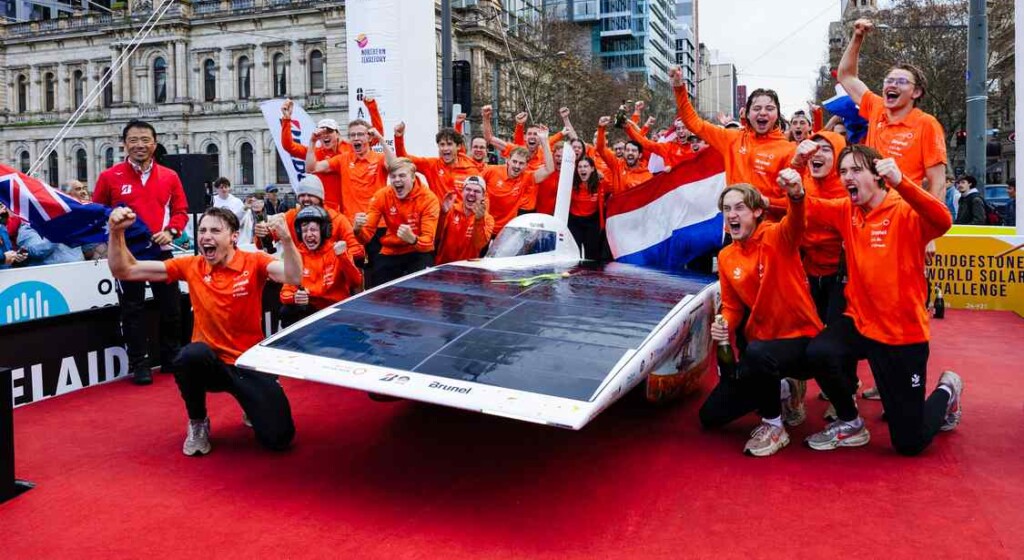
Solar-Powered Cars Race Across Australian Outback – with Fins to Also Harness the Wind

The Brunel Solar team from the Netherlands celebrates victory in Adelaide – credit, Charlie Bliss, Tim Hanley, Riley Williams, Julian Modra, Michael Hurren & Reece Calvert from Swift Hound.

At the Bridgestone World Solar Challenge, innovators and motorsport experts competed to race solar-powered cars 2,000 miles across the Australian Outback.

Reminiscent of the 24 Hours of Le Mans, when Interwar Period engineers tried to balance speed, maneuverability, and durability with wild designs, some of which eventually became road-standard, the World Solar Challenge hopes to push engineers to develop sustainable solutions to challenges facing electric automotion today.

This year, the spirit of innovation and problem solving was pushed even further, as along with racing from Darwin to Adelaide, the challenge took place in the wintertime, with 20% less sun than in other Australian seasons.

When looking at the cars, the first thing one notices is how much they look like aircraft carriers—a necessity for fitting enough solar panels to charge the batteries.

The other boat-like design is their narrow undercarriage and hull-shaped sides which help make them more aerodynamic. Much of the actual horsepower of an average car comes from pushing the air out of its way. The more aerodynamic a car, the less wind it must move, and the less energy it consumes.

This year however, even with these radical body shapes, the contests have had to push further the bounds of aerodynamism and efficiency.

“Fins are the flavor of the month, or certainly the flavor of this event,” said one organizer.

Indeed many of vehicles sported one or even two hi-tech fins. The Millennium car from the University of Michigan team uses its fin like a combination of the rudder and sail on a boat, generating forward thrust while also stabilizing it in crosswinds.

“This event is very relevant to look at the future,” said Bridgestone Vice President Hiroshi Imai, in a report from Reuters. “Even near-future technology may come from this kind of event.”

The Dutch team Brunel Solar eventually won the race, arriving in Adelaide 34 hours after leaving Darwin. Their car, the Nuna 13, had not one but two fins, which it used to achieve higher speeds without extra energy consumption. Solar-Powered Cars Race Across Australian Outback – with Fins to Also Harness the Wind
Read More........

AI is a multi-billion dollar industry. It’s underpinned by an invisible and exploited workforce

In dusty factories, cramped internet cafes and makeshift home offices around the world, millions of people sit at computers tediously labelling data.

These workers are the lifeblood of the burgeoning artificial intelligence (AI) industry. Without them, products such as ChatGPT simply would not exist. That’s because the data they label helps AI systems “learn”.

But despite the vital contribution this workforce makes to an industry which is expected to be worth US$407 billion by 2027, the people who comprise it are largely invisible and frequently exploited. Earlier this year nearly 100 data labellers and AI workers from Kenya who do work for companies like Facebook, Scale AI and OpenAI published an open letter to United States President Joe Biden in which they said:

Our working conditions amount to modern day slavery.

To ensure AI supply chains are ethical, industry and governments must urgently address this problem. But the key question is: how?

What is data labelling?

Data labelling is the process of annotating raw data — such as images, video or text — so that AI systems can recognise patterns and make predictions.

Self-driving cars, for example, rely on labelled video footage to distinguish pedestrians from road signs. Large language models such as ChatGPT rely on labelled text to understand human language.

These labelled datasets are the lifeblood of AI models. Without them, AI systems would be unable to function effectively.

Tech giants like Meta, Google, OpenAI and Microsoft outsource much of this work to data labelling factories in countries such as the Philippines, Kenya, India, Pakistan, Venezuela and Colombia.

China is also becoming another global hub for data labelling.

Outsourcing companies that facilitate this work include Scale AI, iMerit, and Samasource. These are very large companies in their own right. For example, Scale AI, which is headquartered in California, is now worth US$14 billion.

Cutting corners

Major tech firms like Alphabet (the parent company of Google), Amazon, Microsoft, Nvidia and Meta have poured billions into AI infrastructure, from computational power and data storage to emerging computational technologies.

Large-scale AI models can cost tens of millions of dollars to train. Once deployed, maintaining these models requires continuous investment in data labelling, refinement and real-world testing.

But while AI investment is significant, revenues have not always met expectations. Many industries continue to view AI projects as experimental with unclear profitability paths.

In response, many companies are cutting costs which affect those at the very bottom of the AI supply chain who are often highly vulnerable: data labellers.

Low wages, dangerous working conditions

One way companies involved in the AI supply chain try to reduce costs is by employing large numbers of data labellers in countries in the Global South such as the Philippines, Venezuela, Kenya and India. Workers in these countries face stagnating or shrinking wages.

For example, an hourly rate for AI data labellers in Venezuela ranges from between 90 cents and US$2. In comparison, in the United States, this rate is between US$10 to US$25 per hour.

In the Philippines, workers labelling data for multi-billion dollar companies such as Scale AI often earn far below the minimum wage.

Some labelling providers even resort to child labour for labelling purposes.

But there are many other labour issues within the AI supply chain.

Many data labellers work in overcrowded and dusty environments which pose a serious risk to their health. They also often work as independent contractors, lacking access to protections such as health care or compensation.

The mental toll of data labelling work is also significant, with repetitive tasks, strict deadlines and rigid quality controls. Data labellers are also sometimes asked to read and label hate speech or other abusive language or material, which has been proven to have negative psychological effects.

Errors can lead to pay cuts or job losses. But labellers often experience lack of transparency on how their work is evaluated. They are often denied access to performance data, hindering their ability to improve or contest decisions.

Making AI supply chains ethical

As AI development becomes more complex and companies strive to maximise profits, the need for ethical AI supply chains is urgent.

One way companies can help ensure this is by applying a human right-centreed design, deliberation and oversight approach to the entire AI supply chain. They must adopt fair wage policies, ensuring data labellers receive living wages that reflect the value of their contributions.

By embedding human rights into the supply chain, AI companies can foster a more ethical, sustainable industry, ensuring that both workers’ rights and corporate responsibility align with long-term success.

Governments should also create new regulation which mandates these practices, encouraging fairness and transparency. This includes transparency in performance evaluation and personal data processing, allowing workers to understand how they are assessed and to contest any inaccuracies.

Clear payment systems and recourse mechanisms will ensure workers are treated fairly. Instead of busting unions, as Scale AI did in Kenya in 2024, companies should also support the formation of digital labour unions or cooperatives. This will give workers a voice to advocate for better working conditions.

As users of AI products, we all can advocate for ethical practices by supporting companies that are transparent about their AI supply chains and commit to fair treatment of workers. Just as we reward green and fair trade producers of physical goods, we can push for change by choosing digital services or apps on our smartphones that adhere to human rights standards, promoting ethical brands through social media, and voting with our dollars for accountability from tech giants on a daily basis.

By making informed choices, we all can contribute to more ethical practices across the AI industry.The Conversation

Ganna Pogrebna, Executive Director, AI and Cyber Futures Institute, Charles Sturt University

This article is republished from The Conversation under a Creative Commons license. Read the original article.

Read More........

Ferocity, fitness and fast bowling: how Virat Kohli revolutionised Indian cricket

Kohli’s collision with Sam Konstas during the Boxing Day Test versus Australia.

Vaughan Cruickshank, University of Tasmania and Brendon Hyndman, Charles Sturt University

Virat Kohli announced his retirement from Test cricket on Monday.

While his Instagram message just said this was the “right time”, his poor recent Test form, mental fatigue and desire to spend more time with his family, charity foundation and expanding business empire have been suggested as other influential factors.

During his 14-year Test career “King Kohli” has been the backbone of the Indian batting line-up, and his absence is a huge blow as the Indians prepare to tour England next month.

The megastar scored 9,230 runs in 123 Tests at an average of 46.85, including 30 centuries.

These numbers put him in the top five Indian test batsmen of all time, but his legacy extends far beyond his batting achievements.

Kohli, 36, quit Twenty20 Internationals last year (after India won its second world title). He may continue to play one-day internationals.

Rising to the top of Test cricket

Kohli has been the greatest Indian batsman of his generation.

He made his Test debut in 2011 against the West Indies and played his final match against Australia in January.

He scored centuries against every country he played against, with more than half of these coming overseas.

His seven Test centuries in Australia is the second most by an overseas batsman.

He was at his peak between 2014 and 2019, when he averaged more than 60 in Test cricket and became one of the “fab four” (the world’s best Test batsmen) alongside Steve Smith, Kane Williamson and Joe Root.

This period also included six double-hundreds in 18 months, and 13 months as the number one ranked Test batsman in the world.

Kohli the leader

Kohli is India’s greatest ever Test captain.

His tenure from 2014 to 2022 was a golden age for Indian Test cricket.

India won 40 of 68 Tests (59%) in this period and did not lose a Test series at home. India was the number one ranked Test team in the world from 2016–20 and won its first Test series in Australia in 2018–19.

These statistics make Kohli one of the most successful Test captains of all time.

Beyond these numbers, he was a charismatic and aggressive captain who redefined India’s approach to Test cricket by bringing a more competitive edge to the team.

He drove higher expectations around fitness, training intensity and fast bowling that continue to shape Indian cricket.

Mandatory fitness testing and improved dieting and recovery practices, which redefined the team’s standards, are attributed to Kohli’s leadership.

Similarly, Indian success was strongly contributed to by Kohli encouraging the development of a world-class pace bowling attack, which marked a significant shift from the spin-heavy approach of Indian cricket.

Controversies

While Kohli’s energy, passion and intensity contributed to his success as batsman and captain, they also led to numerous confrontations with opposition players, which some believed to be disrespectful and arrogant.

His intense celebrations and assertive body language also drew criticism from conservative cricketing audiences.

Many of these controversies have occurred in Australia, where Kohli enjoyed a love-hate relationship with Australian players and crowds.

Examples include flipping the bird to the crowd, making sandpaper gestures (in reference to the 2018 Australian ball tampering scandal, also known as Sandpapergate) and shoulder-barging young Australian batsman Sam Konstas.

What will his Test legacy be?

For more than a decade, Kohli has been the heartbeat of the Indian Test team, and his retirement marks the end of an era.

He reshaped the mindset of Indian cricket and cultivated a faster, fitter, fiercer, more successful team.

Kohli was also one of the greatest ambassadors of Test cricket, and has played a significant role in ensuring the game remains relevant in an era increasingly dominated by T20 cricket.

He made Test cricket aspirational again because he wanted it to thrive. He knew India needed to dominate the hardest format to be respected.

His social media reach (272 million followers on Instagram and 67.8 million on X) is more than Tiger Woods, LeBron James and Tom Brady combined, and was even referred to by LA2028 Olympics organisers when they announced cricket’s entry into the games.

In recent days, Kohli has been described as “a modern-day giant”, a “provocateur in chief”, and “his generation’s most profound figure”.

Love him or hate him, he elevated the spectacle of Test cricket. His electric energy brought the best out of India and its opponents and made him impossible to ignore when batting or fielding.

As respected cricket writer Peter Lalor noted recently:

Nobody is irreplaceable, but nobody can replace Virat.The Conversation

Vaughan Cruickshank, Senior Lecturer in Health and Physical Education, University of Tasmania and Brendon Hyndman, Associate Dean (Academic), Charles Sturt University

This article is republished from The Conversation under a Creative Commons license. Read the original article.

Read More........

Mastercard plans to get rid of credit card numbers. We could be heading towards the end of cards

Mastercard has announced plans to remove the 16-digit number from their credit and debit cards by 2030 in a move designed to stamp out identity theft and fraudulent use of cards.

The numbers currently used to identify cards will be replaced with tokenisation and biometric authentication

In 2022, Mastercard added biometric options enabling payments to be made with a smile or wave of the hand.

Tokenisation converts the 16-digit card number into a different number – or token – stored on your device, so card information is never shared when you tap your card or phone or make payments online.

The first rollout of these numberless cards will be through a partnership with AMP Bank, but it is expected other banks will follow in the coming 12 months.

Why card security is important

There is nothing quite like the sinking feeling after receiving a call or text from your bank asking about the legitimacy of a card transaction.

In 2023-2024 the total value of card fraud in Australia was A$868 million, up from $677.5 million the previous financial year.

Credit card numbers and payment details are often exposed in major data breaches affecting large and small businesses.

Late last year, the US Federal Trade Commission took action against the Marriott and Starwood Hotels for lax data security. More than 300 million customers worldwide were affected.

Event ticketing company Ticketmaster was also hacked last year. The details of several hundred million customers, including names, addresses, credit card numbers, phone numbers and payment details were illegally accessed.

So-called “card-not-present fraud”, where an offender processes an unauthorised transaction without having the card in their physical possession, accounts for 92% of all card fraud in Australia. This rose 29% in the last financial year.

The Card Verification Value (CVV) (or three-digit number on the back of a credit card) aimed to ensure the person making the transaction had the physical card in their hands. But it is clearly ineffective.

Benefits of removing credit card numbers

Removing the credit card number is the latest attempt to curb fraud. Removing numbers stops fraudsters processing unauthorised card-not-present transactions.

It also reduces the potential for financial damage of victims exposed in data breaches, if organisations are no longer able to store these payment details.

The storage of personal information is a contested issue. For example, the 2022 Optus data breach exposed information from customers who had previously held accounts with the telco back in 2018.

Removing the ability of organisations to store payment details in the first place, removes the risk of this information being exposed in any future attack.

While any efforts to reduce fraud are welcome, this new approach raises some new issues to consider.

Potential problems with the new system

Mastercard has said customers will use tokens generated by the customer’s banking app or biometric authentication instead of card numbers.

This is likely to be an easy transition for customers who use mobile banking.

However, the use of digital banking is not universal. Many senior consumers and some people with a disability don’t use digital banking services. They would be excluded from the new protections.

While strengthening the security attached to credit cards, removing numbers shifts the vulnerability to mobile phones and telecommunication providers.

Offenders already access victims’ phones through mobile porting and impersonation scams. These attacks are likely to escalate as new ways to exploit potential vulnerabilities are found.

There are also concerns about biometrics. Unlike credit card details, which can be replaced when exposed in a data breach, biometrics are fixed. Shifting a focus to biometrics will increase the attractiveness of this data, and potentially opens victims up to ongoing, irreversible damage.

While not as common, breaches of biometric data do occur.

For example, web-based security platform BioStar 2 in the UK exposed the fingerprints and facial recognition details of over one million people. Closer to home, IT provider to entertainment companies Outabox is alleged to have exposed facial recognition data of more than one million Australians.

Will we really need cards in the future?

While removing the numbers may reduce credit card fraud, emerging smart retail technologies may remove the need for cards all together.

Smartphone payments are already becoming the norm, removing the need for physical cards. GlobalData revealed a 58% growth in mobile wallet payments in Australia in 2023, to $146.9 billion. In October 2024, 44% of payments were “device-present” transactions.

Amazon’s innovative “Just-Walk-Out” technology has also removed the need for consumers to bring a physical credit or debit card all together.

Amazon Go and the world’s most advanced shopping technology.

This technology is available at more than 70 Amazon-owned stores, and at more than 85 third-party locations across the US, UK, and Australia. These include sports stadiums, airports, grocery stores, convenience stores and college campuses.

The technology uses cameras, weight sensors and a combination of advanced AI technologies to enable shoppers in physical stores make purchases without having to swipe or tap their cards at the checkout line.

Such technology is now being offered by a variety of other vendors including Trigo, Cognizant and Grabango. It is also being trialled across other international retailers, including supermarket chains Tesco and ALDI.

While Just-Walk-Out removes the need to carry a physical card, at some point consumers still need to enter their cards details into an app. So, to avoid cards and numbers completely, smart retail tech providers are moving to biometric alternatives, like facial recognition payments.

Considering the speed at which smart retail and payment technology is entering the marketplace, it is likely physical credit cards, numberless or not, will soon become redundant, replaced by biometric payment options.The Conversation

Gary Mortimer, Professor of Marketing and Consumer Behaviour, Queensland University of Technology and Cassandra Cross, Associate Dean (Learning & Teaching) Faculty of Creative Industries, Education and Social Justice, Queensland University of Technology

This article is republished from The Conversation under a Creative Commons license. Read the original article.

Read More........

What’s a trade war?

This article is part of The Conversation’s “Business Basics” series where we ask experts to discuss key concepts in business, economics and finance.


Thanks to US President-elect Donald Trump, the term “trade war” is back in the headlines. Trump campaigned successfully on a platform of aggressive trade policies, and since being elected, has only doubled down on this posture.

On Tuesday, he threatened Mexico and Canada with new 25% tariffs on all goods, and a separate “additional” 10% tariff on China “above any additional tariffs”.

While the term might conjure up dramatic images of battlefield tactics, the real economic impact of any looming trade war is likely to hit much closer to home – both for Americans and the rest of the world.

Global supply chains are deeply interlinked. That means a major trade war initiated by the US could push up the prices of all kinds of goods – from new cars to Australian-inspired avocado on toast.

To understand where we might be headed, it’s worth unpacking the metaphor. What exactly is a trade war? What are the “weapons” countries use? Perhaps most importantly – can either side win?

The weapons of war

There are many “weapons” available to a country in a trade war, but tariffs are often a popular choice. This is simply an extra tax put on a product as it crosses a border as an import.

For example, all else equal, Trump’s proposed 25% tariff on goods from Canada would bump the price of a $32,000 Canadian-built car up to $40,000.

Tariffs are usually paid by whoever is importing the product and paid to the government of the importing country.

That means the extra cost is almost always passed on to consumers.

Why would any government want to force prices up like that? Because it gives locally produced goods without the tariff a cost advantage.

That might seem like a reasonable way to protect local industries, but tariffs can backfire in unexpected ways. Consider how many foreign parts go into “American-made” products.

When a car rolls off a US assembly line, it’s built from thousands of components – many of which have to be imported from other countries. If those parts face tariffs, manufacturing costs rise for domestic producers, and prices rise further for domestic consumers.

Limiting what comes in

There are other trade restrictions, too, referred to as non-tariff measures. Quotas are one example. These place limits on how many units of something can be imported during a specific time period.

Returning to our earlier example, the US could choose to set an import quota on that same Canadian-made car of one million per year. Once that limit had been reached, no more Canadian cars could enter the country, even if consumers wanted to buy them.

This artificial scarcity can drive up prices because demand stays the same while supply is restricted. Like tariffs, the theory is that those higher prices for imports will cause consumers to favour locally manufactured goods.

More covert weapons

Some other trade restrictions are more covert – arguably easier to conceal and deny.

Imagine your export permit was cancelled without explanation or your shipment of lychees was left rotting in a foreign port for reasons that seem to be political.

Or your country suddenly disappears from another country’s electronic export system, meaning that you now cannot export anything there at all (this happened to Lithuania, which was removed from China’s customs database).

These are the sorts of trade war tactics that my research team and I have been studying in our Weaponised Trade Project.

We have collected nearly 100 examples of coercive trade weapons over the past decade, used by a wide range of countries against their competitors.

Today’s tariff is tomorrow’s trade war

Once deployed, trade weapons can cause political tensions to escalate rapidly. Other countries often retaliate with their own tit-for-tat measures. From there, they can escalate into full-blown trade wars.

The new president of Mexico, Claudia Sheinbaum, has already warned this may happen, in response to Trump’s threats earlier this week.

One tariff would be followed by another in response, and so on until we put at risk common businesses.

We’ve had some nasty trade wars before. One of the most notorious examples from history were the “beggar-thy-neighbour” tariffs and other protectionist policies of the interwar years, which deepened the Great Depression.

You might remember this from the classic movie Ferris Bueller’s Day Off:

The Smoot-Hawley tariffs of the 1930s were the subject of a now-famous movie scene.

When countries restrict trade, prices typically rise for consumers, jobs can be lost in industries dependent on foreign materials, and trade and economic growth slow on both sides.

Politicians might claim victory when their foreign competitors make concessions, but economists generally agree that trade wars create more losers than winners.The Conversation

Lisa Toohey, Professor of Law, UNSW Sydney

This article is republished from The Conversation under a Creative Commons license. Read the original article.
Read More........

The importance of saving and investing

Consumer Education

Your financial wellbeing starts with financial literacy. The more you know, the better equipped you are to plan and manage your finances.

AVBOB proudly brings you Mutual Wellness in 60 Seconds, a series on financial wellness matters, and all things ‘mutual’.

As Africa’s largest mutual society, AVBOB takes your financial health seriously.

In the video below, we look at the importance of saving and investing.

Saving and investing

Whether it’s being prepared for life’s challenges or reaching your financial goals, savings can assist to make things happen.

Despite tough economic conditions, you don’t have to give up your dreams of financial stability, quality education, a well-earned holiday or an emergency fund. The secret to successful investing is to start small.

You can always increase the amount you invest. However, the key is to simply start… the sooner the better.Did you know that AVBOB offers 5-year and 10-year investment accounts that let you save from as little as R250 per month? Over and above the interest that you will receive, you will also be eligible to get bonuses and other benefits that come with the investment plan. The importance of saving and investing
Read More........

Why does the Olympics have an ‘AI agenda’ and what does it mean for the future of sport?

Tom Hartley, University of Tasmania and Vaughan Cruickshank, University of Tasmania

The 2024 Summer Olympics, kicking off in Paris on July 26, will be novel for more than just the first inclusion of breakdancing. The event will also be the first instalment of the quadrennial sportsfest since the International Olympic Committee (IOC) unveiled its Olympic AI Agenda.

You might be wondering why the Olympics – founded in 1896 in imitation of the famous athletic contest of ancient Greece – needs an “AI agenda”. What can computers do to help the human body’s quest to reach higher, faster and stronger?

The answer, according to the IOC, is quite a lot. The committee’s far-reaching agenda envisions a world in which AI systems aid athletes in reaching their peak performance, help to ensure fair play, optimise event operations, and transform the spectator experience.

The goal, according to IOC president Thomas Bach, is “to set the course for the AI future of sport with responsible leadership by embracing the change while preserving the Olympic values”.

Spotting talent, training athletes, rehabilitating injuries

Most of what the IOC has in mind is quite specific to sport, but some of it is the kind of AI applications that could be used by organisations in many fields.

Chief among sport-focused uses of AI are those that focus on individual athletes. By evaluating huge data sets based on performance, physical traits, and skills, AI systems can make it easier to spot talent. These systems could operate on a large scale and might identify people who are currently being missed.

AI could also play a role in helping talented individuals become world-class athletes. We are already seeing AI systems designed to support coaches by providing personalised training plans.

Optimising training and uncovering hidden patterns in the behaviour of individuals or groups of athletes is another promising application of AI models. Coaches can use these models to adapt training strategies continuously through feedback.

AI training systems can be more affordable and accessible than traditional coaching. There are also AI tools that can analyse video of movements such as a tennis swing in real time and provide feedback – and some need no more equipment than a smartphone.

Organisations such as Swimming Australia are already using AI tools to interpret athlete data using natural language.

AI-powered tools are also changing injury prevention and rehabilitation. By analysing biomechanical data, training logs and medical records, AI can identify injury risk factors and provide personalised recommendations to avoid them.

For instance, AI models can analyse an athlete’s movement patterns to detect imbalances, suggesting targeted exercises and corrective techniques to reduce injury risk and enhance recovery. Research also shows AI technologies can identify knee injuries with accuracy comparable to physicians, potentially reducing the need for specialised medical practitioners.

Refereeing and judging

The IOC also believes another key use for AI is to help make sport more fair.

Technological aids for officials are not new. Think of cricket’s decision review system, the NRL’s bunker, and electronic line calling in tennis. The FIFA World Cup’s “semi-automated” offside technology uses AI.

AI judging is also coming to gymnastics. For casual viewers, it can be hard to understand why one gymnast gets a higher score than another.

In a bid to make judging more transparent, a judging support system was employed across all apparatus at the 2023 world championships. This AI-based tool strictly matches gymnast movements to the rulebook, and may make the sport more accessible for viewers.

Viewing experience

New technologies and digital innovations also make the Olympic Games more accessible for fans.

During the 2020 Tokyo games (actually held in 2021 due to the COVID pandemic), digital engagement doubled compared to the Rio games of 2016, with Australia being one of the top countries for consuming digital content.

A recent survey showed Australian audiences generally oppose AI-produced political news, but they are more accepting of AI-generated sports content.

More recent research from IBM showed 55% of global tennis fans surveyed believe AI will positively impact sports. This sentiment reflects a growing acceptance of AI’s role in enhancing the experience for fans.

The IOC wants to use AI to create “more personalised fan experiences”, but we don’t yet know exactly what those will be.

Improving efficiency

Away from the sport itself, AI will also be used in an effort to improve efficiency, reduce costs and enhance sustainability in the Olympics. This will be for things such as optimising transportation, workforce training, logistics and ticket sales.

The IOC plans to share the knowledge gained from this year’s games with other sports organisers to help them create more engaging and cost-effective events.

AI technology will be used to safeguard athletes and officials from social media abuse. An expected half a billion social comments will be monitored during the 2024 Paris Olympics, with abusive posts automatically erased to protect athletes.

Change or be changed

In sport as in the rest of society, it will be crucial to establish guidelines for safe and responsible implementation of AI. An important first step is to ensure data fed to AI systems is secure, accurate, fair and inclusive.

In 2014, the IOC launched a program of reform in a fast-moving world with the motto “change or be changed”. This imperative has taken on a new urgency with the rapid progress of AI technologies in recent years.

As we have seen, AI is making inroads at this year’s games, and we can expect to see even more of it at the Los Angeles games due in 2028 and the 2032 games booked for Brisbane. Are we ready to embrace it?The Conversation

Tom Hartley, Lecturer in Health and Physical Education, University of Tasmania and Vaughan Cruickshank, Senior Lecturer in Health and Physical Education, University of Tasmania

This article is republished from The Conversation under a Creative Commons license. Read the original article.

Read More........

Dubai Company Buys Used Cooking Oil to Turn Into Biofuel for Cars Citywide to Reduce CO2 Emissions

Used cooking oil collection truck and one of the biofuel production plants – Credit: Lootah Biofuels
A Dubai-based company Lootah Biofuels is producing biodiesel from used cooking oil bringing sustainable transportation options to a major oil-producing country. The result is a fuel that is less expensive, renewable, and clean. The United Arab Emirates company now boasts having their own fuel outlets across the city of Dubai, delivering 60 million liters annually. It is the brainchild of Yousif Bin Saeed Al Lootah, who wants the UAE to be the first nation in the region to mandate that biofuels blends be featured alongside other fuel in all public stations. They pay for the used cooking oil collected, thus giving an incentive to providers like restaurants, bakeries, and food chains, which provide 500,000 liters of waste oil every month. The company says it converted the waste oil into 770 tons of biofuel last year. The Lootah Biofuels website reports that used cooking oil has the highest carbon saving ratio amongst all the available biodiesel feedstock—and calculates their product has caused the reduction of 500 million tons of CO2, so far.MORE RENEWABLE GOOD NEWS: United Dubai Company Buys Used Cooking Oil to Turn Into Biofuel for Cars Citywide to Reduce CO2 Emissions
Read More........

Liverpool is Building the World’s Largest Tidal Power Project to Power a Million Homes

The Rance Tidal Power Station, which Mersey Tidal Power are studying to inform the construction of a similar plant for Liverpool.
The River Mersey and the Bay of Liverpool are the largest assets this famous English city possesses, and attempting to beat the British government to a net-zero economy, Liverpool City Region have entered phase 3 planning stage to build the largest tidal power plant on Earth. Schemes to harness the predictable power of the tides in Liverpool Bay date back to 1924, and with one of the largest tidal ranges of any coastal city in the UK, government utility Mersey Tidal Power believe that they can power 1 million homes and protect the city from floodwaters, all without disturbing the local estuarine ecosystem. Mersey Tidal Power have released precious little information on the plans thus far, but Eletrek reports that a large dam would be a barrier between the Irish Sea and a tidal basin. Underneath the dam would be large turbines and sluice gates which would open as the tide comes in, pulling water onto the turbines to generate energy. The gates
would close as the 10-meter-high tide finishes, and as the gravity of the moon begins to pull on the water four hours later, the gates would open, causing it to rush past the turbines a second time, generating more clean energy. “I think that we have a unique opportunity to harness the power of our greatest natural assets—our river and our people—to deliver a cleaner, greener, more prosperous future for our children,” said Liverpool mayor Steve Rotherham. Tidal power projects are few and far between in both scale and reliability, but like geothermal power, they offer an alternative to sun and wind power which can be interrupted by weather conditions. The multibillion-dollar project is in Phase 3 concept development and is about to enter the formal planning stage. Mersey Tidal Power has consulted with experts at the Rance tidal power plant in France, in operation since the 1960s, as well as K Power, which runs the largest tidal plant in the world at Sihwa Lake in South Korea. Concept imagery from Liverpool City Region Combined Authority shows a similar design to the installation at Rance. The top of the dam would serve as a causeway with green spaces and bike paths that would connect the city of Liverpool to the Wirral Peninsula, the way Rance is connected to St. Malo. Liverpool City and Mersey Tidal Power are under no illusions as to the complexity and challenge of the project, but they estimate that the capacity of a River Mersey Tidal station could power 1 million homes—essentially the whole of Liverpool—for 120 years. Liverpool is Building the World’s Largest Tidal Power Project to Power a Million Homes - Good News Network
Read More........