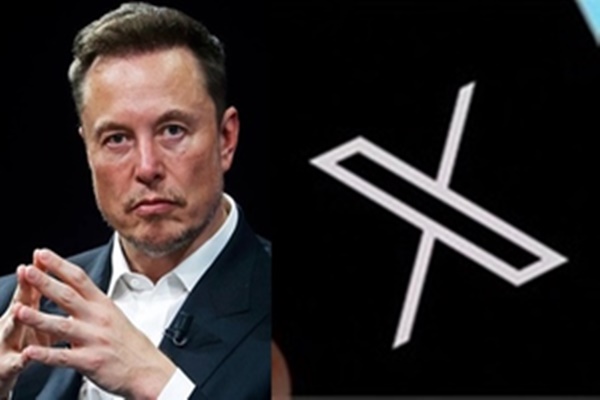
Brazilian SC Judge suspends Elon Musk’s platform X after he refuses to name a legal representative

A Brazilian Supreme Court Justice has ordered the suspension of Elon Musk’s social media platform X in Brazil after the tech billionaire refused to name a legal representative in the country. The move further escalates the months-long feud between the two persons over free speech, far-right accounts and misinformation. Justice Alexandre de Moraes had warned Musk earlier this week that X could be blocked in Brazil if he failed to comply with his order to name a representative, and established a 24-hour deadline.

The company did not have a representative in the country since earlier this month. Justice De Moraes said the platform would remain blocked until it complies. Responding to the ban, Elon Musk accused the Brazilian Judge of destroying free speech in the country. Source: https://www.newsonair.gov.in/brazilian-sc-judge-suspends-elon-musks-platform-x-after-he-refuses-to-name-a-legal-representative/
Read More........

India hands over G20 presidency to Brazil

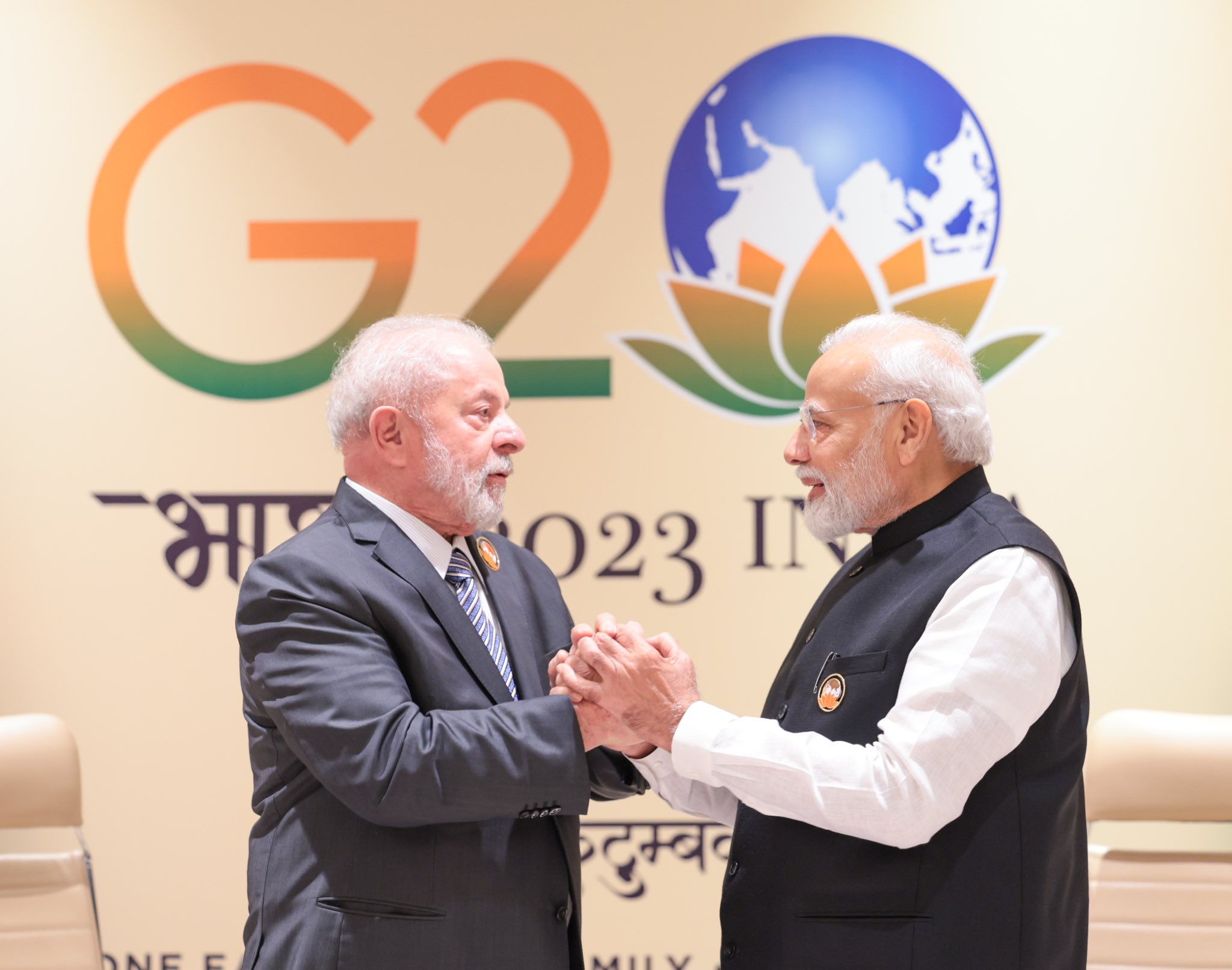
President of Brazil Luiz Inacio Lula da Silva and Indian Prime Minister Narendra Modi at the G20 summit held in New Delhi Sept. 9 and 10. Brazil took over the presidency from India. PHOTO: X @India’s Ministry of External Affairs

NEW DELHI (Reuters) – India on Sunday, Sept. 10, 2023, formally handed over the G20 presidency to Brazil at the closing ceremony of the annual summit of the grouping, that was held in New Delhi this weekend. India Prime Minister Narendra Modi completed the transition by handing over the ceremonial gavel of the presidency to Brazil President Luiz Inacio Lula da Silva. India has had the presidency of the G20 since Dec. 1, when it took over from Indonesia, and will continue to hold the position until Nov. 30. During the two-day summit, the bloc adopted a consensus declaration that made commitments on several issues, including that of food and energy security, climate change and global debt vulnerabilities. Modi, on Sunday, also proposed a “virtual summit” of the grouping at the end of November to assess the status of the suggestions and proposals put forth by members and determine “how their progress can be accelerated”.“In that session, we can review the topics decided during this summit,” Modi said, adding that details would be shared with members. Source: https://www.newsindiatimes.com/
Read More........

Brics+ and the Tricky Business of Balancing Global Geopolitics

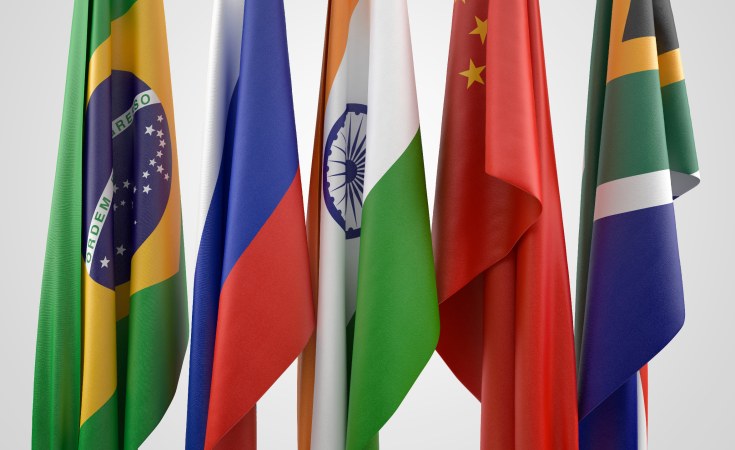
By Priyal Singh: Will an expanded BRICS precipitate a new international order, or collapse under the weight of its internal contradictions? The words of 13th century Persian poet Jalāl al-Dīn Muḥammad Rūmī, 'As you start to walk the way, the way appears,' certainly found new resonance in Johannesburg last week at the 15th BRICS Summit. Apart from expanding the diplomatic club to include Iran, Argentina, Egypt, Ethiopia, Saudi Arabia and the United Arab Emirates, the summit revealed the global south's growing disillusionment with the current structure of the international system. These frustrations have bolstered BRICS' appeal as a counterweight to leading Western countries, such as those composing the G7. More significantly, an expanded BRICS represents a resounding call for international reform by global south states, exclusive from, and in opposition to, traditional Western powers. This unprecedented moment reflects the shifting locus of global power, and has propelled an expanded BRICS to chart a way into unknown territory. Decisions over the nature and trajectory of global order were once the sole preserve of the European 'great' powers, along with the United States (US). The contemporary international system will undoubtedly be shaped by the Asia-Pacific region, Africa, the Middle East and Latin America. If global institutions fail to evolve, international cooperation on pressing issues will inevitably fail If global institutions fail to evolve and accommodate this reality, international cooperation on the most pressing issues of our time will inevitably fail. On paper, this is the fundamental challenge BRICS intends to address in order to bring about a more 'representative, fairer international order, [and] a reformed multilateral system.' How it does so, however, remains poorly defined.  One likely approach is to use the group's combined economic clout to pursue global governance, financial and justice system reform, and alternative paths on specific issues like climate change. Already, the current BRICS states' collective economic output (based on GDP adjusted for purchasing power parity) is roughly US$3 trillion larger than the G7, which includes Canada, France, Germany, Italy, Japan, the US and United Kingdom. (As a non-enumerated member, the European Union is excluded.) With six new BRICS members in 2024, this difference rises to just under US$11 trillion. However, economic output measured by GDP based on current exchange rates places the G7 as the larger combined economy (even with the six new BRICS members). Coordinated action on points of contention may not be as easy for BRICS as for the G7 Regardless, countries in the global south are increasingly poised to challenge the economic dominance of traditional powers. And based on the former's current growth trajectories, will decisively outperform the G7 economies over the coming decades. This combined economic influence could help to secure greater representation and fairer rules and procedures in the United Nations Security Council, International Criminal Court, World Bank and International Monetary Fund - among others alluded to in the BRICS Johannesburg II Declaration. However, coordinating common action on specific points of contention may not be as easy for the expanded BRICS grouping as for the G7. G7 countries have structured their cooperation on global matters around shared liberal political values and norms, particularly on democracy and civil liberties. While these have been threatened in recent years by the rise of populist right-wing administrations, G7 members' considerable normative and political alignment underpins their global economic clout. The expanded BRICS grouping, on the other hand, is a more arbitrary constellation of states with very different (and sometimes diametrically opposed) political systems and values. They range from progressive constitutional democracies to closed and repressive theocracies, to countries experimenting with hybrid authoritarianism. Ironically, BRICS may be in its ascendency due to its ambiguity and loosely articulated vision: An analysis of various governance variables across member countries, including perceptions of political stability, rule of law, government effectiveness and basic freedoms, reveals a high level of variance. Scores for each of these variables show a standard deviation from the mean that is often more than double that of G7 countries. That raises serious questions about BRICS' ability to pursue coherent, coordinated action on global institutional reform, despite members agreeing that the international system is unfairly structured. Without a robust normative basis for cooperation, disagreements over issues such as gender equality, individual rights and liberties, and the character of a new international order, could derail momentum needed for meaningful change.  Ironically, BRICS may well be in its ascendency due to its ambiguity and loosely articulated vision of multipolarity and a reformed international system. However, as the group expands and evolves into something more concrete, difficult issues may not be as easy to kick down the road as before. For example, how do all members justify provisions in the Johannesburg II Declaration on respecting international humanitarian law in conflict situations, increased participation of women in peace processes, and the promotion and protection of democracy, human rights and fundamental freedoms for all? Squaring these provisions with the brazen violations by certain current and incoming BRICS members will test the mettle of the diplomatic club. These contradictions must be overcome for BRICS to muster not only its economic clout, but the moral and political capital to pursue reforms and serve as a counterweight to the G7. Rumi's wisdom still rings true, but as the expanded BRICS group marches towards a new world order, the way ahead may be murkier than initially expected.Priyal Singh, Senior Researcher, Africa in the World, ISS Pretoria. Source: https://allafrica.com/
Read More........

Brazil`s hospitals facing oxygen crisis


The hospitals in the city of Manaus of Brazil have been hit by a massive oxygen crisis since mass vaccinations have not yet begun and it causes medical threats to the city's coronavirus patients. 

The BBC quoted health officials as warning in local media on Friday that oxygen shortages could kill many people in the Amazon jungle city. 

The city has “run out of oxygen and some health centers have become a type of suffocation chamber,” Jessem Orellana, from the Fiocruz-Amazonia scientific investigation institute, told AFP.

“Here there aren’t any empty beds left, any oxygen tanks, nothing — all we have left is faith,” Manaus resident Luiza Castro told AFP.

Amazonas Governor Wilson Lima said the state was “in the most critical moment of the pandemic.”

A female doctor from the area appealed for help in a video posted on the Internet. "We are in a terrible situation," she said, " A unit of the hospital has run out of oxygen."

In the video clip, the woman said, "There is no oxygen. Many people are dying. If anyone has oxygen, bring it to the clinic. Many people are dying." Source: https://www.daily-bangladesh.com/
Read More........

Coronavirus drives Brazil jobless rate to record 14.4 percent


The jobless rate in Brazil hit a record 14.4 percent in the June to August period as the coronavirus pandemic pounded Latin America’s largest economy, the government reported Friday.

News Agency AFP reported that this is the highest level of unemployment recorded in Brazil since the government started measuring joblessness by three-month periods in 2012.

For the May to July stretch it had reached 13.8 percent, which was also a record, the Brazilian statistics institute said. From June to August a record of nearly six million people simply gave up trying to find a job, it added. 

Brazil’s economy lost 4.3 million jobs for the three-month period, bringing the total number of unemployed to 13.8 million people, the government said.

But that was an improvement from the 7.3 million jobs lost from May to July, fueling hope that the recovery is gaining steam.

“We are now seeing greater movement in the labour market,” said Adriana Beringuy, an analyst for the statistics institute.

However, some other numbers remain grim.

On Wednesday the Brazilian real hit a five-month low of 5.75 to the dollar, and the Sao Paulo stock market slid nearly five percent over fears for the impact Europe’s second wave of infections will have on the global economy.

Brazil, Latin America’s biggest country, with 212 million people, entered a recession in the second quarter of the year with a record economic contraction of 9.7 percent.

Lately, forecasts for the year have been improving somewhat.

The International Monetary Fund (IMF), which in June was predicting Brazil’s economy would shrink a devastating 9.1 percent in 2020, this month revised its estimate to -5.8 percent.

The coronavirus pandemic has taken a crushing human toll in Brazil, killing more than 158,000 people. That is the second-highest death toll worldwide, after the United States.

The health crisis has also triggered a political fight in Brazil between state governors who support lockdown measures to save lives and far-right President Jair Bolsonaro, an ally of Donald Trump. 

Like the US president, Bolsonaro regularly downplays the risk of the virus and favours keeping the economy open. 

Brazil was undergoing a gradual reopening during the June-August period, after going into lockdowns that were unevenly implemented depending on the city or state.Bolsonaro faces criticism for his response to the pandemic. Opponents say his resistance to lockdown measures has further weakened the economy, not protected it .Source: https://www.daily-bangladesh.com
Read More........

Bolsonaro again tests positive for coronavirus

Jair Bolsonaro _file

Brasilia: Brazilian President Jair Bolsonaro confirmed that he has once again tested positive for the novel coronavirus, roughly a week after he contracted the virus.

"We hope that in the next few days, they will give me a new test and, everything will be fine so that we can return to normal activity," Xinhua news agency quoted the President as saying in a live Facebook broadcast on Wednesday.

Bolsonaro, who repeatedly played down the risks posed by the virus which he termed "a little flu" and asserting that he would not be seriously affected by it, said he would get tested again in a few days.

In a statement, the communication secretariat of the presidency said that Bolsonaro was currently staying at the Alvorada Palace in Brasilia, "and continues to be accompanied by the medical team".

According to the statement, the latest test was carried out on Tuesday morning and the result came out at night.

On July 7, Bolsonaro announced that after developing a fever and general discomfort, he tested positive for COVID-19 at the Brazilian Armed Forces Hospital.

Bolsonaro is 65 years old, making him part of an age group experts consider to be at high risk for developing complications from the disease.

Brazil currently accounts for the second highest number of COVID-19 cases and deaths in the world at 1,966,748 and 75,366, respectively, according to the Johns Hopkins University.

Despite the rising numbers, Bolsonaro has argued that regional lockdowns werehaving a more damaging effect than the virus itself, and accused the media of spreading panic and paranoia.Source: https://english.madhyamam.com/
Read More........

FIFA World Cup: Sublime Lionel Messi lights up Maracana

It was Messi's first goal in the finals since scoring in Argentina's 6-0 win over Serbia & Montenegro almost eight years ago (Source: Reuters)
Lionel Messi finally made his mark on the World Cup and lit up the Maracana with his first goal in the finals for eight years but Argentina had to battle hard for a 2-1 win over debutants Bosnia in their opening Group F match on Sunday.
Messi, four-times world player of the year and Argentina’s best footballer since Diego Maradona graced the 1986 tournament, put his side 2-0 ahead on a night when the stadium was turned into little Buenos Aires by tens of thousands of his countrymen. “It was important to start with a win and to get three points but we need to improve,” man-of-the-match Messi told reporters. Although they took the lead in the third minute when Sead Kolasinac netted the fastest own goal in World Cup history, Argentina looked unconvincing until Messi struck with a dazzling run and sweet left-foot shot that went in off the post in the 65th minute after a one-two with substitute Gonzalo Higuain. It was Messi’s first goal in the finals since scoring in Argentina’s 6-0 win over Serbia & Montenegro almost eight years ago to the day. Even then they could not afford to relax as Bosnia substitute Vedad Ibisevic scored in the 85th minute to set up a tense finale. “They were two different halves,” Argentina coach Alejandro Sabella told a news conference. “In the first one I think we controlled the Bosnians well, but beyond that, we didn’t create the kind of depth that we managed in the second half. Obviously we need to improve.” The match was the first game in the tournament to be played at the Maracana, which on Monday celebrates the 64th anniversary of its official opening at the start of the 1950 World Cup. It was ironic that it was Argentina celebrating in party-style as they just about lived up their billing as odds-on favourites to qualify from a group which also includes Iran and Nigeria and keep alive their hopes of a third world title. UNWANTED RECORD: The match began dramatically when Kolasinac put through his own net after two minutes eight seconds, beating the previous unwanted record set by Paraguay’s Carlos Gamarra against England in 2006 by 38 seconds. He was in the wrong place when a Messi free kick, headed on by Marcos Rojo, hit him and went in. Bosnia, naturally shaken after making such a bad start to their first ever match in the finals, did not dwell on their misfortune for long. After surviving a nervy spell, they began to look the better side against a subdued Argentina team who were in danger of losing their record of winning their opening match in their last five World Cups. Messi, whose tepid displays in the last World Cup in South Africa when he failed to score were exhaustively documented, made little impression until his goal and Bosnia had their chances with both Senad Lulic and Edin Dzeko going close in the first half. Substitute Ibisevic earned a place in Bosnian soccer folklore by scoring their first World Cup goal when he placed his angled shot through Sergio Romero’s legs, but it was too little too late. Bosnia were far from outplayed, however, and capitalised on a cautious safety-first approach from Sabella in the first half. Playing with five at the back against lone striker Dzeko and with Sergio Aguero and Messi getting limited service in attack, Bosnia dealt with their more illustrious opponents with relative ease. Muhamed Besic did a good policing job on Messi who was largely anonymous in the first half. Sabella changed his formation at halftime, introducing Fernando Gago in midfield and Higuain in attack but in the end it was Messi’s magic, as so often is the case, that made the difference. “The objective was to play as well as we can against Argentina, who are the favourites to win the World Cup, and I think we played a good match,” Bosnia coach Safet Susic said. “We played well in both halves and it was only because of the psychological pressure that we looked as if we had run out of steam a little bit in the closing stages.” Source: The Indian Express
Read More........

World Cup alternatives: what to watch instead of football


Football fever has firmly taken hold, with the World Cup having finally got underway in Brazil. But with 64 matches packed into four weeks, not everybody is cheering. For the UK, most of the games will take place in the evenings. If you can't bear the thought of wall-to-wall football, Here are our top ten entertainment alternatives... Television: Game of Thrones finale: The tenth episode of Game of Thrones looks set to be "the best season finale ever", according to The Independent, with producers promising the "finest hour" of the series so far. Fans can watch the show at 9pm on Monday 16 June on Sky Atlantic, tactfully missing the Iran v Nigeria match. Cinema: Oculus: What better way to avoid all thoughts of football than by scaring yourself silly? Oculus is out this week and described by IndieWire as "one of the scariest American horror movies in years". Mike Flanagan's psychological horror stars Karen Gillan as a woman who is convinced that an antique mirror is responsible for the misfortunes of her family. Exhibitions: Great War in Portraits: This week is your last chance to see The Great War in Portraits at the National Gallery in London. The gallery is open until 9.00pm on Thursdays and Fridays, providing the perfect opportunity to avoid the evening games. The Guardian praises the "eerie power" of the exhibition, which "redeems the dead from the miasma of horror that has engulfed this war in modern memory". Music: Isle of Wight Festival: If you are lucky enough to have bagged tickets to the Isle of Wight festival you can enjoy three glorious days of football-free festivities. Biffy Clyro, Red Hot Chilli Peppers and Kings of Leon are headlining, with entertainment lasting until 2am on Saturday night – helping you firmly avoid the England v Italy match at 11pm. Comedy: Aamer Rahman: Australian-Bangladeshi stand-up Aamer Rahman is performing at Soho Theatre until 21 June. Rahman's material – mainly about racial politics – is "often dark", says The Guardian, but his "outspoken, unsentimental and absurdist" humour as "pretty irresistible". Television: True Detective: For those who missed it and for those who want to experience it all over again, True Detective has been released on DVD this week. One of the most acclaimed TV shows of the year, it stars Woody Harrelson and Matthew McConaughey as two Louisiana cops hunting for a serial killer. A moveable feast that will let you miss any match of your choice. Theatre: Fathers and Sons: Brian Friel's play, loosely based on Ivan Turgenev's 1862 masterpiece, has been "beautifully staged" at the Donmar Warehouse in London, says The Times. Directed by Lyndsey Turner, it explores the predicaments of parenting and growing up. Cinema: Belle: British drama Belle will be out in cinemas on Friday. Directed by Amma Asante, it stars Gugu Mbatha-Raw as the historical character Dido Elizabeth Belle, a mixed-race aristocrat in 18th century Britain. The Daily Telegraph describes it as a "graceful, rousing, vital film" with Mbatha-Raw doing "genuine, star-making work". Music: Hampton Court Palace Festival: As the match between Brazil and Croatia kicked off last night, Jools Holland & his Rhythm & Blues Orchestra was opening the Hampton Court Palace Festival. The festival goes on for two weeks, with Van Morrison playing this Monday and the Royal Philharmonic Classical Gala and Fireworks on Saturday. Theatre: Intimate apparel: Intimate Apparel, the British premiere of Lynn Nottage's play about a seamstress in 1905 New York, is on at Ustinov Studio, Theatre Royal in Bath until 28 June. Laurence Boswell's "first-rate" production is given five-stars by The Guardian. ·For further concise, balanced comment and analysis on the week's news, try The Week magazine. Subscribe today and get 6 issues completely free.Source: The Week UK
Read More........

BRICS summit delivers tangible results, Singh meets Putin & Invites the Chinese Premiere

The leaders of five major emerging economies on Wednesday wrapped up their latest round of summit in the South African city of Durban to promote their partnership for development, integration and industrialization. It is the first time for the BRICS nations, namely Brazil, Russia, India, China and South Africa, to hold their leaders' meeting on the continent of Africa. China Pledges to Enhance BRICS Cooperation While addressing the summit in his keynote speech, Chinese President Xi Jinping called on all BRICS members to work hand in hand for common development. He pledged that China would strengthen cooperation with other members to make economic growth of BRICS countries more robust and their cooperation better-structured and more productive. BRICS cooperation not only brings benefits to the peoples of the five countries, but also contributes to promoting democracy in international relations, Xi said. He said all members should manage their own affairs well by growing the economy and improving people's lives, strengthen coordination of macroeconomic policies, reform the international monetary and financial systems, and promote trade and investment liberalization and facilitation. They should jointly participate in the setting of international development agenda and make global development more balanced, he said. BRICS countries should work hard to boost cooperation in economy and trade, finance, infrastructure, movement of people and other fields, Xi said. He also called for improving global economic governance and increasing the say and representation of BRICS countries, and urged the BRICS nations to move toward the goal of integrated market, multi-tiered financial network, connectivity by land, air and sea, and greater cultural exchanges. Tangible Results: At the summit, the five BRICS members have achieved a number of tangible results, and agreed to expand their future cooperation to more sectors, according to a statement issued after the meeting. The most tangible outcomes, among others, is that the leaders have agreed to establish a development bank for mobilizing resources for infrastructure and sustainable development projects in the BRICS, as well as other emerging and the developing nations. The BRICS leaders believed that the bank serves as a supplement to the existing efforts of multilateral and regional financial institutions for global growth and development, adding that the initial contribution to the bank should be sustainable and sufficient. Meanwhile, the members also agreed to explore the construction of a financial safety net through the creation of a Contingent Reserve Arrangement (CRA). The leaders said the idea would help BRICS countries forestall short-term liquidity pressures, provide mutual support and further strengthen financial stability.  In the statement, the countries also expressed their common aspiration to
improve global economic governing make them more representative and to reflect the "growing weight" of the BRICS and other developing nations, adding that the leadership selection of international financial institutions should be open, transparent and merit-based. Additionally, the BRICS nations would explore the possibility of strengthening their cooperation between their state-owned firms, and promote the dialogues among the small and medium-sized companies. They would also consider to expand their cooperation to more sectors including public diplomacy, anti-corruption, drug control, youth exchanges, tourism, energy and sports. Also in the statement, the leaders of the BRICS countries voiced their opinions on a series of international hotspots including peace in the Middle East, Iranian nuclear issue, and the situation in Syria, Mali, Central African Republic, the Democratic Republic of Congo and Afghanistan. Cooperative Partnership between BRICS & Africa: Also on Wednesday, the leaders of the BRICS members and some African countries, after the summit, discussed their cooperation at the first BRICS Leaders-Africa Dialogue Forum, which is under the theme "Unlocking Africa's potential: BRICS and Africa cooperation on infrastructure." While addressing the forum, Chinese President Xi Jinping said the dialogue between leaders of BRICS and African countries reflected the political will of both sides to realize equality and inclusiveness and seek common development. Xi said the Chinese government is willing to form a cooperative partnership for transnational and trans-regional infrastructure, and help the African nations with the consultation, planning, feasibility research and project design of promoting interconnections and resource censor. He also promised to help Africa to train 300 managing and technical personnel specialized in the field of infrastructure, and encourage Chinese enterprises and financial institutions to participate in the building and operating the infrastructure. The Chinese leader also reaffirmed China's promise to give zero-tariff treatment to 97 percent of the tariff items of exports to China from the least developed nations having diplomatic ties with China. Other leaders of the BRICS nations said the BRICS countries would like to forge a cooperative partnership with Africa, and help Africa in constructing its infrastructure. The African leaders said Africa needs to strengthen its infrastructure, promote integration and industrialization, and lift over-all competitiveness and the capacity for sustainable development. The African nations are willing to set up with the BRICS members a cooperative partnership that highlights mutual support, mutual benefit and win-win results, said the leaders. Source: China.org.cnPutin meets with Indian Prime Minister Singh "on theВладимир Путин россия индия премьер-министр Индии Манмохан Синх сингх
sidelines" of BRICS summit: BRICS is an alliance for economic cooperation between Brazil, Russia, India, China and South Africa – hence the abbreviation. At the meeting, Mr. Putin suggested to Mr. Singh to exchange opinions on acute issues of relations between the two counties and of the world’s political life. “High-ranking Russian and Indian officials meet very often,” Mr. Putin said. “This gives us an opportunity to maintain friendly relations and to control the situation in every sphere of these relations.” The Indian Prime Minister thanked the Russian President for his personal contribution in partnership between the two countries. “When you came to India in December,” Mr. Singh said, “we had a good opportunity to discuss many aspects of relations between our two countries. I am very satisfied with the results of those talks.” “At present, India and Russia are actively cooperating in the sphere of security, in atomic energy and in many other spheres,” Manmohan Singh continued. “The mechanism of annual summits allows to have very detail discussions of all aspects of cooperation between our two countries and global political problems.” Finance ministers of the BRICS countries unable to reach agreement on development bank - Russia’s Finance Ministry Head: Finance  ministers of the BRICS countries  yet unable to reach agreement on keyАнтон Силуанов
questions concerning creation of the BRICS development bank – Head of Russia’s Finance Ministry Anton Siluanov said at a press conference in South African Durban. The parties also failed to reach an agreement on whether the BRICS members' involvement in the bank's management will be proportionate to the size of their contributions or whether they will manage it on a parity basis regardless of their contributions, he said. "We considered this issue today. A list of questions has been compiled to be answered, that is, the capital and the management mechanism, and also whether those who contribute more will have preferences or whether decisions will be made through a consensus. We agreed on the whole that we will continue working on establishing a BRICS bank after the unsettled issues are answered," Siluanov told journalists on the sidelines of a BRICS summit on Tuesday. The parties agreed to continue addressing these issues at the next meetings of the BRICS finance ministers, Siluanov said. It was agreed preliminarily that the establishment of a new bank would require each country's contribution of $2 billion, he said. "This is not a small amount of money. It will be not easy for us to discuss this at the parliament, and not only for us but also for the other countries. Therefore, this was discussed as an idea, and there are positive reviews on it, and we will continue working on a mechanism of its implementation," he said. BRICS agree on establishingбрикс страна национальная валюта россия индия китай юар бразилия деньги финансы
Bank of Development: The initial capital of the BRICS bank of development is expected to amount not less than $50 billion. It is not clear how the stakes will be distributed between the states. Durban is to host the BRICS summit on Wednesday. Besides the economic issues the leaders of BRICS are to discuss urgent international issues such as the Syrian crisis. Russia’s President Vladimir Putin has already arrived to Durban for talks. BRICS countries have agreed on establishing their Bank of Development (single financial institution for Brazil, Russia, India, China and South Africa), South Africa’s Finance Minister Pravin Gordhan said in Durban Tuesday. The initial capital of the BRICS bank of development is expected to amount not less than $50 billion. It is not clear how the stakes will be distributed between the states. Durban is to host the BRICS summit on Wednesday. Besides the economic issues the leaders of BRICS are to discuss urgent international issues such as the Syrian crisis. Russia’s President Vladimir Putin has already arrived to Durban for talks. Source: Voice of Russia, Singh meets Chinese President Xi Jinping :Durban: Prime Minister Manmohan Singh on Wednesday met Chinese President Xi Jinping during the summit of the BRICS nations - Brazil, Russia, India, China and South Africa - in Durban, South Africa. This was the first structured high-level contact between the two countries since the change of leadership in China. The meeting lasted for 45 minutes. Speaking to reporters after the meeting, Dr Singh said India values its ties with China. "The bilateral relationship with China is of great importance. As Prime Minister of India, it has been my great privilege to interact regularly with the Chinese relationship over the last decade. I hope to intensify such dialogue and communications with you and the new leadership of China to put our relations on an even higher growth trajectory," Dr Singh said. The two leaders discussed all contentious issues, including the boundary and Chinese dams along the Brahmaputra River. Chinese President was all praise
for Dr Singh for his statesmanship and was hopeful that he would continue to improve ties between both the countries. Mr Jinping said relationship with India is important to China. "The Chinese President, in fact, himself told Dr Singh that he knew about the good bonding our prime minister shared with his predecessors," an Indian official said. Mr Jinping invited Dr Singh to China and the Prime Minister too invited the Chinese Premiere to New Delhi. Both the leaders have accepted each other's invitations; the dates are yet to be worked out. Mr Jinping had last week propounded five proposals for improving bilateral ties with India. These included keeping aside differences on various issues while improving mutual ties and accommodation of each other's concerns while dealing with "core interests". He had also suggested that peace and tranquility should be maintained on the boundary pending settlement of the issue. Fifth BRICSA map highlighting the BRICS countries
BRICS is an international political organisation of leading emerging economies, arising out of the inclusion of South Africa into the BRICImage Link Wikimedia
Summit Declaration and action plan: Leaders of the BRICS nations, namely Brazil, Russia, India, China and South Africa wrapped up their latest round of summit Wednesday in South African city of Durban. The following is the full text of the declaration and action plan of the summit: Fifth BRICS Summit, Durban: 27 March 2013: BRICS and Africa: Partnership for Development, Integration and Industrialisation: eThekwini Declaration: 1. We, the leaders of the Federative Republic of Brazil, the Russian Federation, the Republic of India, the People's Republic of China and the Republic of South Africa, met in Durban, South Africa, on 27 March 2013 at the Fifth BRICS Summit. Our discussions took place under the overarching theme, "BRICS and Africa: Partnership for Development, Integration and Industrialization." The Fifth BRICS Summit concluded the first cycle of BRICS Summits and we reaffirmed our commitment to the promotion of international law, multilateralism and the central role of the United Nations (UN). Our discussions reflected our growing intra-BRICS solidarity as well as our shared goal to contribute positively to global peace, stability, development and cooperation. We also considered our role in the international system as based on an inclusive approach of shared solidarity and cooperation towards all nations and peoples. 2. We met at a time which requires that we consider issues of mutual interest and systemic importance in order to share concerns and to develop lasting solutions. We aim at progressively developing BRICS into a full-fledged mechanism of current and long-term coordination on a wide range of key issues of the world economy and politics. The prevailing global governance architecture is regulated by institutions which were conceived in circumstances when the international landscape in all its aspects was characterized by very different challenges and opportunities. As the global economy is being reshaped, we are committed to exploring new models and approaches towards more equitable development and inclusive global growth by emphasizing complementarities and building on our respective economic strengths. 3. We are open to increasing our engagement and cooperation with non-BRICS countries, in particular Emerging Market and Developing Countries (EMDCs), and relevant international and regional organizations, as envisioned in the Sanya Declaration. We will hold a Retreat together with African leaders after this Summit, under the theme, "Unlocking Africa's potential: BRICS and Africa Cooperation on Infrastructure." The Retreat is an opportunity for BRICS and African leaders to discuss how to strengthen cooperation between the BRICS countries and the African Continent. 4. Recognizing the importance of regional integration for Africa's sustainable growth, development and poverty eradication, we reaffirm our support for the Continent' s integration processes. 5. Within the framework of the New Partnership for Africa's Development (NEPAD), we support African countries in their industrialization process through stimulating foreign direct investment, knowledge exchange, capacity-building and diversification of imports from Africa. We acknowledge that infrastructure development in Africa is important and recognize the strides made by the African Union to identify and address the continent's infrastructure challenges through the development of the Program for Infrastructure Development in Africa (PIDA), the AU NEPAD Africa Action Plan (2010-2015), the NEPAD Presidential Infrastructure Championing Initiative (PICI), as well as the Regional Infrastructure Development Master Plans that have identified priority infrastructure development projects that are critical to promoting regional integration and industrialization. We will seek to stimulate infrastructure investment on the basis of mutual benefit to support industrial development, job-creation, skills development, food and nutrition security and poverty eradication and sustainable development in Africa. We therefore, reaffirm our support for sustainable infrastructure development in Africa. 6. We note policy actions in Europe, the United States and Japan aimed at reducing tail-risks in the world economy. Some of these actions produce negative spillover effects on other economies of the world. Significant risks remain and the performance of the global economy still falls behind our expectations. As a result, uncertainty about strength and durability of the recovery and the direction of policy in some major economies remains high. In some key countries unemployment stays unusually elevated, while high levels of private and public indebtedness inhibit growth. In such circumstances, we reaffirm our strong commitment to support growth and foster financial stability. We also underscore the need for appropriate action to be taken by advanced economies in order to rebuild confidence, foster growth and secure a strong recovery. 7. Central Banks in advanced economies have responded with unconventional monetary policy actions which have increased global liquidity. While this may be consistent with domestic monetary policy mandates, major Central Banks should avoid the unintended consequences of these actions in the form of increased volatility of capital flows, currencies and commodity prices, which may have negative growth effects on other economies, in particular developing countries. 8. We welcome the core objectives of the Russian Presidency in the G20 in 2013, in particular the efforts to increased financing for investment and ensure public debt sustainability aimed at ensuring strong, sustainable, inclusive and balanced growth and job creation around the world. We will also continue to prioritize the G20 development agenda as a vital element of global economic stability and long-term sustainable growth and job creation. 9. Developing countries face challenges of infrastructure development due to insufficient long-term financing and foreign direct investment, especially investment in capital stock. This constrains global aggregate demand. BRICS cooperation towards more productive use of global financial resources can make a positive contribution to addressing this problem. In March 2012 we directed our Finance Ministers to examine the feasibility and viability of setting up a New Development Bank for mobilizing resources for infrastructure and sustainable development projects in BRICS and other emerging economies and developing countries, to supplement the existing efforts of multilateral and regional financial institutions for global growth and development. Following the report from our Finance Ministers, we are satisfied that the establishment of a New Development Bank is feasible and viable. We have agreed to establish the New Development Bank. The initial contribution to the Bank should be substantial and sufficient for the Bank to be effective in financing infrastructure. 10. In June 2012, in our meeting in Los Cabos, we tasked our Finance Ministers and Central Bank Governors to explore the construction of a financial safety net through the creation of a Contingent Reserve Arrangement (CRA) amongst BRICS countries. They have concluded that the establishment of a self-managed contingent reserve arrangement would have a positive precautionary effect, help BRICS countries forestall short-term liquidity pressures, provide mutual support and further strengthen financial stability. It would also contribute to strengthening the global financial safety net and complement existing international arrangements as an additional line of defence. We are of the view that the establishment of the CRA with an initial size of 100 billion U.S. dollars is feasible and desirable subject to internal legal frameworks and appropriate safeguards. We direct our Finance Ministers and Central Bank Governors to continue working towards its establishment. 11. We are grateful to our Finance Ministers and Central Bank Governors for the work undertaken on the New Development Bank and the Contingent Reserve Arrangement and direct them to negotiate and conclude the agreements which will establish them. We will review progress made in these two initiatives at our next meeting in September 2013. 12. We welcome the conclusion between our Export-Import Banks (EXIM) and Development Banks, of both the "Multilateral Agreement on Cooperation and Co-financing for Sustainable Development" and, given the steep growth trajectory of the African continent and the significant infrastructure funding requirements directly emanating from this growth path, the "Multilateral Agreement on Infrastructure Co-Financing for Africa." 13. We call for the reform of International Financial Institutions to make them more representative and to reflect the growing weight of BRICS and other developing countries. We remain concerned with the slow pace of the reform of the IMF. We see an urgent need to implement, as agreed, the 2010 International Monetary Fund (IMF) Governance and Quota Reform. We urge all members to take all necessary steps to achieve an agreement on the quota formula and complete the next general quota review by January 2014. The reform of the IMF should strengthen the voice and representation of the poorest members of the IMF, including Sub-Saharan Africa. All options should be explored, with an open mind, to achieve this. We support the reform and improvement of the international monetary system, with a broad-based international reserve currency system providing stability and certainty. We welcome the discussion about the role of the SDR in the existing international monetary system including the composition of SDR's basket of currencies. We support the IMF to make its surveillance framework more integrated and even-handed. The leadership selection of IFIs should be through an open, transparent and merit-based process and truly open to candidates from the emerging market economies and developing countries. 14. We emphasize the importance of ensuring steady, adequate and predictable access to long term finance for developing countries from a variety of sources. We would like to see concerted global effort towards infrastructure financing and investment through the instrumentality of adequately resourced Multilateral Development Banks (MDBs) and Regional Development Banks (RDBs). We urge all parties to work towards an ambitious International Development Association(IDA)17 replenishment. 15. We reaffirm our support for an open, transparent and rules-based multilateral trading system. We will continue in our efforts for the successful conclusion of the Doha Round, based on the progress made and in keeping with its mandate, while upholding the principles of transparency, inclusiveness and multilateralism. We are committed to ensure that new proposals and approaches to the Doha Round negotiations will reinforce the core principles and the developmental mandate of the Doha Round. We look forward to significant and meaningful deliverables that are balanced and address key development concerns of the poorest and most vulnerable WTO members, at the ninth Ministerial Conference of the WTO in Bali. 16. We note that the process is underway for the selection of a new WTO Director-General in 2013. We concur that the WTO requires a new leader who demonstrates a commitment to multilateralism and to enhancing the effectiveness of the WTO including through a commitment to support efforts that will lead to an expeditious conclusion of the DDA. We consider that the next Director-General of the WTO should be a representative of a developing country. 17. We reaffirm the United Nations Conference on Trade and Development' s (UNCTAD) mandate as the focal point in the UN system dedicated to consider the interrelated issues of trade, investment, finance and technology from a development perspective. UNCTAD's mandate and work are unique and necessary to deal with the challenges of development and growth in the increasingly interdependent global economy. We also reaffirm the importance of strengthening UNCTAD's capacity to deliver on its programs of consensus building, policy dialogue, research, technical cooperation and capacity building, so that it is better equipped to deliver on its development mandate. 18. We acknowledge the important role that State Owned Companies (SOCs) play in the economy and encourage our SOCs to explore ways of cooperation, exchange of information and best practices. 19. We recognize the fundamental role played by Small and Medium-Sized Enterprises (SMEs) in the economies of our countries. SMEs are major creators of jobs and wealth. In this regard, we will explore opportunities for cooperating in the field of SMEs and recognize the need for promoting dialogue among the respective Ministries and Agencies in charge of the theme, particularly with a view to promoting their international exchange and cooperation and fostering innovation, research and development. 20. We reiterate our strong commitment to the United Nations (UN) as the foremost multilateral forum entrusted with bringing about hope, peace, order and sustainable development to the world. The UN enjoys universal membership and is at the center of global governance and multilateralism. In this regard, we reaffirm the need for a comprehensive reform of the UN, including its Security Council, with a view to making it more representative, effective and efficient, so that it can be more responsive to global challenges. In this regard, China and Russia reiterate the importance they attach to the status of Brazil, India and South Africa in international affairs and support their aspiration to play a greater role in the UN. 21. We underscore our commitment to work together in the UN to continue our cooperation and strengthen multilateral approaches in international relations based on the rule of law and anchored in the Charter of the United Nations. 22. We are committed to building a harmonious world of lasting peace and common prosperity and reaffirm that the 21st century should be marked by peace, security, development, and cooperation. It is the overarching objective and strong shared desire for peace, security, development and cooperation that brought together BRICS countries. 23. We welcome the twentieth Anniversary of the World Conference on Human Rights and of the Vienna Declaration and Program of Action and agree to explore cooperation in the field of human rights. 24. We commend the efforts of the international community and acknowledge the central role of the African Union (AU) and its Peace and Security Council in conflict resolution in Africa. We call upon the UNSC to enhance cooperation with the African Union, and its Peace and Security Council, pursuant to UNSC resolutions in this regard. We express our deep concern with instability stretching from North Africa, in particular the Sahel, and the Gulf of Guinea. We also remain concerned about reports of deterioration in humanitarian conditions in some countries. 25. We welcome the appointment of the new Chairperson of the AU Commission as an affirmation of the leadership of women. (more) 26. We express our deep concern with the deterioration of the security and humanitarian situation in Syria and condemn the increasing violations of human rights and of international humanitarian law as a result of continued violence. We believe that the Joint Communique of the Geneva Action Group provides a basis for resolution of the Syrian crisis and reaffirm our opposition to any further militarization of the conflict. A Syrian-led political process leading to a transition can be achieved only through broad national dialogue that meets the legitimate aspirations of all sections of Syrian society and respect for Syrian independence, territorial integrity and sovereignty as expressed by the Geneva Joint Communique and appropriate UNSC resolutions. We support the efforts of the UN-League of Arab States Joint Special Representative. In view of the deterioration of the humanitarian situation in Syria, we call upon all parties to allow and facilitate immediate, safe, full and unimpeded access to humanitarian organizations to all in need of assistance. We urge all parties to ensure the safety of humanitarian workers. 27. We welcome the admission of Palestine as an Observer State to the United Nations. We are concerned at the lack of progress in the Middle East Peace Process and call on the international community to assist both Israel and Palestine to work towards a two-state solution with a contiguous and economically viable Palestinian state, existing side by side in peace with Israel, within internationally recognized borders, based on those existing on 4 June 1967, with East Jerusalem as its capital. We are deeply concerned about the construction of Israeli settlements in the Occupied Palestinian Territories, which is a violation of international law and harmful to the peace process. In recalling the primary responsibility of the UNSC in maintaining international peace and security, we note the importance that the Quartet reports regularly to the Council about its efforts, which should contribute to concrete progress. 28. We believe there is no alternative to a negotiated solution to the Iranian nuclear issue. We recognize Iran's right to peaceful uses of nuclear energy consistent with its international obligations, and support resolution of the issues involved through political and diplomatic means and dialogue, including between the International Atomic Energy Agency (IAEA) and Iran and in accordance with the provisions of the relevant UN Security Council Resolutions and consistent with Iran's obligations under the Treaty on the Non-Proliferation of Nuclear Weapons(NPT). We are concerned about threats of military action as well as unilateral sanctions. We note the recent talks held in Almaty and hope that all outstanding issues relating to Iran' s nuclear program will be resolved through discussions and diplomatic means. 29. Afghanistan needs time, development assistance and cooperation, preferential access to world markets, foreign investment and a clear end-state strategy to attain lasting peace and stability. We support the global community's commitment to Afghanistan, enunciated at the Bonn International Conference in December 2011, to remain engaged over the transformation decade from 2015-2024. We affirm our commitment to support Afghanistan' s emergence as a peaceful, stable and democratic state, free of terrorism and extremism, and underscore the need for more effective regional and international cooperation for the stabilization of Afghanistan, including by combating terrorism. We extend support to the efforts aimed at combating illicit traffic in opiates originating in Afghanistan within the framework of the Paris Pact. 30. We commend the efforts of the AU, the Economic Community of West African States (ECOWAS) and Mali aimed at restoring sovereignty and territorial integrity of Mali. We support the civilian efforts of the Malian Government and its international community partners in realizing the transitional program leading up to the presidential and legislative elections. We emphasize the importance of political inclusiveness and economic and social development in order for Mali to achieve sustainable peace and stability. We express concern about the reports of the deterioration in humanitarian conditions in Mali and call upon the international community to continue to cooperate with Mali and its neighboring countries in order to ensure humanitarian assistance to civilian population affected by the armed conflict. 31. We are gravely concerned with the deterioration in the current situation in the Central African Republic (CAR) and deplore the loss of life. We strongly condemn the abuses and acts of violence against the civilian population and urge all parties to the conflict to immediately cease hostilities and return to negotiations. We call upon all parties to allow safe and unhindered humanitarian access. We are ready to work with the international community to assist in this endeavor and facilitate progress to a peaceful resolution of the conflict. Brazil, Russia and China express their sympathy to the South African and Indian governments for the casualties that their citizens suffered in the CAR. 32. We are gravely concerned by the ongoing instability in the Democratic Republic of the Congo (DRC). We welcome the signing in Addis Ababa on 24 February 2013 of the Peace, Security and Cooperation Framework for the Democratic Republic of the Congo and the Region. We support its independence, territorial integrity and sovereignty. We support the efforts of the UN, AU and sub-regional organizations to bring about peace, security and stability in the country. 33. We reiterate our strong condemnation of terrorism in all its forms and manifestations and stress that there can be no justification, whatsoever, for any acts of terrorism. We believe that the UN has a central role in coordinating international action against terrorism within the framework of the UN Charter and in accordance with principles and norms of international law. In this context, we support the implementation of the UN General Assembly Global Counter-Terrorism Strategy and are determined to strengthen cooperation in countering this global threat. We also reiterate our call for concluding negotiations as soon as possible in the UN General Assembly on the Comprehensive Convention on International Terrorism and its adoption by all Member States and agreed to work together towards this objective. 34. We recognize the critical positive role the Internet plays globally in promoting economic, social and cultural development. We believe it's important to contribute to and participate in a peaceful, secure, and open cyberspace and we emphasize that security in the use of Information and Communication Technologies (ICTs) through universally accepted norms, standards and practices is of paramount importance. 35. We congratulate Brazil on hosting the UN Conference on Sustainable Development (Rio+20) in June 2012 and welcome the outcome as reflected in "The Future we Want," in particular, the reaffirmation of the Rio Principles and political commitment made towards sustainable development and poverty eradication while creating opportunities for BRICS partners to engage and cooperate in the development of the future Sustainable Development Goals. 36. We congratulate India on the outcome of the 11th Conference of the Parties to the United Nations Conference on Biological Diversity (CBD COP11) and the sixth meeting of the Conference of the Parties serving as the Meeting of the Parties to the Cartagena Protocol on Biosafety. 37. While acknowledging that climate change is one of the greatest challenges and threats towards achieving sustainable development, we call on all parties to build on the decisions adopted in COP18/CMP8 in Doha, with a view to reaching a successful conclusion by 2015, of negotiations on the development of a protocol, another legal instrument or an agreed outcome with legal force under the Convention applicable to all Parties, guided by its principles and provisions. 38. We believe that the internationally agreed development goals including the Millennium Development Goals (MDGs) address the needs of developing countries, many of which continue to face developmental challenges, including widespread poverty and inequality. Low Income Countries (LICs) continue to face challenges that threaten the impressive growth performance of recent years. Volatility in food and other commodity prices have made food security an issue as well as constraining their sources of revenue. Progress in rebuilding macro-economic buffers has been relatively slow, partly due to measures adopted to mitigate the social impact of exogenous shocks. Many LICs are currently in a weaker position to deal with exogenous shocks given the more limited fiscal buffers and the constrained aid envelopes, which will affect their ability to sustain progress towards achieving the MDGs. We reiterate that individual countries, especially in Africa and other developing countries of the South, cannot achieve the MDGs on their own and therefore the centrality of Goal 8 on Global Partnerships for Development to achieve the MDGs should remain at the core of the global development discourse for the UN System. Furthermore, this requires the honoring of all commitments made in the outcome documents of previous major international conferences. 39. We reiterate our commitment to work together for accelerated progress in attaining the Millennium Development Goals (MDGs) by the target date of 2015, and we call upon other members of the international community to work towards the same objective. In this regard, we stress that the development agenda beyond 2015 should build on the MDG framework, keeping the focus on poverty eradication and human development, while addressing emerging challenges of development taking into consideration individual national circumstances of developing countries. In this regard the critical issue of the mobilization of means of implementation in assisting developing countries needs to be an overarching goal. It is important to ensure that any discussion on the UN development agenda, including the "Post 2015 Development Agenda" is an inclusive and transparent inter-Governmental process under a UN-wide process which is universal and broad based. 40. We welcome the establishment of the Open Working Group on the Sustainable Development Goals (SDGs), in line with the Rio+20 Outcome Document which reaffirmed the Rio Principles of Sustainable Development as the basis for addressing new and emerging challenges. We are fully committed to a coordinated inter-governmental process for the elaboration of the UN development agenda. 41. We note the following meetings held in the implementation of the Delhi Action Plan: . Meeting of Ministers of Foreign Affairs on the margins of UNGA. . Meeting of National Security Advisors in New Delhi. . Meetings of Finance Ministers, and Central Bank Governors in Washington DC and Tokyo.. Meeting of Trade Ministers in Puerto Vallarta. . Meetings of Health Ministers in New Delhi and Geneva. 42. We welcome the establishment of the BRICS Think Tanks Council and the BRICS Business Council and take note of the following meetings which were held in preparation for this Summit: . Fifth Academic Forum . Fourth Business Forumx. Third Financial Forum 43. We welcome the outcomes of the meeting of the BRICS Finance Ministers and Central Bank Governors and endorse the Joint Communique of the Third Meeting of the BRICS Trade Ministers held in preparation for the Summit. 44. We are committed to forging a stronger partnership for common development. To this end, we adopt the eThekwini Action Plan. 45. We agree that the next summit cycles will, in principle, follow the sequence of Brazil, Russia, India, China and South Africa. 46. Brazil, Russia, India and China extend their warm appreciation to the Government and people of South Africa for hosting the Fifth BRICS Summit in Durban. 47. Russia, India, China and South Africa convey their appreciation to Brazil for its offer to host the first Summit of the second cycle of BRICS Summits, i.e. the Sixth BRICS Summit in 2014 and convey their full support thereto. eThekwini Action Plan: 1. Meeting of BRICS Ministers of Foreign Affairs on the margins of UNGA. 2. Meeting of BRICS National Security Advisors. 3. Mid-term meeting of Sherpas and Sous-Sherpas. 4. Meetings of Finance Ministers and Central Bank Governors in the margins of G20 meetings, WB/IMF meetings, as well as stand-alone meetings, as required. 5. Meetings of BRICS Trade Ministers on the margins of multilateral events, or stand-alone meetings, as required. 6. Meeting of BRICS Ministers of Agriculture and Agrarian Development, preceded by a preparatory meeting of experts on agro-products and food security issues and the Meeting of Agriculture Expert Working Group. 7. Meeting of BRICS Health Ministers and preparatory meetings. 8. Meeting of BRICS Officials responsible for population on the margins of relevant multilateral events. 9. Meeting of BRICS Ministers of Science and Technology and meeting of BRICS Senior Officials on Science and Technology. 10. Meeting of BRICS Cooperatives. 11. Meetings of financial and fiscal authorities in the margins of WB/IMF meetings as well as stand-alone meetings, as required. 12. Meetings of the BRICS Contact Group on Economic and Trade Issues (CGETI). 13. Meeting of the BRICS Friendship Cities and Local Governments Cooperation Forum. 14. Meeting of the BRICS Urbanization Forum. 15. Meeting of BRICS Competition Authorities in 2013 in New Delhi. 16. 5th Meeting of BRICS Heads of National Statistical Institutions. 17. Consultations amongst BRICS Permanent Missions and/or Embassies, as appropriate, in New York, Vienna, Rome, Paris, Washington, Nairobi and Geneva, where appropriate. 18. Consultative meeting of BRICS Senior Officials in the margins of relevant sustainable development, environment and climate related international fora, where appropriate. New areas of cooperation to be explored, - BRICS Public Diplomacy Forum. - BRICS Anti-Corruption Cooperation. - BRICS State Owned Companies/State Owned Enterprises. - National Agencies Responsible for Drug Control. - BRICS virtual secretariat. - BRICS Youth Policy Dialogue. - Tourism.- Energy.- Sports and Mega Sporting Events.  Source: China.org.cn
Read More........

Gap expansion strategy 2013

US retailer Gap has been on a mission to expand and last year the group opened 75 new Gap and Banana Republic stores. This year the company is focussing on creating a new international structure. Gap intends to expand into Brazil and Peru in 2013 and into India in 2014. The group is also trying to strengthen relations with its partners. “In December, our franchise partner FIBA launched a new e-commerce site in Turkey to supplement the merchandise offer of Gap and Banana Republic stores across the entire country. It was a big step forward for us. This is the first time that our relationship with a franchise partner has developed into a line,” said Stefan Laban, senior vice president of Gap International. “This was clearly a year that generated a lot of miles.” In addition to organisational developments and new markets, the Gap brand having success in its endeavours after its appointment of new creative director Rebekka Bay, last September. The first collection under Bay’s direction is scheduled for spring 2014 and her influence is already showing in the collections. “She works closely on the presentation of the collection and its key signature pieces. She brings an authentic point of view,” explained Fiona Collins, senior PR director for Europe. “For example, she pushed us to be confident enough to present a simple jeans and t-shirt outfit. Because that’s what Gap is ultimately. Rather than trying for a glam look, we are going toward something fresh and clean. It is also an opportunity to evolve the way we communicate. But it is still too early to discuss that.” In charge of the women’s, men’s, 1969, accessories, and “body” collections, Rebekka Bay wants to give Gap a new ‘creative impulse’, an area in which the two giants H&M and Zara are already far ahead. Gap’s international ambitions also include strengthening their presence of these two companies in Europe. “When you look at the activity of other brands such as Zara, you see it is huge in Europe, but very small in North America,” said Collins. “We are almost a reflection of this. We have this very strong activity in America, but in Europe, we are still very small. So there are huge opportunities.” Image: Gap SS13, Source: Fashion-United
Read More........

BRICS to strengthen cooperation in health sector

A map highlighting the BRICS countries
BRICS is an international political organisation of leading emerging economies, arising out of the inclusion of South Africa into the BRICImage Link Wikimedia
New Delhi, Jan 10: Health officials of the BRICS countries - Brazil, Russia, India, China and South Africa - Thursday discussed ways to strengthen cooperation in areas of manufacturing affordable health products and developing advanced health technologies. The two-day deliberations begin Thursday with meeting of health secretaries and senior advisers, while the health ministers would participate on Friday. The meeting will result in adoption of a Delhi Communique, which will see concrete plans on issues like integrated management of non-communicable prevention, coordination and financing of research and development for medical products, strengthening health surveillance and drug discovery and development. Addressing the meeting, India's Health Secretary P.K. Pradhan said BRICS countries represent 43 percent of the world's population and this is both a strength and challenge for them. "Although we have been able to make significant progress in providing better health facilities to our peoples, we must recognize that much more still needs to be done," said Pradhan. He said that the BRICS countries have several unique strengths such as the capacity for manufacturing affordable health products and research in some cutting edge areas. "At the same time, we know that a large number of health challenges of the BRICS countries are common. We must together rise to the occasion with specific and agreed plans of collaboration to harness our strengths and overcome our weaknesses," he said. This is the second meeting of BRICS health ministers following the first at Beijing in July 2011. The Beijing Declaration emphasised the need for technology transfer as a means to empower developing countries, and the importance of generic medicines in realising the right to health. It also emphasised the fostering of cooperation among BRICS countries to make available and improve medical technology. It was agreed to establish a technical working group to discuss specific proposals. Source: iGovernment.in
Read More........

India pips brazil, russia to become 4th largest market for sony

Japanese consumer electronics giant Sony today said its Indian operations have emerged as its fourth largest globally, overtaking businesses in Brazil and Russia by the end of December quarter this fiscal. The sluggish demand in developed nations has helped the company's growing subsidiary Sony India, which has clocked a revenue of over Rs 6,000 crore during April-December period in 2012-13, to improve its position in global ranking. "The Indian operations has become the number four in global ranking. We have overtaken Brazil and Russia, which were ahead of us in last fiscal," Sony India Managing Director Kenichiro Hibi told reporters here. The existing top three positions are held by the US, China and Japan, he said without sharing details. "We have almost touched last year's revenue... We are completely on our track to treble our turnover to Rs 20,000 crore by 2015," Hibi said. The Indian operations' revenue for 2011-12 was Rs 6,313 crore compared to Rs 5,446 crore in the previous fiscal. The company is expecting 30-40 per cent growth in this fiscal. Sony India's achievement comes at a time when its parent is reporting losses due to unfavourable foreign exchange rates, impact of tsunami in Japan, floods in Thailand and adverse market sentiments in developed countries. Sony Corporation reported 9.58 per cent fall in its sales for the year ending March 31, 2012, at 6.49 trillion yen. Its net loss also widened to 456.7 billion yen in the year. For the quarter ending September 30 last year, the Japanese major incurred a net loss of 15.5 billion yen. Its sales stood at 1,604.7 billion yen. Asked about the growth driver for Sony India, Hibi said: "Bravia, Vaio and Xperia are the major contributor to our rise. These three have contributed 70 per cent of our revenue." He further said the Indian operations is contributing 5-10 per cent of Sony Corp's global revenue at present and it "has the potential to grow". When asked if Sony India will be able to move further in the ranking, Hibi said: "The gap between Japan and India is very big, but the growth rate in India is higher than that of the parent... The headquarter is focussing more in India and it is a very strategic market." To expand its presence further, the company is looking to customise products more to meet Indian customers' demand, he added. The company will also introduce more "affordable and entry-level products, mostly TV sets, but with certain premiumness" in India during next year. Hibi, however, said the company does not have any plan to set up an assembly line in India at present despite "demand for our products are rising". Sony aims to treble mobile division revenues in India by FY'15 Consumer electronics major Sony today said it is targetting to treble revenue of its mobile division in India to Rs 3,000 crore by 2014-15 on the back its new range of smart phones in the country. "India is considered as a very key country in Sony's overall business strategy. Our global President and CEO Kazuo Hirai and I are spending more time to understand the Indian market," Sony Mobile Communications President and CEO Kunimasa Suzuki told reporters here. Talking about the mobile phone market, he said the company is a late entrant in the growing smart phone segment and is now looking to gain market share on the basis of new products. When asked about the Indian mobile business, Sony India Mobile Division Head (Sales and Marketing) Thapar said: "We are looking to treble our revenue from mobile segment by 2014-15. We had a sales income of around Rs 1,000 crore during last fiscal." The company's growth will be driven by a range of smart phones such as Tipo, Miro and Xperia, he added. He said the company's market share in smart phone division during November 2012 stood at around 9 per cent. The Indian market is estimated to be 1.8 crore smart phones during 2012-13 and is estimated to grow to 3 crore in next fiscal. Thapar further said the company is expanding its Xperia sales shops to 100 by March 2014 from 45 outlets at present. On the global market, Suzuki said Sony is aiming to earn a revenue of 18 billion euro by 2014-15 from 5.3 billion euro in last financial year. Source: Express India
Read More........

Vettel wins Japanese GP

Red Bull driver Sebastian Vettel of Germany, center, celebrates on the podium after winning the Japanese Formula One Grand Prix, as third placed Sauber driver Kamui Kobayashi of Japan looks on, and second placed Ferrari driver Felipe Massa of Brazil climbs on to the podium, at the Suzuka Circuit in Suzuka, Japan. (AP Photo/Greg Baker) Vettel wins Japanese GP
Red Bull driver Sebastian Vettel of Germany, center, celebrates on the podium after winning the Japanese Formula One Grand Prix, as third placed Sauber driver Kamui Kobayashi of Japan looks on, and second placed Ferrari driver Felipe Massa of Brazil climbs on to the podium, at the Suzuka Circuit in Suzuka, Japan. (AP Photo/Greg Baker) Source: Hindustan Times
Read More........

Hyundai Targets Brazilian Market with New 2013 HB20 Supermini, Confirms Sedan and CUV


With its sights heavily set on increasing its footprint in the growing Brazilian market, Hyundai lifted the covers off a new model named HB20 (HB stands for 'Hyundai Brazil'), with which it will enter the biggest and most competitive segment in the country’s car market. The HB20 was not only designed for Brazil but it will also be the first model to be produced at Hyundai’s fully-owned new plant in Piracicaba, located in the Brazilian state of São Paulo. Production of the sub-compact hatch will begin on September 20, while sales will start in early October. "For Hyundai, the launch of HB20 means a lot more than simply presenting a new model. Unlike our other models currently offered in Brazil, HB20 is the first model strategically  developed and produced exclusively for the Brazilian market," said Chang Kyun Han, President of Hyundai Motors Brazil. The five-door hatchback is related to the European market i20 featuring a revised exterior styling and a different interior. Hyundai says it has adapted the HB20 to the needs of buyers in Brazil. "This new car is optimized to the taste of Brazilian consumers and the driving conditions in this country, with years of dedication from our engineers," said Kyun Han. "I guarantee with pride that HB20 will change the perception of Brazilian customers in the small car segment" Hyundai’s flex-fuel car comes with three available powertrains, including 1.0-liter (80hp) and 1.6-liter (128hp) engines linked to a five-speed manual gearbox and a 1.6-liter unit with an automatic transmission turning the front wheels. Prices in Brazil will start at BRL 31,995 (about US$15,800 or €12,200). Hyundai noted that its HB family of models will also have sedan and crossover versions that will enter the market in 2013, adding that all three vehicles will be produced alongside the HB20 at the Piracicaba factory, which is the company's seventh overseas manufacturing base outside South Korea, after Turkey, India, China, the United States, the Czech Republic and Russia. Story References: Hyundai Brazil and Autossegredos Thanks to Henrique R. for the tip! Source: Carscoop
Read More........

environmentalists will press issue at RIO 20 conference

RTSea; In June, the RIO+20 conference will be held in Rio de Janeiro. This conference name is more of a nickname, as it is officially the United Nations Conference on  Sustainable Development.Many of  the issues 
discussed revolve around land use and crop yields in addition to water usage and availability. The goal is to be able to provide for human populations in a responsible manner that can guarantee available resources for generations to come. None of this can be accomplished without considering the impact mankind is having on nature and wildlife in general. The BBC recently reported that environmentalists will be pressuring government leaders at the conference to make a more concerted effort to protect nature as a critical component of any sustainable development policy. "The Rio+20 conference is an opportunity for the world to get serious about the need for development to be made sustainable," said David Nussbaum, CEO of World Wildlife Fund-UK. "We need to elevate the sense of urgency, and I think this is ultimately not only about our lives but the legacy we leave for future generations."   Environmentalist will be doing more than just talking a good game. They will be arming themselves with new data to emphasize the importance of nature conservation. The Living Planet Report has recently issued need data based on analysis of trends seen in over 9,000 animal populations compiled by the Zoological Society of London. The report confirms an overall 30% decline in wildlife since 1970. Wildlife in tropical areas,
particularly in tropical lakes and rivers, showed the greatest decline of as much as 60%. The Global Footprint Network is also conducting analysis of our global footprint - our impact based on a composite measure of our use of fossil fuels, cropland for food production, wood consumption, and wild-caught fish. In areas of the world where there is high development in lands that harbor harsh environments, our impact is most noticeable. The Persian Gulf emerges as the region with the highest per-capita ecological footprint, with Qatar, Kuwait and the United Arab Emirates topping the list of the least sustainable nations. But developed nations like the United States, Denmark, Belgium, and Australia are not far behind. However, there are some rays of hope. In Pakistan, a program has proved successful in reducing water consumption and pesticide and fertilizer use in growing cotton, while still producing the same yield. It just takes initiative and an understanding that it is a global issue, not confined to one nation or one region of the world. "We need to address this with the same urgency and determination with which we tackled the systemic financial crisis globally," said Nussbaum in describing how it is not too late to turn existing negative trends around. Source: RTSea
Read More........

Brazilian boy with no feet to train at Barcelona

Muniz appeared on the hit Brazilian show TV Globo, where officials for Barcelona saw his story. He then showed off his skills at a training session in Saquarema.
Gabriel Muniz is impressing soccer fans all around the world with his inspiring story. Despite not having feet, the boy is one of the best soccer players in his school. That is just how this little kid rolls, according to his mom. He started walking before he was one. We would go after him, expecting him to keep falling, but he never fell. Muniz continues to exceed expectations, not willing to consider himself with a handicap. He even
An 11-year-old Brazilian boy has earned a place at the Barcelona football team's summer training camp - despite being born without feet.
has ankle prosthetics, but the report states he ditches those to play soccer, even against older kids. By then, Catalan officials were so moved that they offered him an invitation to travel to Barcelona's September academy. There he will get a chance to see all the players he would consider putting on a dream team of sorts. Here is the wonderful side Muniz would pick if he were the Catalan manager: Me, Messi, Dani Alves, Villa, Iniesta, Xavi, Victor Valdez, Adriano, Puyol, Pique, Mascherano and Sanchez. Source: Sam Daily Times
Read More........