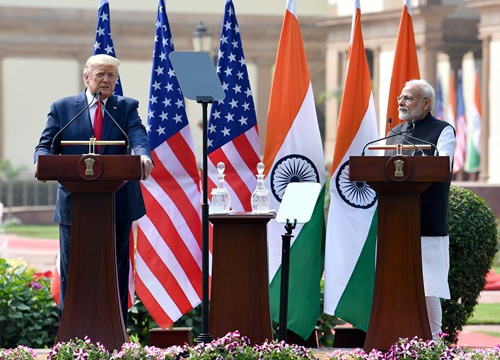
Biden's Secretary of State-designee Blinken sees India ties as 'high priority', important to Indo-Pacific 'order'


Antony Blinken, who has said that strengthening and deepening ties with India will be a “high-priority” in a new administration, has been designated for the post of secretary of state by President-elect Joe Biden. He said India will remain important "to the future of the Indo-Pacific and the kind of order that we all want.” 

Making the announcement of key foreign policy and national security designees on Monday, Biden said, “We have no time to lose when it comes to our national security and foreign policy. I need a team ready on Day One to help me reclaim America’s seat at the head of the table, rally the world to meet the biggest challenges we face, and advance our security, prosperity, and values.”

Kamala Harris, who will be the vice president, described Blinken as “crisis-tested” and among the “best of America.”

Blinken, who was the deputy secretary of state in the administration of former President Barack Obama, said during the presidential campaign that from “Biden’s perspective, strengthening and deepening the relationship with India is going to be a very high priority.”

Blinken is considered closer to the centre. He has met with Indian External Affairs Minister S. Jaishankar when he was the foreign secretary and Blinken was the deputy secretary of state.

India is “fair, stable, and hopefully increasingly democratic and it’s vital to being able to tackle some of these big global challenges,” Blinken said in July while speaking at the Hudson Institute, a conservative think tank in Washington DC.

"It’s usually important to the future of the Indo-Pacific and the kind of order that we all want,” he said affirming President Donald Trump's emphasis on the region as a counterbalance to China.

He spoke of the differences Biden has with India over Kashmir and the Citizenship Amendment Act, which gives priority for citizenship to Christians, Buddhists and Sikhs fleeing persecution in neighbouring Muslim countries.

Rather than the punitive actions advocated by some in the Democratic Party, Blinken said at the Hudson Institute, “You’re always better engaging with a partner and a vitally important one like India, when you can speak frankly and directly about areas where you have differences even as you’re working to build greater cooperation and strengthen the relationship going forward.”

“That would be the approach and again, I think we’ve seen evidence that it works,” he said.

But that would still be an irritant in the relations between the two democracies.

Biden is taking a broader view of international relations integrating the strategic aspects of issues like climate change, for which he has given high priority.

Blinken was a key figure in the Paris climate negotiations that produced the landmark agreement on fighting global warming.

He said that US team with Biden “worked hard to persuade India that it would be more prosperous and more secure if it’s signed on to the Paris Climate Agreement. We succeeded. It wasn’t easy.”

Trump pulled out of the Paris pact, which Biden has vowed to rejoin.

An important designation was that of former Secretary of State John Kerry as the special presidential envoy for climate and as a member of the National Security Council, highlighting the high-level of importance Biden places on the environment.

A close adviser to Biden, Jake Sullivan has been designated for the national security advisor post. He had been national secretary advisor to Biden when he was the vice president.

Avril Haines, who was designated for the director of national intelligence, will become the first woman to head the intelligence community.

She is a former deputy director of the Central Intelligence Agency and deputy national security advisor and had worked with Biden when he chaired the Senate Foreign Relations Committee.

Alejandro Mayorkas is the designee for Secretary of Homeland Security, the first Latino to hold the post if confirmed by the Senate.

For permanent representative to the United Nations, Biden has designated Linda Thomas-Greenfield, who will get a cabinet rank. She is a former assistant secretary of state in charge of Africa.

Harris said, “These crisis-tested national security and foreign policy leaders have the knowledge and expertise to keep our country safe and restore and advance America’s leadership around the world. They represent the best of America.” Source: https://southasiamonitor.org
Read More........

Modi’s phone call to Biden to affirm bilateral ties


Indian Prime Minister Narendra Modi phone called newly elected US President Joe Biden and congratulated him on Tuesday night. During this, he reiterated New Delhi’s commitment to affirm good bilateral relations with Washington.

At the same time, he told Biden to greet Kamala Harris, the elected Vice President of the United States of Indian descent. 

According to Indian media, the phone call was important in the coming days for India-US bilateral relations. 

“I greet US President-elect Joe Biden over the phone,” Modi tweeted, saying: “We pledge to continue our commitment to the strategic relationship between India and the United States. Issues like climate change, cooperation in the Indo-Pacific region, tackling COVID were also discussed.”

Modi’s last meeting with Biden was in 2014. Biden was then vice president of the United States under Barack Obama.

It is to be noted that Modi’s “friendship” with President Donald Trump in the past was eye-catching that took the relationship into a different dimension with “Howdy Modi” in Houston in September 2019 or “Namaste Trump” in Gujarat in February 2020. The world has seen those programs as evidence of the chemistry of the two leaders’ personal relationships.According to some diplomatic experts, Modi and Trump are residents of the same pole in terms of political position. However, despite his good relations with Modi, Trump’s stance on US immigration policy was quite strict. On the other hand, everyone knows about the Modi government’s “tough” stance on “infiltrators” in India. Source: https://www.daily-bangladesh.com/
Read More........

High time for Nepal to look beyond India and China

a
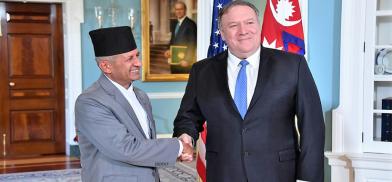
The US aid under MCC is a golden opportunity for Nepal to look beyond India and China and seek greater engagement with other powers and to derive economic benefit and relinquish meaningless geopolitical adventures, writes Vikash Kumar for South Asia Monitor

Among diverse political turbulences being seen in Nepal, one which is being less talked about is Nepal’s indecisiveness over the US aid amounting to $500 million under the Millennium Challenge Corporation (MCC). While the government is inclined to accept it, Finance Minister Yubaraj Khatiwada incorporated this in the new budget before its parliamentary endorsement – and now the grant is facing opposition, inter alia, from within the ruling Nepali Communist Party (NCP).

The opponents are forwarding the arguments that accepting the aid may damage its blossoming ties with China. Prima facie, there may be some element of truth in this argument, but it is shorn of any understanding of Nepal’s national interest.

Nepal is sandwiched between two Asian giants which share great ambitions for its future and whose geopolitical interests are colliding as they try to sell off their versions of worldview. Nepal is, of late, becoming hotbed for this bilateral competition. History is witness to the fact that when two big powers compete for their interests in other nations it has resulted in unbearable consequences. The two examples are of the Gulf nations and Afghanistan.

Fear of the dragon

The fear of China’s reaction over a sovereign decision, essentially economic in nature, speaks volume about the intrusion of that country in Nepalese political landscape. Discussions in Nepalese media platforms and among policymakers are revolving more upon the US Indo-Pacific agenda versus China’s Belt and Road Initiative (BRI). It should, in no way, be Nepal’s immediate priority. Surprisingly, what is absent in the discussions are the cost-benefit ratio of these projects. A perusal of the MCC aid and geopolitical events of recent past shows that the cost-benefit scale skews in favour of economic advantage to the country.

Firstly, the MCC aid is a grant, not a loan. Thus, it comes with a benefit sans any obligation. There are no legal or political conditions attached to it and thus a claim that Nepal’s sovereignty will be compromised by accepting the aid is wholly fallacious. Secondly, these projects relate to electricity transmission and road maintenance. As per MCC, the electricity projects include, inter alia, laying of 300 km of high voltage power lines, equivalent to one-third the length of Nepal; the addition of a second cross-border transmission line to facilitate greater electricity trade with India; and activities to improve sector governance to increase private investment. The road project is chiefly concerned with maintaining key roads, measuring 300 km, which are vital for the movement of goods and people. 

An aid amounting to nearly 1.5 percent of the GDP must not be rejected for imaginary fear of the dragon. Thirdly, China must not be expected to react negatively just because of the fact that the aid is coming from a rival nation. If it is so, India should have acted in a similar imaginary way in 2017 when Nepal became a party in BRI, an initiative India rejects as it passes through 'Pakistan Occupied Kashmir'. Also, the sensitivity of India’s concern, which relates to the geopolitical issue, is graver than that of China’s as it concerns an economic project.

Concerns relating to the issue of provisions of MCC may be alleviated by having negotiations with the US over it. For example, Nepal can negotiate that in place of the US law, it will have provisions of international law, and that there would be an independent international tribunal to settle any disputes, whatsoever that would arise pertaining to the project. In the past, we have seen Nepal’s compulsion as it has accepted its fate of playing a role between India and China, and thus making itself more vulnerable to the whims and caprices of these two countries. 

Multi-alignment approach

US aid under MCC is a golden opportunity for Nepal to look beyond India and China and seek greater engagement with other powers and to derive economic benefit and relinquish meaningless geopolitical adventures. The best example in South Asia is of India that followed a non-aligned policy, although a shaky one, throughout the Cold War which enabled it to get benefits from both the superpower blocs and wrath of none. 

Now, of course, there has been a shift in strategic alignment of India – it is now undertaking appropriate diplomatic manoeuvring – as China’s claim of peaceful rise seems rather flimsy in view of a perennial projection of its hard power against its neighbours, while the US under Donald Trump looks more unstable now. But the time has not come, till now, for Nepal to take any sides.

Economic cooperation should not be halted due to a geopolitical competition wherein Nepal does not have any significant stakes. Nepal must free itself from China-India paranoia and should start asserting its strategic autonomy. Nepal should seek greater engagement with other powers too and not just with the US. Rather than outrightly rejecting the MCC aid, it must undertake further negotiations to ward off its concerns relating to its sovereignty. The message should go out to both Asian giants that Nepal could not be taken for granted as it will follow a multi-aligned approach in contradiction to its hitherto China-India balancing approach. This will ensure more diplomatic leverage and clout for Nepal vis-à-vis India and China.

(The writer is pursuing LLM in International Law from Faculty of Legal Studies, South Asian University, New Delhi. The views expressed are personal. He can be contacted at vksharmaahiyapur@gmail.com) Source: https://southasiamonitor.org
Read More........

India need not compete with China in Bangladesh: Focus should be on mutually beneficial issues

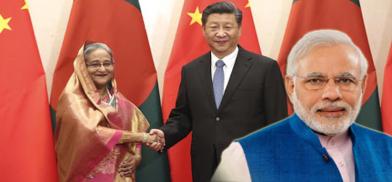
Bangladesh is a very important neighbour for India. The fulcrum of India’s Act East policy and vital for development of India’s North East, it has a major role in the success of BIMSTEC, writes Maj Gen Alok Deb (retd) for South Asia Monitor

Two news items in the past few weeks provide interesting perspectives on the evolving nature of Bangladesh’s foreign relations and their implications for India. The first is a report (June 19 ) which notes that ‘In a significant show of economic diplomacy in South Asia, China has announced tariff exemption for 97% of exports from Bangladesh......Bangladesh imports around $15 billion in Chinese goods but its China-bound exports had been very low in comparison. The supply chain disruption caused by US-China trade war is likely to be filled by a boost in export of tariff-exempted goods from Bangladesh. Multiple sectors of Bangladesh are likely to be major beneficiaries of this move’.

The second item, by the Turkish news wire Anadolu Agency (July 8), refers to the visit of the High Commissioner of Pakistan (an appointment filled only in November 2019 after a gap of nearly 20 months) to the Bangladesh foreign ministry, after which the High Commissioner stated "...we want stronger relations with brotherly Bangladesh in all walks of life. We share common bonds of history, religion and culture..’" Interestingly, the report mentions that the Bangladesh foreign ministry did not issue a statement about this meeting.

Irritants in ties

Bangladesh is a very important neighbour for India. The fulcrum of India’s Act East policy and vital for development of India’s North East, it has a major role in the success of BIMSTEC ( Bay of Bengal Initiative for Multi-Sectoral Technical and Economic Cooperation). It has become India’s biggest trade partner in South Asia. India exported $9.21 billion worth of goods to Bangladesh in FY 2018-19, against imports of $1.04 billion during the same period. Despite restrictions imposed by Covid 19, improvements in connectivity continue, the latest manifestation being the Addendum to the Protocol on Inland Water Transit and Trade signed in May this year.

According to this the number of Indo Bangladesh Protocol routes have been increased from eight to ten with new locations added to existing routes. Five new ports of call in both countries have been operationalised, with each country now having eleven ports of call and two ‘extended’ ports of call. India continues to assist Bangladesh in other ways as well. In addition to providing grants for specific projects, it has extended three Lines of Credits (LOC) to Bangladesh in the last eight years amounting to $8 billion for the development of infrastructure in various sectors including roads, railways, shipping and ports – the highest to any country.

For bolstering our Neighbourhood First policy with Bangladesh, leveraging the gains of the last decade while scanning for the remotest cloud on the horizon is an ongoing imperative. While both countries have walked the talk to a great extent irritants continue to bedevil the relationship. Sharing of river waters, and reaction of Bangladesh’s civil society to the Citizenship Amendment Act, and proposed National Register of Citizens are two examples. Though the official line taken by that government on the second issue has been restrained, Bangladesh Prime Minister Sheikh Hasina’s statement to Gulf News in January this year that the Act was "not necessary" reflects its dismay.

This mood gets confirmed when examining the number of official visits from that country which have since been cancelled – prominently those of Foreign Minister A K Abdul Momen, just a day after passing of the CAA, Deputy Foreign Minister Shahriar Alam, who did not attend the Raisina Dialogue, and finally the parliamentary delegation which cancelled its March visit. Bangladesh is also pressing India to take a more active line in resolving the Rohingya issue. Perusal of vernacular media and writings of researchers indicate that views of diehard anti-India Islamists continue to find a constituency amongst the general public and sizeable segments of the opposition. This is where the Pakistani attempt to establish a foothold, mentioned in the July 8 news report merits attention.

China's growing footprints

China continues to woo Bangladesh as a member of the Belt and Road Initiative. Yet the Hambantota debt trap in Sri Lanka has imposed caution on Bangladesh: development of Sonadia port through Chinese assistance has been shelved. The largesse offered, however, is difficult to ignore – whether the $20 billion loan announced during President Xi Jinping’s 2016 visit or the 70% debt for financing the $2 billion Payra power project whose first unit has gone on steam this year. Further, China State Shipbuilding Corporation (CSSC) has announced that one of its affiliates has secured the bid for construction of a yard with ancillaries at the Payra port, the third-largest in Bangladesh.

The Bangladesh military continues to depend on China, importing tanks, fighter jets and frigates. As per the China Power report of CSIS, between 2008 and 2018, China provided $1.93 billion of weapons, supplying a range of systems from Ming class submarines to small arms.

That India has its eye firmly on the ball can be gauged from the communication of External Affairs Minister S Jaishankar to his Bangladeshi counterpart (July 9) where India’s view that ”an early, safe (and) sustainable repatriation of displaced persons from Rakhine (Myanmar) is in the collective interest of all..” has been clearly conveyed. This enunciation of India’s stand on the vexed Rohingya issue would go some distance in dispelling Bangladeshi misgivings.

With some nimble footwork India could also exploit opportunities that the slow pace of execution of China funded projects provide. After close to four years of signing deals for executing 27 projects valued at $20 billion, only six have commenced as of December 2019, as reported by Bangladesh’s Financial Express. India could focus on other important projects which are doable in an efficient and timely manner.

India need not compete with China in Bangladesh. It must remain focussed on mutually beneficial issues decided in an atmosphere of transparency to make this relationship stronger.

(The writer is a former Deputy Director-General of the Institute for Defence Studies and Analyses (IDSA). New Delhi. The views expressed are personal Source: https://southasiamonitor.org
Read More........

Rajnath Singh witnesses para dropping skills of Armed Forces at Stakna, Leh

JUL 17, 2020 LEH: Defence Minister Rajnath Singh, Chief of Defence Staff General Bipin Rawat and Army Chief General MM Naravane on Friday arrived at Stakna, Leh to witness para dropping skills of the Armed Forces here. Troops of Armed Forces carried out para dropping exercise here in presence of the Defence Minister and Army officials. The Defence Minister also witnessed scoping weapons. Defence Minister is on a two-day visit to Ladakh and Jammu and Kashmir. He will take stock of the situation at both the Line of Actual Control (LAC) and the Line of Control (LOC). Earlier today, taking to Twitter, Singh wrote, "Leaving for Leh on a two-day visit to Ladakh and Jammu-Kashmir. I shall be visiting the forward areas to review the situation at the borders and also interact with the Armed Forces personnel deployed in the region. Looking forward to it." While Pakistan constantly violates ceasefire from across the LoC, China has continued to intrude into Indian territory in Ladakh region in recent past, escalating tensions between India and its eastern neighbour. On June 15, twenty Indian soldiers were killed during combat with Chinese forces in Galwan valley, leading to tensions between both nations. Chinese soldiers subsequently started moving back following dialogues between two countries through the military level and diplomatic level. Copyright © Jammu Links News, Source: Jammu Links News
Read More........

President Trump still ready to mediate on Kashmir issue

US President Donald Trump today said he stood ready to mediate between India and Pakistan over the Kashmir issue even as he said that India and the United States will work together against terrorism and together both the countries are making all possible efforts towards it.
  • On the second day of his maiden visit to India, the US President stressed on the need for an India-US trade deal even as he praised Prime Minister Narendra Modi saying, ''You have a very special Prime Minister, he really knows what he is doing", President Trump also interacted with business leaders in Delhi after which he addressed media at a press conference held in the US Embassy.
  • Addressing the media, the President touched upon the India-Pakistan row and said Kashmir obviously is a big problem between India and Pakistan, they are going to work out their problem. They have been doing it for a long time. 
  • Trump said. “I have good equation with Pakistan PM Imran Khan, they are working to control cross-border terrorism: 
  • The US President also said, ''I don't think anyone has done more than I did on containing radical Islamic terrorism'' while addressing media in Delhi. 
  • Ready to mediate on Kashmir issue if India and Pakistan agree on it: US President Donald Trump while addressing media in Delhi
  • If you look back India has worked hard for religious freedom. PM Modi wants people to have religious freedom in India: US President Donald Trump while addressing a press conference in Delhi. 
  • On CAA, he said, ''I want to leave that to India and hopefully they will make the right decision for their people.''
  • ''Did not discuss CAA with PM Modi'', said President Trump while addressing media in Delhi. 
  • India, he said, is buying a lot of military equipments from the US. But he said, ''India is probably nation with highest tariffs, Harley Davidson has to pay huge amount of tariff.''
  • The US President was earlier given a ceremonial welcome at Rashtrapati Bhawan after which he went to Rajghat along with First Lady Melania to pay homage to Mahatma Gandhi. In the evening, President Trump will take part in the grand dinner programme being organised in the Rashtrapati Bhawan. 
  • The President's Banquet for Donald Trump is scheduled to start at 7.30 pm at Rashtrapati Bhawan. Around 90 to 100 guests are expected to attend the Banquet. Both US President and Indian President will make a short speech. A multi-course menu has been prepared for Trump and his delegation.
  • Prime Minister Narendra Modi and President said there was useful and comprehensive discussion on trade and that there was an appreciation that it increased steadily year on year over the last few years - US exports to India had a fairly dramatic increase.
  • What we have done for the healthcare sector is phenomenal, Trump said while addressing a press conference, adding that both countries are working out a trade deal and negotiations have already begun.
  • Our teams have made tremendous progress for a comprehensive trade agreement and I'm optimistic we can reach a deal of great importance to both countries. Since I took office, US exports to India are up nearly 60 per cent and exports of high quality American energy have grown by 500 per cent, he said.
  • Earlier today we expanded our defence cooperation with agreements for India to purchase more than $3 billion of advanced American military equipment, including Apache and MH-60 Romeo Helicopters - finest in the world. These will enhance our joint defence capabilities,Trump said.
  • Prime Minister Modi said the most important foundation of the special relationship between India and the USA is people to people contact. Professionals, students, the Indian diaspora in USA have a major contribution in this. We've also agreed to start negotiations on a massive trade deal. We hope that we will get positive results, benefitting both. At the global level, our relationship is depended on the similar democratic values we share, he said. Source: https://www.domain-b.com/
Read More........

2 MoUs, 1 Letter of Co-op signed during US President Donald Trump's India visit

New Delhi: The Prime Minister’s Office (PMO) has announced that three international documents, including two MoUs and one letter of cooperation, have been signed during US President Donald Trump’s official visit. One Memorandum of Understanding is on Mental Health, and the other MoU is on the Safety of Medical Products.

The Memorandum of Understanding on Mental Health was signed between the Department of Health and Family Welfare of the Government of India, and the Department of Health and Human Services of the Government of the United States of America.

The MoU on the Safety of Medical Products was signed between the Central Drugs Standard Control Organization within the Directorate General of Health Services of the Ministry of Health and Family Welfare of India, and the Food and Drug Administration (FDA) of the Department of Health and Human Services of the United States of America.

The Letter of cooperation was signed between the Indian Oil Corporation Limited and ExxonMobil India LNG Limited, and USA’s Chart Industries Inc.

Further information is awaited on the documents and will be published when made available Source: https://indusdictum.com
Read More........

Merkel, Macron meet as Germany takes on high-stakes EU presidency

Chancellor Angela Merkel and French President Emmanuel Macron

AFP/Berlin: Chancellor Angela Merkel hosts French President Emmanuel Macron for talks on Monday, days before Germany takes on the rotating presidency of the European Union with the economy in the throes of the most severe storm since World War II.

Berlin's chairing of the 26-member bloc will be its last with Merkel in charge, and could be the one that defines the legacy of the leader dubbed the ‘eternal chancellor’.

With the future of the bloc's relationship with Britain to be determined, a crucial shift to a lower carbon world in the balance and crises from Libya to Syria all jostling for attention, there is no shortage of burning issues to tackle.

But the COVID0-19 pandemic and the economic devastation it has wrought have become a bull in the painstakingly arranged EU china shop.

‘This crisis that we're currently experiencing is different compared to any other we have experienced since the founding of Europe,’ Merkel, in power since 2005, told parliament in an address laying out priorities for the EU presidency.

‘Alone in Europe, it has claimed more than 100,000 lives. A few weeks of economic standstill was enough to endanger what we have built up over years.’

With all to play for, member states are anxiously looking to Europe's biggest economy to take charge.

In an interview published Saturday, European Commission chief Ursula von der Leyen said it was ‘very fortunate that Germany is taking over the presidency at this time of a major crisis.’

Merkel's long experience and credibility ‘helps enormously,’ she told the Handelsblatt newspaper.

So high are the expectations that Germany's EU ambassador Michael Clauss said in jest they are making him ‘sleep badly, because I think the expectations are already a bit overstretched.’

‘We have to act as honest brokers, otherwise we won't have the support of the council.’

- German 'bulldozer' -

Besides its geopolitical weight and economic heft, Germany is taking on custodianship of the bloc with a strong hand as it has so far withstood the health emergency better than most other member states.

Its economy also entered the crisis well-endowed to fight the impact.

Crucially, compared to the debt crisis that threatened to sink the single currency zone in 2009-2010, Germany looks very different today -- it's out with Scrooge and in with Lady Bountiful.

Once an obstinate champion of budgetary rigour, Merkel's government has ditched its no-new-debt dogma to throw resources at the crisis.

At home, its programme to shore up the economy totals more than a trillion euros in spending, loans and guarantees.

Together with Macron, Merkel had sketched out the backbone of the 750 million-euro ($840-million) fund proposed by von der Leyen to bolster the bloc's economy.

The fund would offer grants -- with no repayment obligation -- to countries hardest hit by the pandemic, a major policy U-turn for Berlin.

With an eye on the devastating blow taken by the worst-hit countries like Spain or Italy, Merkel explained that it was ‘imperative that Germany not only thinks of itself but is prepared for an extraordinary act of solidarity’.

‘In such a crisis, everyone is expected to do what is necessary. And what is necessary in this case is rather extraordinary,’ she told the Sueddeutsche Zeitung newspaper.

The recovery fund is likely to be among the key points raised when Merkel and Macron hold talks at German government retreat Meseberg on Monday, with frugal nations such as Austria and the Netherlands sharp critics.

But observers believe that the EU's biggest paymaster Berlin will ram through a yes.

‘When the Germans are certain they are right, it's very bulldozer, there is no margin for discussion,’ a high-ranking EU official said.

- 'Swan song' -

An EU diplomat agreed, saying: ‘On the recovery fund, I expect Germany to dictate the whole process. Merkel is holding all the cards and (EU Council chief) Charles Michel will follow that.

‘She also wants to get Brexit out of the way and she will always go for the deal as she wants to keep the West together. Third leg will be restoring ties with US after the election there.’

Merkel, who has ruled out running for a fifth term next year, won't have much time.

Brexit talks will have to be done by the end of the year, while in November, focus will be on whether US President Donald Trump, whose relationship with Merkel has been frosty at best, manages to hold on to his job.

What is clear is that Merkel's fingerprints will be all over the EU's roadmap through the next six months.

‘This will be a very Merkel presidency, her swan song,’ said the EU diplomat, adding that she would be using it ‘to craft her legacy’.Merkel,  Source:https://www.gulf-times.com/
Read More........

Global support grows for India amid tense standoff with China

Mike Pompeo said the move will boost integrity and national security of India Highlighting the India-China  border  issue, he  called  the  region  the epicenter  of  rising  strategic competition
  • As a tense India-China military standoff along their border is set to complete two months later this week, voices of support seem to be growing in favour of New Delhi.
  • US secretary of state Mike Pompeo on Wednesday backed India’s move to ban 59 Chinese mobile apps on national security grounds, saying that New Delhi’s steps were to safeguard its security.
  • Only last week, he had announced a “rebalance" of US troops to Asia, citing China’s aggressive posturing in the South China Sea and East China Sea besides the moves against India along the border. Japanese ships joined those of the Indian navy over the weekend for an exercise. Also on Wednesday, Australia announced $270 billion in military spending over the next decade, mainly to meet challenges in its immediate neighbourhood and the Indo-Pacific region.
  • That these countries are members of the “Quadrilateral"—that comprises India, the US, Australia and Japan—comes as no surprise. The group held its first meeting in November 2017 at the level of officials and also had its first meeting at the level of ministers last year.
  • Given China’s stance against India—the clash in Ladakh on 15 June with casualties that were the first in 45 years, China’s disregard for pacts signed with India to ensure border stability is maintained—analysts have been calling for India to completely overhaul its ties with Beijing. And this includes giving a military dimension to the “Quad."
  • The US relocating troops to Asia “is an important signal that the US will not sit and watch as China attempts to throw its weight around on the Sino-India border as well as in the South China Sea," said Gautam Bambawale, former Indian ambassador to China, Pakistan and Bhutan. “Even earlier, the US had moved three of its carrier battle groups to this part of the world as a clear indication of its resolve to tackle Chinese aggressiveness in Asia," he said in a recent opinion piece in The Economic Times, pointing to news reports that said that three US aircraft carrier strike groups were patrolling in the Indo-Pacific region in a signal to China of US resilience following novel coronavirus cases striking some of the US Navy’s operations.
  • “This is the time to admit Australia into our Malabar naval exercises. This is the appropriate time to strengthen the Quad and provide it a military angle. Now is the time to enhance our intelligence sharing with all these nations. By changing its force structure and posture, the US is signalling India that she supports us entirely," he added.
  • Unveiling the Australian government’s 2020 Defence Strategic Update and the 2024 Structure Plan, Prime Minister Scott Morrison seemed to strike a similar note stating that Indo-Pacific was the “epicentre" of rising “strategic competition", highlighting the border dispute between India and China as an example of increasing tensions over territorial claims in the region.
  • Morrison warned “the risk of miscalculation and even conflict is heightening" in the region.
  • Livemint Source: Defenseblog-njs.blogspot.com
Read More........

President Trump still ready to mediate on Kashmir issue

US President Donald Trump today said he stood ready to mediate between India and Pakistan over the Kashmir issue even as he said that India and the United States will work together against terrorism and together both the countries are making all possible efforts towards it. 
  • On the second day of his maiden visit to India, the US President stressed on the need for an India-US trade deal even as he praised Prime Minister Narendra Modi saying, ''You have a very special Prime Minister, he really knows what he is doing", President Trump also interacted with business leaders in Delhi after which he addressed media at a press conference held in the US Embassy.
  • Addressing the media, the President touched upon the India-Pakistan row and said Kashmir obviously is a big problem between India and Pakistan, they are going to work out their problem. They have been doing it for a long time. 
  • Trump said. “I have good equation with Pakistan PM Imran Khan, they are working to control cross-border terrorism: 
  • The US President also said, ''I don't think anyone has done more than I did on containing radical Islamic terrorism'' while addressing media in Delhi. 
  • Ready to mediate on Kashmir issue if India and Pakistan agree on it: US President Donald Trump while addressing media in Delhi
  • If you look back India has worked hard for religious freedom. PM Modi wants people to have religious freedom in India: US President Donald Trump while addressing a press conference in Delhi. 
  • On CAA, he said, ''I want to leave that to India and hopefully they will make the right decision for their people.''
  • ''Did not discuss CAA with PM Modi'', said President Trump while addressing media in Delhi. 
  • India, he said, is buying a lot of military equipments from the US. But he said, ''India is probably nation with highest tariffs, Harley Davidson has to pay huge amount of tariff.''
  • The US President was earlier given a ceremonial welcome at Rashtrapati Bhawan after which he went to Rajghat along with First Lady Melania to pay homage to Mahatma Gandhi. In the evening, President Trump will take part in the grand dinner programme being organised in the Rashtrapati Bhawan. 
  • The President's Banquet for Donald Trump is scheduled to start at 7.30 pm at Rashtrapati Bhawan. Around 90 to 100 guests are expected to attend the Banquet. Both US President and Indian President will make a short speech. A multi-course menu has been prepared for Trump and his delegation.
  • Prime Minister Narendra Modi and President said there was useful and comprehensive discussion on trade and that there was an appreciation that it increased steadily year on year over the last few years - US exports to India had a fairly dramatic increase.
  • What we have done for the healthcare sector is phenomenal, Trump said while addressing a press conference, adding that both countries are working out a trade deal and negotiations have already begun.
  • Our teams have made tremendous progress for a comprehensive trade agreement and I'm optimistic we can reach a deal of great importance to both countries. Since I took office, US exports to India are up nearly 60 per cent and exports of high quality American energy have grown by 500 per cent, he said.
  • Earlier today we expanded our defence cooperation with agreements for India to purchase more than $3 billion of advanced American military equipment, including Apache and MH-60 Romeo Helicopters - finest in the world. These will enhance our joint defence capabilities,Trump said.
  • Prime Minister Modi said the most important foundation of the special relationship between India and the USA is people to people contact. Professionals, students, the Indian diaspora in USA have a major contribution in this. We've also agreed to start negotiations on a massive trade deal. We hope that we will get positive results, benefitting both. At the global level, our relationship is depended on the similar democratic values we share, he said. Source: https://www.domain-b.com
Read More........

Coronavirus: PM Modi calls on SAARC nations to chalk out strategy to fight COVID-19

Several decisions taken in last 6 months empowered lives of 130 Cr Indians: PM Modi
New Delhi: Prime Minister Narendra Modi called today for SAARC nations to chalk out a strong strategy to fight the novel coronavirus. The PM suggested that these strategies could be discussed via video conferencing, and said that by coming together SAARC nations can set an example for the world and contribute to a healthier planet.

“I would like to propose that the leadership of SAARC nations chalk out a strong strategy to fight Coronavirus. We could discuss, via video conferencing, ways to keep our citizens healthy. Together, we can set an example to the world, and contribute to a healthier planet,” Prime Minister Modi urged.

In the series of tweets, Modi said that South Asia, which is home to a significant portion of the global population, should leave no stone unturned to ensure the health of its people. He also said that the Government is trying its best at various levels to combat COVID-19.

“Our planet is battling the COVID-19 Novel Coronavirus. At various levels, governments and people are trying their best to combat it. South Asia, which is home to a significant number of the global population should leave no stone unturned to ensure our people are healthy,” PM Modi tweeted. Source: https://indusdictum.com
Read More........

UAE, South Korea Sign MoU to Protect Intellectual Property

BY CHUN GO-EUN (INFO@KOREAITTIMES.COM): According to the Arab Financial Investment, The Ministry of Economy has recently signed a strategic new Memorandum of Understanding (MoU) with the Korean Intellectual Property Office (KIPO) to further promote and protect intellectual property in the UAE. The MoU was signed by H.E. Engineer Mohammed Ahmed Bin Abdul Aziz Al Shehhi, Undersecretary for Economic Affairs and Choi Donggyou, Commissioner, KIPO on the sidelines of the 56th series of Meetings of the World Intellectual Property Organization(WIPO), which opened last October 3 and will run until October 11, 2016at the WIPO headquarters in Geneva, Switzerland. H.E. Al Shehhi, who is heading the participating UAE delegation, shared that the MoU follows in the direction of previously signed agreements between the UAE and KIPO--all focused on the development of a system that can promote and protect intellectual property rights in the country. The move is expected to encourage more creativity and innovation among inventors and creators while also providing an attractive economic and investment environment in compliance with the set objectives and goals of UAEVision 2021. Under the terms of the recently signed agreement, both countries will be working closely to help establish and operate theInternational Centre of Patent Registration (ICPR) at the UAE Ministry of Economy, a new international center that will oversee the registration of patents in the UAE. The new facility will house an international body of patent experts that will review and evaluate patents based on a special intellectual property system. In addition, the center is set to be designated as an International Searching Authority and International Preliminary Examining Authority under the Patent Cooperation Treaty of the WIPO (PCT ISA/IPEA). In line with this, both UAE and South Koreawill be tasked with exchanging consultative duties with the WIPO in the course of searching and examining newer patents for registration. Lastly, the center will establish training programs for professionals in the field of intellectual property to further develop their skills and abilities. The center is also expected to develop key research and studies covering issues and topics concerning intellectual property. Source: http://www.koreaittimes.com/
Read More........

Two leaders of Korea and the Netherlands Adopted Upgraded Bilateral Ties to Future-oriented Partnership

kab943
By Oh Hae-Young (haeya@koreatimes.com): President Park Geun-hye and Prime Minister Mark Rutte of the Netherlands held a summit at Cheong Wa Dae in the morning on Sept 27. They agreed to elevate friendly, cooperative bilateral relations, which have been developed over 55 years since the establishment of diplomatic ties in 1961, to a comprehensive, future-oriented partnership. At the summit, the two leaders adopted a joint statement that contains details of this agreement as well as the determination for and directions of cooperation in the future. President Park noted in particular that Korea and the Netherlands were working closely together not only on such bilateral issues as trade and investment but also on other global issues, living up to the intent of the comprehensive partnership. She went on to express her high regard for the value that the two countries placed on one another as future-oriented partners, as they were maximizing the potential for cooperation in promising areas in the future, including nuclear energy, smart farming, new and renewable energy and the creative industry. It has been decided this time to regularly hold a policy consultation meeting and a newly-founded joint economic committee meeting between the two governments, which the two leaders agreed would go a long way towards enhancing the momentum for bilateral cooperation. Prime Minister Rutte expressed his appreciation to the Korean Government for having commemorated his country`s Korean War veterans for a long time. In reply, President Park said that she always remembered Korean War veterans` sacrifices and devotions, which laid the groundwork for Korea`s progress, and felt grateful to them. President Park noted that the Netherlands was a key member of the EU and an exemplary country of the international community that will take a seat in the UN Security Council in 2018. In regard to the North Korean nuclear issue, the President expressed her hope that the Netherlands will play a more active role so that necessary sanctions and diplomatic measures, in addition to the implementation of UN Security Council resolutions, would be sought at the EU level. Noting that the two countries are speaking with one voice on various global issues such as terrorism, development and climate change, the two leaders agreed to further expand cooperation on the international stage. After the summit, the two leaders attended a signing ceremony of MOUs on bilateral cooperation in four areas: working holiday program, technological innovation, big data statistics and investment. Source: http://www.koreaittimes.com/
Read More........

US missile shield completes installation in Romania

Romanian and U.S. officials pose for a group photo during a ceremony at Romania's Foreign Ministry headquarters in Bucharest, Romania's capital, Dec. 18, 2015. A U.S. missile shield in Romania's Deveselu military base is technically ready as a ceremony in the Romanian Foreign Ministry on Friday marks its completion. [Photo/Xinhua]
A U.S. missile shield in Romania's Deveselu military base is technically ready as a ceremony in the Romanian Foreign Ministry on Friday marks its completion. The Deveselu antimissile defence system will strengthen national security and that Romania's participation in this project reflects the excellent state of the relation between Bucharest and Washington, Romanian Foreign Minister Lazar Comanescu told the ceremony. In his turn, U.S. Ambassador Hans Klemm reiterated that the antimissile system at Deveselu was set up exclusively against threats coming from outside Europe, it's not directed at the Russian Federation and it does not possess the ability to threaten Russia. Yet, Moscow has been at odds with Washington over the issue of missile defence for years. Russia sees the shields as a direct threat. Also attending the event were Romanian Defense Minister Mihnea Motoc, director of the U.S. Missile Defense Agency Vice Admiral James D. Syring and NATO Assistant Secretary General Patrick Auroy. The Deveselu base is the first to feature the Aegis Ashore ballistic missile defense system, a land-based version of the sophisticated radar-tracking system installed on U.S. warships since 2004. The anti-missile base is equipped with a SPY-1 radar system and a vertical-launch missile system armed with long-range SM-3 missiles. Located in an old Romanian air base on the border with Bulgaria, construction of the missile shield began two years ago. A site in Poland is scheduled to become operational by 2018. Source: China.org.cn
Read More........

Are you eligible for a diplomatic passport?

By romy fernandis: A diplomat is a person who is appointed by his or her government to be its representative in countries where the two governments work together. The diplomat is the representative of his or her government in the host country. Once you become a diplomat, you automaticallyget diplomatic passport. To become a diplomat, you will either be appointed by the national government or the head of state, which sends you to any country that he wishes. You will be the link between your government and the host government in terms of international relations, trade, and any other businesses that the two governments agree upon. Once you get diplomatic passport, you will be expected to safeguard the interests of your country in the host country, and any persons from your country who are employed in the host country are under you, and can contact you in case they experience any kind of problems in that country. You become an ambassador for your country and you are required to follow the host government's rules all the time. A number of people who get diplomatic passport, by being offered diplomatic posts are those who have worked as civil servants for a long time, or politicians who have been royal to the government of the day. Other people who can get diplomatic passport by being appointed as diplomats are people well known in the corporate industry, and have made huge contributions to their government's economies. Being appointed a diplomat to enable you get diplomatic passport is not easy, this requires a person who is organized, respected, tolerant, a good listener, a problem solver, slow to anger, and a fast learner. Another requirement that is mandatory and one that can make you become a diplomat is organizational skills. To be appointed a diplomat and get diplomatic passport, you will need to undergo a thorough interview which involves both oral and written questions. You are also supposed to be a person whose interests include the current affairs and one who keeps abreast with the other things that take place in the whole world. If you are qualified and have what it takes to be a diplomat, you will get diplomatic passport and start using it immediately. Once you become a diplomat, people may also refer to you as an envoy, counselor, ambassador or even a minister. Some of the duties that you will be required to carry out as a diplomat include; taking care of your government's interests in the host country. Once you get diplomatic passportafter being appointed as a diplomat, you will hence forth become the bridge that connects your government with the host country, in terms of all the businesses and relationships that will be carried out by the two nations. Source: http://www.articlesbase.com/
Read More........

India, Singapore ink strategic partnership


Nine deals signed, Modi pays homage at INA memorial SINGAPORE, Nov 24: India and Singapore signed a joint declaration on strategic partnership and nine bilateral accords on Tuesday, the second day of Prime Minister Narendra Modi’s visit to this city state. Modi and Singaporean Prime Minister Lee Hsien Loong signed the joint declaration on strategic partnership to elevate bilateral relations to a “strategic partnership to deepen and broaden engagement in existing areas of cooperation and catalyse new ones ranging from political, defence and security cooperation to economic, cultural and people to people contact”, an official statement said. “The strategic partnership is also a framework to contribute to greater regional stability and growth,” it added. Besides this, two agreements on defence cooperation and loan of artifacts from India to Singapore, two executive programme/operationalisation documents on arts and culture, and white-shipping, and five memorandums of agreement (MoUs) on cyber security, civil aviation, knowledge exchange in the field of planning, urban planning, and combating drug trafficking were also signed. The agreement on defence cooperation enhances cooperation in the field by providing for defence ministers’ dialogue, joint exercises between armed forces, and cooperation between defence industries to identify areas of co-production and co-development, the statement said. The second agreement “extends the loan of Indian artifacts to the Asian Civilisations Museum of Singapore”. The operationalisation document on arts and culture is on an “executive programme on cooperation in the fields of the arts, heritage, archives and library” between the Indian and Singaporean governments for the years 2015-2018. The second operationalisation document has been signed following the technical agreement on sharing white-shipping or commercial shipping information about movement of cargo ships between the Indian and Singapore navies signed on July 21, 2015. “Following the signing of technical agreement between the two navies on sharing white-shipping information in July 2015, both navies have established a two-way linkage. This has enhanced bilateral cooperation in the area of maritime security,” the statement said. The MoU on cyber security was signed between the Indian Computer Emergency Response Team (CERT-In) and the Singapore Computer Emergency Response Team (SingCERT). “The MoU promotes closer cooperation and exchange of information pertaining to cyber security between the computer emergency response teams of the two countries by establishment of a broader framework for future dialogue; exchange of information on
such  cyber-attacks; research collaboration in smart technologies; exchange of information on prevalent cyber security policies and best practices as well as professional exchanges,” the statement said. The MoU on civil aviation “facilitates mutual cooperation in a number of mutually agreed areas of civil aviation services and airport management beginning with Jaipur and Ahmedabad airports”. The third MoU promotes knowledge and information exchange in areas as urban planning, waste water management, solid waste management and public-private partnerships between India’s NITI Aayog and the Singapore Cooperation Enterprise (SCE). The MoU on combating drug “facilitates and enhances cooperation by exchange of information on trends in the illicit manufacture and those arrested on drug trafficking charges and establishes direct contact points” between the Narcotics Control Bureau (NCB) of India and the Central Narcotics Bureau (CNB) of Singapore. “Capacity building, skill upgrading and knowledge development are also identified as areas of cooperation,” the statement said. The fifth MoU was signed between the Town and Country Planning Organisation of India and the Singapore Cooperation Enterprise in Capacity Building in the field of urban planning and governance. It provides for participation of government officials from India in capacity-building programmes in areas such as urban planning and management. The documents were signed following bilateral talks between Modi and Lee here. After the signing of the documents, External Affairs ministry spokesperson Vikas Swarup tweeted that the two prime ministers noted the importance of culture between the two countries and encouraged more exhibitions, exchanges and interactions. Modi and Lee noted their shared interest in furthering cooperation in the areas of science and technology, particularly in space, biomedicine and ayurveda, the spokesperson added. The two prime ministers also released two postal stamps showing Rashtrapati Bhavan and Istana, the Singaporean presidential palace, to mark 50 years of diplomatic relations between the two countries. Earlier on Tuesday, Modi was accorded a ceremonial welcome at Istana following which he met Singapore President Tony Tan Keng Yam and Emeritus Senior Minister Goh Chok Tong. Modi arrived in Singapore from Malaysia on Monday on a bilateral visit in the second and last leg of his four-day visit to southeast Asia. On Tuesday, he paid his respects at the INA memorial here. (IANS). Source: The SentinelImage: flickr.com
Read More........

Japanese PM Shinzo Abe to visit India next month for annual summit

Narendra Modi with Japan PM Shinzo Abe. (Photo: PTI), Modi and Abe are likely to review implementation of various decisions taken in course of... 
New Delhi: Japanese Prime Minister Shinzo Abe will be here on December 11 to hold annual summit talks with his Indian counterpart Narendra Modi and take further the already close relations between the two major Asian economies. In the 9th annual Indo-Japan summit talks, Modi and Abe are likely to review implementation of various decisions taken in course of last one year to boost ties, particularly in the trade and investment sector. "The Japanese Prime Minister will be here on December 11," said a source. Modi had visited Japan from August 30 to September 3 last year during which that country had announced doubling of its private and public investment in India to about USD 34 billion over a period of five years. The two sides had also decided to elevate their ties to a Special Strategic Global Partnership. During the summit talks last year, Modi and Abe had agreed to enhance defence and strategic cooperation to a new level and also decided to speed up negotiations on civil nuclear deal. While agreeing on greater defence equipment and technology cooperation, the two sides had decided to expedite discussions on modalities for the sale of Japanese US-2 amphibian aircraft. Foreign Secretary S Jaishankar had held talks with top Japanese officials in Tokyo last month to finalise agenda and other details of Abe's visit here. India and Japan have been expanding their economic and strategic engagement in recent years resulting in cooperation in a vast swathe of fields including defence and security. The economic engagement witnessed significant rise after both countries signed a a Comprehensive Economic Partnership Agreement (CEPA) in 2011. Source: The Asian AgeImage: flickr.com
Read More........

China willing to work with US to contribute to world peace, stability

Chinese Foreign Minister Wang Yi (R) meets with U.S. Secretary of State John Kerry in Kuala Lumpur, capital of Malaysia, on Aug. 5, 2015. Chinese Foreign Minister Wang Yi met here Wednesday with U.S. Secretary of State John Kerry, discussing Chinese President Xi Jinping's forthcoming state visit to the United States in September and other issues of mutual concern. [Photo/Xinhua]
Chinese Foreign Minister Wang Yi met Wednesday with U.S. Secretary of State John Kerry, discussing Chinese President Xi Jinping's forthcoming state visit to the United States in September and other issues of mutual concern. China is willing to make full preparation with the U.S. side to ensure the success of the Chinese president's historic tour, Wang said at the meeting on the sidelines of the ongoing 48th ASEAN Foreign Ministers' Meeting. He noted that the visit will not only make further arrangements for mutually beneficial cooperation in various fields so as to push forward a new model of major-country relations, but will also jointly send positive signals to the international community. The Chinese foreign minister expressed his hope that both sides deepen their mutually beneficial cooperation in various fields such as investment, military, climate change, finance, economy and trade, energy and law- enforcement. China is also willing to boost coordination and collaboration with the United States on regional and international issues concerning Korean Peninsula nuclear issue, Iran nuclear program, Middle East, anti-terrorism, Afghanistan among others, and play a constructive role in safeguarding world peace and stability. Wang said it is important now for both countries to properly handle two major issues - strategic mutual trust and sound interaction in the Asia-Pacific region. Noting that this year marks the 70th anniversary of the victory of World War II, Wang said the current international order and system with the United Nations as its core was built by China and the United States, together with other countries; Highlighting China is a constructor and defender of the current international system, Wang also expressed China's willingness to make concerted efforts with other countries to reform and improve the system so as to make it better accommodate the common wishes of all countries in the world. Wang said China has no intention of edging the United States out of Asia, which has its practical interests in the Asia-Pacific, and China would like to see the United States play a positive role in the region. Lots of problems won't get solved without cooperation between the two countries, he said, adding that China is willing to realize sound interaction with the United States in the Asia- Pacific, and contribute to the healthy development of China-U.S. relations. Kerry, for his part, said Washington is willing to work together with Beijing to ensure the success of Xi's visit. The United States supports a strong and prosperous China, and would like to see China's further development; the United States is ready to establish strategic mutual trust with China, and explore sound interaction in the Asia-Pacific affairs. He said the United States has never sought to confront China in the region. Washington appreciates the important and positive role played by Beijing on the Iran nuclear program, Korean Peninsula nuclear issue, climate change, among others, Kerry said the United States will continue deepening cooperation with China in various fields, and it also highly appreciates China's prominent contribution to the Anti-Fascist War. The two sides also exchanged views on the situation in the South China Sea. Wang stressed that China has adopted a "dual-track" approach in addressing the South China issue with the ASEAN countries and established a mechanism to negotiate on the issue. Kerry said Washington is concerned about the situation in the South China Sea, but will not intervene in specific disputes. The U.S. side supports China resolving the South China Sea disputes with related countries through peaceful negotiation. Source: China.org.cn
Read More........

PM Modi greets Obama with hug


US President Barack Obama landed in New Delhi on Sunday for the start of a 3-day visit to India, receiving a hug from Prime Minister Narendra Modi as he disembarked from Air Force One. In a departure from protocol, Mr Modi drove to the airport to greet the President and his wife, Michelle. Source: Video
Read More........

Modi ends triumphal US visit with many agreements

Prime Minister Narendra Modi concluded his almost riotous US visit with a ''Thank you America,'' at the end of his final engagement at an event organised by the US-India Business Council (USIBC) on Tuesday. Perhaps he would have been more correct to say ''thank you USA,'' but Canadians and Latin Americans are not as thin-skinned as Indians on such issues. Modi is on his way back home after what he described as a "hugely successful journey", which included a rock-star style arrival and appearance at Madison Square Garden and a warm reception from President Barack Obama. In a rare gesture, President Obama joined Modi to pay homage at the Martin Luther King Jr Memorial. Both the leaders took a round of the memorial and Obama was seen explaining significance of the site to Modi. In a joint vision statement and a joint op-ed in the Washington Post (See: What Modi and Obama wrote in the Washington Post), Modi and Obama vowed to "chalein saath saath - together we go forward" with a new agenda to realise the full potential of a renewed US-India partnership for the 21st century. Both sides agreed to make "joint and concerted efforts" to dismantle safe havens for terror and criminal networks like LeT, JeM, D-company, al Qaeda and Haqqani network. The two countries will take steps to disrupt financial and tactical support to these terror outfits. Many commentators see the visit as a significant success that has brought the strategic partnership between India and the US back on track; though others are more sceptical – after all his tumultuous reception was almost entirely by persons of Indian origin, and the outward show of bonhomie means little in real terms, as the US is always careful to guard its own interests as it sees them. The joint statement issued after Tuesday's summit at the White House that lasted nearly two hours listed what some called a 'laundry list' of things they can do together in fields ranging from health and education to space exploration. But more significantly, Modi secured a commitment from Obama to make joint and concerted efforts to dismantle terrorist safe havens – though again, what it means on the ground remains to be seen. Modi made it clear that India is not going to join America's battles, including "any coalition" in the fight against Islamic State terrorism in West Asia. A trilateral partnership agreed on Afghanistan would be developmental and not involve military cooperation. The statement specifically mentioned four Pakistan-based groups - Lashkar-e-Toiba, Jaish-e-Mohammad, Dawood Ibrahim's 'D-Company', and the Haqqanis besides al Qaeda - and also reiterated their call for Pakistan to bring the perpetrators of the November 2008 Mumbai terrorist attack to justice. There was also no immediate breakthrough on a civil nuclear deal, stalled over India's tough liability laws, but there was some progress. Modi said, ''We are serious about resolution of issues on both sides to enable civilian nuclear energy cooperation to take off. It is important for India's energy security." An inter-agency contact group will be set up to address the issues of liability, administrative and technical issues. From the Indian side, agencies like the Department of Atomic Energy, ministry of external affairs, and finance ministry will be involved. Obama said India meets the standards of the Missile Technology Control Regime (MTCR) and is "now ready" for the membership of the elite Nuclear Suppliers Group (NSG), a 48-member body which controls global nuclear trade. A big booster is an agreement on extending the defence agreement for another 10 years. Modi invited US companies to participate in defence manufacturing sector in India, which has recently raised the FDI cap from 26 to 49 per cent. Commitment to facilitate the actions necessary to increase bilateral trade five-fold from the current $100 billion. The proposed steps include establishing an Indo-US Investment Initiative an Infrastructure Collaboration Platform. India will welcome two trade missions in 2015 focused on meeting India's infrastructure needs with US technology and services. Obama and Modi had a candid discussion about WTO issues. "India supports trade facilitation but it is my wish that a solution should take care of our food security concerns. ''I am sure that it is possible to do that early," Modi said. "I am looking forward to building up on relationship and make more progress." The US reaffirmed support for India's membership of the expanded UN Security Council and backed it for "voice and vote" in international financial institutions like IMF and World Bank. The US will be the lead partner in developing Allahabad, Ajmer and Vishakapatnam as 'Smart Cities'. The countries will also cooperate in the Mars Miss, Source: domain-b
Read More........