New Delhi, Jan 15 (ANI): President Pranab Mukherjee, who presented 'Krishi Karman Awards' to eight states for their achievements in foodgrain production in 2011-12 at a function here on Tuesday, highlighted the challenges faced by the agriculture sector. Congratulating the award winning States and farmers, President Mukherjee expressed hope that the strategies adopted in the recent past and new technologies would further strengthen this sector. Madhya Pradesh, Tamil Nadu, Manipur and Nagaland received the awards for special contribution to total foodgrains production. Bihar received the award for contribution to production and productivity of rice, Haryana for wheat, Jharkhand for pulses and Uttar Pradesh for coarse cereals. Punjab, Uttarakhand, Assam, West Bengal, Tripura, Rajasthan, Gujarat, Arunachal Pradesh, Mizoram and Himachal Pradesh received commendation awards. The awards were received by Chief Ministers of Madhya Pradesh, Haryana and Manipur and Agriculture Ministers/ Agriculture Secretaries of other States. For the first time, one female and one male farmer from the eight award winning states were also given awards for their outstanding performance. Agriculture Minister Sharad Pawar speaking on the occasion said 'there are two significant developments in production of foodgrains in the country in 2011-12' " One, there is broadening of the food production basket, with as many as 18 States qualifying for awards with record production in the year," said Pawar. "Second, there is a definite shift in production base with inclusion of hitherto low productivity States like Madhya Pradesh, Bihar, Jharkhand and Nagaland in the award winners list ahead of many better known names in foodgrains production. Krishi Karman Awards are serving their purpose in letter and in spirit by highlighting the good work in relatively unsung places," he added. (ANI), Source: News-Track-India

Prez presents 'Krishi Karman awards' to states with record foodgrain production

India test-fires manoeuvrable version of BrahMos

India today successfully test-fired a highly manoeuvrable version of the 290-km range supersonic cruise missile BrahMos from a naval warship off the coast of Vishakhapatnam in Bay of Bengal. “At 9.30 a.m., the missile blasted off in a pre-designated war scenario taking a ‘double-manoeuvre in S-form’ hitting the designated target ship just one metre above water line. The sheer velocity and power of hit made the missile rip through the ship’s hull,” BrahMos Aerospace CEO A. Sivathanu Pillai said here. Source: Naval Open Source INTelligence
How the East was won in 1971

The surrender of 93,000 Pakistani soldiers and birth of Bangladesh is the stuff of legend and song both here and across the border. Here’s the back story told by one of the men who put the pieces on the board and helped in the vivisection of a major threat to India. Forty-one years ago, Lt. General Amir Abdullah Khan Niazi, commander of Pakistani forces in East Pakistan, surrendered to the Indian Army at Dhaka’s Ramna Race Course. The architect of the only public surrender in recorded history, Lt. General J. F. R. Jacob (retired), tells the incredible story of how a gamble, a convincing bluff, and a false map engineered Pakistan’s ignominy. The iconic photograph of Pakistan’s surrender of December 16, 1971, is a study in human expression. As Niazi puts pen to paper, he looks like he’d rather be dead. Lt. General Jagjit Singh Aurora watches soberly. His wife causes some commotion as she tries to peek at the document, eyebrows raised in curiosity. The Indian officers appear torn between amusement and surprise. On the far right, one man stands proudly, looking straight ahead and smiling as if at a private joke. His eyes are sunken from lack of sleep, but they have the satisfied gleam of a man who has achieved the impossible. That officer is then-Major General Jacob Farj Rafael Jacob, Chief of Staff of the Eastern Command, who would retire as Lt. General six and a half years later. A few hours before a new nation was signed into birth, armed with only a
typed sheet he had drafted himself and a pipe that would be written about by the gawking press, this man had given Niazi an ultimatum. Niazi had nearly 30,000 troops in Dhaka. India had 3,000, 30 miles out. A 20,000-strong unit of the Mukti Bahini, headed by Tiger Siddiqi, was supposed to march in, but hadn’t. An official draft of the surrender document was expected from Delhi, but wasn’t in. Imagine this: With an aide by his side, Jacob reads out his draft of the surrender document to Niazi. Niazi: “Who the hell said I’m going to surrender? You’ve only come here to negotiate a ceasefire, and you’re asking for an unconditional surrender!” Jacob: “General, this is not unconditional. If you surrender, I’ll ensure the protection of you and your men, your families, and ethnic minorities. You will be treated with respect and dignity as officers and men, according to the Geneva Convention. But if you don’t, obviously, I can’t take responsibility.” With his aides, including Maj. General Farman Ali, advising him not to surrender, Niazi keeps on talking. Jacob: “Look, General, I can’t give you better terms. So, please think it over, I’ll give you 30 minutes, and then I’ll order the resumption of hostilities, and the bombing of Dacca cantonment.” He walks out, and paces the corridor outside Niazi’s office. He would later be described as “calmly puffing a pipe.” The truth is, he has
very little going for him. The ceasefire is about to expire, the UN is in session, America is pushing for a resolution that would require the Indians to return home, and the Soviets wouldn’t veto it any more. If Niazi calls his bluff, Jacob has only a tenth of Pakistan’s strength at his disposal. He says a short prayer, dodges the press, and walks back in after 30 minutes. There is dead silence. The paper is on the table. Jacob: “General, do you accept this?” No answer from Niazi. Jacob: “General, do you accept this?” Still no answer. Jacob: “General, do you accept this?” Niazi stares at the table. Tears roll down his cheeks. Jacob picks up the document and announces, “I take it as accepted.” All the Pakistani generals present grunt and scowl. Jacob calls Niazi aside. Jacob: “You will surrender in public.” Niazi: “I won’t. I will surrender in my office.” Jacob: “You will surrender in public. I’ve already given orders that you will surrender
 on the racecourse, in front of the people of Dacca. And you will provide a guard of honour.” Niazi: “I have no one to command it.” Jacob points to Niazi’s ADC and says, “He will command it.” Four hours after Jacob landed in Dhaka, as fighting was going on in the streets between the Mukti Bahini and the Pakistani army, a ceasefire had been converted into a public surrender. It’s poetic to think that force of will could defeat logic and logistics. But can the battlefield boil down to mind games? There are many versions of what happened that day. Niazi’s is recorded in the findings of the high-level (appointed by Prime Minister Zulfiqar Ali Bhutto) Hamoodur Rahman Commission’s Report, declassified by Pakistan in 2000. Jacob has revealed parts of his version in his two books, Surrender at Dacca (published in 1997), and his autobiography An Odyssey in War and Peace(published in 2011). Months after he was awarded the commendation of merit, friends of liberation war honour, by the government of Bangladesh, I meet the 89-year-old general at his home in Delhi. As he walks towards an antique chair in the exquisitely furnished hall of his compact flat in Som Vihar, the General doesn’t seem to have changed a great deal in the 41 years since that famous photograph was taken. The greying hair is now silver, but his eyes are as sharp, bearing as tall, handshake firm, and baritone commanding. His distinctive drollness, apparent in his columns for various media outlets, now leads him to subvert poetry to describe his life in the army. A tenure wrought by accidental twists and tragicomic turns. A Baghdadi Jew born into an affluent family in Calcutta, young Jacob enlisted in the Army against his father’s wishes, in 1942, to fight the Nazis. He served five years in the World War and its fallout, but never did fight Hitler’s Army. As luck would have it, his regiment was repulsed by Rommel’s forces at the oasis of Bir Hakeim in Libya, even before he reached it. They were sent back to British India to get reinforcements and equipment, and then ordered to join the Arakan Campaign in Burma. In those swamps and jungles, he met then-Lt. Colonel (later Field Marshal) Cariappa, then-Lt. Colonel (later General) Thimmayya, and many others. He then went to Sumatra for a year, commanding a “Punjabi Mussalman battery”. His second-in-command was Shaukat Reza, to be later known for his role in East Pakistan. “He was such a reasonable guy when he was with me,” recalls General Jacob, “But I heard later that he was responsible for many atrocities in Dhaka.” Another familiar face he would encounter in East Pakistan was Tikka Khan, one of his students at Deolali Artillery School. “I can’t place him much, it was so long ago, and he didn’t seem to be much of an officer, because I usually remember those,” he says. It was in Sumatra that he was given a guard of honour by a garrison following the Japanese surrender. “I didn’t want to inspect it, and I was walking away, and soldier by solider, they looked at me pathetically, like they were asking,
‘Why are you not inspecting it?’ They were all turned out nicely, so I went back and inspected the guard. So I made Niazi do it,” the General smiles. To hear him tell it, the tale of the surrender unfolds like a comedy of errors. On December 13, 1971, the Indian army was in small strength outside Dhaka. Jacob had begun communicating with Niazi on the wireless. The international situation was tricky. America, under Richard Nixon, supported Pakistan. The American resolution in the UN was vetoed by the Soviets, but there would be no more vetoes. “The American fleet was in the Straits of Malacca. There was consternation in Delhi. We got an order to go back and capture all the towns we had bypassed in East Pakistan, but not Dhaka. We were right outside it, and being asked to go back. So, we ignored it, and carried on. “Fortunately, we got an intercept on the 14th of December about a meeting in Government House in Dhaka. There were two government houses, so we took an educated guess, and it turned out to be right. The Indian Air Force bombed it within two hours. The governor of East Pakistan resigned, and went to the Intercontinental Hotel. “The same afternoon, Niazi and Farman Ali went to see Spivack, the American consul general, with these proposals: (a) Ceasefire under the United Nations (b) Withdrawal under UN (c) Handover of the government to the UN (d) No trials for war crimes and things of the sort. There was no mention of India.” The draft was given to Bhutto, then Pakistani foreign minister, in New York, on December 15. That evening, India announced a unilateral ceasefire in East Pakistan. That evening in New York, a resolution by Poland, part of the Soviet bloc, was introduced at the UN. Bhutto tore it up in rage, because it did not condemn India as an aggressor, and stormed out, saying Pakistan would fight till the end, and never surrender. That was the morning of December 16, India time. And Jacob got a phone call from the army chief General Sam Maneckshaw. “He says, ‘Jake, go get a surrender.’ I said, ‘On what terms? I’ve already sent you a surrender document. Do I negotiate on that?’ Obviously, the government had not confirmed
it. “He said, ‘You know what to do, Jake, just go.’ Like I said, I had been talking to Niazi for three days, and I made a slip and said Niazi had invited me for lunch. I forgot about it, and then I was changing helicopters in Jessore, when a man comes running up to me, with an order, saying it was from Army HQ. And I thought, ‘Thank God, they’ve approved of the document.’ “You see, I’m carrying my typed version of the surrender document, nothing to do with the government, it’s my typed document. So, with much relief, I open it. It reads, ‘The Government of India has approved of General Jacob having lunch with Niazi.’ Who the hell asked them, anyway?” When he arrived in Dhaka, he was met by UN representatives who said they would come with him to arrange the withdrawal of the Pakistani army and the takeover of the government. “I said thank you, no thank you,” he says, “Now, the fighting’s still going on between the Pak Army and Mukti Bahini. A Pakistani brigadier met me at the airfield to guide me to Niazi, in a Pakistani Army car! So, the Muktis saw it, and fired at it. I jumped out with my hands up, and the Muktis recognised my olive green as Indian. They wanted to kill the brigadier, and then attack Niazi’s headquarters. I had to explain to them that they were going to surrender. All this while, I was unarmed. After another hassle, we managed to go.” Was he sure he could get a surrender? “I always wanted one,” says Jacob, “I was thinking of it, but we had only been speaking about the ceasefire over the wireless. He kept asking if they could retain their positions if they surrendered, and all sorts of things like that. But no, I wasn’t sure he’d agree. I was alone, in very hostile territory. I had to take the risk, there was no option. I had to bluff Niazi. I conveyed that we had many, many, many more troops than were present. It was a question of my will and his will. When I came
out of his office, all I was thinking was, ‘What if he says no, what do I do? I have nothing in my hand’. “The ceasefire was about to expire. [Army commander Lt. General Jagjit Singh] Aurora was on his way to sign the papers. Suppose I failed, we’d all be in the bag. We’d have to go back the next day.” As he smoked outside, waiting for Niazi’s answer, Jacob had to handle another problem. “The BBC was there, everyone was there, the press was asking me all sorts of questions. I dodged them. Alan Hart with the BBC followed me up and down, asking questions. I asked, ‘Are you recording?’ and he said no. The bloody man had a recorder, and was recording everything I said. Thankfully, I didn’t put my foot in it.” The General pauses, as he recalls the moment of reckoning. “I, to this day, don’t understand why Niazi crumbled, but getting that surrender was touch and go.” Niazi himself told the Hamoodur Rahman Commission he was blackmailed by Jacob. “He threatened to hand us over to the Bahini, and said they would bayonet us,” Niazi is recorded as having said. Jacob rubbishes the allegations. “I did put pressure on him, but I didn’t say I would hand him over to the Mukti Bahini. That’s a lie. In fact, in the Hamoodur Rehman report, one of the officers present said I never used the word ‘bayonet’. I did say, though, that I would not be responsible for what happened, and that I would order the immediate resumption of hostilities.” Pakistan had lost, but the war wasn’t won. Jacob had no clue what the instrument of surrender General Aurora was bringing with him would say. The plan was to meet Aurora and his entourage, which included his wife, at the airfield in Dhaka. But it wasn’t going to be easy getting to the airport, because the only car available was Niazi’s, and the Mukti Bahini recognised the car en route, stopped it and jumped on it. “Thankfully, my staff officer was a Sikh, so he put his turbaned head out, and shouted at them. Near the airport, we chanced upon a couple of our
paratroopers, sightseeing in a jeep. I asked them to follow us.” And it was a good thing. At the airport, a truckload of Mukti Bahini drove up. “Among them, there was this man, wearing our OG (olive green) and this badge with the rank of Major General, followed by two others. I placed him as Tiger Siddiqi, and I had this sudden feeling he wanted to kill Niazi. If that happened, there would be no surrender. So, I told the para boys to shield Niazi and point their rifles at Siddiqi. Then I ordered him off the airfield. Finally they left, and I heaved a sigh of relief.” The aircraft carrying Aurora, Lt. General Sagat Singh, Wing Commander Khondker, Vice Admiral Krishnan and others arrived. Mrs Aurora joined Aurora and Niazi in the last car, leaving Jacob to hitch a ride in a truck to the Ramna Racecourse. After inspecting the guard of honour, Aurora and Niazi sat down to sign the instrument of surrender. “Niazi removed his epaulettes, and then his revolver, and handed them over to Aurora,” says Jacob. “After the signing, the crowd wanted to lynch Niazi. We had very few troops there. So we put a cordon around Niazi, put him in an army jeep and whisked him away. That document had to be re-signed in Kolkata two weeks later. For some reason, the time printed was 16:31 hours. It was signed at 16:55!” “Now, here’s the thing,” the General says, “When I later examined the revolver Niazi handed over, I realised it could not have been his. The barrel was practically choked with dirt, and the lanyard was dirty. Maybe that was his way of getting some of his own back at us. But we won the war, and we took 93,000 prisoners.” Winning the war looked impossible at one point, and it was difficult from the start. As Pakistan launched Operation Searchlight in the East, from March 26, 1971, millions of refugees began to pour into India. “At the beginning of April, [General] Sam Maneckshaw called up to say the government wants the army to move into East Pakistan immediately. I told him that was not possible, and he asked why. We had mountain divisions which weren’t trained in riverine warfare. There were no bridges and no transport, and there were several wide river networks between us and Dhaka, all unbridged. The monsoon was about to break.” Maneckshaw said he would get back to Jacob, and phoned the next day. “When he came back the next day, he said they were accusing him and the army of being cowards. So I told him, ‘You tell them it’s not you, it’s the Eastern Command that’s not moving.’ So he asked me,
‘When the bloody hell can you move?’ I said not before 15th of November, because that is when the ground would have dried up, and we would be able to move, if we got the bridges and other stores required. He went back to tell [Prime Minister] Mrs [Indira] Gandhi and the Cabinet that. “We knew a war was coming, and by the end of May 1971, I had made a plan to capture East Pakistan, based on certain strategic parameters: a. The final objective was to be Dhaka, the geopolitical and geostrategic heart of East Pakistan b. I knew the Pakistanis would defend the towns. So, Pakistani fortified positions and towns were to be bypassed, and thrust lines selected accordingly c. Subsidiary objectives were to be selected in order to secure communication centres as also to destroy command and control centres. Enemy forces bypassed were to be dealt with later. d. In order to achieve the above, it was essential to draw the Pakistani forces into the towns and border areas, leaving Dhaka and key areas lightly defended “The most important of these decisions was to bypass the towns and head straight for Dhaka. You see, capturing a town takes a long time, and I knew the UN was bound to intervene, so the campaign had to be short. The army was so far used to moving on metalled roads with supplies following it. I said, ‘No! You move on subsidiary tracks and open a supply route later. You go in self-contained, so you don’t have to depend on the main roads.’ And the plan was to close in on Dhaka from all directions.” In his book, General Jacob outlines the plan in more detail: The terrain in East Pakistan is divided by the Ganges, Brahmaputra, and Meghna river systems into four sectors. We selected subsidiary objectives for each sector. •In the north-western sector north of the Ganges and west of the Brahmaputra, we selected the communication centre of Bogra as the principal subsidiary objective. •The western sector lies south and west of the Ganges. Critical objectives were Jessore, Magura, and Faridpur (Goalundo Ghat). Faridpur was to be the final subsidiary objective, as it lay opposite the city of Dacca. •The south-eastern sector lay east of the Meghna. The key objectives were to be Daudkhandi and Chandpur on the Meghna, an important river port in the proximity to Dacca. •I had no doubt that Dacca was the primary and final objective. No campaign could be complete without its capture. He sent an outline to the Director of Military Operations, Maj. General K. K. Singh, and began building up logistics even before orders came in. The Border Roads Organisation was engaged to make
roads, and build hospitals and airfields. However, a meeting with the DMO and Maneckshaw in the first week of August 1971 left Jacob convinced that “the aim appeared to be limited to taking territory, and setting up a ‘provisional Bangladesh government’.” “These orders were issued in writing and never changed. They said we would capture the entry ports of Khulna and Chittagong, and our thrust weighted accordingly. There was no mention of Dhaka. I said we had to take Dhaka, but was told if we took Khulna and Chittagong, the war would be over. I asked how, Before the war even began, though, there was the matter of finding troops. This wasn’t easy, because the Eastern Command had to remember troops were needed against a possible Chinese invasion, as well as for anti-Naxalite operations in the North East, to say nothing of the defence of Bhutan. We asked the Army HQ for two additional infantry divisions. 9 Infantry and 4 Mountain Divisions were already temporarily located here for anti-Naxalite operations. These we proposed to allot for the Western Sector. We had 57 and 8 Mountain Divisions with no artillery operating in a counter-insurgency role in Mizoram and Nagaland, we could use them in the South East. We would require an additional infantry division. 23 Mountain Division was the reserve for 4 Corps in Assam and could allot this division. For command and control of the sector we could use HQ 4 Corps, whose primary role was to defend against the Chinese in Tibet, which could move to this area leaving behind a small HQ at Tezpur. We needed one infantry division plus to move from the north as well as a para-dropped force to capture Dacca. “I begged for troops from the 6 Mountain division, but was told that I was not going to get them, because the Chinese were likely to attack. Maneckshaw refused to give me any troops from the north to take Dacca. I was given a para battalion group. I planned to drop it at Tangail, and link up with that in 24 hours. It occurred exactly as we had planned.” The two divisions in Mizoram and Nagaland had no artillery. Jacob moved all the artillery from the Chinese border, as well as three more brigades. It helped that, soon, Maj. General K. K. Singh was replaced by Maj. General Inder Gill as DMO. Gill and Jacob got on well. Meanwhile, the training of the Mukti Bahini was underway. Army HQ had spelt out three tasks for the Eastern Command: Advise and guide the provisional government of Independent East Bengal in their endeavour to wage a campaign of guerrilla warfare in East Pakistan. Organise and equip a guerrilla force of
20,000, which could subsequently be expanded to 100,000. Plan, direct and coordinate guerrilla forces in East Pakistan in three stages: - Initially operate where there were no Pakistani forces. - Follow by striking at outposts and convoys, and sabotage. - Finally, guerrillas were to operate as sub-units and groups Maneckshaw wanted the guerrillas trained in three to four weeks, but Jacob said he needed three months to train the fighters, and five for the junior leaders. Camps were set up in border areas, and intensive training and arming began. It paid off. Not only did the Mukti Bahini attack crucial communications centres, they made it hard for the Pakistani army to move from one place to another without being ambushed. They even found updated maps the Pakistanis were using, and handed them over to the Indians. On November 30, 1971, the Mukti Bahini operations were over. “Then I told Aurora my plan for Dhaka. He said he would inform Maneckshaw! I said don’t inform him, because Maneckshaw has said the Chinese are likely to attack, and he doesn’t know about this move [of the three brigades].’ “And, of course, he didn’t think Dhaka was important. Inder Gill helped me in this. But nothing was conveyed to Maneckshaw about this until that day, when Aurora sent him a signal saying that I had moved these brigades down to capture Dhaka. “The answer came in two hours and went: ‘Who the hell told you to move these brigades? You will move them back at once!’ Then, Aurora came in all vexed, and asked what we’d do now. When I called up Gill, he said ‘Why the hell did you have to send that stupid signal? Maneckshaw is shouting at me for not telling him about it’. “I said I hadn’t sent that message, and there’s no way I would send those brigades back, because the war is about to start, and how would we get them back on time? Then, Gill told me, ‘Jake don’t send them back, but please don’t commit them into Bangladesh without Army HQ sanction, because the chief is adamant.’ I gave him my word. And, eventually, Maneckshaw didn’t allow us to move those brigades
into Bangladesh until December 8, five days after the war began!” The war began on December 3, when Maneckshaw called Jacob to say Pakistan had bombed Indian airfields in the west. Aurora was to inform Mrs Gandhi, who was in Kolkata, while Jacob tied up with air support and began operations. “The advance from the north went off well, and though the move of the two brigades was delayed, the para drop took place as planned. By December 13, we had about 3,000 troops outside Dhaka,” says Jacob. But it wasn’t smooth sailing. Air Chief Marshal P. C. Lal writes in his book, My Years with the IAF: “Here, I must clarify one doubt that has existed in my mind and also the minds of others as to what the objectives of the 1971 war were. As defined by the chiefs of staff and by each respective service chief, it was to gain as much ground as possible in the East and to neutralise the Pakistani forces there to the extent we could and to establish a base, as it were, for a possible state in Bangladesh.” The fall of Dhaka was considered unlikely or that Pakistani forces would collapse as they did. Considering the UN was in session, “and [may] compel the two sides to come to some sort of ceasefire such as in Kashmir”, the focus was on a quick war with limited objectives. He hints that there was very little coordination among the various wings of the armed forces. “With that basic understanding between the three services, the Army, the Navy and the Air Force, they were left to plan their activities as they thought best.” Then came the bombshell. “On December 13, with the American fleet moving into the Straits of Malacca, we intercepted radio signals from Islamabad to the Pakistani forces in the east, which said, ‘Fight on, you are getting help from yellow (China) from the north, and white (America) from the south.’ Maneckshaw reacted and sent us an order to capture ‘all the towns in Bangladesh except Dhaka’. “We were right outside Dhaka, and we were asked to go back and capture the towns we’d bypassed to get there! Not only that, he copied the order down to the corps. So we rang the corps to tell them to ignore the orders. Aurora came agitated into my room, showing me the signal and saying this was my fault because he wanted to capture the towns, and I had opposed it. So I got hold of Niazi that night and explained that our forces outside Dhaka were very strong, a Mukti Bahini uprising
was imminent, and offered to protect him, his men, and the ethnic minorities if he surrendered.” In a syndicated column written on February 3, 1998, veteran journalist Kuldip Nayar quotes from Niazi’s The Betrayal of East Pakistan, in which he calls the promise of help from China “a farce”. Niazi goes on to write, “When the Indians did impose the blockade, I spoke to General Hamid (next to Yahya Khan) about using the ‘hump route’ [via Tibet]. He said, ‘Sorry, Niazi, we cannot use the route, you are on your own, carry on with whatever you have, good luck.’ I was abandoned in midstream.” Nayar also quotes from Niazi’s interrogation after the surrender, saying it reveals he “was not told of the pre-emptive strike and start of operations in West Pakistan before they took place”, thus confirming it was Pakistan that started the war. It’s also possible that Niazi’s buckling may have had something to do with information Jacob had cleverly passed to a political officer in the US Consulate. The officer, George B. Griffin, prided himself till at least 2002, on his discretion and skill. The transcript of an interview, given to Stuart Charles Kennedy, now released by the US Department of State for ‘Teaching of Diplomats’, mentions an occasion when he and his wife had been called to dine at General Jacob’s. At this time, American ambassadors Farland in Islamabad and Kenneth Keating in Delhi appeared to be “squabbling”. No one was sure of the American stance. After dinner, Jacob said, “Don’t you have to go to the bathroom? Go through the bedroom.” Griffin says, “I found a huge map of the region on his wall, all of the Indian military formations carefully plotted… I stared at it for as long as I dared, then raced to the Consulate and filed the news that there were troops where we didn’t know there were troops, and many more than we had thought. “What the Indians did was rather remarkable. They took over East Pakistan almost without firing a shot. They did it by transporting an entire division across the Brahmaputra River by tank. Tanks that could swim. Soviet tanks. They did it covertly. Nobody tracked them. I guess we didn’t have good real-time satellite imagery in those days, and didn’t pick it up until I saw his map. It showed a whole division east of the Brahmaputra River that we didn’t know about. They just rolled into Dhaka one day, and that was it. The Pakistanis surrendered or fled in various ways.” Nobody tracked them because there was nobody to be tracked. “I wanted false information on our deployments to be sent to Pakistan,” the General chuckles. “The map in my bedroom was altered accordingly. There was no division with tanks east of the Brahmaputra to swim across. Nor were any of our tanks capable of doing so.” Griffin, he maintains, is a good man. Suspected by the Indian government of being from the CIA, he
was posted to Kolkata because his credentials weren’t accepted in Delhi. “He wasn’t a CIA guy, but he would still have had to report it to his bosses, who may have informed Pakistan.” What really lost Pakistan the war, though, is bad strategy on Niazi’s part, Jacob says. “His strategy was to defend towns and territories. Once I knew that, and assessed it, we based our strategy on his strategy. He would defend the towns, and we would bypass them and go to Dhaka. Had he, instead of defending the towns, defended the river crossings, we would never have got to Dhaka.” While Niazi blames the surrender on Jacob “blackmailing” him, the National Defence College of Pakistan words it differently. In Crossed Swords, Pakistani American writer Shuja Nawaz notes that “In the words of a later Pakistan National Defence College study of the war, the Indians planned and executed their offensive against East Pakistan in a text book manner. It was a classic example of thorough planning, minute coordination, and bold execution. The credit clearly goes to General Jacob’s meticulous preparations in the Indian Eastern Command.” “The Hamoodur Rahman Commission asked Niazi, ‘You had 26,400 troops in Dhaka, and the Indians a few thousand outside, and you could have fought on for at least two more weeks. The UN was in session, and had you fought on for even one more day, the Indians would have had to go back. Why then did you accept a shameful, unconditional, public surrender, and provide a guard of honour commanded by your ADC?’ And that’s when Niazi came up with that nonsense about me threatening to have him bayoneted. He simply lost his nerve,” says Jacob. Jacob's contention that Maneckshaw had wanted to move into Bangladesh in April 1971, rather than wait, and that the army chief had ordered the recapture of towns that were bypassed, while Jacob himself insisted on the importance of Dhaka, don’t find place in the official version of events. “There are Doubting Thomases who say there were no written orders or plans for the capture of Dhaka. Now, things are fluid in war time, and you don’t put everything down in writing. I did write a demi-official letter to General Gurbux Gill [previous General Officer Commanding] in November 1971, outlining the plan for the capture of Dhaka. Unfortunately, all the documents relating to the operation were ordered to be shredded by Aurora after the war.” He recalls that members of the team that were deputed to write the official history of the 1971 war came to see him, having met Maneckshaw, Aurora, General Sagat Singh
and General Inder Gill. “They had not planned to meet me until Gill told them that the only one who could give them an authoritative account was Jacob. I briefed them. They looked puzzled, because they had been given highly coloured accounts from those interviewed earlier. Brigadier Bhimayya, assisting the team, got them to see the operation instructions, and all the signals issued, including those ordering the brigades back to the Chinese border, and the one of December 13 from Maneckshaw, copied to the corps commanders, ordering us to return to capture the towns we had bypassed and making no mention of Dhaka. Later, Bhimayya told me the Ministry of Defence had decided Maneckshaw’s and not my account should be accepted,” Jacob shrugs. He’s made peace with it now, and is firm that he doesn’t want to malign anyone, or “go for” them. All he wanted was to put his own version out there, and this he did in Surrender at Dacca (1997). However, it does upset him that there is a popular perception that he spoke of Maneckshaw’s orders only when the latter wasn’t around to offer a rebuttal. “What I wrote about that in 2011 is only a condensed version of what I wrote in 1997,” he says, “And I gave both Aurora and Maneckshaw the book 15 years ago. They were both around then, and neither contradicted anything. The only thing Maneckshaw said was, ‘Why did you put that awful picture of me in the book?’ Aurora didn’t reply at all.” While some say it is not possible for an Army Chief’s orders to be flouted, or for troop movements to be kept from him, Jacob has many supporters, especially in the armed forces. Vir Chakra awardee Maj. General D. K. ‘Monty’ Palit writes to him, in a letter dated 15 May, 2007, “I have just been reading the interview you had given to Karan Thapar, published in The Hindu. One significant point you made has been an eye-opener, and not just to me, I imagine… the general impression in Delhi (probably influenced by what Army HQ under Sam’s influence was putting out) was that it was Sam who had resisted pressures from Mrs Gandhi and the Ministry to go into the offensive in Bangladesh immediately. I see from the interview that on the contrary Sam wanted a premature offensive with limited aims—and it was you who held out for restraint and to wait to attack only when the strategic, tactical and logical factors (and the international climate) offered the Indians optimum conditions. To one who had the opportunity of sizing up Sam’s… shallow character, that sounds entirely in accordance.” Another person who vouches for Jacob’s
version is Kuldip Nayar, whoaccessed the interrogation of Niazi, much to Jacob’s astonishment (since he himself was told the papers were not available with the army). “I’ve talked to him at length,” says Nayar, when I ask him what made him certain about Jacob’s account. “And he was on the field, the one who was in Dhaka. I think he’s an upright man, and one is impressed by his frankness, you know.” Jacob notes that Maneckshaw bore no grudge for going with his instinct. Was he worried that he would get into deep trouble for flouting orders in an institution as hierarchical as the Army? Pat comes the reply. “No, I wasn’t worried, because I knew what I was doing was right. I honestly believed in what I was doing, and I knew it would work out. So, I didn’t worry.” In his nearly four decades in the Army, Lt. General Jacob seems never to have unquestioningly bowed to the higher ranks. Attending an interview to join the army, when he was barely out of his teens, he encountered the “pompous ruler of one of the princely states” on the panel. The royal asked him, “Do you shoot games?” He replied, “No, sir, I don’t shoot games, I shoot goals.” There was stunned silence, after which everyone else broke into laughter. A Canadian officer found himself on the wrong end of a young Major Jacob’s wrath when he made anti-Semitic comments in Burma. “I hammered him,” says Jacob, decades later. Looking back on the Bangladesh Liberation War, he says, "It was touch and go, like I said, but credit for our victory must go to a lot of people. Indira Gandhi showed guts and determination throughout. Jagjivan Ram was very efficient. He provided us with the wherewithal to fight, everything we needed. And I don't want to take anything away from Sam Manekshaw, who managed matters in Delhi, and Aurora in Calcutta. Inder Gill as DMO played an important role. Most of all, all the officers and men of the Eastern Army whose brilliant lightning campaign led to our victory must be given their due. We suffered heavy losses - 4000 killed and 14,000 wounded. Let us not forget their sacrifice." “I’ve said all I have to say now,” he says with a smile, “The truth won’t die with me. As long as you don’t misquote me.” His comic timing is perfect, and I grin, “Shalom, General.” "Jai Hind," he replies, with a smile. Source: Disbursed Meditations
typed sheet he had drafted himself and a pipe that would be written about by the gawking press, this man had given Niazi an ultimatum. Niazi had nearly 30,000 troops in Dhaka. India had 3,000, 30 miles out. A 20,000-strong unit of the Mukti Bahini, headed by Tiger Siddiqi, was supposed to march in, but hadn’t. An official draft of the surrender document was expected from Delhi, but wasn’t in. Imagine this: With an aide by his side, Jacob reads out his draft of the surrender document to Niazi. Niazi: “Who the hell said I’m going to surrender? You’ve only come here to negotiate a ceasefire, and you’re asking for an unconditional surrender!” Jacob: “General, this is not unconditional. If you surrender, I’ll ensure the protection of you and your men, your families, and ethnic minorities. You will be treated with respect and dignity as officers and men, according to the Geneva Convention. But if you don’t, obviously, I can’t take responsibility.” With his aides, including Maj. General Farman Ali, advising him not to surrender, Niazi keeps on talking. Jacob: “Look, General, I can’t give you better terms. So, please think it over, I’ll give you 30 minutes, and then I’ll order the resumption of hostilities, and the bombing of Dacca cantonment.” He walks out, and paces the corridor outside Niazi’s office. He would later be described as “calmly puffing a pipe.” The truth is, he has
very little going for him. The ceasefire is about to expire, the UN is in session, America is pushing for a resolution that would require the Indians to return home, and the Soviets wouldn’t veto it any more. If Niazi calls his bluff, Jacob has only a tenth of Pakistan’s strength at his disposal. He says a short prayer, dodges the press, and walks back in after 30 minutes. There is dead silence. The paper is on the table. Jacob: “General, do you accept this?” No answer from Niazi. Jacob: “General, do you accept this?” Still no answer. Jacob: “General, do you accept this?” Niazi stares at the table. Tears roll down his cheeks. Jacob picks up the document and announces, “I take it as accepted.” All the Pakistani generals present grunt and scowl. Jacob calls Niazi aside. Jacob: “You will surrender in public.” Niazi: “I won’t. I will surrender in my office.” Jacob: “You will surrender in public. I’ve already given orders that you will surrender

Ratan Tata calls for a 'friendlier' Mamata


Mamata undisputed leader on Facebook with 1 lakh followers
With different political parties trying to reach out to netizens, West Bengal Chief Minister Mamata Banerjee has outstripped them all as her official Facebook page today crossed one lakh followers. it was around one-and-a-half month ago that Banerjee, who earlier courted controversy for being "intolerant" of comments and cartoons about her on social networking sites, had joined the social media by registering her presence on Facebook. "In an age of 360 degree communication, we want to stay in touch with people by using all available platforms for communication - from street meetings to posters, stage events to electronic and print media. And, now it has stretched to social media platforms," Trinamool Congress spokesperson Derek O'Brien said. Party sources said Banerjee spent close to half-an-hour every day on social media sites after returning home from office. Other politicians were also trying to build up their online base but were far behind 'didi' in the virtual race. Among other Trinamool Congress leaders having a strong online presence is Urban Development and Municipal Affairs minister Firhad Hakim who joined Facebook in January, 2011 and now has more than 2,600 online friends. CPI(M) leaders Kanti Ganguly and Manab Mukherjee, who have been on Facebook for around two years, have over 5,000 online friends each. West Bengal Pradesh Congress Committee (WBPCC) chief Pradip Bhattacharya, who opened an account on Facebook and Twitter a month before Banerjee, has around 500 followers. Stating that politicians were left with no option but to get logged in, the MP said, "If we tell people something through a press conference or a public meeting, our voices reach them. But we do not get to know what they think. "But on Facebook we get that feedback from the common people and so we are encouraging our party leaders to use this medium," he said. Led by Jay Prakash Majumdar, the party has formed a cyber cell which maintains WBPCC's official Facebook page. "The number of visitors on the page in a month is almost 13,000. In the next six months you will see that our online presence has increased by leaps and bounds," Majumdar said. Source: Indian Express
Pranab Mukherjee sworn in 13th President of India
Pranab Mukherjee, who has had an active political career spanning five decades, today became the 13th President of India pledging to protect the Constitution and rise above personal or partisan interests. The 76-year-old leader, who is the first leader from Bengal to become President, was administered the oath of office to "preserve, protect and defend the constitution and law" by Chief Justice of India Sarosh Homi Kapadia at an impressive ceremony in the historic Central Hall of Parliament. Watch video: Pranab's first speech as Prez The veteran leader, who had played significant roles in government, party and Parliament in his long political career, took the oath in English in the name of God to a thunderous applause and thumping of desks by those in the packed Central Hall. Vice President Hamid Ansari, Speaker Meira Kumar, Prime Minister Manmohan Singh and outgoing President Pratibha Patil, Cabinet Ministers, leaders of opposition, UPA Chairperson Sonia Gandhi, Governors, Chief Ministers, MPs and diplomats were present in the ceremony. West Bengal Chief Minister Mamata Banerjee, who announced her party's support to Mukherjee at the last moment, and Bihar Chief Minister Nitish Kumar, whose party JD(U) broke ranks with NDA, also attended the function. Shortly after he assumed office, it was announced that Omita Paul, his long-time aide, was appointed as Secretary to the President. Hunger biggest humiliation: Pranab In his brief acceptance address, he said the principal responsibility of this office is to function as the guardian of the Constitution. "I will strive to preserve, protect and defend our Constitution not just in word but in spirit," Mukherjee said in his speech that was punctuated by repeated thumping of desks and applause. "I am deeply moved by the high honour you have accorded to me. Such honour exalts the occupant of this office, even as it demands that he rises above personal or partisan interests in the service of the national good," he said. "There is no greater reward for a public servant than to be elected the first citizen of our republic," Mukherjee said. The veteran leader reminded the gathering whose majority included top leaders of political parties, MPs, chief ministers and governors that "We are all, across the divide of party and region, partners at the altar of our motherland". After the hurly-burly of politics, a new journey for Pranab He said word poverty should be eliminated from the dictionary of modern India. "There is no humiliation more abusive than hunger. Trickle-down theories do not address the legitimate aspirations of the poor. We must lift those at the bottom so that poverty is erased from the dictionary of modern India," Mukherjee said. He also said that corruption is an evil and "we cannot allow our progressed to be hijacked by the greed of a few". Mamata invites President Pranab to visit West Bengal Before the function in Parliament, the outgoing President and the President-elect, wearing a black achkan, churidar (long coat, pyjama), drove a small distance in the bullet-proof Presidential limousine from the North Court to the forecourt of Rashtrapati Bhavan. Patil received the last guard of honour from the horse mounted Presidential Body Guards (PBG) and then the two drove down the Raisina Hill to nearby Parliament House in a procession accompanied by the PBG. Source: Indian Express

Singur row: Setback for Mamata as HC declares land act void
Dealing a blow to Mamata Banerjee's government, Calcutta High Court today passed its verdict on the Singur land and held Singur Land Rehabilitation and Development Act, 2011 as unconstitutional and void. A division Bench of the High Court held that the Singur Act void as President's assent was not taken. Justices Pinaki Chandra Ghosh and Mrinal Kanti Chowdhury set aside an earlier single Bench order that had upheld the act on land acquisition. The implementation of the land acquisition order stayed for two months by the court to allow the aggrieved party to appeal before a higher court. Tata Motors had challenged the order of the single Bench of the Calcutta High Court which had upheld the Singur Land Rehabilitation and Development Act, 2011, by which the West Bengal government vested the land leased to the company at Singur, before the division bench of the Court. Tata Motors had appealed against the order of Justice I P Mukerji, which was passed on September 28 last year. Justice Mukerji had held the Singur Land Rehabilitation and Development Act 2011 to be constitutional. The court had, however, ordered on September 28 an unconditional stay of the judgement till November 2 to allow any aggrieved party to file an appeal, if it so desired. Tata Motors had been leased 997 acre at Singur in Hooghly district, about 40 km from here, by the previous Left Front government for its Nano car project, billed as the cheapest car. The Trinamool Congress, which was then the main Opposition in West Bengal, had demanded return of 400 acre to farmers unwilling to give land for the project. Tata Motors had moved to Sanand in Gujarat in 2008 citing law and order problems, but had kept possession of the leased land at Singur. After coming to power in May 2011, Chief Minister Mamata Banerjee had the Singur Act passed in the Assembly as one of her government's first major legislation. Trinamool Congress, which was then the main Opposition in West Bengal, had demanded return of 400 acres to farmers unwilling to give land for the project. Tata Motors had moved its Nano small car factory to Sanand in Gujarat in 2008 citing law and order problems, but had kept possession of the leased land at Singur. After coming to power in May 2011, Chief Minister Mamata Banerjee had the Singur Act passed in the Assembly as one of her government's first major legislations. Counsel for the state government Kalyan Bandyopadhyay, who is also a Trinamool Congress MP, said that the state would appeal against the order in the Supreme Court. Tata Motors welcomes Calcutta HC verdict on Singur land Tata Motors welcomed today's Calcutta High Court order that held as unconstitutional the Singur Land Rehabilitation and Development Act, 2011, under which the West Bengal Government had vested land leased to the top auto maker. When contacted, a Tata Motors spokesperson here said, "We welcome the court verdict." In a setback to Mamata Banerjee Government, the High Court held as unconstitutional and void the Act under which the State had vested land leased to Tata Motors by the previous Left Front Government at Singur in Hooghly district, about 40km from Kolkata. Giving its verdict on an appeal by Tata Motors, a Division Bench comprising Justices Pinaki Chandra Ghosh and Mrinal Kanti Chaudhury observed that the Presidential assent was not sought for the Act. The Bench set aside the order of Justice I P Mukerji who had upheld the Act, passed on September 28 last year. Tata Motors had challenged the order of the single bench. Tata Motors had been leased 997 acres at Singur for its Nano car project. The then Opposition Trinamool Congress had demanded return of 400 acres to farmers unwilling to give land for the project. As opposition to the plant grew, Tata Motors had moved its Nano small car factory to Sanand in Gujarat in 2008, but kept possession of the leased land at Singur. After coming to power in May 2011, Chief Minister Mamata Banerjee had the Singur Act passed in the Assembly as one of her Government's first major legislative measures.Source: Indian Express
Shah Rukh defends the West Bengal chief minister's action
 GaramGossips: As critics criticized Mamata Banerjee for giving a rousing welcome to a private corporate team like KKR, Bollywood megastar Shah Rukh Khan defended the West Bengal chief minister's action. "There is no harm in being happy and sharing happiness. Nobody should criticize it. It's alright to be happy," told Shahrukh, the co-owner of the Kolkata Knight Riders which lifted the Indian Premier League (IPL) trophy. "Let's not be political. It has been done because we all are happy. There is no wrong if we bring a small pinch of happiness in the city of joy," he told. King Khan, who is also Bengal's brand ambassador, along with the KKR team was felicitated by Banerjee for winning the IPL tournament. With a frenzied crowd of thousands cheering on, KKR took a victory parade from south Kolkata's Hazra Crossing on a flower-bedecked open top trailer. Around 70,000 people gathered at the Eden Gardens where the team was given a civic reception whereas 20,000-30,000 stood outside to have a glimpse of Shah Rukh and Gautam Gambhir. Banerjee's gala felicitation at Eden Gardens had drawn severe criticism from a section of the people who had slammed the state government for spending so much money on the felicitation of a private cricket team. Source: GaramGossips
Mamata Banerjee’s gifts for Hillary Clinton

Image Link Flickr
Kolkata: West Bengal Chief Minister Mamata Banerjee will gift visiting US secretary of state Hillary Clinton
Rabindranath Tagore's Gitanjali and Gitabitan, and the collected works of Swami Vivekananda during a meeting with her on Monday. Mamata said that the collected works of Swamiji had been brought from Belur Math. A scarf brought from Santiniketan will also be presented to the visiting former US first lady by the chief minister.A meeting has been slated between Mamata Banerjee and Clinton at the Writers' Buildings, the state secretariat, at 11 am on Monday.Source; Asian Age'Powerful Hillary, influential Mamata's meet significant'


News Track India: Kolkata, April 30 (IANS) US Secretary of State Hillary Clinton's proposed meeting with West Bengal Chief Minister Mamata Banerjee, coming soon after the latter was named one of the world's most influential people by the prestigious Time magazine, may help in removing the adverse feelings that exist in the state about American policies, say analysts. It may also result in increased American investment. Banerjee's Trinamool Congress, the second largest partner in the United Progressive Alliance (UPA) central government, has blocked quite a few economic reform initiatives, especially the FDI in multi-brand retail. In that respect, the Clinton-Banerjee dialogue is of utmost significance. Clinton, who will visit Bangladesh, will stop over in Kolkata next week and the proposed talks with Banerjee are scheduled for May 7. "FDI has to be on the agenda during the meet and with the American economy going through a bad phase, economic reforms carried by India are likely to impact the global economy especially America's," said political analyst Sabyasachi Roychowdhury. Economist Bipul Malakar feels the visit will provide Clinton an opportunity to clear certain misconceptions people have about America and its policies. "To a large extent that too inexplicably, people of the state have an adverse feeling towards America and its policies. This visit surely provides an opportunity to Clinton to address the peculiar issue and ally all fears. The visit is likely to yield not only political but also economical benefits," he said. Some feel the visit may lead to increase in potential American investment in the state. "She (Clinton) is expected to be accompanied by a business entourage. She would not only be meeting policy makers or politicians but also people from the industry. Some pacts or collaborations are bound to happen," regional director of Indo-American Chamber of Commerce, Madhusree Daityari said. Roychowdhury agreed. "The visit may lead to increase in potential American investment at least it can spruce up the stocks. This certainly would be good opportunity to discuss potential investment in the state in fields like information technology or biotech where the land requirement is comparatively lesser," he said. US Ambassador to India Nancy J Powell who Monday met Banerjee said she (Powell) was looking forward to Clinton's visit. "I am looking forward to welcoming Secretary of State Hillary Clinton to Kolkata next week. I think this visit will be an opportunity for her to see firsthand how much this city and Eastern India have transformed and what a bright future lies ahead," she said after the meet. At the national level, the strategic importance of Cinton's tour was not lost on experts. "Clinton's India visit carries strategic importance as it comes weeks before the US-India Strategic Dialogue in Washington co-chaired by her and External Affairs Minister S.M. Krishna as also the Barack Obama administration is on its way out and facing elections," Roychowdhury said.'Source: News Track India
Mamata demands removal of offensive content from Facebook
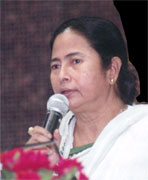
domain-b: It is becoming increasingly clear that West Bengal Chief Minister Mamata Banerjee has a very
 thin skin – or an empress-sized ego without the concomitant statesmanship, depending on one's point of view. Despite the outraged uproar caused by the controversial 'cartoon case', Banerjee has apparently asked the state Criminal Investigation Department (CID) to demand from Facebook the removal of four portrayals of her which she finds offensive. The CID on Monday wrote to the social networking site asking it to remove four the portraits lampooning Banerjee. It has also sought the IP address of the computer from which the pictures were first uploaded onto Facebook. Last week, Jadavpur University professor Ambikesh Mahapatra was arrested, allegedly roughed up, and jailed overnight in a case where he should have got immediate bail (See: Twitterati slams Mamata for arrest over cartoons). This sparked a wave of lampoons and internet protests, under titles like arrestme.com. All political parties except Banerjee's Trinamool Congress reacted with outrage, calling Banerjee a ''fascist'' and so forth. There were widespread public protests even in her own state against her intolerance to criticism. Mahapatra's neighbour Subrata Sengupta was arrested along with Mahapatra for the same 'crime'. Both have been released; but on bail. Apart from other things, they were charged under the Indian Penal Code for 'eve-teasing', defamation, and humiliating a woman. The Mahapatra cartoon showed Banerjee and new railway minister Mukul Roy planning how to get rid of party MP and Roy's predecessor Dinesh Trivedi, who was sacked from his job by Banerjee for daring to increase passenger fares across the board, in the current Railway Budget. The cartoon in itself was not particularly amusing; but Banerjee's reaction certainly is in a tragi-comic sense. She was conspicuously absent at the meeting between the centre and states, particularly those ruled by non-Congress parties, on Monday to discuss the proposal for a National Counter Terrorism Centre (NCTC). Several states are opposing the NCTC on the ground that it infringes on their autonomy in matters of law enforcement. Banerjee, despite her Trinamool Congress being part of the ruling United Progressive Alliance, has been the most vociferous critic of the move. While other opposing chief ministers like Orissa's Naveen Patnaik, Bihar's Nitish Kumar and Tamil Nadu's J Jayalalithaa attended the New Delhi conference, Banerjee chose to send state finance minister Amit Mitra to the conference. He used the opportunity to read out his boss's speech demanding stronger measures by the centre to curb cybercrime, which she said is on the increase. "A dedicated cell [to control cybercrime] is functioning [in Bengal] under the control of Director General of Police, CID. A cyber police station has been set up in Kolkata and a cyber-lab has also been set up,'' Banerjee said through Mitra. Underlining her separation from reality, Banerjee told reporters at Writers' Building in Kolkata that the performance of her government in Bengal ''is 100 out of 100''; while accusing the media of ''distorting'' the image of her government. ''You people see only negative ... you can't see anything positive or else you would have noticed the government's performance,'' she said. "There is a limit to everything. The media has its right to freedom. But that does not mean you can impose your views on others just because you have a pen in your hand." Days before the cartoon controversy popped up, Banerjee had barred all major English newspapers as well as several prominent Indian-language papers from state libraries on the ground (not literally stated of course) that they were critical of her. She has also come under fire over the recent arrest of molecular biologist Partho Sarathi Ray for his alleged role in protests against an the eviction drive at a hutment colony in Kolkata. Scientists from India and abroad along with prominent social activists have written to Prime Minister Manmohan Singh seeking his intervention to get Ray freed. The state CID took over the Facebook case on 12 April following a police complaint filed by a resident of Kolkata saying he found the pictures depicting Banerjee offensive. A CID officer reportedly said that writing to Facebook was routine as there were frequent complaints against its content. But asking for an IP address to track the origin of an upload is a first. The Trinamool Congress supremo was also recently criticized for transferring a top cop who backed a rape victim. Kolkata's Joint Police Commissioner (Crime) Damayanti Sen, who reportedly incurred Banerjee's wrath for backing the Park Street rape victim, was transferred from her position to a 'punishment posting' on 4 April. Sen is now Deputy Inspector General (Training) of a police school in Barrackpore. The 'controversial' cartoon is a caricature of filmmaker Satyajit Ray's thriller Sonar Kella. It has been doing rounds on the internet after the Trinamool Congress supremo forced Trivedi to resign from his post over his Rail Budget.Mahapatra uploaded the cartoon on his Facebook account, besides sending it to 65 people via e-mail, reports said. Source: domain-b.com
 thin skin – or an empress-sized ego without the concomitant statesmanship, depending on one's point of view. Despite the outraged uproar caused by the controversial 'cartoon case', Banerjee has apparently asked the state Criminal Investigation Department (CID) to demand from Facebook the removal of four portrayals of her which she finds offensive. The CID on Monday wrote to the social networking site asking it to remove four the portraits lampooning Banerjee. It has also sought the IP address of the computer from which the pictures were first uploaded onto Facebook. Last week, Jadavpur University professor Ambikesh Mahapatra was arrested, allegedly roughed up, and jailed overnight in a case where he should have got immediate bail (See: Twitterati slams Mamata for arrest over cartoons). This sparked a wave of lampoons and internet protests, under titles like arrestme.com. All political parties except Banerjee's Trinamool Congress reacted with outrage, calling Banerjee a ''fascist'' and so forth. There were widespread public protests even in her own state against her intolerance to criticism. Mahapatra's neighbour Subrata Sengupta was arrested along with Mahapatra for the same 'crime'. Both have been released; but on bail. Apart from other things, they were charged under the Indian Penal Code for 'eve-teasing', defamation, and humiliating a woman. The Mahapatra cartoon showed Banerjee and new railway minister Mukul Roy planning how to get rid of party MP and Roy's predecessor Dinesh Trivedi, who was sacked from his job by Banerjee for daring to increase passenger fares across the board, in the current Railway Budget. The cartoon in itself was not particularly amusing; but Banerjee's reaction certainly is in a tragi-comic sense. She was conspicuously absent at the meeting between the centre and states, particularly those ruled by non-Congress parties, on Monday to discuss the proposal for a National Counter Terrorism Centre (NCTC). Several states are opposing the NCTC on the ground that it infringes on their autonomy in matters of law enforcement. Banerjee, despite her Trinamool Congress being part of the ruling United Progressive Alliance, has been the most vociferous critic of the move. While other opposing chief ministers like Orissa's Naveen Patnaik, Bihar's Nitish Kumar and Tamil Nadu's J Jayalalithaa attended the New Delhi conference, Banerjee chose to send state finance minister Amit Mitra to the conference. He used the opportunity to read out his boss's speech demanding stronger measures by the centre to curb cybercrime, which she said is on the increase. "A dedicated cell [to control cybercrime] is functioning [in Bengal] under the control of Director General of Police, CID. A cyber police station has been set up in Kolkata and a cyber-lab has also been set up,'' Banerjee said through Mitra. Underlining her separation from reality, Banerjee told reporters at Writers' Building in Kolkata that the performance of her government in Bengal ''is 100 out of 100''; while accusing the media of ''distorting'' the image of her government. ''You people see only negative ... you can't see anything positive or else you would have noticed the government's performance,'' she said. "There is a limit to everything. The media has its right to freedom. But that does not mean you can impose your views on others just because you have a pen in your hand." Days before the cartoon controversy popped up, Banerjee had barred all major English newspapers as well as several prominent Indian-language papers from state libraries on the ground (not literally stated of course) that they were critical of her. She has also come under fire over the recent arrest of molecular biologist Partho Sarathi Ray for his alleged role in protests against an the eviction drive at a hutment colony in Kolkata. Scientists from India and abroad along with prominent social activists have written to Prime Minister Manmohan Singh seeking his intervention to get Ray freed. The state CID took over the Facebook case on 12 April following a police complaint filed by a resident of Kolkata saying he found the pictures depicting Banerjee offensive. A CID officer reportedly said that writing to Facebook was routine as there were frequent complaints against its content. But asking for an IP address to track the origin of an upload is a first. The Trinamool Congress supremo was also recently criticized for transferring a top cop who backed a rape victim. Kolkata's Joint Police Commissioner (Crime) Damayanti Sen, who reportedly incurred Banerjee's wrath for backing the Park Street rape victim, was transferred from her position to a 'punishment posting' on 4 April. Sen is now Deputy Inspector General (Training) of a police school in Barrackpore. The 'controversial' cartoon is a caricature of filmmaker Satyajit Ray's thriller Sonar Kella. It has been doing rounds on the internet after the Trinamool Congress supremo forced Trivedi to resign from his post over his Rail Budget.Mahapatra uploaded the cartoon on his Facebook account, besides sending it to 65 people via e-mail, reports said. Source: domain-b.com