 Polling is underway in South Korea to elect a new Parliament. About 44 million people are eligible to vote for its 300-member National Assembly. The outcome of today’s polls will also set the tone for the remaining years of Yoon Suk-yeol’s presidency. The election comes nearly two years after conservative President Yoon Suk Yeol won the 2022 presidential election defeating Lee Jae-myung of the Democratic Party by just 0.73 per cent – the slimmest margin in South Korean history. South Korea has a powerful presidential system, checked and balanced by the assembly which can pass or stop bills. The parliament is currently dominated by the Democratic Party which holds 142 out of 297 seats.Polling underway in South Korea to elect new Parliament
Polling underway in South Korea to elect new Parliament
Polling is underway in South Korea to elect a new Parliament. About 44 million people are eligible to vote for its 300-member National Assembly. The outcome of today’s polls will also set the tone for the remaining years of Yoon Suk-yeol’s presidency. The election comes nearly two years after conservative President Yoon Suk Yeol won the 2022 presidential election defeating Lee Jae-myung of the Democratic Party by just 0.73 per cent – the slimmest margin in South Korean history. South Korea has a powerful presidential system, checked and balanced by the assembly which can pass or stop bills. The parliament is currently dominated by the Democratic Party which holds 142 out of 297 seats.Polling underway in South Korea to elect new Parliament
One to one meeting between Trump, Kim Jong-un on card in May

Washington: After months of trading insults and threats of nuclear annihilation, President Donald Trump agreed to meet with North Korean leader Kim Jong-un by May to negotiate an end to Pyongyang’s nuclear weapons program, South Korean and U.S. officials said on Thursday.
The South Korean national security director, Chung Eui-yong, told reporters outside the White House of the planned summit, after briefing Trump and other top U.S. officials about a rare meeting with Kim in the North Korean capital on Monday. The meeting would be a first between a sitting US president and a North Korean leader, offering a potential breakthrough in relations between the two adversaries.
Chung Eui-yong, South Korea's national security adviser, first made the announcement at the White House on Thursday evening, later confirmed by Trump in a social media post. "President Trump appreciated the briefing and said he would meet Kim Jong-un by May to achieve permanent denuclearisation," Chung told reporters.
He said that the North Korean leader has expressed his "commitment to denuclearisation" and will "refrain from any further nuclear or missile tests" during the negotiations. In a post on Twitter early on Friday, Trump wrote, "Meeting being planned!"
"Kim Jong-un talked about denuclearisation with the South Korean Representatives, not just a freeze. Also, no missile testing by North Korea during this period of time. Great progress being made but sanctions will remain until an agreement is reached," Trump said.
Chung Eui-yong, South Korea's national security adviser, had on Tuesday announced that the North Korean leader had agreed to meet with South Korea's President Moon Jae-in in April. Washington made the announcement of the proposed meeting between Trump and Kim Jong-un soon after this.
The agreements, which follow a flurry of cooperative steps taken by the Koreas during last month's Pyeongchang Winter Olympics, brightened prospects for a dialogue between North Korea and the US over the North Korea's nuclear programme.
The meeting if held would be unprecedented during seven decades of animosity between the U.S. and North Korea. The countries do not even have formal diplomatic relations. They remain in a state of war because the 1950-53 Korean War ended with an armistice and not a peace treaty. Source: ummid.com
Samsung & KB picked as best places to work by university students

SEOUL, KOREA - Samsung Electronics (manufacturing) and KB Financial Group (finance) were selected as the best places to work by university students for four consecutive years. In the categories of non-manufacturing and start-up business, Korean Air and Kakao each achieved the top spots, first in their history. To celebrate the fourth anniversary of its foundation, the Korea Economic Daily’s bi-weekly magazine “Campus Job & Joy” conducted a survey with 1,000 college students throughout the country. In this survey, Samsung Electronics was selected as the best place to work by 22.6 percent of the respondents, ranking No. 1 for four straight years. Following Samsung Electronics were CJ CheilJedang (11.8%), AmorePacific (10.4%), POSCO (6.5%), and Hyundai Motor (6.4%). In the non-manufacturing sector, Korean Air came on top with 14.9 percent. Korean Air’s rank has continued to rise from No. 8 in 2011 to No. 3 in 2012 and No. 2 in 2013. Source: Korea-Times, Courtesy-Images: coretek.vn, Flickr.com
New Paradigm for New Era: Smart Watches

By: YEON CHOUL-WOONG, Less than a decade ago, few expected that smart phones would someday become indispensable to our daily lives. However, today, smart phones have entrenched themselves as the paradigm of this smart technology era by inextricably interweaving with our daily lives in tandem with the transitions from fixed-line phones to cordless telephones and from mobile phones to smart phones. Then, what kinds of new technologies will head up both smart phones and new paradigms for a new era? Advances in smart device technologies, best represented by wearable devices, probably flash across many people’s minds. Making a departure from control technologies dependent on a mouse or a keyboard, the world will see new control technologies, which have been often seen in science fiction films (e.g. controlling objects through human senses, thoughts or eye movements), taking root as a new paradigm for the smart technology era. The front-runner that leads the smart device pack in line with new market expectations is definitely smart watches. Competition in the smart watch market has been heating up faster than any other market as early comers, such as Samsung Electronics, Apple, Sony and Motorola, have been vying against one another to expand market share and as latecomers, like Google and LG Electronics, have also jumped into the smart watch fray. Against this backdrop, it would be nice to take a closer look at what kinds of smart watches are put on the market and their distinguishable features. The LG G Watch: On March 18, LG Electronics and Google took the wraps off their jointly-developed smart watch, the LG G
Watch, powered by Android Wear (a software platform for building new Android wearables). Thus, the LG G Watch can work with all the smartphones running the Android operating system. The G Watch’s key features are divided largely into two: convenience-oriented functions (e.g. Google Maps and Google Hangouts) and informative functions (e.g. Google Now, which delivers information in the form of “cards” to the user, which it predicts the user will want, based on its analysis of the user’s search queries and repeated actions, such as common locations and repeated calendar appointments, etc.) For instance, when you are headed for the bus stop you frequent, Google Now’s traffic and transit card will automatically inform you of bus arrival times. In addition, it will automatically offer you updated information related to your areas of interest and hobbies. It also supports the Ok Google voice command. Hence the user can simply say “Ok Google” to ask questions or get things done. Motorola’s the Moto 360: Not to be outdone by LG Electronics, Motorola timed the unveiling of the Moto 360 to coincide with that of the LG G Watch. The Moto 360, also powered by Google’s Android Wear, shows off e-mail, text messages, automatic alarm
settings and voice command functions. The thing that sets the Moto 360 apart from other smart watches is its classic design. As shown above, the Moto 360 looks like a round-shaped analog wristwatch, somewhat unique for a smart watch. “The wristwatch has been through several evolutions since it first became a popular fashion accessory more than 100 years ago. From mechanical to electronic movements, analog to digital faces, the wristwatch has been reinvented several times over, but the basic design has endured for a century because of its elegance and usefulness ‘at a glance.’ Our vision for Moto 360 was to celebrate that history as we reimagined the wristwatch for the future,” Motorola explained in its official blog. The Samsung Galaxy Gear: The Galaxy Gear is the first wearable device developed by Samsung Electronics. This Android-based smart watch features nearly 70 Galaxy Gear-only apps and a 1.9-megapixel camera built into its strap. What’s more, its Smart Relay function enables the Galaxy Gear to sync with the Galaxy
Note 3.The Galaxy Gear, equipped with a 320 x 320-pixel AMOLED touchscreen, is available in six color variations. The battery pack within the the Galaxy Gear supports 25 hours of continued use, which means the Galaxy Gear needs to be charged on a daily basis, a weakness pointed out by many. The Sony SmartWatch 2: The SmartWatch 2, an Android-based smart watch produced by Sony, also furnishes
several SmartWatch2-only apps, just like the Samsung Galaxy Gear. The Sony SmartWatch 2, the third iteration of Sony’s smart watch, boasts its excellent water-resistant capability: it can remain watertight at up to 1m deep for about 30 minutes. Its interoperability is also deserving of attention. It is compatible with any Android-based smartphones running Android 4.0 and above and it will run for over three days on a single charge. However, there is a caveat: it does not come with a camera. The Pebble: The Pebble, a
smart watch developed by Pebble Technology and released in 2013, is somewhat old-fashioned compared to the recently-unveiled smart watches. For those who look for a built-in camera, phone functions, a touch screen and voice-activated commands, the Pebble is not the answer. Instead, just like traditional wrist watches, the user can control the Pebble’s varied functions via the buttons placed on the left and right sides of its face. It comes in five different colors - black, white, red, gray and orange. The Pebble has been well received by consumers, who prefer easy-to-control smart watches with simple designs. The Adidas miCoach Smart Run: The Adidas miCoach Smart Run, Adidas’s first entry into the smart watch market,
is packed with GPS, Wi-Fi connection and an accelerometer. It works more like a personal fitness coach on the wrist: it tracks the user’s heart rate and offers various customized fitness programs. The miCoach Smart Run also acts as a music player. The user can listen to music on the miCoach via Bluetooth, wearing wireless headphones. Its Adidas-specific simple but chic black design and battery life of up to one week on a single charge greatly appeal to young people enjoying workouts and sports. Source: Koreas Times
is packed with GPS, Wi-Fi connection and an accelerometer. It works more like a personal fitness coach on the wrist: it tracks the user’s heart rate and offers various customized fitness programs. The miCoach Smart Run also acts as a music player. The user can listen to music on the miCoach via Bluetooth, wearing wireless headphones. Its Adidas-specific simple but chic black design and battery life of up to one week on a single charge greatly appeal to young people enjoying workouts and sports. Source: Koreas Times
3D Factory Succeeds in Commercializing 65-inch UHD Non-Glasses 3D Display

SEOUL, KOREA - Throughout the entire part of the media ranging from films to photos and games, the contents using 3D technology are gaining more popularity today. 3D products, however, have a critical weakness. To fully enjoy them, users need to have dedicated glasses. Designed to overcome the weakness, non-glasses 3D display is drawing ever-rising attention. The demand for non-glasses 3D display is expected to continue to grow since it can be used in a wide variety of areas.Against this backdrop, a local company “3D Factory” succeeded in commercializing 65-inch non-glasses 3D display, garnering attention from the related industries. The 65-inch non-glasses 3D display, developed by 3D Factory, boasts high-quality resolution that is about four times higher than that of existing FHD. Prior to the 65-inch display, 3D Factory has already developed 24-, 39- and 50-inch displays. In the world’s largest home electronics exhibition CES 2014, 3D Factory displayed a 55-inch UHD non-glasses display. Source: Korea-Times
Kia Guns for BMW with New Cross GT Concept at Chicago Auto Show
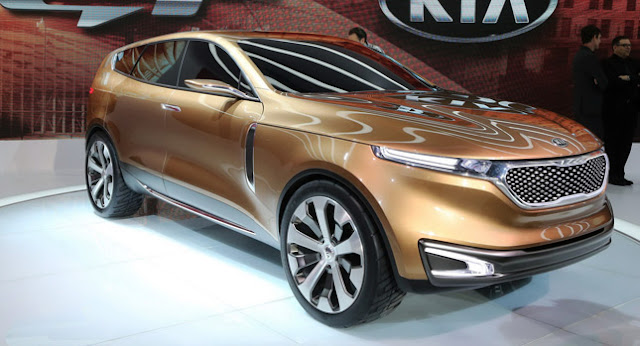
Whereas Germany's premium carmakers are looking to expand their reach in smaller segments, Korea's Hyundai and Kia are actively flirting with the idea of enhancing their range with more premium and larger-size vehicles. At this week's Chicago Auto Show, Kia pulled the covers off the new Cross GT concept, which it describes as "blurring the line" between GT sedan study and a luxury crossover vehicle. The reference to the rear-wheel drive GT sedan also has to do with the fact that the Cross GT is based on the same chassis. The Koreans state that, while purely conceptual,the Cross GT reveals the brand's "intentions to potentially offer a larger premium SUV than the current Sorento in certain markets". Kia may not say it directly, but with this concept, it is aiming towards the likes of the BMW X5 and X6. At 122.0 inches (3,099mm), the Cross GT’s wheelbase is longer than Sorento’s by 15.7 inches (399mm), and its overall length of 192.8 inches (4,897mm) is 8.4 inches (213mm) greater than Kia's CUV. Also, with a width of 79.1-inch (2,009mm), it's 4.9 inches (124mm) wider than Sorento, but its overall height of 65.3 inches (1659mm) is 1.6 inches (41mm) shorter for a more aggressive stance. Penned at the Kia Design Center America (KDCA) in Irvine, California, the four-seater model sports dual rear-hinged doors (more commonly referred to as “suicide” doors) and a clam-shell design for the traditional glass hatch and tailgate. For its motivation, the concept utilizes a parallel hybrid system linking a 3.8-liter V6 engine to an 8-speed automatic transmission and torque-vectoring all-wheel-drive. The electric motor is positioned between the V6 and the transmission, offering an emissions-free driving range of 20 miles (32km). Combined, the V6 and the electric motor produce 400hp and 500 lb-ft of peak torque. Commenting on the Cross GT, Kia's newly appointed president and global design chief, Peter Schreyer, said: “The debut of the GT in 2011 heralded a new frontier for Kia, both from a design and a business perspective. It beautifully illustrated to the world that the brand was ready to explore the possibility of perhaps one day offering a full-size rear-wheel-drive luxury saloon. The Cross GT, with its raised stance and large cargo area, allows us to envision the GT in the form of a full-size luxury crossover.”Source:n Carscoops
Luxury houses raise prices

Ferragamo is expecting its goods to be more expensive, with increases in costs, such as higher manufacturing rates and expansion, being passed on to the consumer. Ferragamo is thought to have one of the most extensive, long-time retail networking in Asia, particularly in China. The company recently acquired an additional stake in its long time distribution partner in China, reaching a total of 75 percent of shares. According to Pambianco, Ferragamo is increasing prices in Europe by as much as 11 percent. In China, prices of luxury goods are, on average, 20 percent more expensive than in Europe due to taxes. Ferragamo is focussing on its expansion strategy with mono-brand store openings set for mainland China, Hong Kong and Taiwan. Indonesia and South Korea are also included in Ferragamo’s expansion plans. Foreign shoppers in the UK and in Europe can purchase luxury products cheaper if they apply for a Global Refund. Residents outside of the EU can apply to have their VAT returned for purchases over 30 British pounds. Generally, the procedure for obtaining a valid customs stamp is 3 months from the issuing month. A Tax Free Form must be stamped by a valid customs stamp and the rebate must be sent for by post. Images: Ferragamo, Source: Fashion United
US, China compete for the role of “king of sea”
In 2012, the US announced that it is starting “to return to Asia” – that is, to broaden its military presence in the south of the Asia-Pacific region. This is the US’s response to China’s increasing military activity in disputable waters in the East China and the South China Seas. The US is going to move up to 60% of its navy to the Asia-Pacific region. That would increase the US’s military presence there 3 times in comparison with the current situation. At present, about 60 to 70 US military ships and from 200 to 300 planes are constantly present at US naval bases in Japan and South Korea. Besides, at least 2 US aircraft carriers are constantly keeping watch in the region. Now, according to President Obama’s order, US naval forces are to increase in Australia, Singapore and the Philippines. In Australia, the number of US marines will be increased 10 times and will reach 2,500 people. Besides, the US will have broader access to the Australian naval base on the coast of the Indian Ocean, to the south of the city of Perth. Up to 4 US navy ships will be deployed near Singapore’s coast. The US is also planning to deploy up to 500 servicemen and reconnaissance aircraft in the Philippines and to create a center for repairing US navy ships there. Moreover, the US does not rule out that in some time from now, the Philippines may become the center of commanding US forces in the Asia-Pacific region. “In such conditions, the Chinese are starting to feel surrounded by US forces from all sides,” Russian expert in Eastern affairs Yuri Tavrovsky said in an interview with the Voice of Russia. “After all, the US does not hide that the reason why it is strenthening its military presence in the Asia-Pacific region is the growing influence of China there.” “In its turn, China is actively developing its navy,” Mr. Tavrovsky continues. “It is hard to deny that within the last few years, China’s economy has been rapidly developing, which has allowed China to considerably increase its military might. It would probably be an exaggeration to say that China is becoming aggressive, but it is obviously starting to realize that it is getting strong enough to afford dictating its will to other countries.” Another Russian expert, Evgeny Kanaev, is predicting that the US-Chinese relations will most probably aggravate even further: “I don’t think that China’s leaders today want to make compromises with the US. It is unlikely that China will agree to create a program of developing its navy that would satisfy the US. In its turn, the US also doesn’t want to be ousted by China from its positions in the Asia-Pacific region. Besides its military presence there, the US also wants to maintain control over all the transport routes in this region, and China is now becoming a serious rival for the US from this point of view as well.” Experts are concerned that the US’s policy of regaining military control over the Asia-Pacific region and its competition for this role with China may aggravate the situation in this region to a very dangerous point. Source: Voice of Russia
Sonia, Manmohan among world's most powerful: Forbes
Washington: Congress president Sonia Gandhi and Prime Minister Manmohan Singh are ranked 12th and 19th, respectively, on the Forbes list of 'The World's Most Powerful People'. US President Barack Obama retains his top position. As leader of India's ruling party, Sonia Gandhi, 65, who was ranked sixth on Forbes list of Power Women, "has the reins of the world's second-most-populous country and tenth-largest economy", the US business magazine said. "Son Rahul is next in line to take over India's most famous political dynasty," it suggested. Listing Manmohan Singh, 80, 19th on the power list, Forbes says: "The Oxford- and Cambridge-educated economist is the architect of India's economic reforms, but Singh's quiet intellectualism is increasingly seen as timid and soft." German Chancellor Angela Merkel moves up to number two from fourth place last year, followed by Russian President Vladimir Putin (No.3), Bill & Melinda Gates Foundation Co-chair Bill Gates (No.4) and Pope Benedict XVI (No.5). Rounding out the Top 10 are US Federal Reserve Chairman Ben S Bernanke (No.6), Saudi Arabian King Abdullah bin Abdulaziz al Saud (No.7), European Central Bank Ppresident Mario Draghi (No.8), General Secretary of the Communist Party of China Xi Jinping (No.9) and British Prime Minister David Cameron (No.10). Facebook CEO Mark Zuckerberg (No.25) dropped out of the Top 10 to 25, from No.9 in 2011. Pakistan Army chief General Ashfaq Parvez Kayani is listed 28th on the list, while Zaheer ul-Islam the "new head of Pakistan's notorious intelligence service" Inter-Services Intelligence is ranked 52nd. Among the 14 newcomers to the list are LinkedIn co-founder Reid Hoffman (No.71), the world's most powerful venture capitalist and SpaceX CEO Elon Musk (No.66), the entrepreneur behind Paypal, Tesla Motors and the private space industry. They are joined by President Francois Hollande (No.14) of France, North Korea Supreme Leader Kim Jong-Un (No.44) and Microsoft CEO Steve Ballmer (No.46). Among the drop-offs are Chinese President Hu Jintao, who is on his way out of office and US Treasury Secretary Timothy Geithner and Secretary of State Hillary Clinton - both of whom have announced they won't return to their powerful posts for Obama's second term. Forbes said it assembled the list using four criteria: power over lots of people, financial resources controlled, whether the person has power in various spheres of life, and whether that person actively uses the power. Source: News Bullet
Deepika wins silver in Archery World Cup final

India's top archer Deepika Kumari settled for a silver medal after losing to World No.1 Bo Bae Ki of South Korea in the World Cup Final in Tokyo on Sunday. Deepika, who slipped to the number two spot in the rankings following her shocking first round loss in the London Olympics last month, gave the South Korean a tough fight before going down 4-6. It turned out to be a low-scoring tie with Ki's 28 in third end being the highest score. Deepika shot a 27 in the second end for her best score in the match. Another South Korean, Hyeonju Choi, secured the bronze defeating America's Jennifer Nichols 6-4 in the third place play-off. Deepika had beaten Nichols in the semifinals following her win over Miki Kanie of Japan in the last eight stage. Source: Hindustan Times
Indonesia orders 3 submarines from ROK
 Indonesian Defense Minister Purnomo Yusgiantoro said on Tuesday the defense ministry had officially ordered three new submarines from a South Korean dockyard under Transfer of Technology (TOT) scheme. "The contract had already been signed. There will be transition phase in the production process where Indonesia wants to build one in an Indonesian dockyard," the minister said in his office here. Under the TOT scheme, one submarine will entirely be built in South Korea, one jointly produced by Indonesian and S. Korean engineers and another one built in Indonesia, the minister said. Source: Naval Open Source INTelligence
BRIC countries to drive DTT receivers market
 |
| BRICS is an international political organisation of leading emerging economies, arising out of the inclusion of South Africa into the BRIC: Image Link Wikimedia |
The global active base for Digital Terrestrial Television (DTT) Receivers is projected to reach 2.4 billion units by 2018, driven by TV digitisation in BRIC (Brazil, Russia, India, and China) countries, according to GIA research. Future growth in the demand for DTT Receivers will also be driven by the widespread adoption of digital TV standards across various consumer electronic devices. Many Western European countries such as Denmark, France, Germany, Norway, Sweden, and Spain have already become fully digitalised by successfully completing DSO. Other major markets such as Italy, UK, Japan, Canada, Portugal, and South Korea are poised to complete ASO in 2012. By the year 2015 some of the most populated countries in the world such as China, India, Mexico, Romania, Russia, and the US aim to completely switch over to digital format in all forms of broadcasting. GIA suggests the fortune of the global market for DTT receivers is poised to chart a growing pattern on the demand graph in future, primarily driven by the widespread popularity of free terrestrial television. In fact, free terrestrial TV continues to find favor among a large number of consumers, especially in developed nations, in spite of the growth in the adoption of pay TV in recent times. The affordability of free terrestrial TV is the major factor responsible for this trend, as consumers are only required to pay a single upfront amount for the receiver with no additional subscription costs. Additionally, with terrestrial digitalisation garnering widespread popularity on a global scale, emerging countries such as China, South Africa and Brazil are projected to witness a surge in demand for DTT receivers in future. China alone is projected to account for a substantial amount of users in the coming years. GIA points out that the DTT Receivers market is being driven by the digitisation of television across the globe. Television continues to strengthen its position in the global media market by cornering a greater share of viewer attention and revenues, despite the growing competition from alternate media channels. The potential for growth is immense given the fact that about 50 per cent of the world’s population is yet to be touched by the television boom. Emerging markets, particularly India and China, offer enormous growth prospects. Over the years, Multiple Systems Operators (MSOs) have been making enormous investments for delivering and supporting enhanced video, voice and data services such as VoD and HD digital video. MSOs have been offering bundled broadband service packages in order to gain an edge over providers of digital broadcast satellite services and telecom companies. The need to compete effectively is essential given the fact that content providers are offering increasingly personalised content through the Internet and to multiple user devices. This led MSOs to upgrade their networks by using Networked (PVRs) which allow them to shift video storage to the networks from the set top boxes thereby adding more capacity. MSOs are also placing increased emphasis on offering time-shifted television to consumers. These efforts have led to numerous technological advancements, which have proven beneficial for the global television industry. A case in point is online TV content and Digital Video Recorders (DVRs) that have played a critical role in boosting overall viewership. The US and Europe account for nearly two-thirds of the global active base for DTT Receivers. However, with these markets nearing saturation, emerging markets such as China, India, Russia, and Brazil are expected to drive the market for DTT Receivers in future as these countries embark on digitisation of TV. Source: Advanced Television
Ban: UN enjoys 'strong support' from China
![United Nations Secretary-General Ban Ki-moon speaks during an exclusive interview by the Xinhua News Agency at the UN headquarters in New York, July 11, 2012. Ban Ki-moon said that the United Nations enjoys 'strong support' from China in most of important agendas of the world body, which include peacekeeping, development, human rights and humanitarian assistance. [Shen Hong/Xinhua]](https://lh3.googleusercontent.com/blogger_img_proxy/AEn0k_tltn7C7q6jqtf8mYM8MKueQMdjpJgB8kAH5HYmIKYq91Hrr0TmPTjIhAiXmLEBIcJTKzU-QnLwseW3ZYD--UAta2E7-N8xz9ma9u58VV0k_mLYH1EWDHnVEhllktXOzmxQ8Dm5PBU8rq2P7MIZ94vcwDGcEPlt=s0-d)
United Nations Secretary-General Ban Ki-moon speaks during an exclusive interview by the Xinhua News Agency at the UN headquarters in New York, July 11, 2012. Ban Ki-moon said that the United Nations enjoys "strong support" from China in most of important agendas of the world body, which include peacekeeping, development, human rights and humanitarian assistance. [Shen Hong/Xinhua]
The secretary-general made the statement in a recent interview with Xinhua on the eve of his visit to China, the first one since he got re-elected as the UN chief in June 2011. "I am very pleased and excited to have an opportunity to be visiting China again," said the secretary-general, who has been to China many times before, adding that he saw the upcoming visit very important because it comes in the early months of his second term, which began on Jan. 1. China's role: "I'm very much grateful for China's continuing support and global role China is playing in the international community," he said. "Most of the important agendas the United Nations is doing to have a strong support from the Chinese government: peacekeeping, development, human right issues, humanitarian assistance." "China has been expanding its global role all throughout the world," he said, adding that during his upcoming visit to China, " I'd like to discuss all this matter, (and) how we can strengthen further the cooperative relationship and partnership between UN and China." During his stay in Beijing, Ban is expected to meet with Chinese President Hu Jintao and other Chinese leaders, and he is scheduled to attend the Fifth Ministerial Conference of the Forum on China-Africa Cooperation, which is slated for July 19-20 in the Chinese capital. "Any important agenda within the United Nations, starting from peace and security, development, human rights, (and) humanitarian assistance, all these require Chinese active support and engagement," he said. "As the secretary-general of the United Nations, I will emphasize the importance of Chinese stronger and enhanced participation and engagement to Chinese leaders," he said. "I am very much grateful for Chinese support for the United Nations, as well as for me as the secretary-general." Chinese culture: Ban, a Korean national, said that he learned "many important, valuable wisdom" from the Chinese classics, which "have given me a lot of inspiration and wisdom." "From (the) Chinese classics, we learn many important, valuable wisdom," he said. "These are the ones that have influenced me since early, early days, like Kongzi (Confucius), Mengzi (Mencius) lessons of these great philosophers, and educators, have given me a lot of inspiration and wisdom." Confucius and Mencius were both great philosophers in ancient China, their thoughts are still flowering in both China and many other countries. Confucius (551-479 BC) had talked about heaven and humanity becoming one, imagined humankind and the natural world in perfect harmony. Mencius (379-281BC) earned him the title "second sage," meaning a great thinker just next to Confucius. Chief among his basic tenets was an emphasis on the obligation of rulers to provide for the common people. "Their thoughts are becoming more and more universal now in the world," Ban said. Although he started to practise Chinese calligraphy when he was a child, a modest Ban said, "I am just a beginner." "I'm very much impressed, whenever I see many beautifully written calligraphies by many Chinese people," he said. "I want to really learn more, because I am still practising it." "By practising calligraphy you can also concentrate," he said. "This is not only good for spiritual way, but also helps your body health, by concentrating you can forget about all of this, but you can only devote all your time and energy on writing this calligraphy." "I simply don't have much time to practice, whenever I have time, I and my wife really enjoy writing and practising calligraphy," he said. In mid-January this year, Ban displayed one of his Chinese calligraphy work at an exhibition held at the UN headquarters in New York, sending his good wishes to the Chinese people as the Year of the Dragon is coming. Ban's work contains two Chinese characters, "Heping," which means "peace." Although the strokes seem a little bit immature, the calligraphy as a whole is well-balanced and beautiful. "Peace, Heping you said just now, development, and human rights, these are three pillars of the United Nations Charter, one day I presented my own writing, Heping to one of the exhibitions, in the UN, I feel proud, but even so, my calligraphy was not good enough, " he said. "I need more practice." Source: China
Apple patent case: Samsung Galaxy Nexus banned in US

A judge in California has blocked US sales of Samsung's Galaxy Nexus smartphones while the court decides on the firm's patent dispute with Apple.
US District Judge Lucy Koh said Apple "has shown a likelihood of establishing both infringement and validity". Earlier this week, she barred sales of Samsung's Galaxy Tab 10.1 tablet in the US until the case was resolved. However, she said that Apple would have to post bonds of nearly $100m (£64m) to enforce the rare pre-trial injunctions. The bonds serve to secure payment of damages sustained by Samsung should it win the cases. Samsung, the South Korean electronics giant, said it was "disappointed" by Friday's decision. "We will take all available measures, including legal action, to ensure the Galaxy Nexus remains available to consumers," it said in a statement. California-based Apple and Samsung are involved in a variety of legal cases in various countries across the globe amid claims and counter claims of patent infringement. While Apple had accused Samsung of "blatant copying" of its design and look, the South Korean firm has alleged that Apple infringed its patents relating to the way phones and tablet PCs connect to the internet. Apple and Samsung are two of the biggest manufacturers of tablet PCs and smartphones in the world. Sales of the iPad more than doubled to 15.43m for the three months to 31 December 2011. And in the first quarter of 2012 it sold 13.6m, giving it about 63% of the global tablet market, according to research firm Display Search. Samsung sold 1.6m tablets over the same period, giving it a 7.5% share. The success of Apple's iPhone and iPad has seen the firm recently become the world's most valuable company. Meanwhile, Samsung has enjoyed considerable success in the sectors with its Galaxy range of products. The demand for tablet PCs and smartphones is likely to grow even further in the near term. Analysts said that given the growth potential, the two firms were using every possible tactic to ensure that they capture a bigger share of the market. Source: SAM Daily Times
Asian tigers move away from dollar
China, Japan and South Korea are taking further steps to replace the dollar in trade between them as the countries start negotiations on a free trade agreement, Vladimir Rozhankovsky, Head of Research at Nord Capital told RT. The deal would be signed by the end of the year, Chinese Premier Wen Jiabao with Japan's Prime Minister Yoshihiko Noda and South Korean President Lee Myung-bak announced during their Fifth Trilateral Summit in Beijing on May 13. The countries have been mulling the idea of the union for several years. “China started negotiations on using national currencies in the region’s trade as early as in 2008, during the crisis as the country wanted to secure itself from probable default of the US dollar,” Rozhankovsky told RT. In 2010 China and Japan agreed on trading some commodities in the yen and the yuan. “It took about two years to trial the idea of trade in the local currencies and now it’s time to follow up a success,” Rozhankovsky said. Source: The Coming Crisis
Oh no! Not again! Not another Korean stem cell fraud
 BioEdge: Korean scientists will need more than a stiff drink to recover their joie de vivreafter stem cell researcher at Seoul National University admitted that she manipulated data for articles published in an international journal. Veterinary researcher Kang Soo-kyung was pinged by an anonymous whistleblower who sent the editors of ten journals a 70-slide Powerpoint report on her irregularities. On May 19 Antioxidants & Redox Signaling announced that four of her papers were being retracted, including two in the latest issue. Kang ‘fessed up immediately. “In response to allegations brought forth by a reader of this Journal, I take full responsibility as corresponding author and accept that some of the data presented is not accurate. I retract the publication in its entirety from scientific literature,” she said in a statement.However, she also insinuated that the whistleblower was driven by malice. “About 80 percent of the evidence used against me is false,” she said. There could be more unsettling revelations, as the whistleblower claims that Kang has been cheating since 2006. “If we don’t stop this author now, no one can prove fabrication later on,” he wrote. A cloud now hangs over more than a dozen of her studies. Poor oversight may have contributed to the problem. Kang was hauled before a university committee two years ago after “mistakes” surfaced in a paper for theInternational Journal of Cancer. Some Korean scientists blame intense pressure and competition. “The school and the government demand their scholars show visible progress in their projects on yearly basis. They are all stressed. What she did is unacceptable but I can see where her deeds came from,” one scientist commented on a Korean university blog. The latest incident is a painful reminder that one of the worst scientific frauds of the past century happened in the same field at the same university by another veterinary researcher. In 2005, after being feted as a national treasure for being the first in the world to clone human embryos and create embryonic stem cells, Hwang Woo Suk turned out to be a fraud. The incident severely tarnished Korea’s scientific reputation. This new imbroglio will do nothing to shine it up. Source: BioEdge
Apple TV set to disrupt established players
Advanced Television: An Apple TV set has the potential to be a huge hit with consumers, according to the findings of a new research report. Strategic marketing and research consultancy KAE and online polls specialist Toluna, have teamed up to release a major new study illustrating how large manufacturers could lose out if Apple launches a physical TV set. Overall, the study highlighted that 25 per cent of consumers in the US find the idea appealing and would buy it once it becomes commercially available – compared to 30 per cent in the UK. Consumers that already own at least one Apple device are more likely to buy an Apple TV set, two in five (US 38 per cent – UK 43 per cent) find the idea appealing and would purchase should the product become available. According to Lee Powney, Chief Commercial Officer at KAE, the huge potential of an Apple TV set, although impressive, should not be seen in isolation. “Such a move would be an incredibly powerful extension of the iOS platform, accessed via a more compelling device option than Apple’s current offering (Apple TV). It would create new monetisation opportunities for developers and accessory manufacturers by bringing the Apple experience further into the home. This would strengthen both the ecosystem and the benefits that consumers derive from owning many differing Apple devices. Will Apple do this? The pressure to maintain the lion’s share of preference from ecosystem members and create additional device-to-device interaction benefits for consumers means it should do this, and must do this.” The report suggests that Sony, Samsung and LG are the market-leading brands most likely to suffer should Apple decide to launch its mooted Apple TV concept. In the UK, a sizeable 38 per cent of current Sony TV owners and 36 per cent of Samsung TV owners claimed they find the idea of an Apple TV appealing and would buy one. In the US, the brand most at risk from the concept is LG, where three in 10 (31 per cent) of owners would be likely to convert should an Apple TV become available. Approximately three in five US consumers questioned who were very likely to buy the TV said they trust Apple to produce a high quality TV set (59 per cent), a sentiment echoed by UK consumers (62 per cent). Design also features highly in respondents’ reasons to purchase with over half of all those likely to buy claiming that Apple’s reputation in ground-breaking design would no doubt also be used in TV (52 per cent in US and 58 per cent in the UK). “Although this wave of research looked only at the USA and UK, we believe that the greatest revenue opportunities in 2013-15 for an Apple TV set are clustered in the ‘home territories’ of Apple’s TV competitors – i.e. Japan, Korea and China. We’re excited at the prospect of measuring that potential and the impact that success will have on Apple’s share price,” said David Rankin, MD of KAE. Consumers were asked which features they felt an Apple TV set would be equipped with: The top anticipated feature for potential customers of the unconfirmed Apple TV set is similar for both countries, which is the ability to connect to the Internet (73 per cent in the US and 75 per cent in the UK). The other top features selected by potential US customers were running apps on TV (44 per cent) and the ability to synchronise automatically with other Apple devices (41 per cent). For the UK market, the other two main features expected were the ability to synchronise automatically with other Apple devices (47 per cent) and for the device to be 3D enabled (41 per cent).Source: Advanced Television

