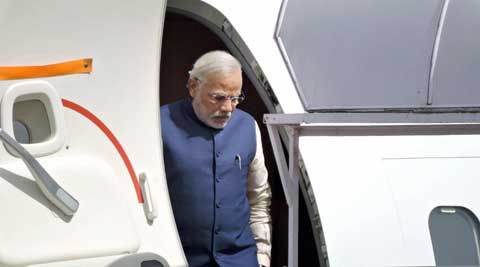
PM Narendra Modi dedicates largest warship INS Vikramaditya to the nation, pitches for self-reliance

Prime Minister Narendra Modi inspects the Guard of Honour at INS Hansa airbase at Dabolim in Goa. (Source: PTI)
Prime Minister Narendra Modi on Saturday dedicated India’s largest warship INS Vikramaditya to the nation and pitched for making the country self-reliant in manufacturing defence equipment, shedding dependence on imports.
In his first outing after taking charge as Prime Minister, he addressed the naval personnel onboard the ship off the Goa coast, calling the addition of the warship to the force as a “historic” step. “It is an important day for our nation. It is a golden day in Indian Navy’s history. For me, it is a matter of pride and happiness that INS Vikramaditya is joining the Navy. It is a historic step,” he said. Stressing on the need for self-reliance in defence equipment manufacturing, he said, “We need to give immense importance 
to latest technology. This will help the nation. Why should we import defence equipment? We must be self sufficient. Why can’t we  The Prime Minister also promised to set up a War Memorial for those who sacrificed their lives for the country. send our defence equipment to other nations.”  He said this government has come with a determination and was committed to implement the “One Rank, One pension” scheme for defence personnel. “Our government has the potential to match anyone in the world and the reason for this is the capability of our soldiers who give us the strength to do so,” he said in his address, adding that the country intends to move forward in the same manner, without lowering its eyes. He also called
for setting up a Naval NCC network across the country that could prepare a dedicated force of soldiers which could help the Navy emerge as a big force in the coming times. Arriving on board the warship in a Sea King chopper, the Prime Minister was given the ceremonial guard of honour by the Navy and was briefed about the warship. He also sat in a MIG 29 aircraft and had a feel of the combat fighter on the ship. The Prime Minister spent a few hours on board the 44,500-tonne warship, his first visit to any defence facility. The prime minister was accompanied by Minister of State for Defence Rao Inderjit Singh, National Security Adviser Ajit Doval, Defence Secretary R K Mathur and Naval Chief Admiral Robin Dhowan. During his stay on the ship, acquired from Russia for over Rs 15,000 crore, Modi witnessed ‘air power demonstration’ by various naval aircraft, including MiG 29K, Sea Harriers, P 8I Long Range Maritime Patrol Anti-Submarine Warfare aircraft, TU 142M and IL-38SD maritime surveillance planes along with Kamov and
Sea King helicopters. He also witnessed high-speed manoeuvres by the Navy’s Western Fleet ships including aircraft carrier INS Viraat, Delhi-class destroyers and Talwar-class frigates. The air demonstrations were, however, hampered by heavy rain. Modi interacted with the senior officers and the crew. The deal for the aircraft carrier was signed during the previous NDA regime in 2004 and the ship will be dedicated to the nation after a gap of ten years. The vessel had joined the Indian Navy on November 16, 2013. The ship was earlier commissioned by the then defence minister A K Antony in Russia. Vikramaditya, a floating airfield, has an overall length of about 284 metres and a maximum beam of about 60 metres, stretching as much as three football fields put together. Standing about 20 storeys tall from the keel to the highest point, the ship has a total of 22 decks and carries 1,600 personnel. With her complete stock of provisions, she is capable of sustaining herself at sea for about 45 days. It is a modified Kiev-class aircraft carrier which was purchased by India from Russia for the Indian Navy in 2013. The ship has been renamed in honour of Vikramaditya, a legendary 1st century BC emperor. Originally built as Baku and commissioned in 1987, the carrier served with the Soviet (until the dissolution of the Soviet Union) and Russian Navies before being decommissioned in 1996 as it was too expensive to operate. Source: The Indian Express
Read More........

Russia can switch to payments with India, China in national currencies crushing dollar amid sanctions - experts

Experts believe that the wish of the West to restrict Moscow’s cooperation with Brussels and Washington will play into the hands of the Russian economy. Wisdom and presence of mind are two components that will guarantee success for a new spiral of Russia’s cooperation with eastern countries. Also, this will allow us to counter-balance the risks that the European market is exposed to.
The European economy, experts point out, still remains in the grip of a crisis, while China, for example, is prosperous. The West, including the US, has begun to curtail the profitable relations with Russia on the background of Ukrainian problems, which has nothing to do with the East. And business always develops in the environment of stability and mutual interest. It is reasonable that at present the Russian economy – that is investments, exports, imports and technology – is speeding up its advance in the eastern direction, President of the Centre of Strategic Communications Dmitry Abzalov says. Instead of America and Europe, our target is South-East Asia now. Russia has decided to develop cooperation with Asian countries. India, for example is our partner in issues of the military-industrial complex, in the high-tech segment. Cooperation with China is based on the raw materials sector, engineering, military technology. Recall that the Russian president’s visit is due in May. Most likely, agreements on natural gas will be signed. Actually, bearing in mind that China will become the world’s largest economy in the near future, the development of the eastern vector will guarantee that a considerable part of extra profits and the growth of the home market will be generated in the South-East Asia. Analysts believe that western sanctions could provide stronger positions to the developing countries, one of which is Russia itself. This is especially true of the high-tech sector, both in the regional and global market. In particular, Russia is practicing phase-out of imports. The national industry is expected to develop faster due to external factors. Discussing the reasons for the imposed sanctions, experts say that at present the western elites are seizing the opportunity to dictate their terms to the Russian economy. Actually, this happened on the past as well but the situation became especially strained when Russia started talking about the Customs Union, head of the Centre of Economic Research at the Institute of Globalization and Social Movements Vasily Koltashov says. European elites are rather short-sighted and oriented at controlling the markets, including the Russian economy, especially the raw materials sector. They never lost interest in that sector. For this reason, they will always be in conflict with Russia, especially after Russia announced the establishment of the Customs Union. Still, it is wrong to say that Russia is in conflict with the EU. On the contrary, Russians are extremely tired of the permanent economic crisis in the EU, the aggravation of that crisis and the austerity policy. Speaking about the priorities of the eastern vector for Russia, experts point out that the establishment of new stock exchanges in South-East Asia is not far off and they can become serious competition for London or New York. And for Russia as a resource-dependent country this is one of the determining factors. The more so, because the Chinese economy grows fast, constantly increasing its consumption of oil and gas. Thus, in 1980 China consumed only 3% of the global oil production. Now it consumes 10%, leaving Japan behind. Only the US is still ahead. If this trend persists, China will inevitably start thinking about the establishment of an alternative oil and gas market. Also, chances are that Russia, as one of the largest suppliers of oil and gas, will soon switch to mutual payments with India and China in the national currencies – roubles, yuans and rupees. In this case the dollar and the euro will gradually retire into the background. Source: Voice Of Russia
Read More........

Europe risks losses of $215 billion by stopping Russian gas imports

Europe will have to spend up to $215 billion through investments if it decides to stop buying Russian natural gas, US-based financial research company Sanford C. Bernstein & Co said Wednesday. "Europe needs natural gas demand to go down by 15 billion cubic meters to be able to stop purchasing Russian gas. It will also have to spend around $40 billion dollars on more expensive alternatives energy sources," the company said in a statement.
Stopping supplies of Russia gas will lead to a situation whereby "every European will have to take a cold shower once a month, CO2 emissions will increase by 300 million tons per year, tax incentives for Norwegian gas production will amount to $12 billion dollars, the power of nuclear energy in Europe will increase 5 percent, and most of the businesses that consume significant amounts of gas will be closed," the company said. "We considered various scenarios of Europe refusing Russian gas supplies but none of them seem attractive," the company said. "Our conclusion is that 'the cure is worse than the illness's and that Europeans discontent with its dependency on Russian gas will not last long," Bernstein experts think. It will take five years to implement measures to make up for such a gas shortfall, Bernstein estimated, and more than 10,000 jobs would be eliminated in the process. Source: Voice Of Russia
Read More........

Is Vladimir Putin rebuilding the Russian Empire

President putin has said on more than one occasion that the fall of the Soviet Union was one of the biggest tragedies in history. there seems to be little doubt that he would like to reverse that and rewrite history. he has already made moves in georgia and moldova. Should those moves go unchallenged by the west, especially the united states then would could be moving toward some ultimate conflict that would make wwii seem like a marble game. there are no easy solutions, but something must be done. When president kennedy came into office his first challenge was the bay of pigs failure---the russians perceived weakness and that led to the installation of missiles in cuba and to the cuban missile crisis where kennedy finally found his backbone and stood up to the russians. The point here is that if kennedy had not shown weakness in the beginning of his presidency we might have not been pushed to the brink of wwiii during the missile crisis. putin sees obama's weakness and will not cease his aggressive acts until obama grows a set. Source: Article
Read More........

Olympic Games in Sochi set world record for investments - marketing specialists

Sochi, Russia, Already before its beginning the 2014 Olympics are setting records. The Sochi Games have received an unprecedented support from their sponsors, marketing partners, license holders and suppliers. The general sum of the contracts has reached one and a half billion dollars. That is the highest result not only in the history of Winter Olympics, but also for the Summer Games as well. Sochi is welcoming the first Olympic teams. Both the Coastal and the Mountain Olympic villages have begun ceremonies of welcoming the incoming teams of participants. The athletes and the guest of honor receive the main souvenir of the current Games – knit Olympic gloves as well as of Russia's symbols – matryoshka dolls. In total the participants and guests of the winter Olympics will be able to obtain about five thousand types of souvenirs with Olympic symbols – from sports clothing to coins, stamps, toys and even accessories for pets. According to the specialists, the marketing program is to bring over $500 million in the course of the Olympics. The furry toys depicting the mascots of the Games have already set a record in sales. Over three and a half million of such toys have already been sold. In the course of the Games over 75 thousand fans, about 5 thousand athletes as well as 12 thousand journalists and 25 thousand volunteers will be potential buyers of the Sochi 2014 licensed products. The Olympic Organization Committee has signed marketing contracts with ten international corporations, partners of the International Olympic Committee, as well as with eight national partners. For example, the Summer Olympics in London in 2012 had fewer national partners – seven, despite the fact that summer Olympics are considered to be more attractive for advertisers. Nikolai Dolgopolov, deputy editor-in-chief of the Rossiyskaya Gazeta, explains the current rush of Russian and foreign partners by the uniqueness of the Sochi Olympics. "These are the first Olympic games to take place in an absolutely unusual geographic zone: below is the sea, while above is the cold with temperatures of -10 C. It is the first in the world experiment to conduct winter Olympics in subtropics, which naturally attracts advertisers. There is another important issue. If in the past winter Olympics were attended primarily by athletes from Northern countries, lately winter Olympics have involved more and more participants from all continents. For example, in the current Games Africans, Brazilians and Filipinos are to take part. That also attracts advertisers as they will be able to introduce their products and brands to the Olympic guests from all over the world," Dolgopolov said. The advertizing contracts of global TV companies for the broadcasting of the winter Games in Sochi are also record setting. One of the largest TV companies, the NBC from the USA, has already signed advertizing contracts for $800 million, thus beating the previous record for winter Olympics in Vancouver in 2010. Experts point out that the companies involvement in such a large-scale event as the Olympics has a long-term positive effect in terms of their image. The five Olympic rings are one of the best-recognized brands in the world; it's a guarantee of quality. The positive attitude towards the Olympics will eventually be transferred to the brand, which would entail an increase in sales even after the Games. Sochi 2014 partners have received additional opportunities for the development of their business, says Andrey Malygin, a sports marketing specialist. "The Olympic games are without doubt brand number one in sports. And it is not surprising in my opinion that large companies effectively use the opportunity to once again state their presence. Just look at how actively each of the partners of the Olympics uses its sponsor status. That shows that for the companies the Games are a good time to build closer communication with their clients. For example, Sberbank is good at conducting a campaign by stressing its unique role. It has issued a great deal of advertizing products," Malygin said. Let's point out that the sports program of the Sochi Olympics has also set a record in the number of competitions as well as in the number of new sports added. As a result the total number of sports' types has reached 98. It is 12 more than during the previous winter Games in Vancouver in 2010. Source: Article
Read More........

Unbelievably tight security for Sochi Olympic Game

The 2014 Winter Olympics, officially the XXII Olympic Winter Games, or the 22nd Winter Olympics, is a major international multi-sport event being held in Sochi, Russia. Scheduled for 7–23 February 2014, opening rounds in figure skating, skiing, and snowboard competitions were held on the eve of the Opening Ceremony, 6 February 2014. Both the Olympics and 2014 Winter Paralympics are being organized by the Sochi Organizing Committee (SOC). Sochi was selected as the host city in July 2007, during the 119th IOC Session held in Guatemala City. It is the first Olympics in Russia since the breakup of the USSR in 1991. The USSR was the host nation for the 1980 Summer Olympics in Moscow
It seems that Russian president putin, will go to any extreme to insure the safety of the Olympians at the sochi games. That said, the facilities for them and for those spectators attending the winter games are to say the least sub-par. but then, again its really not fair to compare a Russian toilet with an American one. one must remember that the Russians are just now getting use to indoor plumbing and the ole outhouse is still a recent memory to many Russians. cartoon by henry paynee. Source: ArticleWiki,
Read More........

Sharapova tops Forbes list of highest earning sports figures

Photo: EPA
Russian athlete Maria Sharapova, 26, ended up on top of Forbes magazine’s list of business-savvy sports figures released Monday. Forbes pointed out to tennis star’s status as the biggest-earning female athlete in the world with $29 million of income from mid-2012 to mid-2013. Most of it came through contracts with companies such as Nike and Porsche. She also launched a candy line last year, raking in $6 million on the Sugarpova sweets, the business weekly said. Sharapova is the only Russian on the 30 Under 30 in Sports list dominated by Americans. She was also the only athlete in the top 30. The runner-up was Muthu Alagappan, 23, a basketball analytic, while the third place went to lawyer Jonathan Amoona, 29, who worked on NFA and NBA disputes. Forbes compiles annual 30 Under 30 lists in 15 categories, from finance to food and wine, marking young talents with entrepreneurial acumen who are “impatient to change the world.” Maria Sharapova, currently #3 in WTA ranking, has won 29 singles tournaments, including four Grand Slam titles. In 2005, she became the first Russian to rank as the world’s top tennis player, according to the WTA. Sharapova to change her surname to Sugarpova for the US Open: By  Elena  Malakhova:  The

4time major title holder Maria Sharapova who is also considered the world’s richest sportswoman is going to change her name to Sugarpova for the duration of the US Open in order to promote her sweets brand. Sharapova's outfit for the tournament will be decorated with the logo of her company – a pair of red lips. Of course the 2012 Olympic runner-up will need to receive an approval from the grand slam committee but if that is granted, she could perform under a new name of Sugarpova at the 4th and final grand Slam event of the year. The world number one Serena Williams is the main frontrunner to win the event. First of all she tops the WTA rankings and secondly she is the defending US Open champion. Viktoria Azarenka of Belarus was seeded second for the tournament and she is intending to battle for the trophy as well. Several days ago the world number two Viktoria Azarenka defeated the home favourite Serena Williams in the final of the Cincinnati Open. In the men’s draw the title is expected to be contested between the top 5 players who have set sights on winning the season-ending Grand Slam. The eight time French Open holder Rafael Nadal of Spain has leapfrogged the Olympic champion Andy Murray in the rankings thanks to his victory in the final of the Cincinnati Open. But the well-decorated Spanish player doesn’t agree that his two trophies in as many weeks make him the overwhelming frontrunner of the upcoming tournament at the Flushing Meadows. Novak Djokovic remained number one player, Andy Murray has dropped to the third place swapping places with Nadal. The 17 time Grand Slam winner Roger Federer of Switzerland is down to 7th position. Voice of Russia, RIA, Source: Article
Read More........

Russia’s voting system must be even more open - Putin

Russian President Vladimir Putin has urged representatives of electoral commissions of all levels to do their best in order to create an open voting system in Russia, taking into consideration previous election campaigns. In the course of a meeting with representatives of electoral commissions of all levels, Putin asked them to set forward their suggestions “what else we need to do in order to make our voting system more open so that no one has doubts that it works to the highest organizational and political standard.” The Russian leader also noted that it’s necessary to show that the Russian voting system is “transparent and equally treats all the candidates seeking to be elected at every level and respects rights of all the people involved in an electoral process,” Putin added. Voice of Russia, Interfax, Source: Voice Of Russia
Read More........

Russia could export military equipment and weapons for more than $50 billion annually by 2020.

The "ROSOBORONEXPORT" Federal State Unitary Enterprise is the major Russian specialised agency responsible for arms export. 
By 2020, Russia will be able to reach the level of $50 billion annually in arms exports, Deputy Prime Minister Dmitry Rogozin said. Russia could quadruple its annual arms sales to $50 billion by 2020 in a race for the top spot on the global arms exporters list. “Not counting inflation, I think we could reach $50 billion for export of military equipment and weapons annually by 2020,” Deputy Prime Minister Dmitry Rogozin told reporters in Moscow. “It is four times the current amount.” Source: World Defence News
Read More........

Mandela one of the most monumental figures in politics, his name is inseparably linked to Africa's history - Putin

Russian President Vladimir Putin has offered his condolences following the death of Nelson Mandela, South Africa's long-time leader and a prominent political figure, the Kremlin press service said. Mandela's name is inseparably linked with an entire epoch in Africa's modern history, which witnessed the victory over apartheid and the establishment of the Republic of South Africa as a democratic state, Putin said in his message. Despite the hardships, Mandela stayed true to the ideals of humanism and justice until the end of his life, the Russian president said. Putin once again applauded Mandela's role in promoting friendly relations between Russia and South Africa, which are strategic partners today. Putin's message is addressed to South African President Jacob Zuma and offers the words of sympathy and support to Mandela's family, the government and the people of South Africa. Voice of Russia. Source: Article
Read More........

2014 Brazil World Cup: 'Our group is the biggest surprise'

© Photo: Vesti.Ru
The eyes of the soccer fans are turned to Brazil - the world cup draw for the 2014 has just been held. 32 best teams have just found out the names of their opponents. The tournament kicks off in Brazil next year. Denis Kazansky, Russian sports analyst and soccer commentator, shares the first impressions about the draw. What's the biggest surprise of the draw so far? Our group is the biggest surprise because we hope it will be some easy choice for us and I think that we are in very good position. There is only one top quality team in our group. Who is us? Belgium, Algeria, South Korea and Russia. Belgium is a top quality team and I think they are the toughest to beat. But as for Algeria and South Korea, I suppose that Russian side can be good with them and I think we have lots of expectation from that group and we can gain some wins from there. How can you comment on the chances of the teams? In the group H I think we with the Belgium have to be qualified from the group. As for others, I can say that it is very tough competition in group D – Uruguay, Costa Rica, England and Italy, it will be very interesting - Italy and England. And as for group G, I think that the most important picture is Germany versus USA because the head coach of the USA Juergen Klinsmann is ex-coach of German national site and they will face each other - Joachim Low versus Klinsmann. So, it will be very interesting. I think that we don’t have so-called death group in this competition. What chance does America have to win it all? Zero because I think that the group G where USA is, Germany, Portugal, Ghana are too tough for them. They are very good but I think that Portugal and Germany could qualify from that group. As for USA I am not so sure about it. What about Russia? As I said, Russia has very good chances and I think along with Belgium National site we can qualify and be there in the playoff spot. England? It is tough to say but because of Italy, Uruguay and Costa Rica, I think they are open to beat and I think that England and Italy will qualify from that group. Source: Article
Read More........

BRICS summit delivers tangible results, Singh meets Putin & Invites the Chinese Premiere

The leaders of five major emerging economies on Wednesday wrapped up their latest round of summit in the South African city of Durban to promote their partnership for development, integration and industrialization. It is the first time for the BRICS nations, namely Brazil, Russia, India, China and South Africa, to hold their leaders' meeting on the continent of Africa. China Pledges to Enhance BRICS Cooperation While addressing the summit in his keynote speech, Chinese President Xi Jinping called on all BRICS members to work hand in hand for common development. He pledged that China would strengthen cooperation with other members to make economic growth of BRICS countries more robust and their cooperation better-structured and more productive. BRICS cooperation not only brings benefits to the peoples of the five countries, but also contributes to promoting democracy in international relations, Xi said. He said all members should manage their own affairs well by growing the economy and improving people's lives, strengthen coordination of macroeconomic policies, reform the international monetary and financial systems, and promote trade and investment liberalization and facilitation. They should jointly participate in the setting of international development agenda and make global development more balanced, he said. BRICS countries should work hard to boost cooperation in economy and trade, finance, infrastructure, movement of people and other fields, Xi said. He also called for improving global economic governance and increasing the say and representation of BRICS countries, and urged the BRICS nations to move toward the goal of integrated market, multi-tiered financial network, connectivity by land, air and sea, and greater cultural exchanges. Tangible Results: At the summit, the five BRICS members have achieved a number of tangible results, and agreed to expand their future cooperation to more sectors, according to a statement issued after the meeting. The most tangible outcomes, among others, is that the leaders have agreed to establish a development bank for mobilizing resources for infrastructure and sustainable development projects in the BRICS, as well as other emerging and the developing nations. The BRICS leaders believed that the bank serves as a supplement to the existing efforts of multilateral and regional financial institutions for global growth and development, adding that the initial contribution to the bank should be sustainable and sufficient. Meanwhile, the members also agreed to explore the construction of a financial safety net through the creation of a Contingent Reserve Arrangement (CRA). The leaders said the idea would help BRICS countries forestall short-term liquidity pressures, provide mutual support and further strengthen financial stability.  In the statement, the countries also expressed their common aspiration to
improve global economic governing make them more representative and to reflect the "growing weight" of the BRICS and other developing nations, adding that the leadership selection of international financial institutions should be open, transparent and merit-based. Additionally, the BRICS nations would explore the possibility of strengthening their cooperation between their state-owned firms, and promote the dialogues among the small and medium-sized companies. They would also consider to expand their cooperation to more sectors including public diplomacy, anti-corruption, drug control, youth exchanges, tourism, energy and sports. Also in the statement, the leaders of the BRICS countries voiced their opinions on a series of international hotspots including peace in the Middle East, Iranian nuclear issue, and the situation in Syria, Mali, Central African Republic, the Democratic Republic of Congo and Afghanistan. Cooperative Partnership between BRICS & Africa: Also on Wednesday, the leaders of the BRICS members and some African countries, after the summit, discussed their cooperation at the first BRICS Leaders-Africa Dialogue Forum, which is under the theme "Unlocking Africa's potential: BRICS and Africa cooperation on infrastructure." While addressing the forum, Chinese President Xi Jinping said the dialogue between leaders of BRICS and African countries reflected the political will of both sides to realize equality and inclusiveness and seek common development. Xi said the Chinese government is willing to form a cooperative partnership for transnational and trans-regional infrastructure, and help the African nations with the consultation, planning, feasibility research and project design of promoting interconnections and resource censor. He also promised to help Africa to train 300 managing and technical personnel specialized in the field of infrastructure, and encourage Chinese enterprises and financial institutions to participate in the building and operating the infrastructure. The Chinese leader also reaffirmed China's promise to give zero-tariff treatment to 97 percent of the tariff items of exports to China from the least developed nations having diplomatic ties with China. Other leaders of the BRICS nations said the BRICS countries would like to forge a cooperative partnership with Africa, and help Africa in constructing its infrastructure. The African leaders said Africa needs to strengthen its infrastructure, promote integration and industrialization, and lift over-all competitiveness and the capacity for sustainable development. The African nations are willing to set up with the BRICS members a cooperative partnership that highlights mutual support, mutual benefit and win-win results, said the leaders. Source: China.org.cnPutin meets with Indian Prime Minister Singh "on theВладимир Путин россия индия премьер-министр Индии Манмохан Синх сингх
sidelines" of BRICS summit: BRICS is an alliance for economic cooperation between Brazil, Russia, India, China and South Africa – hence the abbreviation. At the meeting, Mr. Putin suggested to Mr. Singh to exchange opinions on acute issues of relations between the two counties and of the world’s political life. “High-ranking Russian and Indian officials meet very often,” Mr. Putin said. “This gives us an opportunity to maintain friendly relations and to control the situation in every sphere of these relations.” The Indian Prime Minister thanked the Russian President for his personal contribution in partnership between the two countries. “When you came to India in December,” Mr. Singh said, “we had a good opportunity to discuss many aspects of relations between our two countries. I am very satisfied with the results of those talks.” “At present, India and Russia are actively cooperating in the sphere of security, in atomic energy and in many other spheres,” Manmohan Singh continued. “The mechanism of annual summits allows to have very detail discussions of all aspects of cooperation between our two countries and global political problems.” Finance ministers of the BRICS countries unable to reach agreement on development bank - Russia’s Finance Ministry Head: Finance  ministers of the BRICS countries  yet unable to reach agreement on keyАнтон Силуанов
questions concerning creation of the BRICS development bank – Head of Russia’s Finance Ministry Anton Siluanov said at a press conference in South African Durban. The parties also failed to reach an agreement on whether the BRICS members' involvement in the bank's management will be proportionate to the size of their contributions or whether they will manage it on a parity basis regardless of their contributions, he said. "We considered this issue today. A list of questions has been compiled to be answered, that is, the capital and the management mechanism, and also whether those who contribute more will have preferences or whether decisions will be made through a consensus. We agreed on the whole that we will continue working on establishing a BRICS bank after the unsettled issues are answered," Siluanov told journalists on the sidelines of a BRICS summit on Tuesday. The parties agreed to continue addressing these issues at the next meetings of the BRICS finance ministers, Siluanov said. It was agreed preliminarily that the establishment of a new bank would require each country's contribution of $2 billion, he said. "This is not a small amount of money. It will be not easy for us to discuss this at the parliament, and not only for us but also for the other countries. Therefore, this was discussed as an idea, and there are positive reviews on it, and we will continue working on a mechanism of its implementation," he said. BRICS agree on establishingбрикс страна национальная валюта россия индия китай юар бразилия деньги финансы
Bank of Development: The initial capital of the BRICS bank of development is expected to amount not less than $50 billion. It is not clear how the stakes will be distributed between the states. Durban is to host the BRICS summit on Wednesday. Besides the economic issues the leaders of BRICS are to discuss urgent international issues such as the Syrian crisis. Russia’s President Vladimir Putin has already arrived to Durban for talks. BRICS countries have agreed on establishing their Bank of Development (single financial institution for Brazil, Russia, India, China and South Africa), South Africa’s Finance Minister Pravin Gordhan said in Durban Tuesday. The initial capital of the BRICS bank of development is expected to amount not less than $50 billion. It is not clear how the stakes will be distributed between the states. Durban is to host the BRICS summit on Wednesday. Besides the economic issues the leaders of BRICS are to discuss urgent international issues such as the Syrian crisis. Russia’s President Vladimir Putin has already arrived to Durban for talks. Source: Voice of Russia, Singh meets Chinese President Xi Jinping :Durban: Prime Minister Manmohan Singh on Wednesday met Chinese President Xi Jinping during the summit of the BRICS nations - Brazil, Russia, India, China and South Africa - in Durban, South Africa. This was the first structured high-level contact between the two countries since the change of leadership in China. The meeting lasted for 45 minutes. Speaking to reporters after the meeting, Dr Singh said India values its ties with China. "The bilateral relationship with China is of great importance. As Prime Minister of India, it has been my great privilege to interact regularly with the Chinese relationship over the last decade. I hope to intensify such dialogue and communications with you and the new leadership of China to put our relations on an even higher growth trajectory," Dr Singh said. The two leaders discussed all contentious issues, including the boundary and Chinese dams along the Brahmaputra River. Chinese President was all praise
for Dr Singh for his statesmanship and was hopeful that he would continue to improve ties between both the countries. Mr Jinping said relationship with India is important to China. "The Chinese President, in fact, himself told Dr Singh that he knew about the good bonding our prime minister shared with his predecessors," an Indian official said. Mr Jinping invited Dr Singh to China and the Prime Minister too invited the Chinese Premiere to New Delhi. Both the leaders have accepted each other's invitations; the dates are yet to be worked out. Mr Jinping had last week propounded five proposals for improving bilateral ties with India. These included keeping aside differences on various issues while improving mutual ties and accommodation of each other's concerns while dealing with "core interests". He had also suggested that peace and tranquility should be maintained on the boundary pending settlement of the issue. Fifth BRICSA map highlighting the BRICS countries
BRICS is an international political organisation of leading emerging economies, arising out of the inclusion of South Africa into the BRICImage Link Wikimedia
Summit Declaration and action plan: Leaders of the BRICS nations, namely Brazil, Russia, India, China and South Africa wrapped up their latest round of summit Wednesday in South African city of Durban. The following is the full text of the declaration and action plan of the summit: Fifth BRICS Summit, Durban: 27 March 2013: BRICS and Africa: Partnership for Development, Integration and Industrialisation: eThekwini Declaration: 1. We, the leaders of the Federative Republic of Brazil, the Russian Federation, the Republic of India, the People's Republic of China and the Republic of South Africa, met in Durban, South Africa, on 27 March 2013 at the Fifth BRICS Summit. Our discussions took place under the overarching theme, "BRICS and Africa: Partnership for Development, Integration and Industrialization." The Fifth BRICS Summit concluded the first cycle of BRICS Summits and we reaffirmed our commitment to the promotion of international law, multilateralism and the central role of the United Nations (UN). Our discussions reflected our growing intra-BRICS solidarity as well as our shared goal to contribute positively to global peace, stability, development and cooperation. We also considered our role in the international system as based on an inclusive approach of shared solidarity and cooperation towards all nations and peoples. 2. We met at a time which requires that we consider issues of mutual interest and systemic importance in order to share concerns and to develop lasting solutions. We aim at progressively developing BRICS into a full-fledged mechanism of current and long-term coordination on a wide range of key issues of the world economy and politics. The prevailing global governance architecture is regulated by institutions which were conceived in circumstances when the international landscape in all its aspects was characterized by very different challenges and opportunities. As the global economy is being reshaped, we are committed to exploring new models and approaches towards more equitable development and inclusive global growth by emphasizing complementarities and building on our respective economic strengths. 3. We are open to increasing our engagement and cooperation with non-BRICS countries, in particular Emerging Market and Developing Countries (EMDCs), and relevant international and regional organizations, as envisioned in the Sanya Declaration. We will hold a Retreat together with African leaders after this Summit, under the theme, "Unlocking Africa's potential: BRICS and Africa Cooperation on Infrastructure." The Retreat is an opportunity for BRICS and African leaders to discuss how to strengthen cooperation between the BRICS countries and the African Continent. 4. Recognizing the importance of regional integration for Africa's sustainable growth, development and poverty eradication, we reaffirm our support for the Continent' s integration processes. 5. Within the framework of the New Partnership for Africa's Development (NEPAD), we support African countries in their industrialization process through stimulating foreign direct investment, knowledge exchange, capacity-building and diversification of imports from Africa. We acknowledge that infrastructure development in Africa is important and recognize the strides made by the African Union to identify and address the continent's infrastructure challenges through the development of the Program for Infrastructure Development in Africa (PIDA), the AU NEPAD Africa Action Plan (2010-2015), the NEPAD Presidential Infrastructure Championing Initiative (PICI), as well as the Regional Infrastructure Development Master Plans that have identified priority infrastructure development projects that are critical to promoting regional integration and industrialization. We will seek to stimulate infrastructure investment on the basis of mutual benefit to support industrial development, job-creation, skills development, food and nutrition security and poverty eradication and sustainable development in Africa. We therefore, reaffirm our support for sustainable infrastructure development in Africa. 6. We note policy actions in Europe, the United States and Japan aimed at reducing tail-risks in the world economy. Some of these actions produce negative spillover effects on other economies of the world. Significant risks remain and the performance of the global economy still falls behind our expectations. As a result, uncertainty about strength and durability of the recovery and the direction of policy in some major economies remains high. In some key countries unemployment stays unusually elevated, while high levels of private and public indebtedness inhibit growth. In such circumstances, we reaffirm our strong commitment to support growth and foster financial stability. We also underscore the need for appropriate action to be taken by advanced economies in order to rebuild confidence, foster growth and secure a strong recovery. 7. Central Banks in advanced economies have responded with unconventional monetary policy actions which have increased global liquidity. While this may be consistent with domestic monetary policy mandates, major Central Banks should avoid the unintended consequences of these actions in the form of increased volatility of capital flows, currencies and commodity prices, which may have negative growth effects on other economies, in particular developing countries. 8. We welcome the core objectives of the Russian Presidency in the G20 in 2013, in particular the efforts to increased financing for investment and ensure public debt sustainability aimed at ensuring strong, sustainable, inclusive and balanced growth and job creation around the world. We will also continue to prioritize the G20 development agenda as a vital element of global economic stability and long-term sustainable growth and job creation. 9. Developing countries face challenges of infrastructure development due to insufficient long-term financing and foreign direct investment, especially investment in capital stock. This constrains global aggregate demand. BRICS cooperation towards more productive use of global financial resources can make a positive contribution to addressing this problem. In March 2012 we directed our Finance Ministers to examine the feasibility and viability of setting up a New Development Bank for mobilizing resources for infrastructure and sustainable development projects in BRICS and other emerging economies and developing countries, to supplement the existing efforts of multilateral and regional financial institutions for global growth and development. Following the report from our Finance Ministers, we are satisfied that the establishment of a New Development Bank is feasible and viable. We have agreed to establish the New Development Bank. The initial contribution to the Bank should be substantial and sufficient for the Bank to be effective in financing infrastructure. 10. In June 2012, in our meeting in Los Cabos, we tasked our Finance Ministers and Central Bank Governors to explore the construction of a financial safety net through the creation of a Contingent Reserve Arrangement (CRA) amongst BRICS countries. They have concluded that the establishment of a self-managed contingent reserve arrangement would have a positive precautionary effect, help BRICS countries forestall short-term liquidity pressures, provide mutual support and further strengthen financial stability. It would also contribute to strengthening the global financial safety net and complement existing international arrangements as an additional line of defence. We are of the view that the establishment of the CRA with an initial size of 100 billion U.S. dollars is feasible and desirable subject to internal legal frameworks and appropriate safeguards. We direct our Finance Ministers and Central Bank Governors to continue working towards its establishment. 11. We are grateful to our Finance Ministers and Central Bank Governors for the work undertaken on the New Development Bank and the Contingent Reserve Arrangement and direct them to negotiate and conclude the agreements which will establish them. We will review progress made in these two initiatives at our next meeting in September 2013. 12. We welcome the conclusion between our Export-Import Banks (EXIM) and Development Banks, of both the "Multilateral Agreement on Cooperation and Co-financing for Sustainable Development" and, given the steep growth trajectory of the African continent and the significant infrastructure funding requirements directly emanating from this growth path, the "Multilateral Agreement on Infrastructure Co-Financing for Africa." 13. We call for the reform of International Financial Institutions to make them more representative and to reflect the growing weight of BRICS and other developing countries. We remain concerned with the slow pace of the reform of the IMF. We see an urgent need to implement, as agreed, the 2010 International Monetary Fund (IMF) Governance and Quota Reform. We urge all members to take all necessary steps to achieve an agreement on the quota formula and complete the next general quota review by January 2014. The reform of the IMF should strengthen the voice and representation of the poorest members of the IMF, including Sub-Saharan Africa. All options should be explored, with an open mind, to achieve this. We support the reform and improvement of the international monetary system, with a broad-based international reserve currency system providing stability and certainty. We welcome the discussion about the role of the SDR in the existing international monetary system including the composition of SDR's basket of currencies. We support the IMF to make its surveillance framework more integrated and even-handed. The leadership selection of IFIs should be through an open, transparent and merit-based process and truly open to candidates from the emerging market economies and developing countries. 14. We emphasize the importance of ensuring steady, adequate and predictable access to long term finance for developing countries from a variety of sources. We would like to see concerted global effort towards infrastructure financing and investment through the instrumentality of adequately resourced Multilateral Development Banks (MDBs) and Regional Development Banks (RDBs). We urge all parties to work towards an ambitious International Development Association(IDA)17 replenishment. 15. We reaffirm our support for an open, transparent and rules-based multilateral trading system. We will continue in our efforts for the successful conclusion of the Doha Round, based on the progress made and in keeping with its mandate, while upholding the principles of transparency, inclusiveness and multilateralism. We are committed to ensure that new proposals and approaches to the Doha Round negotiations will reinforce the core principles and the developmental mandate of the Doha Round. We look forward to significant and meaningful deliverables that are balanced and address key development concerns of the poorest and most vulnerable WTO members, at the ninth Ministerial Conference of the WTO in Bali. 16. We note that the process is underway for the selection of a new WTO Director-General in 2013. We concur that the WTO requires a new leader who demonstrates a commitment to multilateralism and to enhancing the effectiveness of the WTO including through a commitment to support efforts that will lead to an expeditious conclusion of the DDA. We consider that the next Director-General of the WTO should be a representative of a developing country. 17. We reaffirm the United Nations Conference on Trade and Development' s (UNCTAD) mandate as the focal point in the UN system dedicated to consider the interrelated issues of trade, investment, finance and technology from a development perspective. UNCTAD's mandate and work are unique and necessary to deal with the challenges of development and growth in the increasingly interdependent global economy. We also reaffirm the importance of strengthening UNCTAD's capacity to deliver on its programs of consensus building, policy dialogue, research, technical cooperation and capacity building, so that it is better equipped to deliver on its development mandate. 18. We acknowledge the important role that State Owned Companies (SOCs) play in the economy and encourage our SOCs to explore ways of cooperation, exchange of information and best practices. 19. We recognize the fundamental role played by Small and Medium-Sized Enterprises (SMEs) in the economies of our countries. SMEs are major creators of jobs and wealth. In this regard, we will explore opportunities for cooperating in the field of SMEs and recognize the need for promoting dialogue among the respective Ministries and Agencies in charge of the theme, particularly with a view to promoting their international exchange and cooperation and fostering innovation, research and development. 20. We reiterate our strong commitment to the United Nations (UN) as the foremost multilateral forum entrusted with bringing about hope, peace, order and sustainable development to the world. The UN enjoys universal membership and is at the center of global governance and multilateralism. In this regard, we reaffirm the need for a comprehensive reform of the UN, including its Security Council, with a view to making it more representative, effective and efficient, so that it can be more responsive to global challenges. In this regard, China and Russia reiterate the importance they attach to the status of Brazil, India and South Africa in international affairs and support their aspiration to play a greater role in the UN. 21. We underscore our commitment to work together in the UN to continue our cooperation and strengthen multilateral approaches in international relations based on the rule of law and anchored in the Charter of the United Nations. 22. We are committed to building a harmonious world of lasting peace and common prosperity and reaffirm that the 21st century should be marked by peace, security, development, and cooperation. It is the overarching objective and strong shared desire for peace, security, development and cooperation that brought together BRICS countries. 23. We welcome the twentieth Anniversary of the World Conference on Human Rights and of the Vienna Declaration and Program of Action and agree to explore cooperation in the field of human rights. 24. We commend the efforts of the international community and acknowledge the central role of the African Union (AU) and its Peace and Security Council in conflict resolution in Africa. We call upon the UNSC to enhance cooperation with the African Union, and its Peace and Security Council, pursuant to UNSC resolutions in this regard. We express our deep concern with instability stretching from North Africa, in particular the Sahel, and the Gulf of Guinea. We also remain concerned about reports of deterioration in humanitarian conditions in some countries. 25. We welcome the appointment of the new Chairperson of the AU Commission as an affirmation of the leadership of women. (more) 26. We express our deep concern with the deterioration of the security and humanitarian situation in Syria and condemn the increasing violations of human rights and of international humanitarian law as a result of continued violence. We believe that the Joint Communique of the Geneva Action Group provides a basis for resolution of the Syrian crisis and reaffirm our opposition to any further militarization of the conflict. A Syrian-led political process leading to a transition can be achieved only through broad national dialogue that meets the legitimate aspirations of all sections of Syrian society and respect for Syrian independence, territorial integrity and sovereignty as expressed by the Geneva Joint Communique and appropriate UNSC resolutions. We support the efforts of the UN-League of Arab States Joint Special Representative. In view of the deterioration of the humanitarian situation in Syria, we call upon all parties to allow and facilitate immediate, safe, full and unimpeded access to humanitarian organizations to all in need of assistance. We urge all parties to ensure the safety of humanitarian workers. 27. We welcome the admission of Palestine as an Observer State to the United Nations. We are concerned at the lack of progress in the Middle East Peace Process and call on the international community to assist both Israel and Palestine to work towards a two-state solution with a contiguous and economically viable Palestinian state, existing side by side in peace with Israel, within internationally recognized borders, based on those existing on 4 June 1967, with East Jerusalem as its capital. We are deeply concerned about the construction of Israeli settlements in the Occupied Palestinian Territories, which is a violation of international law and harmful to the peace process. In recalling the primary responsibility of the UNSC in maintaining international peace and security, we note the importance that the Quartet reports regularly to the Council about its efforts, which should contribute to concrete progress. 28. We believe there is no alternative to a negotiated solution to the Iranian nuclear issue. We recognize Iran's right to peaceful uses of nuclear energy consistent with its international obligations, and support resolution of the issues involved through political and diplomatic means and dialogue, including between the International Atomic Energy Agency (IAEA) and Iran and in accordance with the provisions of the relevant UN Security Council Resolutions and consistent with Iran's obligations under the Treaty on the Non-Proliferation of Nuclear Weapons(NPT). We are concerned about threats of military action as well as unilateral sanctions. We note the recent talks held in Almaty and hope that all outstanding issues relating to Iran' s nuclear program will be resolved through discussions and diplomatic means. 29. Afghanistan needs time, development assistance and cooperation, preferential access to world markets, foreign investment and a clear end-state strategy to attain lasting peace and stability. We support the global community's commitment to Afghanistan, enunciated at the Bonn International Conference in December 2011, to remain engaged over the transformation decade from 2015-2024. We affirm our commitment to support Afghanistan' s emergence as a peaceful, stable and democratic state, free of terrorism and extremism, and underscore the need for more effective regional and international cooperation for the stabilization of Afghanistan, including by combating terrorism. We extend support to the efforts aimed at combating illicit traffic in opiates originating in Afghanistan within the framework of the Paris Pact. 30. We commend the efforts of the AU, the Economic Community of West African States (ECOWAS) and Mali aimed at restoring sovereignty and territorial integrity of Mali. We support the civilian efforts of the Malian Government and its international community partners in realizing the transitional program leading up to the presidential and legislative elections. We emphasize the importance of political inclusiveness and economic and social development in order for Mali to achieve sustainable peace and stability. We express concern about the reports of the deterioration in humanitarian conditions in Mali and call upon the international community to continue to cooperate with Mali and its neighboring countries in order to ensure humanitarian assistance to civilian population affected by the armed conflict. 31. We are gravely concerned with the deterioration in the current situation in the Central African Republic (CAR) and deplore the loss of life. We strongly condemn the abuses and acts of violence against the civilian population and urge all parties to the conflict to immediately cease hostilities and return to negotiations. We call upon all parties to allow safe and unhindered humanitarian access. We are ready to work with the international community to assist in this endeavor and facilitate progress to a peaceful resolution of the conflict. Brazil, Russia and China express their sympathy to the South African and Indian governments for the casualties that their citizens suffered in the CAR. 32. We are gravely concerned by the ongoing instability in the Democratic Republic of the Congo (DRC). We welcome the signing in Addis Ababa on 24 February 2013 of the Peace, Security and Cooperation Framework for the Democratic Republic of the Congo and the Region. We support its independence, territorial integrity and sovereignty. We support the efforts of the UN, AU and sub-regional organizations to bring about peace, security and stability in the country. 33. We reiterate our strong condemnation of terrorism in all its forms and manifestations and stress that there can be no justification, whatsoever, for any acts of terrorism. We believe that the UN has a central role in coordinating international action against terrorism within the framework of the UN Charter and in accordance with principles and norms of international law. In this context, we support the implementation of the UN General Assembly Global Counter-Terrorism Strategy and are determined to strengthen cooperation in countering this global threat. We also reiterate our call for concluding negotiations as soon as possible in the UN General Assembly on the Comprehensive Convention on International Terrorism and its adoption by all Member States and agreed to work together towards this objective. 34. We recognize the critical positive role the Internet plays globally in promoting economic, social and cultural development. We believe it's important to contribute to and participate in a peaceful, secure, and open cyberspace and we emphasize that security in the use of Information and Communication Technologies (ICTs) through universally accepted norms, standards and practices is of paramount importance. 35. We congratulate Brazil on hosting the UN Conference on Sustainable Development (Rio+20) in June 2012 and welcome the outcome as reflected in "The Future we Want," in particular, the reaffirmation of the Rio Principles and political commitment made towards sustainable development and poverty eradication while creating opportunities for BRICS partners to engage and cooperate in the development of the future Sustainable Development Goals. 36. We congratulate India on the outcome of the 11th Conference of the Parties to the United Nations Conference on Biological Diversity (CBD COP11) and the sixth meeting of the Conference of the Parties serving as the Meeting of the Parties to the Cartagena Protocol on Biosafety. 37. While acknowledging that climate change is one of the greatest challenges and threats towards achieving sustainable development, we call on all parties to build on the decisions adopted in COP18/CMP8 in Doha, with a view to reaching a successful conclusion by 2015, of negotiations on the development of a protocol, another legal instrument or an agreed outcome with legal force under the Convention applicable to all Parties, guided by its principles and provisions. 38. We believe that the internationally agreed development goals including the Millennium Development Goals (MDGs) address the needs of developing countries, many of which continue to face developmental challenges, including widespread poverty and inequality. Low Income Countries (LICs) continue to face challenges that threaten the impressive growth performance of recent years. Volatility in food and other commodity prices have made food security an issue as well as constraining their sources of revenue. Progress in rebuilding macro-economic buffers has been relatively slow, partly due to measures adopted to mitigate the social impact of exogenous shocks. Many LICs are currently in a weaker position to deal with exogenous shocks given the more limited fiscal buffers and the constrained aid envelopes, which will affect their ability to sustain progress towards achieving the MDGs. We reiterate that individual countries, especially in Africa and other developing countries of the South, cannot achieve the MDGs on their own and therefore the centrality of Goal 8 on Global Partnerships for Development to achieve the MDGs should remain at the core of the global development discourse for the UN System. Furthermore, this requires the honoring of all commitments made in the outcome documents of previous major international conferences. 39. We reiterate our commitment to work together for accelerated progress in attaining the Millennium Development Goals (MDGs) by the target date of 2015, and we call upon other members of the international community to work towards the same objective. In this regard, we stress that the development agenda beyond 2015 should build on the MDG framework, keeping the focus on poverty eradication and human development, while addressing emerging challenges of development taking into consideration individual national circumstances of developing countries. In this regard the critical issue of the mobilization of means of implementation in assisting developing countries needs to be an overarching goal. It is important to ensure that any discussion on the UN development agenda, including the "Post 2015 Development Agenda" is an inclusive and transparent inter-Governmental process under a UN-wide process which is universal and broad based. 40. We welcome the establishment of the Open Working Group on the Sustainable Development Goals (SDGs), in line with the Rio+20 Outcome Document which reaffirmed the Rio Principles of Sustainable Development as the basis for addressing new and emerging challenges. We are fully committed to a coordinated inter-governmental process for the elaboration of the UN development agenda. 41. We note the following meetings held in the implementation of the Delhi Action Plan: . Meeting of Ministers of Foreign Affairs on the margins of UNGA. . Meeting of National Security Advisors in New Delhi. . Meetings of Finance Ministers, and Central Bank Governors in Washington DC and Tokyo.. Meeting of Trade Ministers in Puerto Vallarta. . Meetings of Health Ministers in New Delhi and Geneva. 42. We welcome the establishment of the BRICS Think Tanks Council and the BRICS Business Council and take note of the following meetings which were held in preparation for this Summit: . Fifth Academic Forum . Fourth Business Forumx. Third Financial Forum 43. We welcome the outcomes of the meeting of the BRICS Finance Ministers and Central Bank Governors and endorse the Joint Communique of the Third Meeting of the BRICS Trade Ministers held in preparation for the Summit. 44. We are committed to forging a stronger partnership for common development. To this end, we adopt the eThekwini Action Plan. 45. We agree that the next summit cycles will, in principle, follow the sequence of Brazil, Russia, India, China and South Africa. 46. Brazil, Russia, India and China extend their warm appreciation to the Government and people of South Africa for hosting the Fifth BRICS Summit in Durban. 47. Russia, India, China and South Africa convey their appreciation to Brazil for its offer to host the first Summit of the second cycle of BRICS Summits, i.e. the Sixth BRICS Summit in 2014 and convey their full support thereto. eThekwini Action Plan: 1. Meeting of BRICS Ministers of Foreign Affairs on the margins of UNGA. 2. Meeting of BRICS National Security Advisors. 3. Mid-term meeting of Sherpas and Sous-Sherpas. 4. Meetings of Finance Ministers and Central Bank Governors in the margins of G20 meetings, WB/IMF meetings, as well as stand-alone meetings, as required. 5. Meetings of BRICS Trade Ministers on the margins of multilateral events, or stand-alone meetings, as required. 6. Meeting of BRICS Ministers of Agriculture and Agrarian Development, preceded by a preparatory meeting of experts on agro-products and food security issues and the Meeting of Agriculture Expert Working Group. 7. Meeting of BRICS Health Ministers and preparatory meetings. 8. Meeting of BRICS Officials responsible for population on the margins of relevant multilateral events. 9. Meeting of BRICS Ministers of Science and Technology and meeting of BRICS Senior Officials on Science and Technology. 10. Meeting of BRICS Cooperatives. 11. Meetings of financial and fiscal authorities in the margins of WB/IMF meetings as well as stand-alone meetings, as required. 12. Meetings of the BRICS Contact Group on Economic and Trade Issues (CGETI). 13. Meeting of the BRICS Friendship Cities and Local Governments Cooperation Forum. 14. Meeting of the BRICS Urbanization Forum. 15. Meeting of BRICS Competition Authorities in 2013 in New Delhi. 16. 5th Meeting of BRICS Heads of National Statistical Institutions. 17. Consultations amongst BRICS Permanent Missions and/or Embassies, as appropriate, in New York, Vienna, Rome, Paris, Washington, Nairobi and Geneva, where appropriate. 18. Consultative meeting of BRICS Senior Officials in the margins of relevant sustainable development, environment and climate related international fora, where appropriate. New areas of cooperation to be explored, - BRICS Public Diplomacy Forum. - BRICS Anti-Corruption Cooperation. - BRICS State Owned Companies/State Owned Enterprises. - National Agencies Responsible for Drug Control. - BRICS virtual secretariat. - BRICS Youth Policy Dialogue. - Tourism.- Energy.- Sports and Mega Sporting Events.  Source: China.org.cn
Read More........

Foreign adoption ‘second to home care’

Russia has 130,000 orphaned children. The domestic adoptions last year numbered about 70,000. In 2014, the number of orphans in institutional care should go down to 30,000.
Russia’s adoption support programme is likely to cost some 40bln roubles a year. Deputy Prime Minister Olga Golodets gave the figures to President Putin at a meeting in Moscow Wednesday. He said adoption at home must go way before foreign adoption of Russian orphans. In December, the President signed a decree to encourage adoption of Russian orphans by Russian couples. US Ambassador not to discuss orphans in Duma, The US Ambassador to Moscow Michael McFaul will not come to Russia’s State Duma where he was invited to discuss the situation with Russian orphans abused in the US, the Embassy told reporters Wednesday. Moscow to probe same-sex US adoption of Russian kid, Russia’s Foreign Ministry and investigators will probe a same-sex US adoption of Russian orphan Egor Shatabalov, Russia’s human rights ombudsman Konstantin Dolgov said Wednesday. In 2007, a court in Russia’s Kemerovo ruled to give the child to Marcia Ann Brandt of the US who at that time lived in the same-sex marriage with Beth Chapman but concealed the fact. Russia believes this could psychologically damage the boy as well as violates Russia’s Family Code which defines a family as a marriage between a man and a woman. US has worst adoption record from Russia - Astakhov, Russian children’s rights ombudsman Pavel Astakhov has said the United States has shown the highest rate of abuse against adopted Russian orphans. “No other country has recorded so many cases of deaths and violence against our children,” Mr. Astakhov said Wednesday in response to a question from an American journalist. The ombudsman added the rate of Russian children given up for adoption by Americans has approached that of Italy, France and Spain, but none of the latter has shown so much reluctance in tightening control and providing information about the foster children. Russian social care moves to repatriate orphaned Maxim Kuzmin’s brother, Social care officials from Russia’s Pskov region have moved to repeal the adoption of Kirill Kuzmin, the younger brother of the murdered Maxim Kuzmin, who died while living with an American foster family in the United States. They said there were sufficient legal grounds to take the boy from his American adoptive parents, citing charges of child abuse, among others. According to the plaintiffs, death of one of the siblings meant that his living brother could be repatriated. Voice of Russia, RIA, TASS, Source: Voice of Russia
Read More........

Zuckerberg donates $500mln to charity

Zuckerberg said on Tuesday that he made a contribution of 18 million Facebook shares to the Silicon Valley Community Foundation to “lay the foundation for new projects.”
The gifts are part of Zuckerberg's involvement in The Giving Pledge. Launched by Microsoft founder Bill Gates and investor Warren Buffett in 2010, the group asks US billionaires to give away at least half their wealth during their lifetime or after their death and to publicly state their intention with a letter explaining their decision. Voice of Russia, Reuters, Surce: Voice of Russia
Read More........

John Kerry’s “soft power”


.Subscribe
The new US Secretary of State John Kerry has hinted that during Barack Obama’s second presidential term, the US’s foreign policy will change to the side of the so-called “soft power”. 
Mr. Kerry said this during his speech in the Virginia University on February 20, which was his first public speech since he was appointed Secretary of State. In fact, only a few points in Mr. Kerry’s speech were directly linked with the US’s foreign policy. The speech was addressed, first of all, to representatives of the Republican Party in the Congress. In his speech, the new State Secretary made rather transparent hints that the main obstacle for success of US diplomacy is not China’s foreign policy or instability in the Middle East, but… the activities of the US Congress. Until the Congress manages to settle the country’s financial problems, the US’s prestige in the world will only decrease, Mr. Kerry believes. The State Secretary also believes that the “traditional” US practice of solving problems (or what is perceived as problems by US politicians) in various parts of the world with military force is practically always more expensive for the US than trying to solve these problems by diplomatic means. Thus, the US authorities should not be afraid of financing the country’s diplomatic institutions more generously – in any case, this would be cheaper than post factum attempts to correct mistakes of diplomacy by military means, Mr. Kerry is convinced. Russian analyst Andrey Kortunov comments on this: “I won’t say that the fact that Mr. Kerry is calling on the US authorities to solve problems in various parts in the world by diplomacy rather than by force is a cardinal change in the US foreign policy. During his first presidential campaign in 2008, Barack Obama promised that under him, the US’s foreign policy would be less aggressive than it was under George W. Bush. However, during his first presidential term, he – either because of certain objective reasons or something else – didn’t fulfill this promise to the full. Now, Mr. Obama has nothing to lose, because, in any case, this is his last presidential term – and now, he can afford a milder foreign policy.” John Kerry is right – the former policy of “tough power” turned out to be too expensive for the US. For example, in 2012, the US authorities had to allocate as much as $ 115 bln for the war in Afghanistan, while the State Department and the Agency for International Development (a US institution which renders help to developing countries), in total, received only $ 51 bln. Source:Voice of Russia
Read More........

I was Hitler's food taster, says woman

London: Margot Woelk, now a 95-year-old woman, says she was the "food taster" of Adolf Hitler for more than two years, and had to taste the dictator's food to ensure it was not poisoned. Woelk ate fresh fruit and vegetables including asparagus, peppers and peas, and was one of a dozen women Hitler used to protect himself at his Eastern front headquarters, also known as the "Wolf's Lair", the Daily Mail reported. She was taken there in 1942 when evacuated from Berlin to Gross Partsch -- Parcz in modern-day Poland. Her husband had then gone for fighting. "Of course, I was afraid. If the food had been poisoned, I would not be here today. We were forced to eat it, we had no choice," she said. "Between 11 and 12 o'clock, we had to taste the food, and only after all 15 of us had tried it was it was driven to the headquarters by the SS." "It was all vegetarian, the most delicious fresh things, from asparagus to peppers and peas, served with rice, and salads. It was all arranged on one plate, just as it was served to him," she said. Woelk does not recall tasting any meat, fish or drinks. There was always an hour's delay before Hitler ate his meal so that effects of any poison in the food could be seen in the women. Woelk had to report every day, but was only used when Hitler's personal train was in the station. She lived with her mother-in-law outside the headquarters until an unsuccessful assassination attempt on Hitler's life by Claus von Stauffenberg in July 1944. She was then confined to a school building. When Hitler abandoned the lair in November 1944, an officer helped the woman escape to Berlin. Woelk said she believes the other tasters were shot by the advancing Russians. In 1946, she was reunited with her husband who she had presumed dead. The couple lived together until he died in 1990, the daily said. Source: News-Bullet
Read More........

We are ready to work with any US president” –Putin

By Andrey Fedyashin: “We are ready to work with any US president”, Russia’s President Vladimir Putin stated answering a question whether Russia could work with Rep. Mitt Romney if he wins the November 6 elections. Sure thing, we will efficiently work with that candidate whom Americans elect." Putin gave an interview to the Russia Today TV Channel two months ahead of the US elections. His answer is a typical diplomatic statement in the run-up to any elections as the question implies: who will be a better president –Barack Obama or Mitt Romney.However, Putin’s answer has its hidden agenda. It means that Moscow doesn’t care that much about a new White House host but it cares about his political course. It’s not about working with “Dear George, Barack or Mitt” but with the US as a country. Personal relations between the heads of the two nuclear powers are certainly important but not decisive. It’s quite dangerous when global interests of the two parties depend on personalities. Source: Voice of Russia
Read More........

Indian Navy Warships Conclude Israeli Visit


An Indian Navy group comprising four vessels deployed in the Mediterranean Sea visited the Israeli port of Haifa last week, as the two countries celebrate 20 years of diplomatic ties this year. The vessels include the Indian built Delhi Class guided missile destroyer INS Mumbai (D62), the Russian built Talwar Class (Krivak III) class guided missile frigate INS Trishul (F43), Indian built Godavari-Class (Project 16) frigate INS Gomti (F21) and Russian built INS Aditya replenishment and repair ship (A59). The vessels are part of the Indian navy’s western fleet. The Mediterranean tour of the four warships is being headed by Rear Admiral A R Karve. Source: Naval Open Source INTelligence
Read More........

Twitter censorship treads on free speech

twitter твиттер логотип птицаBy Vladimir Gladkov, The Internet community was indignant at the decision of Twitter’s management to delete the account of Guy Adams, independent British journalist. Twitter’s management says it deleted the account because Adams had breached the service’s rules but the journalist and his supporters are convinced that the main reason for that was his criticism of the NBC channel. The incident shows an alarming trend on the Internet when corporations and governments are winning influence over social networks, which until
Read More........

Healthy eating – doctors won’t cope without governments


.Subscribe
By Liza Belozerova, Poorer people in the UK tend to have unhealthier lifestyles - that's according to a report released today by the thinktank, the King's Fund. It also found that those with fewer qualifications tended to smoke and drink more and eat unhealthy foods. It has raised questions over who is responsible for the widening social gap in Britain's lifestyle habits, as Liza Belozerova reports Eating five pieces of fruit and vegetables a day is something many of us remember from the Labor government health campaign that also introduced a smoking ban in public places. Yet the report released today by The King’s Fund charity shows that the effect of that campaign have been mixed. The report covered the time between 2003 and 2008 when a Labor government embarked on a major campaign to promote healthy living and it looked at what it calls “multiple behaviors”: smoking, drinking, eating and physical activity. Although it shows that overall people are leading healthy lives, in England there’s a growing class divide in people’s eating habits. Unskilled and uneducated people tend to have unhealthier life styles, so what went wrong? David Buck, senior fellow researcher at The King’s Fund says that the campaign wasn’t well targeted:“From our perspective, there’s a question on “multiple behavior” rather than emphasizing eating habits on their own. That the campaign wasn’t as much focused, it had lots of campaigns on single behaviors, but wasn’t perhaps as bothered as it should have been about where the success was coming from. It wasn’t really targeting its campaigns and the work it was doing on particular groups in society. And it was also focused on single behavior – smoking strategy, eating strategy, etc. – but again it wasn’t really looking at how this clustered in society and taking actions on basis of that.” Source: Voice of Russia
Read More........